 Add to Chrome
 Add to Firefox
 Add to Edge
Decentralised, Collaborative, and Privacy-preserving Machine Learning for Multi-Hospital Data
Jan 31, 2024
Machine Learning (ML) has demonstrated its great potential on medical data analysis. Large datasets collected from diverse sources and settings are essential for ML models in healthcare to achieve better accuracy and generalizability. Sharing data across different healthcare institutions is challenging because of complex and varying privacy and regulatory requirements. Hence, it is hard but crucial to allow multiple parties to collaboratively train an ML model leveraging the private datasets available at each party without the need for direct sharing of those datasets or compromising the privacy of the datasets through collaboration. In this paper, we address this challenge by proposing Decentralized, Collaborative, and Privacy-preserving ML for Multi-Hospital Data (DeCaPH). It offers the following key benefits: (1) it allows different parties to collaboratively train an ML model without transferring their private datasets; (2) it safeguards patient privacy by limiting the potential privacy leakage arising from any contents shared across the parties during the training process; and (3) it facilitates the ML model training without relying on a centralized server. We demonstrate the generalizability and power of DeCaPH on three distinct tasks using real-world distributed medical datasets: patient mortality prediction using electronic health records, cell-type classification using single-cell human genomes, and pathology identification using chest radiology images. We demonstrate that the ML models trained with DeCaPH framework have an improved utility-privacy trade-off, showing it enables the models to have good performance while preserving the privacy of the training data points. In addition, the ML models trained with DeCaPH framework in general outperform those trained solely with the private datasets from individual parties, showing that DeCaPH enhances the model generalizability.

D3GU: Multi-Target Active Domain Adaptation via Enhancing Domain Alignment
Jan 10, 2024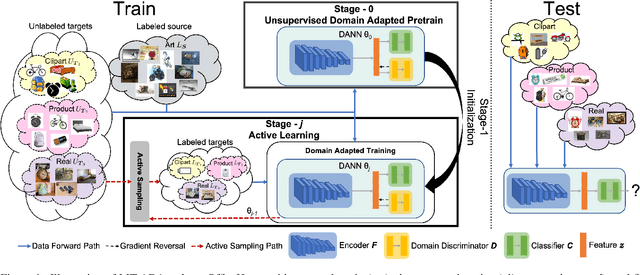
Unsupervised domain adaptation (UDA) for image classification has made remarkable progress in transferring classification knowledge from a labeled source domain to an unlabeled target domain, thanks to effective domain alignment techniques. Recently, in order to further improve performance on a target domain, many Single-Target Active Domain Adaptation (ST-ADA) methods have been proposed to identify and annotate the salient and exemplar target samples. However, it requires one model to be trained and deployed for each target domain and the domain label associated with each test sample. This largely restricts its application in the ubiquitous scenarios with multiple target domains. Therefore, we propose a Multi-Target Active Domain Adaptation (MT-ADA) framework for image classification, named D3GU, to simultaneously align different domains and actively select samples from them for annotation. This is the first research effort in this field to our best knowledge. D3GU applies Decomposed Domain Discrimination (D3) during training to achieve both source-target and target-target domain alignments. Then during active sampling, a Gradient Utility (GU) score is designed to weight every unlabeled target image by its contribution towards classification and domain alignment tasks, and is further combined with KMeans clustering to form GU-KMeans for diverse image sampling. Extensive experiments on three benchmark datasets, Office31, OfficeHome, and DomainNet, have been conducted to validate consistently superior performance of D3GU for MT-ADA.
Dig-CSI: A Distributed and Generative Model Assisted CSI Feedback Training Framework
Dec 10, 2023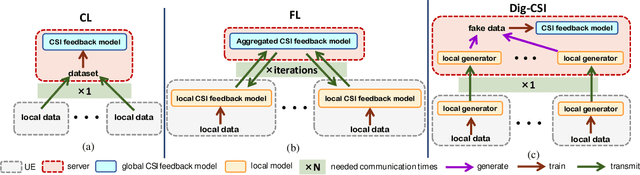
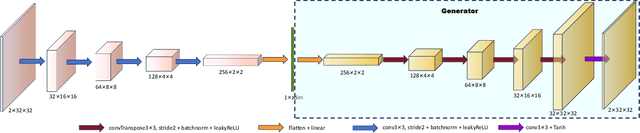
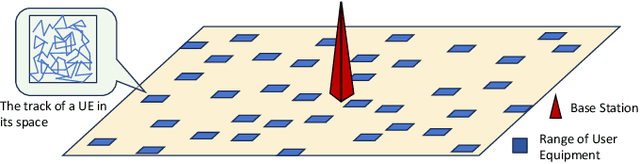
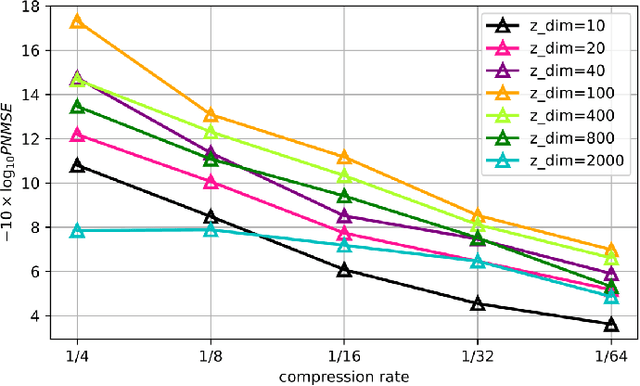
The advent of deep learning (DL)-based models has significantly advanced Channel State Information (CSI) feedback mechanisms in wireless communication systems. However, traditional approaches often suffer from high communication overhead and potential privacy risks due to the centralized nature of CSI data processing. To address these challenges, we design a CSI feedback training framework called Dig-CSI, in which the dataset for training the CSI feedback model is produced by the distributed generators uploaded by each user equipment (UE), but not through local data upload. Each UE trains an autoencoder, where the decoder is considered as the distributed generator, with local data to gain reconstruction accuracy and the ability to generate. Experimental results show that Dig-CSI can train a global CSI feedback model with comparable performance to the model trained with classical centralized learning with a much lighter communication overhead.
Concept-free Causal Disentanglement with Variational Graph Auto-Encoder
Nov 17, 2023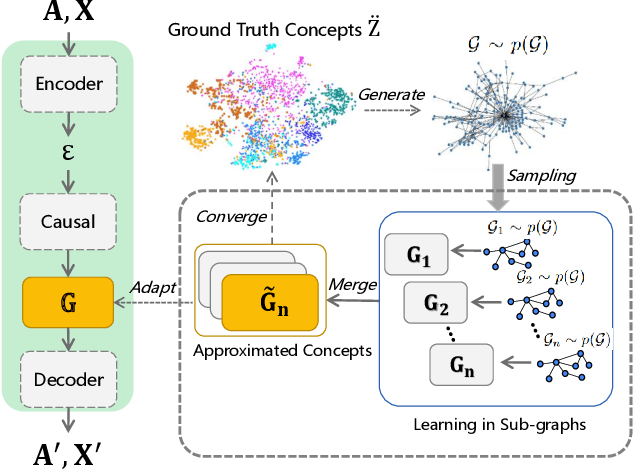
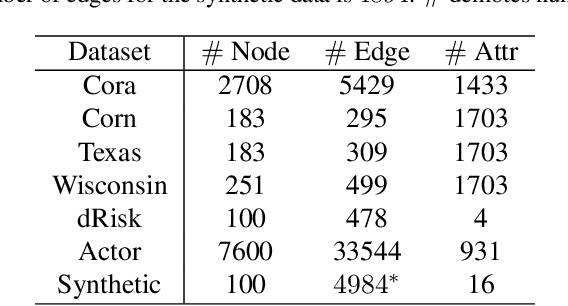

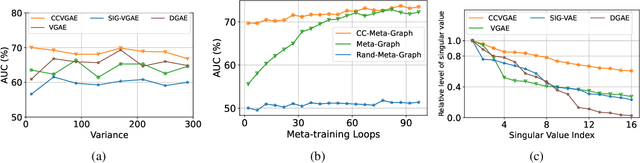
In disentangled representation learning, the goal is to achieve a compact representation that consists of all interpretable generative factors in the observational data. Learning disentangled representations for graphs becomes increasingly important as graph data rapidly grows. Existing approaches often rely on Variational Auto-Encoder (VAE) or its causal structure learning-based refinement, which suffer from sub-optimality in VAEs due to the independence factor assumption and unavailability of concept labels, respectively. In this paper, we propose an unsupervised solution, dubbed concept-free causal disentanglement, built on a theoretically provable tight upper bound approximating the optimal factor. This results in an SCM-like causal structure modeling that directly learns concept structures from data. Based on this idea, we propose Concept-free Causal VGAE (CCVGAE) by incorporating a novel causal disentanglement layer into Variational Graph Auto-Encoder. Furthermore, we prove concept consistency under our concept-free causal disentanglement framework, hence employing it to enhance the meta-learning framework, called concept-free causal Meta-Graph (CC-Meta-Graph). We conduct extensive experiments to demonstrate the superiority of the proposed models: CCVGAE and CC-Meta-Graph, reaching up to $29\%$ and $11\%$ absolute improvements over baselines in terms of AUC, respectively.
EALM: Introducing Multidimensional Ethical Alignment in Conversational Information Retrieval
Oct 02, 2023Artificial intelligence (AI) technologies should adhere to human norms to better serve our society and avoid disseminating harmful or misleading information, particularly in Conversational Information Retrieval (CIR). Previous work, including approaches and datasets, has not always been successful or sufficiently robust in taking human norms into consideration. To this end, we introduce a workflow that integrates ethical alignment, with an initial ethical judgment stage for efficient data screening. To address the need for ethical judgment in CIR, we present the QA-ETHICS dataset, adapted from the ETHICS benchmark, which serves as an evaluation tool by unifying scenarios and label meanings. However, each scenario only considers one ethical concept. Therefore, we introduce the MP-ETHICS dataset to evaluate a scenario under multiple ethical concepts, such as justice and Deontology. In addition, we suggest a new approach that achieves top performance in both binary and multi-label ethical judgment tasks. Our research provides a practical method for introducing ethical alignment into the CIR workflow. The data and code are available at https://github.com/wanng-ide/ealm .
Specializing Small Language Models towards Complex Style Transfer via Latent Attribute Pre-Training
Sep 19, 2023
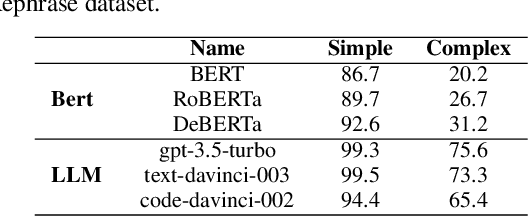
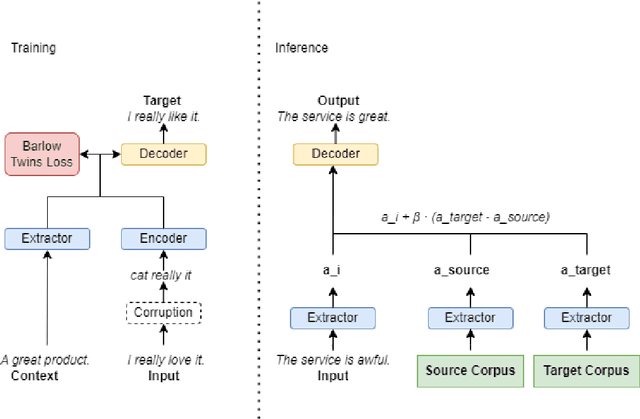
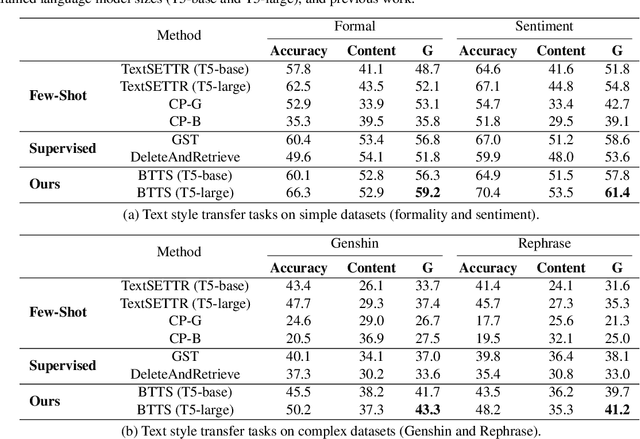
In this work, we introduce the concept of complex text style transfer tasks, and constructed complex text datasets based on two widely applicable scenarios. Our dataset is the first large-scale data set of its kind, with 700 rephrased sentences and 1,000 sentences from the game Genshin Impact. While large language models (LLM) have shown promise in complex text style transfer, they have drawbacks such as data privacy concerns, network instability, and high deployment costs. To address these issues, we explore the effectiveness of small models (less than T5-3B) with implicit style pre-training through contrastive learning. We also propose a method for automated evaluation of text generation quality based on alignment with human evaluations using ChatGPT. Finally, we compare our approach with existing methods and show that our model achieves state-of-art performances of few-shot text style transfer models.
Packet Header Recognition Utilizing an All-Optical Reservoir Based on Reinforcement-Learning-Optimized Double-Ring Resonator
Aug 26, 2023

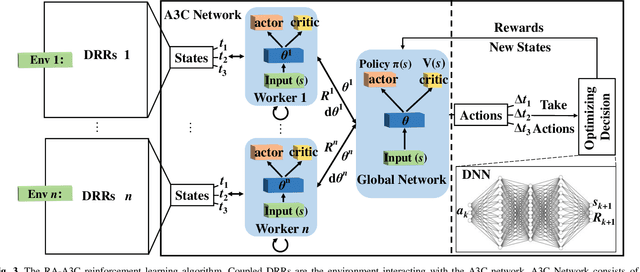
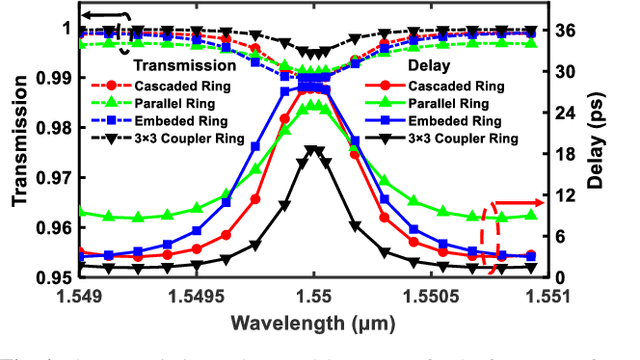
Optical packet header recognition is an important signal processing task of optical communication networks. In this work, we propose an all-optical reservoir, consisting of integrated double-ring resonators (DRRs) as nodes, for fast and accurate optical packet header recognition. As the delay-bandwidth product (DBP) of the node is a key figure-of-merit in the reservoir, we adopt a deep reinforcement learning algorithm to maximize the DBPs for various types of DRRs, which has the advantage of full parameter space optimization and fast convergence speed. Intriguingly, the optimized DBPs of the DRRs in cascaded, parallel, and embedded configurations reach the same maximum value, which is believed to be the global maximum. Finally, 3-bit and 6-bit packet header recognition tasks are performed with the all-optical reservoir consisting of the optimized cascaded rings, which have greatly reduced chip size and the desired "flat-top" delay spectra. Using this optical computing scheme, word-error rates as low as 5*10-4 and 9*10-4 are achieved for 3-bit and 6-bit packet header recognition tasks, respectively, which are one order of magnitude better than the previously reported values.
LoRA-FA: Memory-efficient Low-rank Adaptation for Large Language Models Fine-tuning
Aug 07, 2023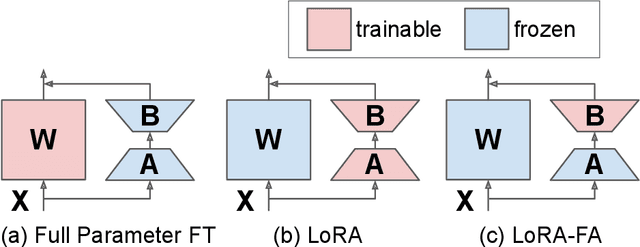


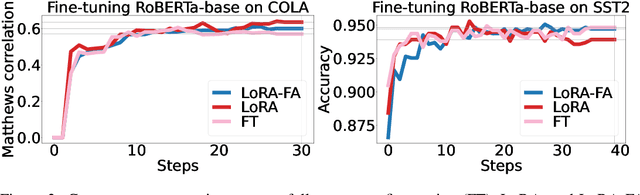
The low-rank adaptation (LoRA) method can largely reduce the amount of trainable parameters for fine-tuning large language models (LLMs), however, it still requires expensive activation memory to update low-rank weights. Reducing the number of LoRA layers or using activation recomputation could harm the fine-tuning performance or increase the computational overhead. In this work, we present LoRA-FA, a memory-efficient fine-tuning method that reduces the activation memory without performance degradation and expensive recomputation. LoRA-FA chooses to freeze the projection-down weight of $A$ and update the projection-up weight of $B$ in each LoRA layer. It ensures the change of model weight reside in a low-rank space during LLMs fine-tuning, while eliminating the requirement to store full-rank input activations. We conduct extensive experiments across multiple model types (RoBERTa, T5, LLaMA) and model scales. Our results show that LoRA-FA can always achieve close fine-tuning accuracy across different tasks compared to full parameter fine-tuning and LoRA. Furthermore, LoRA-FA can reduce the overall memory cost by up to 1.4$\times$ compared to LoRA.
Eva: A General Vectorized Approximation Framework for Second-order Optimization
Aug 04, 2023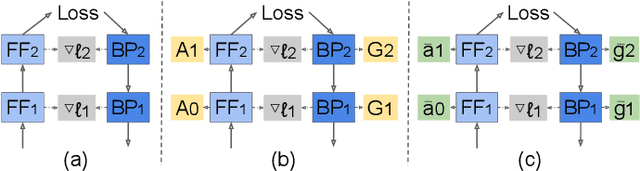
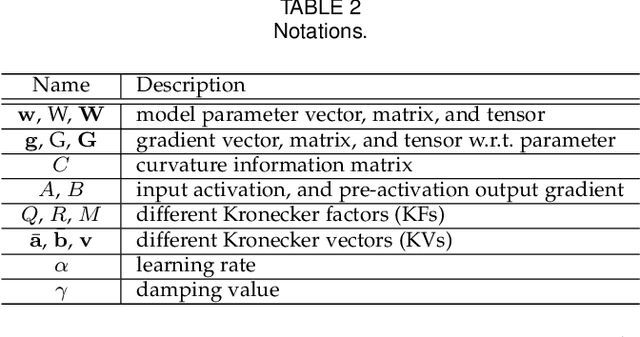
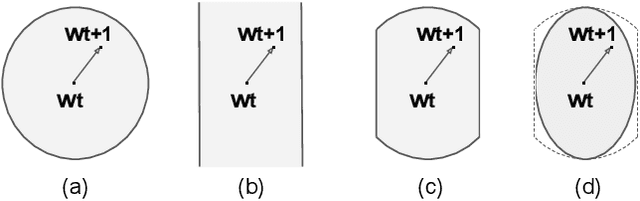
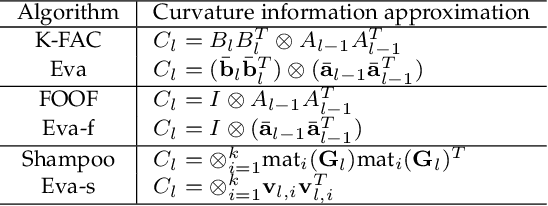
Second-order optimization algorithms exhibit excellent convergence properties for training deep learning models, but often incur significant computation and memory overheads. This can result in lower training efficiency than the first-order counterparts such as stochastic gradient descent (SGD). In this work, we present a memory- and time-efficient second-order algorithm named Eva with two novel techniques: 1) we construct the second-order information with the Kronecker factorization of small stochastic vectors over a mini-batch of training data to reduce memory consumption, and 2) we derive an efficient update formula without explicitly computing the inverse of matrices using the Sherman-Morrison formula. We further extend Eva to a general vectorized approximation framework to improve the compute and memory efficiency of two existing second-order algorithms (FOOF and Shampoo) without affecting their convergence performance. Extensive experimental results on different models and datasets show that Eva reduces the end-to-end training time up to 2.05x and 2.42x compared to first-order SGD and second-order algorithms (K-FAC and Shampoo), respectively.
Beyond the Obvious: Evaluating the Reasoning Ability In Real-life Scenarios of Language Models on Life Scapes Reasoning Benchmark~(LSR-Benchmark)
Jul 11, 2023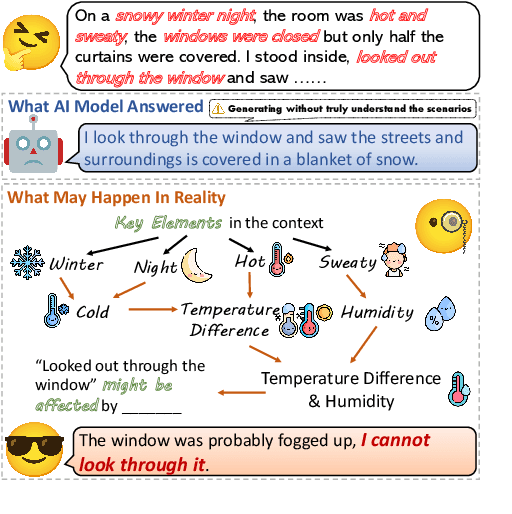
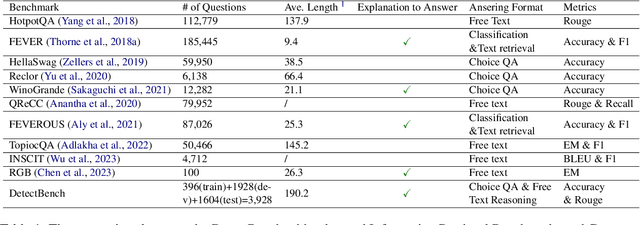
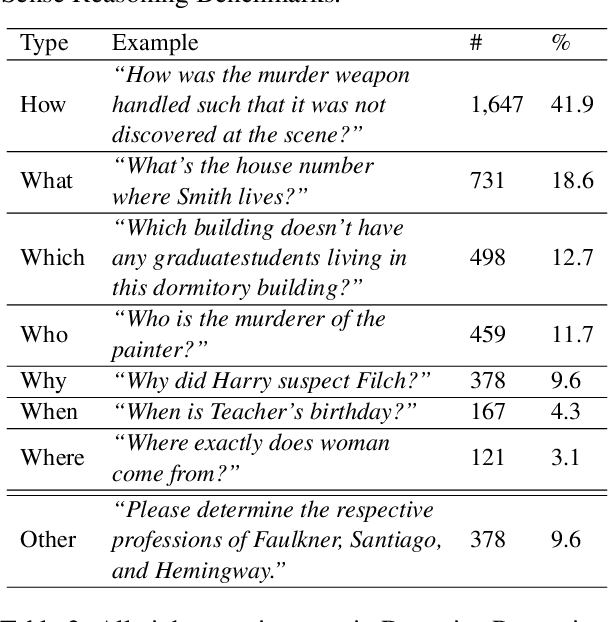
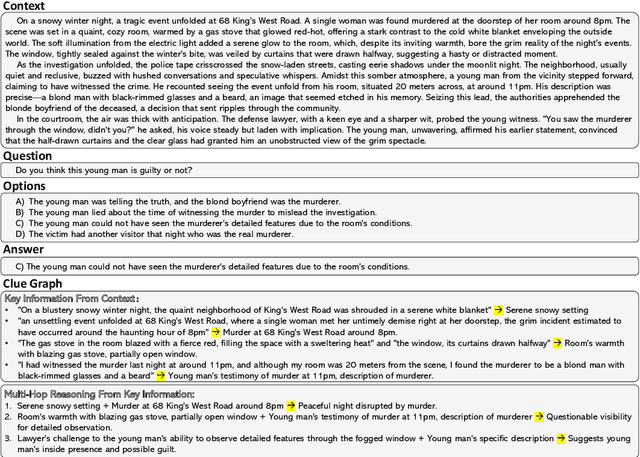
This paper introduces the Life Scapes Reasoning Benchmark (LSR-Benchmark), a novel dataset targeting real-life scenario reasoning, aiming to close the gap in artificial neural networks' ability to reason in everyday contexts. In contrast to domain knowledge reasoning datasets, LSR-Benchmark comprises free-text formatted questions with rich information on real-life scenarios, human behaviors, and character roles. The dataset consists of 2,162 questions collected from open-source online sources and is manually annotated to improve its quality. Experiments are conducted using state-of-the-art language models, such as gpt3.5-turbo and instruction fine-tuned llama models, to test the performance in LSR-Benchmark. The results reveal that humans outperform these models significantly, indicating a persisting challenge for machine learning models in comprehending daily human life.