 Add to Chrome
 Add to Firefox
 Add to Edge
An Accessible Solution for Deformable Image Registration Compared with Learning-Based Approaches
Aug 03, 2026
Deformable image registration (DIR) is a core problem in medical image analysis; but, unlike labeling decision problems such as classification and segmentation, registration is a problem class that involves stringent physical constraints. Although deep learning methods have made faster registration possible, the resulting models are often difficult to interpret compared to hand-crafted methods with explicit objectives and interpretable physical meaning. In this work, we show that an analytical method can still yield competitive and superior results to deep learning in a common deformable registration task. We study pTVreg as a parametric total variation based registration in that context. Observing its different implementations to perform at various degrees, we introduce here an accessible implementation of this method, together with a Bayesian optimization framework that automatically sets self-parameters for any DIR task from a set of sample examples. Experiments on Lung250M-4B show that our proposed implementation achieves state-of-the-art results in this benchmark, substantially superior to existing deep learning solutions and other pTVreg variants as baselines. The source code will be made publicly available at https://github.com/oazeybekoglu/ptvreg-python .

Fast Alternating Radial Beamforming for Speed-of-Sound Imaging Based on Apparent Speckle Shifts
Jul 07, 2026Pulse-echo speed-of-sound (SoS) imaging based on minute misalignments between consecutively acquired ultrasound images traditionally relies on images beamformed on Cartesian grids. Existing SoS imaging developments do not allow for real-time imaging and typically do not prioritize feasibility in conventional ultrasound systems that have limited resources and rigid processing structures. In this work, we propose a resource-efficient approach based on radial beamforming with virtual source transmits for implementation within an on-the-fly beamformer. We also introduce alternating transmissions with fast pair-alternating beamforming for motion-robust displacement tracking with typical line-based beamformers. We tested these methods comparatively on numerical simulations, tissue-mimicking phantom experiments, and in vivo data from breast lesion examinations. We demonstrate that the proposed radial grid beamforming approach performs comparably to a Cartesian grid approach, while allowing implementation on standard hardware for beamforming. Our proposed sequences would allow for SoS data acquisition frame rates of more than 20 fps in parallel to conventional B-mode imaging. The proposed speckle-shift based radial approach with fast alternation between congruent beamforming lines is a major step towards real-time SoS imaging on standard ultrasound systems with moderate resources.
Needle in a Haystack -- One-Class Representation Learning for Detecting Rare Malignant Cells in Computational Cytology
Apr 09, 2026In computational cytology, detecting malignancy on whole-slide images is difficult because malignant cells are morphologically diverse yet vanishingly rare amid a vast background of normal cells. Accurate detection of these extremely rare malignant cells remains challenging due to large class imbalance and limited annotations. Conventional weakly supervised approaches, such as multiple instance learning (MIL), often fail to generalize at the instance level, especially when the fraction of malignant cells (witness rate) is exceedingly low. In this study, we explore the use of one-class representation learning techniques for detecting malignant cells in low-witness-rate scenarios. These methods are trained exclusively on slide-negative patches, without requiring any instance-level supervision. Specifically, we evaluate two OCC approaches, DSVDD and DROC, and compare them with FS-SIL, WS-SIL, and the recent ItS2CLR method. The one-class methods learn compact representations of normality and detect deviations at test time. Experiments on a publicly available bone marrow cytomorphology dataset (TCIA) and an in-house oral cancer cytology dataset show that DSVDD achieves state-of-the-art performance in instance-level abnormality ranking, particularly in ultra-low witness-rate regimes ($\leq 1\%$) and, in some cases, even outperforming fully supervised learning, which is typically not a practical option in whole-slide cytology due to the infeasibility of exhaustive instance-level annotations. DROC is also competitive under extreme rarity, benefiting from distribution-augmented contrastive learning. These findings highlight one-class representation learning as a robust and interpretable superior choice to MIL for malignant cell detection under extreme rarity.
DenOiS: Dual-Domain Denoising of Observation and Solution in Ultrasound Image Reconstruction
Apr 02, 2026Medical imaging aims to recover underlying tissue properties, using inexact (simplified/linearized) imaging models and often from inaccurate and incomplete measurements. Analytical reconstruction methods rely on hand-crafted regularization, sensitive to noise assumptions and parameter tuning. Among deep learning alternatives, plug-and-play (PnP) approaches learn regularization while incorporating imaging physics during inference, outperforming purely data-driven methods. The performance of all these approaches, however, still strongly depends on measurement quality and imaging model accuracy. In this work, we propose DenOiS, a framework that denoises both input observations and resulting solution in their respective domains. It consists of an observation refinement strategy that corrects degraded measurements while compensating for imaging model simplifications, and a diffusion-based PnP reconstruction approach that remains robust under missing measurements. DenOiS enables generalization to real data from training only in simulations, resulting in high-fidelity image reconstruction with noisy observations and inexact imaging models. We demonstrate this for speed-of-sound imaging as a challenging setting of quantitative ultrasound image reconstruction.
Uncertainty Estimation for Trust Attribution to Speed-of-Sound Reconstruction with Variational Networks
Apr 15, 2025Speed-of-sound (SoS) is a biomechanical characteristic of tissue, and its imaging can provide a promising biomarker for diagnosis. Reconstructing SoS images from ultrasound acquisitions can be cast as a limited-angle computed-tomography problem, with Variational Networks being a promising model-based deep learning solution. Some acquired data frames may, however, get corrupted by noise due to, e.g., motion, lack of contact, and acoustic shadows, which in turn negatively affects the resulting SoS reconstructions. We propose to use the uncertainty in SoS reconstructions to attribute trust to each individual acquired frame. Given multiple acquisitions, we then use an uncertainty based automatic selection among these retrospectively, to improve diagnostic decisions. We investigate uncertainty estimation based on Monte Carlo Dropout and Bayesian Variational Inference. We assess our automatic frame selection method for differential diagnosis of breast cancer, distinguishing between benign fibroadenoma and malignant carcinoma. We evaluate 21 lesions classified as BI-RADS~4, which represents suspicious cases for probable malignancy. The most trustworthy frame among four acquisitions of each lesion was identified using uncertainty based criteria. Selecting a frame informed by uncertainty achieved an area under curve of 76% and 80% for Monte Carlo Dropout and Bayesian Variational Inference, respectively, superior to any uncertainty-uninformed baselines with the best one achieving 64%. A novel use of uncertainty estimation is proposed for selecting one of multiple data acquisitions for further processing and decision making.
Image-Based Metrics in Ultrasound for Estimation of Global Speed-of-Sound
Mar 18, 2025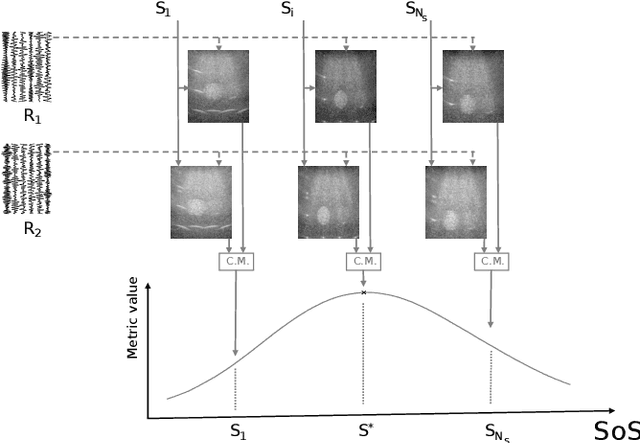
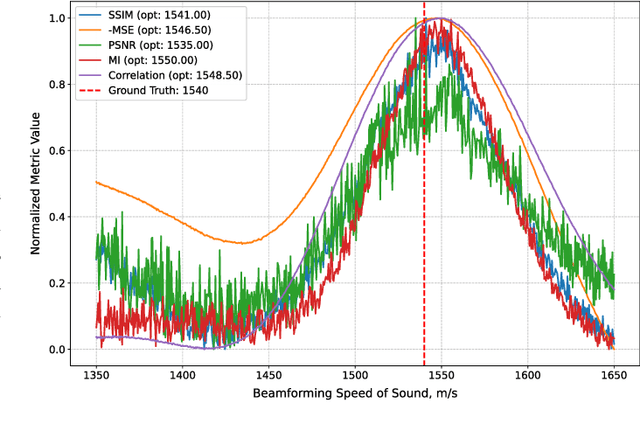
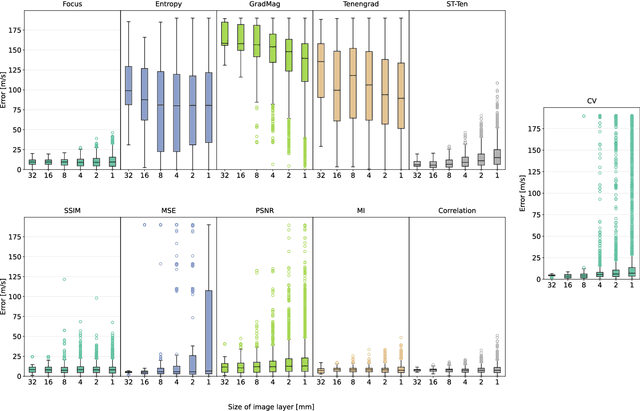
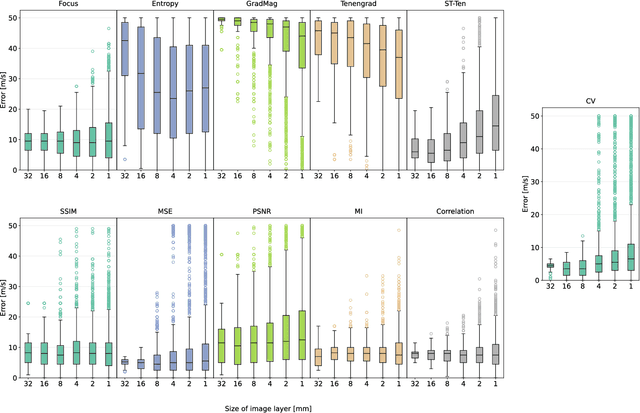
Accurate speed-of-sound (SoS) estimation is crucial for ultrasound image formation, yet conventional systems often rely on an assumed value for imaging. While several methods exist for SoS estimation, they typically depend on complex physical models of acoustic propagation. We propose to leverage conventional image analysis techniques and metrics, as a novel and simple approach to estimate tissue SoS. We study eleven metrics in three categories for assessing image quality, image similarity and multi-frame variation, by testing them in numerical simulations and phantom experiments. Among single-frame image quality metrics, conventional Focus and our proposed Smoothed Threshold Tenengrad metrics achieved satisfactory accuracy, however only when applied to compounded images. Image quality metrics were largely surpassed by various image comparison metrics, which exhibited errors consistently under 8 m/s even applied to a single pair of images. Particularly, Mean Square Error is a computationally efficient alternative for global estimation. Mutual Information and Correlation are found to be robust to processing small image segments, making them suitable, e.g., for multi-layer SoS estimation. The above metrics do not require access to raw channel data as they can operate on post-beamformed data, and in the case of image quality metrics they can operate on B-mode images, given that the beamforming SoS can be controlled for beamforming using a multitude of values. These image analysis based SoS estimation methods offer a computationally efficient and data-accessible alternative to conventional physics-based methods, with potential extensions to layered or local SoS imaging.
FGGP: Fixed-Rate Gradient-First Gradual Pruning
Nov 08, 2024In recent years, the increasing size of deep learning models and their growing demand for computational resources have drawn significant attention to the practice of pruning neural networks, while aiming to preserve their accuracy. In unstructured gradual pruning, which sparsifies a network by gradually removing individual network parameters until a targeted network sparsity is reached, recent works show that both gradient and weight magnitudes should be considered. In this work, we show that such mechanism, e.g., the order of prioritization and selection criteria, is essential. We introduce a gradient-first magnitude-next strategy for choosing the parameters to prune, and show that a fixed-rate subselection criterion between these steps works better, in contrast to the annealing approach in the literature. We validate this on CIFAR-10 dataset, with multiple randomized initializations on both VGG-19 and ResNet-50 network backbones, for pruning targets of 90, 95, and 98% sparsity and for both initially dense and 50% sparse networks. Our proposed fixed-rate gradient-first gradual pruning (FGGP) approach outperforms its state-of-the-art alternatives in most of the above experimental settings, even occasionally surpassing the upperbound of corresponding dense network results, and having the highest ranking across the considered experimental settings.
Joint semi-supervised and contrastive learning enables zero-shot domain-adaptation and multi-domain segmentation
May 08, 2024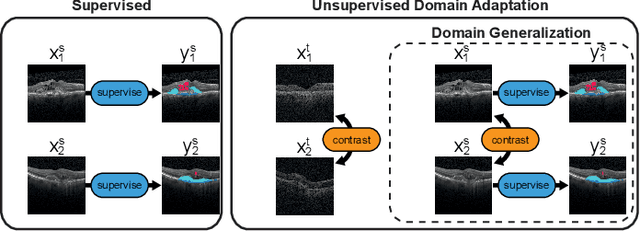
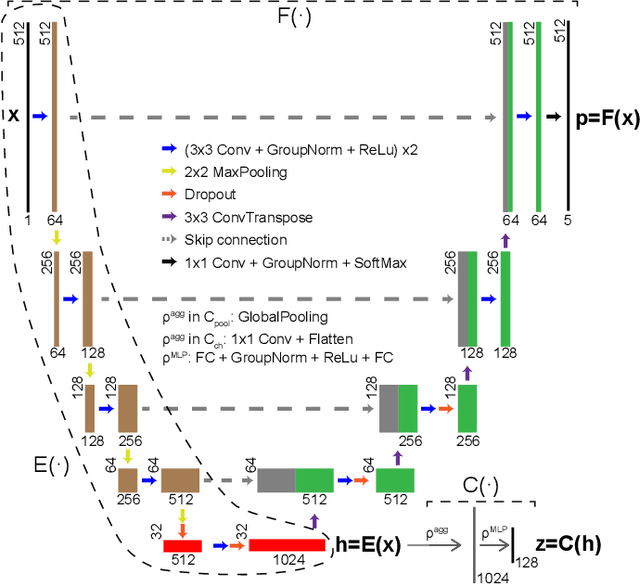
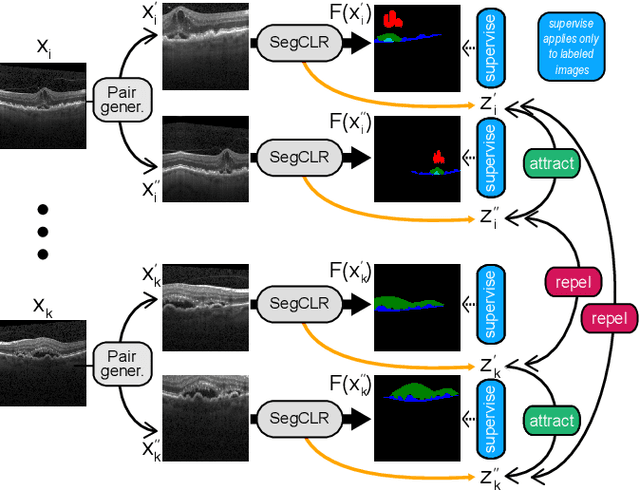
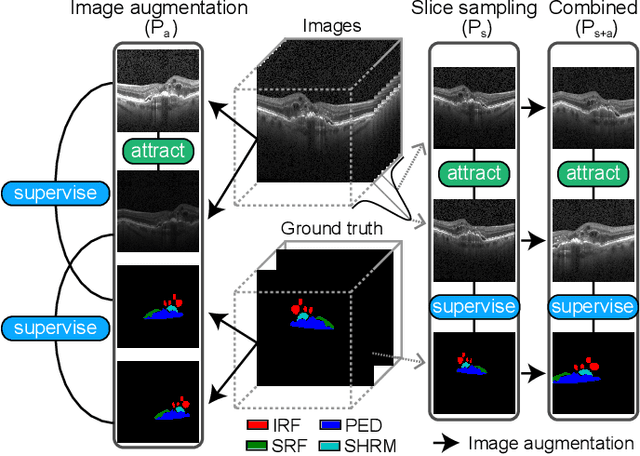
Despite their effectiveness, current deep learning models face challenges with images coming from different domains with varying appearance and content. We introduce SegCLR, a versatile framework designed to segment volumetric images across different domains, employing supervised and contrastive learning simultaneously to effectively learn from both labeled and unlabeled data. We demonstrate the superior performance of SegCLR through a comprehensive evaluation involving three diverse clinical datasets of retinal fluid segmentation in 3D Optical Coherence Tomography (OCT), various network configurations, and verification across 10 different network initializations. In an unsupervised domain adaptation context, SegCLR achieves results on par with a supervised upper-bound model trained on the intended target domain. Notably, we discover that the segmentation performance of SegCLR framework is marginally impacted by the abundance of unlabeled data from the target domain, thereby we also propose an effective zero-shot domain adaptation extension of SegCLR, eliminating the need for any target domain information. This shows that our proposed addition of contrastive loss in standard supervised training for segmentation leads to superior models, inherently more generalizable to both in- and out-of-domain test data. We additionally propose a pragmatic solution for SegCLR deployment in realistic scenarios with multiple domains containing labeled data. Accordingly, our framework pushes the boundaries of deep-learning based segmentation in multi-domain applications, regardless of data availability - labeled, unlabeled, or nonexistent.
Learning the Imaging Model of Speed-of-Sound Reconstruction via a Convolutional Formulation
Sep 01, 2023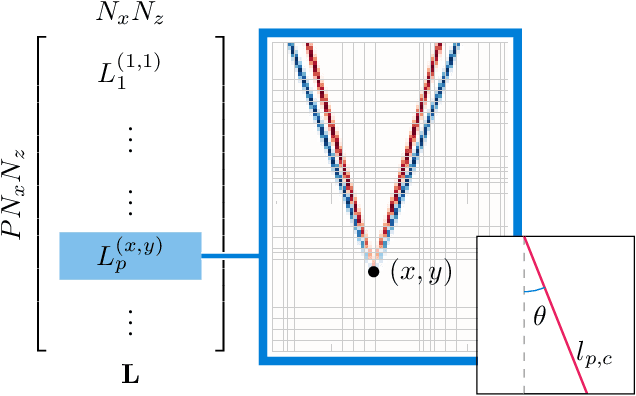
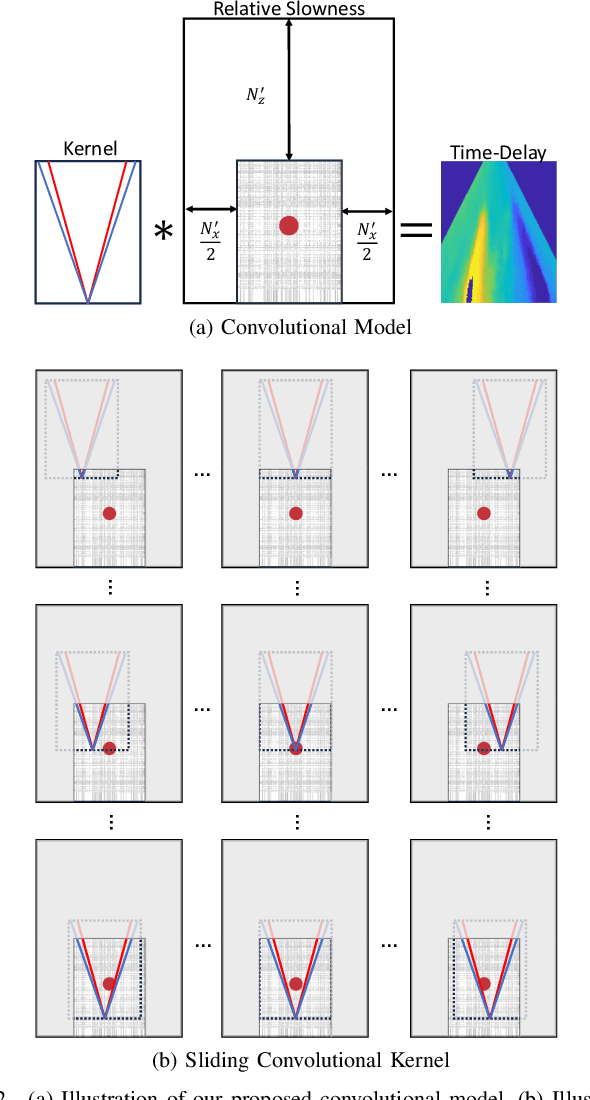
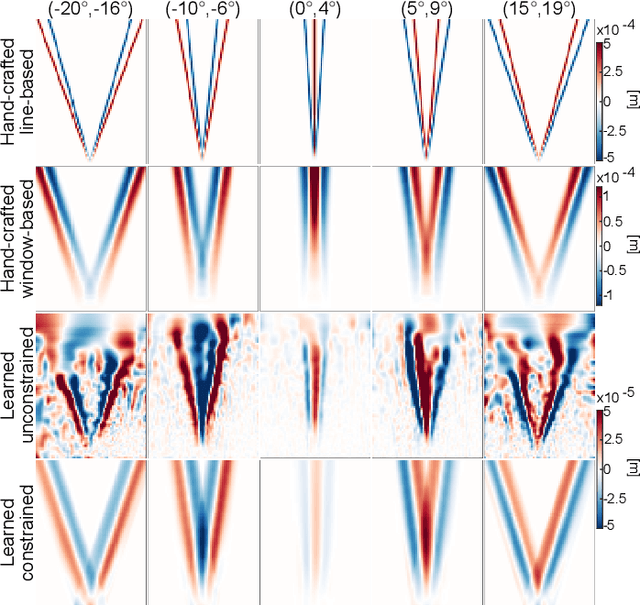

Speed-of-sound (SoS) is an emerging ultrasound contrast modality, where pulse-echo techniques using conventional transducers offer multiple benefits. For estimating tissue SoS distributions, spatial domain reconstruction from relative speckle shifts between different beamforming sequences is a promising approach. This operates based on a forward model that relates the sought local values of SoS to observed speckle shifts, for which the associated image reconstruction inverse problem is solved. The reconstruction accuracy thus highly depends on the hand-crafted forward imaging model. In this work, we propose to learn the SoS imaging model based on data. We introduce a convolutional formulation of the pulse-echo SoS imaging problem such that the entire field-of-view requires a single unified kernel, the learning of which is then tractable and robust. We present least-squares estimation of such convolutional kernel, which can further be constrained and regularized for numerical stability. In experiments, we show that a forward model learned from k-Wave simulations improves the median contrast of SoS reconstructions by 63%, compared to a conventional hand-crafted line-based wave-path model. This simulation-learned model generalizes successfully to acquired phantom data, nearly doubling the SoS contrast compared to the conventional hand-crafted alternative. We demonstrate equipment-specific and small-data regime feasibility by learning a forward model from a single phantom image, where our learned model quadruples the SoS contrast compared to the conventional hand-crafted model. On in-vivo data, the simulation- and phantom-learned models respectively exhibit impressive 7 and 10 folds contrast improvements over the conventional model.
Robust Imaging of Speed-of-Sound Using Virtual Source Transmission
Mar 20, 2023Speed-of-sound (SoS) is a novel imaging biomarker for assessing biomechanical characteristics of soft tissues. SoS imaging in pulse-echo mode using conventional ultrasound systems with hand-held transducers has the potential to enable new clinical uses. Recent work demonstrated diverging waves from single-element (SE) transmits to outperform plane-wave sequences. However, single-element transmits have severely limited power and hence produce low signal-to-noise ratio (SNR) in echo data. We herein propose Walsh-Hadamard (WH) coded and virtual-source (VS) transmit sequences for improved SNR in SoS imaging. We additionally present an iterative method of estimating beamforming SoS in the medium, which otherwise confound SoS reconstructions due to beamforming inaccuracies in the images used for reconstruction. Through numerical simulations, phantom experiments, and in-vivo imaging data, we show that WH is not robust against motion, which is often unavoidable in clinical imaging scenarios. Our proposed virtual-source sequence is shown to provide the highest SoS reconstruction performance, especially robust to motion artifacts. In phantom experiments, despite having a comparable SoS root-mean-square-error (RMSE) of 17.5 to 18.0 m/s at rest, with a minor axial probe motion of ~0.67 mm/s the RMSE for SE, WH, and VS already deteriorate to 20.2, 105.4, 19.0 m/s, respectively; showing that WH produces unacceptable results, not robust to motion. In the clinical data, the high SNR and motion-resilience of VS sequence is seen to yield superior contrast compared to SE and WH sequences.