 Add to Chrome
 Add to Firefox
 Add to Edge
Toward Low-Latency Vision-Language Models with Doubly-Correct Predictions in Egocentric Visual Understanding
Jun 23, 2026
The rapid rise of Vision-Language Models (VLMs) in egocentric visual understanding has made low-latency inference in human-robot collaborative (HRC) tasks increasingly critical. Weight pruning techniques developed for VLMs to shrink model size and computation can be readily applied to satisfy the efficiency demands of on-board processing and real-time interactive robotics. Moreover, safe human-robot interaction demands pruning strategies that preserve doubly-correct predictions; outputs must be both accurate and evidentially grounded to mitigate risks and ensure user trust. In this paper, we present a new study of VLM pruning through the lens of doubly-correct prediction. Our experiments surprisingly show that existing pruning methods often preserve the right evidence localization but undermine correct prediction. To address this, we propose a rationale-informed pruning strategy that better aligns evidence with decisions. Benchmark results on egocentric video datasets demonstrate that our method not only achieves the highest prediction accuracy but also outperforms existing approaches in attaining doubly-correct predictions. We aim to stimulate research on efficient and reliable VLMs, ensuring accuracy-driven advances align with the transparency, auditability, and safety required for responsible human-robot interaction and embodied intelligence.

XAttnMark: Learning Robust Audio Watermarking with Cross-Attention
Feb 07, 2025
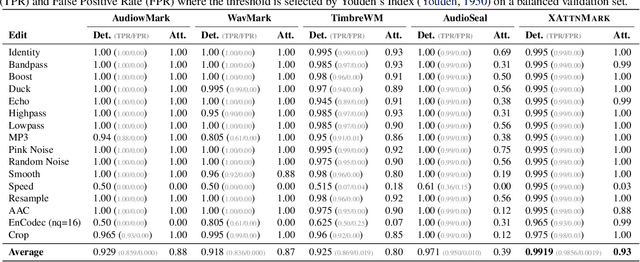


The rapid proliferation of generative audio synthesis and editing technologies has raised significant concerns about copyright infringement, data provenance, and the spread of misinformation through deepfake audio. Watermarking offers a proactive solution by embedding imperceptible, identifiable, and traceable marks into audio content. While recent neural network-based watermarking methods like WavMark and AudioSeal have improved robustness and quality, they struggle to achieve both robust detection and accurate attribution simultaneously. This paper introduces Cross-Attention Robust Audio Watermark (XAttnMark), which bridges this gap by leveraging partial parameter sharing between the generator and the detector, a cross-attention mechanism for efficient message retrieval, and a temporal conditioning module for improved message distribution. Additionally, we propose a psychoacoustic-aligned temporal-frequency masking loss that captures fine-grained auditory masking effects, enhancing watermark imperceptibility. Our approach achieves state-of-the-art performance in both detection and attribution, demonstrating superior robustness against a wide range of audio transformations, including challenging generative editing with strong editing strength. The project webpage is available at https://liuyixin-louis.github.io/xattnmark/.
PETAL: Physics Emulation Through Averaged Linearizations for Solving Inverse Problems
May 18, 2023Inverse problems describe the task of recovering an underlying signal of interest given observables. Typically, the observables are related via some non-linear forward model applied to the underlying unknown signal. Inverting the non-linear forward model can be computationally expensive, as it often involves computing and inverting a linearization at a series of estimates. Rather than inverting the physics-based model, we instead train a surrogate forward model (emulator) and leverage modern auto-grad libraries to solve for the input within a classical optimization framework. Current methods to train emulators are done in a black box supervised machine learning fashion and fail to take advantage of any existing knowledge of the forward model. In this article, we propose a simple learned weighted average model that embeds linearizations of the forward model around various reference points into the model itself, explicitly incorporating known physics. Grounding the learned model with physics based linearizations improves the forward modeling accuracy and provides richer physics based gradient information during the inversion process leading to more accurate signal recovery. We demonstrate the efficacy on an ocean acoustic tomography (OAT) example that aims to recover ocean sound speed profile (SSP) variations from acoustic observations (e.g. eigenray arrival times) within simulation of ocean dynamics in the Gulf of Mexico.
Loop Unrolled Shallow Equilibrium Regularizer (LUSER) -- A Memory-Efficient Inverse Problem Solver
Oct 10, 2022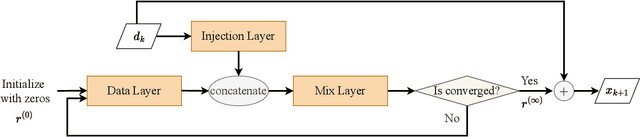
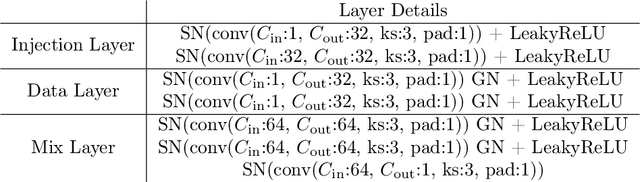
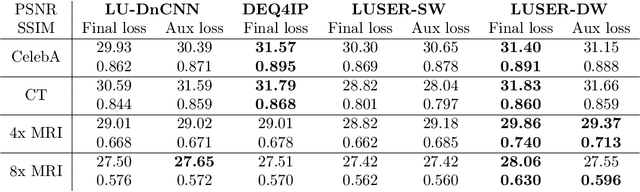
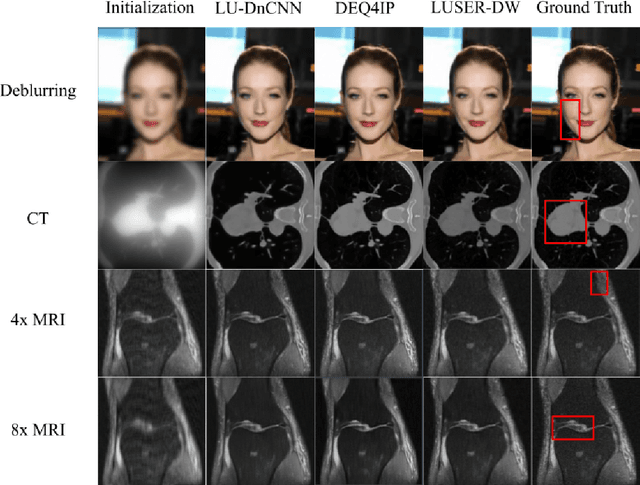
In inverse problems we aim to reconstruct some underlying signal of interest from potentially corrupted and often ill-posed measurements. Classical optimization-based techniques proceed by optimizing a data consistency metric together with a regularizer. Current state-of-the-art machine learning approaches draw inspiration from such techniques by unrolling the iterative updates for an optimization-based solver and then learning a regularizer from data. This loop unrolling (LU) method has shown tremendous success, but often requires a deep model for the best performance leading to high memory costs during training. Thus, to address the balance between computation cost and network expressiveness, we propose an LU algorithm with shallow equilibrium regularizers (LUSER). These implicit models are as expressive as deeper convolutional networks, but far more memory efficient during training. The proposed method is evaluated on image deblurring, computed tomography (CT), as well as single-coil Magnetic Resonance Imaging (MRI) tasks and shows similar, or even better, performance while requiring up to 8 times less computational resources during training when compared against a more typical LU architecture with feedforward convolutional regularizers.