 Add to Chrome
 Add to Firefox
 Add to Edge
WAM-Nav: Asymmetric Latent World-Action Modeling for Unified Visual Navigation
Jun 03, 2026
Visual navigation requires generating smooth and collision-free trajectories under complex geometric and physical constraints. Existing reactive policies that directly map observations to actions lack anticipatory reasoning, limiting their ability to proactively avoid obstacles. While visual imagination offers predictive foresight, conventional modular approaches separate scene prediction from policy learning, often leading to error accumulation and inefficient inference. To address these limitations, we propose WAM-Nav, a Latent World-Action Model for embodied visual navigation that jointly learns action generation and latent visual foresight, enabling more robust and foresighted navigation decisions without compromising inference efficiency. Specifically, WAM-Nav utilizes a shared Diffusion Transformer for asymmetric joint diffusion to concurrently generate long-horizon actions and short-horizon visual foresight, reducing the inference latency and visual error accumulation inherent in multi-step autoregressive rollouts. To further encourage smooth and consistent trajectory generation, we introduce a dual-stream contextual conditioning mechanism that integrates episode-level ego-motion history with sequential visual observations. Combined with a unified goal alignment module that preserves balanced representations across goal types, WAM-Nav naturally supports Image-Goal, Point-Goal, and No-Goal exploration within a single policy. Extensive experiments on the challenging ClutterScenes and InternScenes benchmarks demonstrate strong generalization of WAM-Nav, particularly on Image-Goal and Point-Goal navigation, where it improves success rates by 15.7% and 3.3%, respectively. Real-world deployment further validates effective zero-shot sim-to-real transfer, achieving an average 85% task success rate across diverse indoor and outdoor environments.

HiMemVLN: Enhancing Reliability of Open-Source Zero-Shot Vision-and-Language Navigation with Hierarchical Memory System
Mar 16, 2026LLM-based agents have demonstrated impressive zero-shot performance in vision-language navigation (VLN) tasks. However, most zero-shot methods primarily rely on closed-source LLMs as navigators, which face challenges related to high token costs and potential data leakage risks. Recent efforts have attempted to address this by using open-source LLMs combined with a spatiotemporal CoT framework, but they still fall far short compared to closed-source models. In this work, we identify a critical issue, Navigation Amnesia, through a detailed analysis of the navigation process. This issue leads to navigation failures and amplifies the gap between open-source and closed-source methods. To address this, we propose HiMemVLN, which incorporates a Hierarchical Memory System into a multimodal large model to enhance visual perception recall and long-term localization, mitigating the amnesia issue and improving the agent's navigation performance. Extensive experiments in both simulated and real-world environments demonstrate that HiMemVLN achieves nearly twice the performance of the open-source state-of-the-art method. The code is available at https://github.com/lvkailin0118/HiMemVLN.
EFTViT: Efficient Federated Training of Vision Transformers with Masked Images on Resource-Constrained Edge Devices
Nov 30, 2024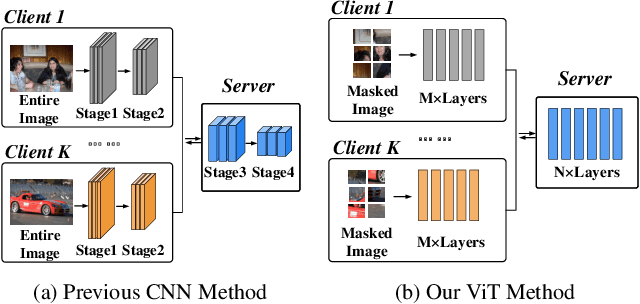

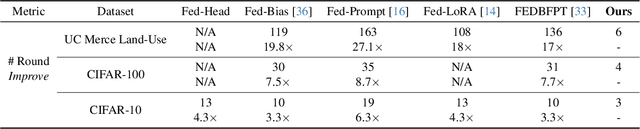

Federated learning research has recently shifted from Convolutional Neural Networks (CNNs) to Vision Transformers (ViTs) due to their superior capacity. ViTs training demands higher computational resources due to the lack of 2D inductive biases inherent in CNNs. However, efficient federated training of ViTs on resource-constrained edge devices remains unexplored in the community. In this paper, we propose EFTViT, a hierarchical federated framework that leverages masked images to enable efficient, full-parameter training on resource-constrained edge devices, offering substantial benefits for learning on heterogeneous data. In general, we patchify images and randomly mask a portion of the patches, observing that excluding them from training has minimal impact on performance while substantially reducing computation costs and enhancing data content privacy protection. Specifically, EFTViT comprises a series of lightweight local modules and a larger global module, updated independently on clients and the central server, respectively. The local modules are trained on masked image patches, while the global module is trained on intermediate patch features uploaded from the local client, balanced through a proposed median sampling strategy to erase client data distribution privacy. We analyze the computational complexity and privacy protection of EFTViT. Extensive experiments on popular benchmarks show that EFTViT achieves up to 28.17% accuracy improvement, reduces local training computational cost by up to 2.8$\times$, and cuts local training time by up to 4.4$\times$ compared to existing methods.