 Add to Chrome
 Add to Firefox
 Add to Edge
RAVA: Retrieval-Augmented Viewpoint Alignment for Subject-Driven Image Generation
Jun 16, 2026
Reference-driven image generation has made rapid progress on identity preservation, but reliable viewpoint control across different subjects remains poorly understood. The difficulty is not merely generating a new image of the target subject: the model must infer the implicit viewpoint of one subject and transfer it to another subject using only image-level evidence, without camera poses, depth, or ray-based conditions. In this setting, existing generators conditioned on multiple image references often rely on spurious semantic correlations, which lead to viewpoint drift, part-level structural mismatches, and missing or unsupported target-specific content. We formulate this challenge as cross-subject viewpoint alignment and propose RAVA, a retrieval-augmented framework that supplies explicit geometric evidence before generation. RAVA first learns a cross-instance viewpoint embedding that retrieves target-subject images aligned with the anchor viewpoint, then applies a LogDet-based subset selection strategy to retain a compact reference set that is both view-consistent and structurally complementary. The selected references are finally consumed by a fine-tuned multi-reference image generator. Experiments show that generic semantic embeddings are nearly random for this task, while the proposed retriever substantially improves viewpoint retrieval quality. On cross-subject generation, RAVA consistently outperforms zero-shot baselines and stronger retrieval alternatives under the same generation backbone. These results indicate that cross-subject viewpoint alignment benefits from retrieval-augmented geometric grounding rather than relying on end-to-end generation alone.

PAL-Bench: Evidence-Grounded Profile Reconstruction from Longitudinal Personal Albums
Jun 15, 2026Longitudinal personal albums are weak-schema multimodal databases: noisy perceptual records whose key facts require joins across faces, text, timestamps, locations, and repeated events. Existing visual, video, document, and lifelog benchmarks test sub-problems, but not album-scale profile reconstruction with social identity binding and evidence citation. Benchmarking this task is difficult because the ground truth needed for evaluation--owner profiles, social graphs, face-name maps, and evidence provenance--is private state that real albums cannot safely release. We introduce PAL-Bench, a controlled benchmark for evidence-grounded reconstruction under a public-record contract. Its Evidence Compiler builds latent private worlds, programs target-level evidence paths, renders album pixels, re-measures them through perception pipelines, and exports audited public/private views. Agents receive only perception-derived public records; targets, identifier maps, and evidence paths remain hidden. PAL-Bench contains 50 synthetic users, 36,659 public photo records, and 2,799 targets over owner facts, identities, and relations. A privacy-preserving audit with 10 participants confirms that PAL-Bench evidence structures match real private albums, though equivalent releases remain privacy-prohibitive. Across seven systems and two compute-matched diagnostics, a seven-metric protocol reveals a gap between plausible profile summarization and faithful social reconstruction: systems recover some owner facts but struggle with recurring identities and evidence citation. PAL-TRACE, a reference framework that freezes identity bindings before owner-fact mining, performs best but leaves hard identity resolution far from solved. PAL-Bench provides a testbed for perceptual entity resolution, multimodal data integration, temporal evidence aggregation, and provenance-aware structured prediction.
Fine-grained Fragment Retrieval in Multi-modal Long-form Dialogues
Jun 03, 2026With the widespread adoption of multi-modal communication platforms, long-form dialogues interleaving text and images have become increasingly common. Users often need to retrieve coherent dialogue fragments related to specific topics, rather than isolated utterances. We propose Fine-grained Fragment Retrieval (FFR), which locates semantically relevant multi-utterance, multi-image fragments in multi-modal long-form dialogues. We explore two settings: (1) FFR within Single-Dialogue, retrieving fragments from a given dialogue; and (2) FFR within Dialogue Corpus, retrieving from a large-scale corpus for open-domain scenarios. For (1), we introduce F2RVLM, a generation-based retrieval model trained with reinforcement learning, using multi-objective rewards and difficulty-aware curriculum sampling to enhance fragment coherence. For (2), we develop FFRS, a two-stage system combining offline fragment-level indexing with online retrieval. Specifically, each dialogue is decomposed into minimal semantic fragments encoded by a Fragment Embedding Model (FEM) into a vector database; at inference, FEM rapidly recalls Top-K candidates, and F2RVLM performs fine-grained reasoning to identify the most relevant sub-content. To support FFR, we construct MLDR, the longest multi-modal dialogue retrieval dataset to date, and a WeChat-based real-world test set. Experiments on both benchmarks demonstrate that F2RVLM and FFRS consistently achieve superior performance across single-dialogue and corpus-level FFR.
PhotoCraft: Agentic Reasoning with Hierarchical Self-Evolving Memory for Deep Image Search
Jun 02, 2026Deep Image Search requires multi-step reasoning over rich contextual cues, such as time, location, and event relations. However, most existing LLM-based agents are stateless and reactive, lacking persistent memory to maintain long-horizon context or transfer experience across tasks, which often leads to execution drift and experience isolation. To address these limitations, we propose PhotoCraft, a training-free, hierarchical memory system for photo-search agents. Inspired by human cognition, PhotoCraft equips MLLMs with working, episodic, and semantic memory, which are dynamically invoked during reasoning to preserve logical consistency and knowledge transferability throughout multi-step reasoning and answer generation. Extensive experiments on DISBench demonstrate that PhotoCraft consistently improves context-aware retrieval across diverse MLLM backbones, achieving gains of up to 18.5\% and effectively mitigating key bottlenecks in memoryless deep image search, offering a practical path toward reliable and generalizable multimodal search agents.
ReCon1M:A Large-scale Benchmark Dataset for Relation Comprehension in Remote Sensing Imagery
Jun 10, 2024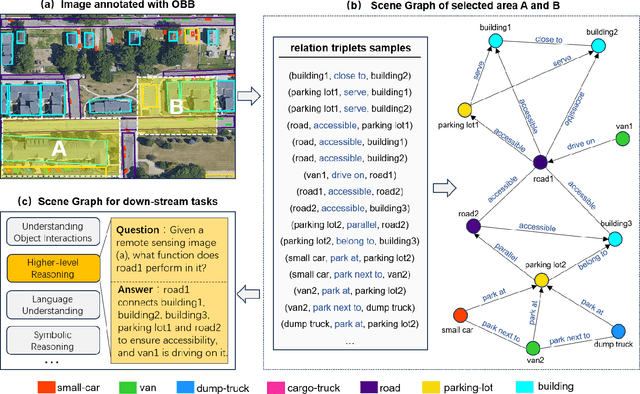
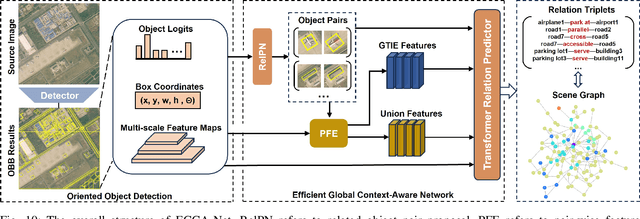
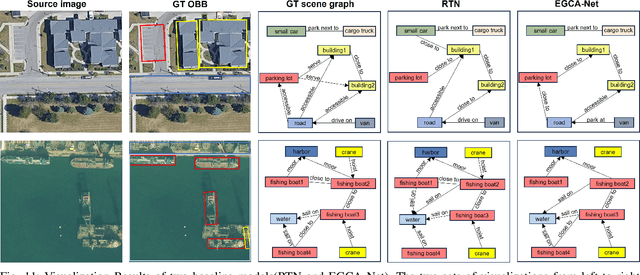
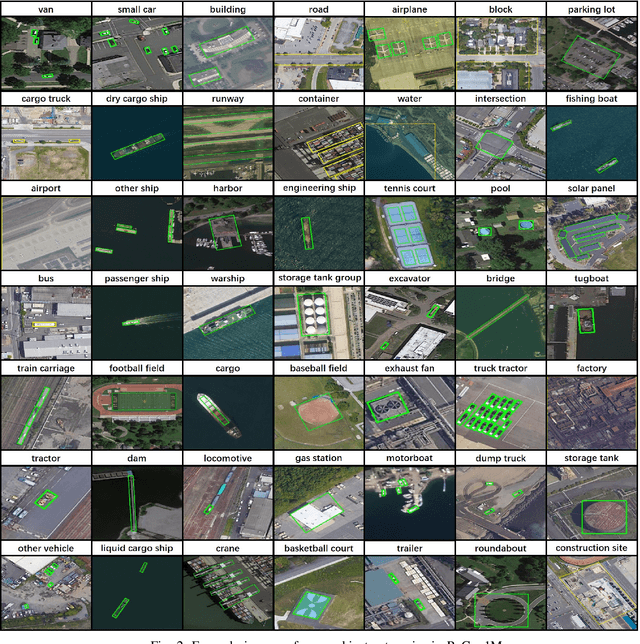
Scene Graph Generation (SGG) is a high-level visual understanding and reasoning task aimed at extracting entities (such as objects) and their interrelationships from images. Significant progress has been made in the study of SGG in natural images in recent years, but its exploration in the domain of remote sensing images remains very limited. The complex characteristics of remote sensing images necessitate higher time and manual interpretation costs for annotation compared to natural images. The lack of a large-scale public SGG benchmark is a major impediment to the advancement of SGG-related research in aerial imagery. In this paper, we introduce the first publicly available large-scale, million-level relation dataset in the field of remote sensing images which is named as ReCon1M. Specifically, our dataset is built upon Fair1M and comprises 21,392 images. It includes annotations for 859,751 object bounding boxes across 60 different categories, and 1,149,342 relation triplets across 64 categories based on these bounding boxes. We provide a detailed description of the dataset's characteristics and statistical information. We conducted two object detection tasks and three sub-tasks within SGG on this dataset, assessing the performance of mainstream methods on these tasks.