 Add to Chrome
 Add to Firefox
 Add to Edge
KEBench: A Benchmark on Knowledge Editing for Large Vision-Language Models
Mar 12, 2024
Currently, little research has been done on knowledge editing for Large Vision-Language Models (LVLMs). Editing LVLMs faces the challenge of effectively integrating diverse modalities (image and text) while ensuring coherent and contextually relevant modifications. An existing benchmark has three metrics (Reliability, Locality and Generality) to measure knowledge editing for LVLMs. However, the benchmark falls short in the quality of generated images used in evaluation and cannot assess whether models effectively utilize edited knowledge in relation to the associated content. We adopt different data collection methods to construct a new benchmark, $\textbf{KEBench}$, and extend new metric (Portability) for a comprehensive evaluation. Leveraging a multimodal knowledge graph, our image data exhibits clear directionality towards entities. This directional aspect can be further utilized to extract entity-related knowledge and form editing data. We conducted experiments of different editing methods on five LVLMs, and thoroughly analyze how these methods impact the models. The results reveal strengths and deficiencies of these methods and, hopefully, provide insights into potential avenues for future research.

PromptIQA: Boosting the Performance and Generalization for No-Reference Image Quality Assessment via Prompts
Mar 08, 2024Due to the diversity of assessment requirements in various application scenarios for the IQA task, existing IQA methods struggle to directly adapt to these varied requirements after training. Thus, when facing new requirements, a typical approach is fine-tuning these models on datasets specifically created for those requirements. However, it is time-consuming to establish IQA datasets. In this work, we propose a Prompt-based IQA (PromptIQA) that can directly adapt to new requirements without fine-tuning after training. On one hand, it utilizes a short sequence of Image-Score Pairs (ISP) as prompts for targeted predictions, which significantly reduces the dependency on the data requirements. On the other hand, PromptIQA is trained on a mixed dataset with two proposed data augmentation strategies to learn diverse requirements, thus enabling it to effectively adapt to new requirements. Experiments indicate that the PromptIQA outperforms SOTA methods with higher performance and better generalization. The code will be available.
Debiasing Large Visual Language Models
Mar 08, 2024
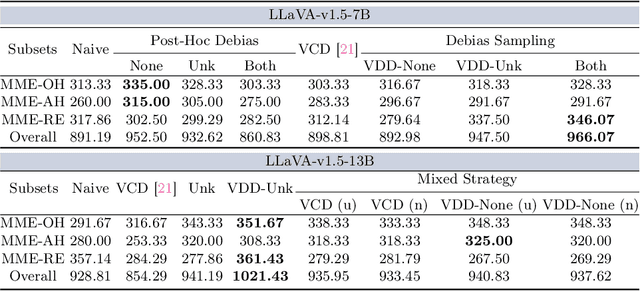


In the realms of computer vision and natural language processing, Large Vision-Language Models (LVLMs) have become indispensable tools, proficient in generating textual descriptions based on visual inputs. Despite their advancements, our investigation reveals a noteworthy bias in the generated content, where the output is primarily influenced by the underlying Large Language Models (LLMs) prior rather than the input image. Our empirical experiments underscore the persistence of this bias, as LVLMs often provide confident answers even in the absence of relevant images or given incongruent visual input. To rectify these biases and redirect the model's focus toward vision information, we introduce two simple, training-free strategies. Firstly, for tasks such as classification or multi-choice question-answering (QA), we propose a ``calibration'' step through affine transformation to adjust the output distribution. This ``Post-Hoc debias'' approach ensures uniform scores for each answer when the image is absent, serving as an effective regularization technique to alleviate the influence of LLM priors. For more intricate open-ended generation tasks, we extend this method to ``Debias sampling'', drawing inspirations from contrastive decoding methods. Furthermore, our investigation sheds light on the instability of LVLMs across various decoding configurations. Through systematic exploration of different settings, we significantly enhance performance, surpassing reported results and raising concerns about the fairness of existing evaluations. Comprehensive experiments substantiate the effectiveness of our proposed strategies in mitigating biases. These strategies not only prove beneficial in minimizing hallucinations but also contribute to the generation of more helpful and precise illustrations.
Stabilizing Policy Gradients for Stochastic Differential Equations via Consistency with Perturbation Process
Mar 07, 2024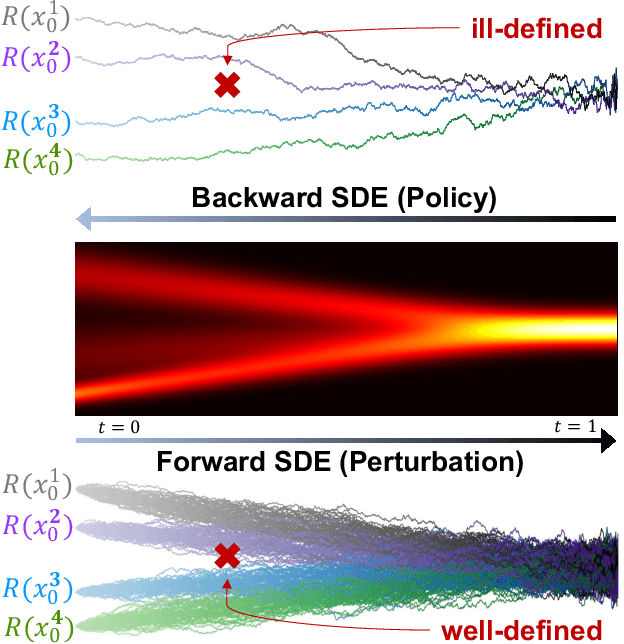
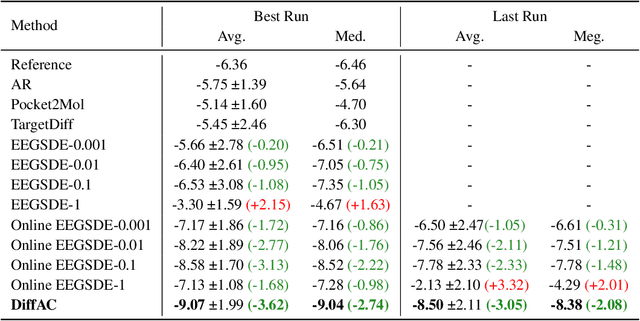
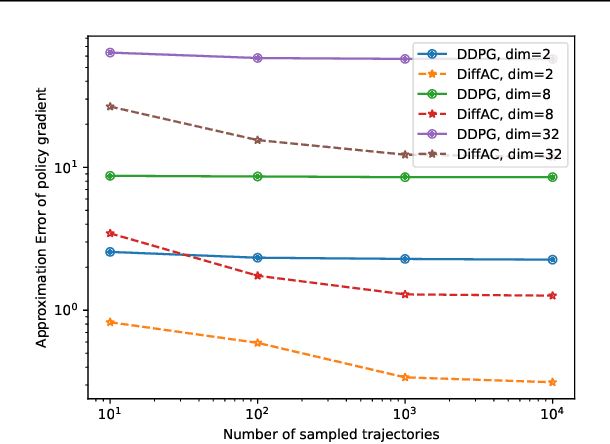
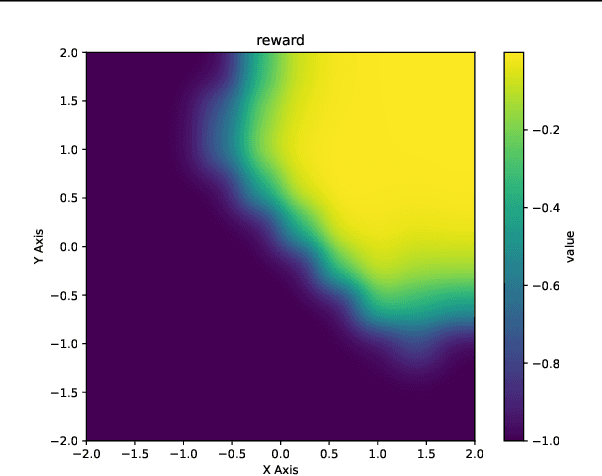
Considering generating samples with high rewards, we focus on optimizing deep neural networks parameterized stochastic differential equations (SDEs), the advanced generative models with high expressiveness, with policy gradient, the leading algorithm in reinforcement learning. Nevertheless, when applying policy gradients to SDEs, since the policy gradient is estimated on a finite set of trajectories, it can be ill-defined, and the policy behavior in data-scarce regions may be uncontrolled. This challenge compromises the stability of policy gradients and negatively impacts sample complexity. To address these issues, we propose constraining the SDE to be consistent with its associated perturbation process. Since the perturbation process covers the entire space and is easy to sample, we can mitigate the aforementioned problems. Our framework offers a general approach allowing for a versatile selection of policy gradient methods to effectively and efficiently train SDEs. We evaluate our algorithm on the task of structure-based drug design and optimize the binding affinity of generated ligand molecules. Our method achieves the best Vina score -9.07 on the CrossDocked2020 dataset.
Random Projection Layers for Multidimensional Time Series Forecasting
Feb 29, 2024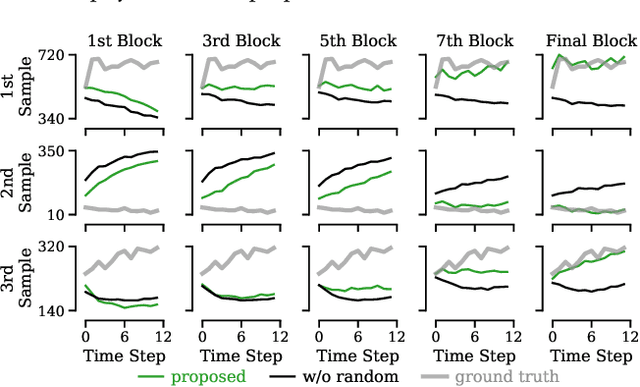


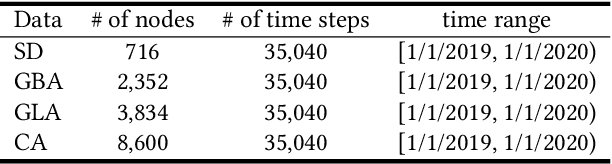
All-Multi-Layer Perceptron (all-MLP) mixer models have been shown to be effective for time series forecasting problems. However, when such a model is applied to high-dimensional time series (e.g., the time series in a spatial-temporal dataset), its performance is likely to degrade due to overfitting issues. In this paper, we propose an all-MLP time series forecasting architecture, referred to as RPMixer. Our method leverages the ensemble-like behavior of deep neural networks, where each individual block within the network acts like a base learner in an ensemble model, especially when identity mapping residual connections are incorporated. By integrating random projection layers into our model, we increase the diversity among the blocks' outputs, thereby enhancing the overall performance of RPMixer. Extensive experiments conducted on large-scale spatial-temporal forecasting benchmark datasets demonstrate that our proposed method outperforms alternative methods, including both spatial-temporal graph models and general forecasting models.
Evolving to the Future: Unseen Event Adaptive Fake News Detection on Social Media
Feb 29, 2024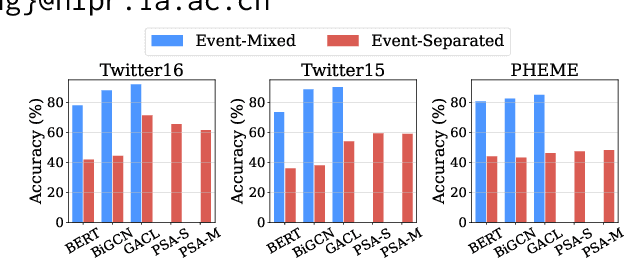
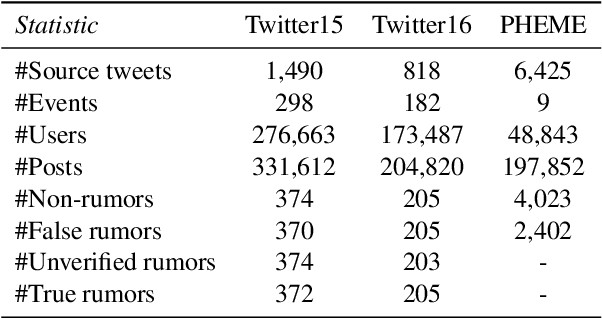
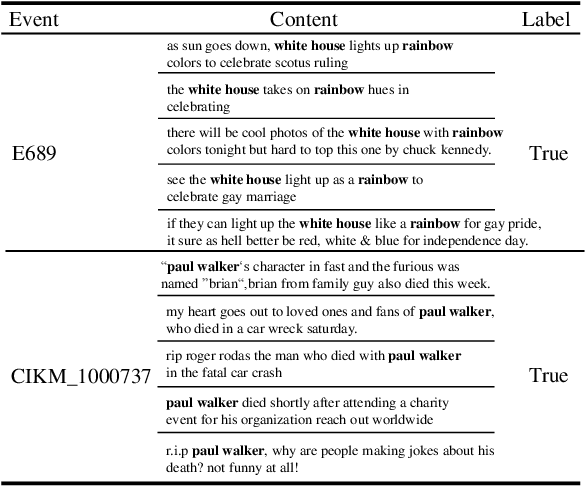
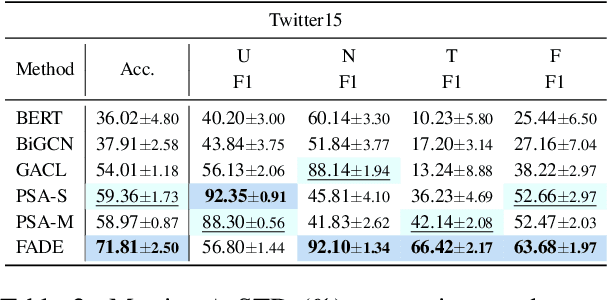
With the rapid development of social media, the wide dissemination of fake news on social media is increasingly threatening both individuals and society. In the dynamic landscape of social media, fake news detection aims to develop a model trained on news reporting past events. The objective is to predict and identify fake news about future events, which often relate to subjects entirely different from those in the past. However, existing fake detection methods exhibit a lack of robustness and cannot generalize to unseen events. To address this, we introduce Future ADaptive Event-based Fake news Detection (FADE) framework. Specifically, we train a target predictor through an adaptive augmentation strategy and graph contrastive learning to make more robust overall predictions. Simultaneously, we independently train an event-only predictor to obtain biased predictions. Then we further mitigate event bias by obtaining the final prediction by subtracting the output of the event-only predictor from the output of the target predictor. Encouraging results from experiments designed to emulate real-world social media conditions validate the effectiveness of our method in comparison to existing state-of-the-art approaches.
BlendSQL: A Scalable Dialect for Unifying Hybrid Question Answering in Relational Algebra
Feb 27, 2024Many existing end-to-end systems for hybrid question answering tasks can often be boiled down to a "prompt-and-pray" paradigm, where the user has limited control and insight into the intermediate reasoning steps used to achieve the final result. Additionally, due to the context size limitation of many transformer-based LLMs, it is often not reasonable to expect that the full structured and unstructured context will fit into a given prompt in a zero-shot setting, let alone a few-shot setting. We introduce BlendSQL, a superset of SQLite to act as a unified dialect for orchestrating reasoning across both unstructured and structured data. For hybrid question answering tasks involving multi-hop reasoning, we encode the full decomposed reasoning roadmap into a single interpretable BlendSQL query. Notably, we show that BlendSQL can scale to massive datasets and improve the performance of end-to-end systems while using 35% fewer tokens. Our code is available and installable as a package at https://github.com/parkervg/blendsql.
Enhancing Temporal Knowledge Graph Forecasting with Large Language Models via Chain-of-History Reasoning
Feb 22, 2024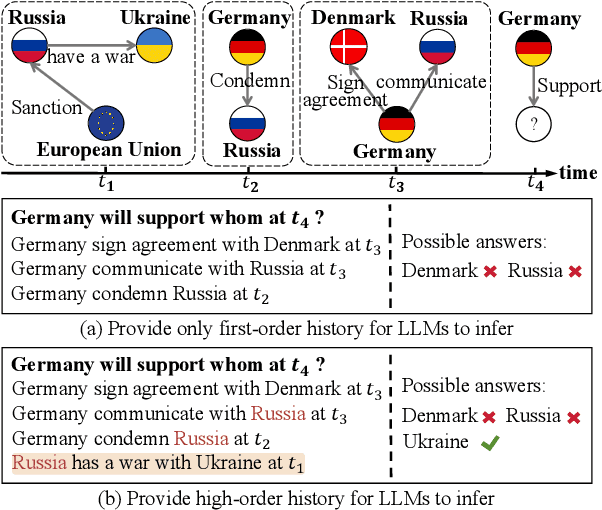
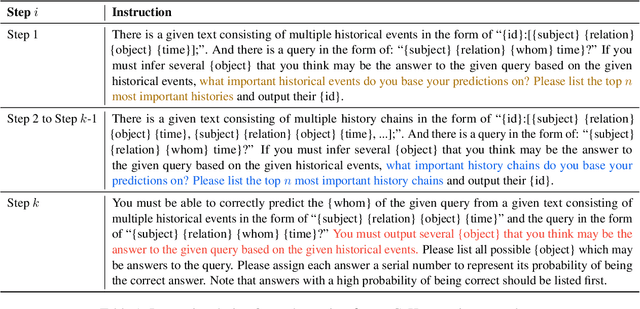
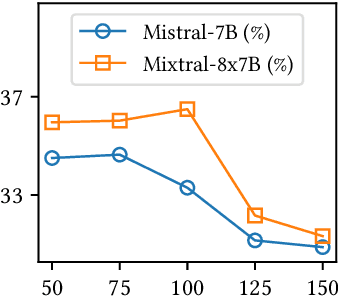
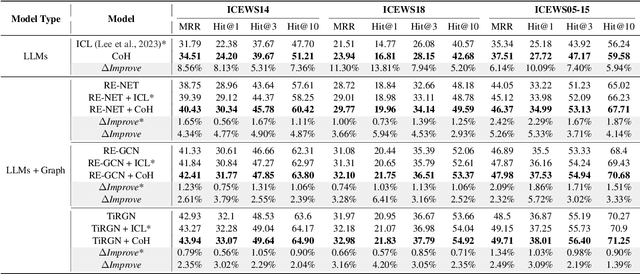
Temporal Knowledge Graph (TKG) forecasting aims to predict future facts based on given histories. Most recent graph-based models excel at capturing structural information within TKGs but lack semantic comprehension abilities. Nowadays, with the surge of LLMs, the LLM-based TKG prediction model has emerged. However, the existing LLM-based model exhibits three shortcomings: (1) It only focuses on the first-order history for prediction while ignoring high-order historical information, resulting in the provided information for LLMs being extremely limited. (2) LLMs struggle with optimal reasoning performance under heavy historical information loads. (3) For TKG prediction, the temporal reasoning capability of LLM alone is limited. To address the first two challenges, we propose Chain-of-History (CoH) reasoning which explores high-order histories step-by-step, achieving effective utilization of high-order historical information for LLMs on TKG prediction. To address the third issue, we design CoH as a paly-and-plug module to enhance the performance of graph-based models for TKG prediction. Extensive experiments on three datasets and backbones demonstrate the effectiveness of CoH.
Text-Guided Molecule Generation with Diffusion Language Model
Feb 20, 2024Text-guided molecule generation is a task where molecules are generated to match specific textual descriptions. Recently, most existing SMILES-based molecule generation methods rely on an autoregressive architecture. In this work, we propose the Text-Guided Molecule Generation with Diffusion Language Model (TGM-DLM), a novel approach that leverages diffusion models to address the limitations of autoregressive methods. TGM-DLM updates token embeddings within the SMILES string collectively and iteratively, using a two-phase diffusion generation process. The first phase optimizes embeddings from random noise, guided by the text description, while the second phase corrects invalid SMILES strings to form valid molecular representations. We demonstrate that TGM-DLM outperforms MolT5-Base, an autoregressive model, without the need for additional data resources. Our findings underscore the remarkable effectiveness of TGM-DLM in generating coherent and precise molecules with specific properties, opening new avenues in drug discovery and related scientific domains. Code will be released at: https://github.com/Deno-V/tgm-dlm.
Heterogeneous Graph Reasoning for Fact Checking over Texts and Tables
Feb 20, 2024Fact checking aims to predict claim veracity by reasoning over multiple evidence pieces. It usually involves evidence retrieval and veracity reasoning. In this paper, we focus on the latter, reasoning over unstructured text and structured table information. Previous works have primarily relied on fine-tuning pretrained language models or training homogeneous-graph-based models. Despite their effectiveness, we argue that they fail to explore the rich semantic information underlying the evidence with different structures. To address this, we propose a novel word-level Heterogeneous-graph-based model for Fact Checking over unstructured and structured information, namely HeterFC. Our approach leverages a heterogeneous evidence graph, with words as nodes and thoughtfully designed edges representing different evidence properties. We perform information propagation via a relational graph neural network, facilitating interactions between claims and evidence. An attention-based method is utilized to integrate information, combined with a language model for generating predictions. We introduce a multitask loss function to account for potential inaccuracies in evidence retrieval. Comprehensive experiments on the large fact checking dataset FEVEROUS demonstrate the effectiveness of HeterFC. Code will be released at: https://github.com/Deno-V/HeterFC.