 Add to Chrome
 Add to Firefox
 Add to Edge
CORE4D: A 4D Human-Object-Human Interaction Dataset for Collaborative Object REarrangement
Jun 27, 2024
Understanding how humans cooperatively rearrange household objects is critical for VR/AR and human-robot interaction. However, in-depth studies on modeling these behaviors are under-researched due to the lack of relevant datasets. We fill this gap by presenting CORE4D, a novel large-scale 4D human-object-human interaction dataset focusing on collaborative object rearrangement, which encompasses diverse compositions of various object geometries, collaboration modes, and 3D scenes. With 1K human-object-human motion sequences captured in the real world, we enrich CORE4D by contributing an iterative collaboration retargeting strategy to augment motions to a variety of novel objects. Leveraging this approach, CORE4D comprises a total of 11K collaboration sequences spanning 3K real and virtual object shapes. Benefiting from extensive motion patterns provided by CORE4D, we benchmark two tasks aiming at generating human-object interaction: human-object motion forecasting and interaction synthesis. Extensive experiments demonstrate the effectiveness of our collaboration retargeting strategy and indicate that CORE4D has posed new challenges to existing human-object interaction generation methodologies. Our dataset and code are available at https://github.com/leolyliu/CORE4D-Instructions.

FreeMotion: MoCap-Free Human Motion Synthesis with Multimodal Large Language Models
Jun 15, 2024Human motion synthesis is a fundamental task in computer animation. Despite recent progress in this field utilizing deep learning and motion capture data, existing methods are always limited to specific motion categories, environments, and styles. This poor generalizability can be partially attributed to the difficulty and expense of collecting large-scale and high-quality motion data. At the same time, foundation models trained with internet-scale image and text data have demonstrated surprising world knowledge and reasoning ability for various downstream tasks. Utilizing these foundation models may help with human motion synthesis, which some recent works have superficially explored. However, these methods didn't fully unveil the foundation models' potential for this task and only support several simple actions and environments. In this paper, we for the first time, without any motion data, explore open-set human motion synthesis using natural language instructions as user control signals based on MLLMs across any motion task and environment. Our framework can be split into two stages: 1) sequential keyframe generation by utilizing MLLMs as a keyframe designer and animator; 2) motion filling between keyframes through interpolation and motion tracking. Our method can achieve general human motion synthesis for many downstream tasks. The promising results demonstrate the worth of mocap-free human motion synthesis aided by MLLMs and pave the way for future research.
4DRecons: 4D Neural Implicit Deformable Objects Reconstruction from a single RGB-D Camera with Geometrical and Topological Regularizations
Jun 14, 2024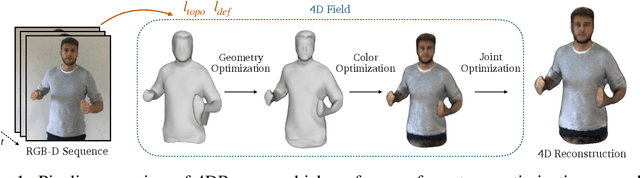
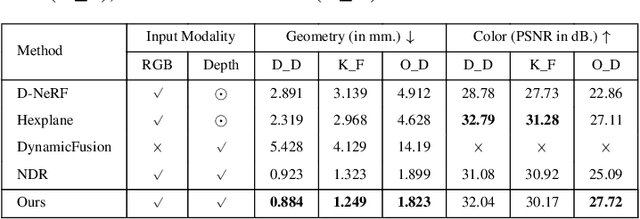
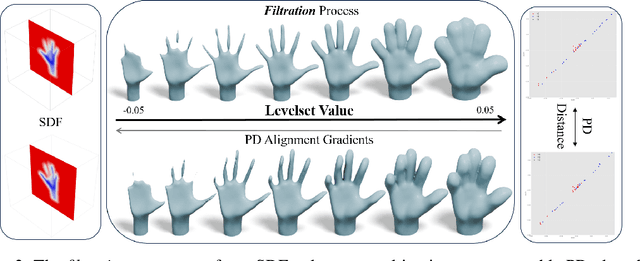
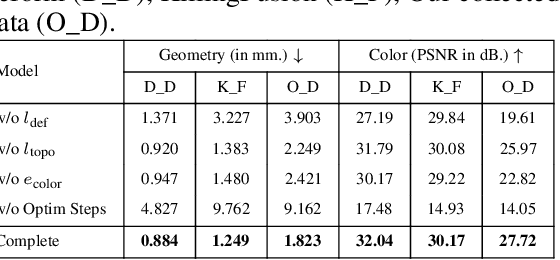
This paper presents a novel approach 4DRecons that takes a single camera RGB-D sequence of a dynamic subject as input and outputs a complete textured deforming 3D model over time. 4DRecons encodes the output as a 4D neural implicit surface and presents an optimization procedure that combines a data term and two regularization terms. The data term fits the 4D implicit surface to the input partial observations. We address fundamental challenges in fitting a complete implicit surface to partial observations. The first regularization term enforces that the deformation among adjacent frames is as rigid as possible (ARAP). To this end, we introduce a novel approach to compute correspondences between adjacent textured implicit surfaces, which are used to define the ARAP regularization term. The second regularization term enforces that the topology of the underlying object remains fixed over time. This regularization is critical for avoiding self-intersections that are typical in implicit-based reconstructions. We have evaluated the performance of 4DRecons on a variety of datasets. Experimental results show that 4DRecons can handle large deformations and complex inter-part interactions and outperform state-of-the-art approaches considerably.
Physics-aware Hand-object Interaction Denoising
May 19, 2024The credibility and practicality of a reconstructed hand-object interaction sequence depend largely on its physical plausibility. However, due to high occlusions during hand-object interaction, physical plausibility remains a challenging criterion for purely vision-based tracking methods. To address this issue and enhance the results of existing hand trackers, this paper proposes a novel physically-aware hand motion de-noising method. Specifically, we introduce two learned loss terms that explicitly capture two crucial aspects of physical plausibility: grasp credibility and manipulation feasibility. These terms are used to train a physically-aware de-noising network. Qualitative and quantitative experiments demonstrate that our approach significantly improves both fine-grained physical plausibility and overall pose accuracy, surpassing current state-of-the-art de-noising methods.
QuasiSim: Parameterized Quasi-Physical Simulators for Dexterous Manipulations Transfer
Apr 11, 2024We explore the dexterous manipulation transfer problem by designing simulators. The task wishes to transfer human manipulations to dexterous robot hand simulations and is inherently difficult due to its intricate, highly-constrained, and discontinuous dynamics and the need to control a dexterous hand with a DoF to accurately replicate human manipulations. Previous approaches that optimize in high-fidelity black-box simulators or a modified one with relaxed constraints only demonstrate limited capabilities or are restricted by insufficient simulation fidelity. We introduce parameterized quasi-physical simulators and a physics curriculum to overcome these limitations. The key ideas are 1) balancing between fidelity and optimizability of the simulation via a curriculum of parameterized simulators, and 2) solving the problem in each of the simulators from the curriculum, with properties ranging from high task optimizability to high fidelity. We successfully enable a dexterous hand to track complex and diverse manipulations in high-fidelity simulated environments, boosting the success rate by 11\%+ from the best-performed baseline. The project website is available at https://meowuu7.github.io/QuasiSim/.
GenN2N: Generative NeRF2NeRF Translation
Apr 03, 2024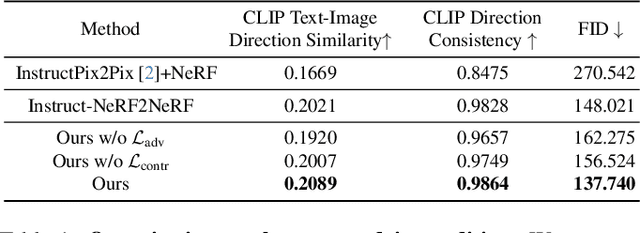


We present GenN2N, a unified NeRF-to-NeRF translation framework for various NeRF translation tasks such as text-driven NeRF editing, colorization, super-resolution, inpainting, etc. Unlike previous methods designed for individual translation tasks with task-specific schemes, GenN2N achieves all these NeRF editing tasks by employing a plug-and-play image-to-image translator to perform editing in the 2D domain and lifting 2D edits into the 3D NeRF space. Since the 3D consistency of 2D edits may not be assured, we propose to model the distribution of the underlying 3D edits through a generative model that can cover all possible edited NeRFs. To model the distribution of 3D edited NeRFs from 2D edited images, we carefully design a VAE-GAN that encodes images while decoding NeRFs. The latent space is trained to align with a Gaussian distribution and the NeRFs are supervised through an adversarial loss on its renderings. To ensure the latent code does not depend on 2D viewpoints but truly reflects the 3D edits, we also regularize the latent code through a contrastive learning scheme. Extensive experiments on various editing tasks show GenN2N, as a universal framework, performs as well or better than task-specific specialists while possessing flexible generative power. More results on our project page: https://xiangyueliu.github.io/GenN2N/
PhysReaction: Physically Plausible Real-Time Humanoid Reaction Synthesis via Forward Dynamics Guided 4D Imitation
Apr 01, 2024
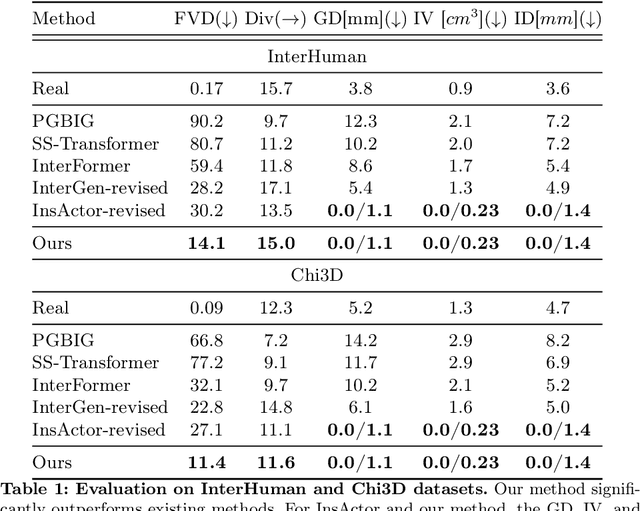
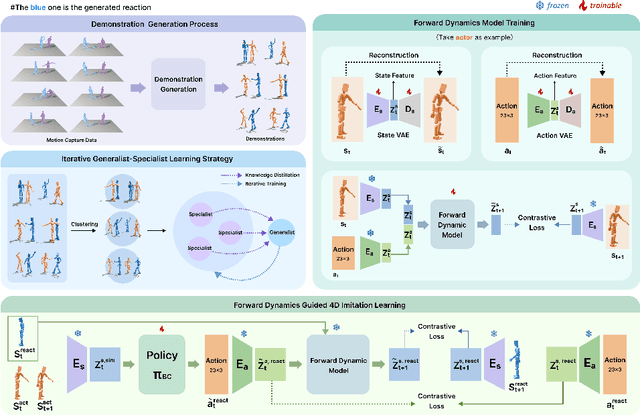

Humanoid Reaction Synthesis is pivotal for creating highly interactive and empathetic robots that can seamlessly integrate into human environments, enhancing the way we live, work, and communicate. However, it is difficult to learn the diverse interaction patterns of multiple humans and generate physically plausible reactions. The kinematics-based approaches face challenges, including issues like floating feet, sliding, penetration, and other problems that defy physical plausibility. The existing physics-based method often relies on kinematics-based methods to generate reference states, which struggle with the challenges posed by kinematic noise during action execution. Constrained by their reliance on diffusion models, these methods are unable to achieve real-time inference. In this work, we propose a Forward Dynamics Guided 4D Imitation method to generate physically plausible human-like reactions. The learned policy is capable of generating physically plausible and human-like reactions in real-time, significantly improving the speed(x33) and quality of reactions compared with the existing method. Our experiments on the InterHuman and Chi3D datasets, along with ablation studies, demonstrate the effectiveness of our approach.
ShapeLLM: Universal 3D Object Understanding for Embodied Interaction
Mar 06, 2024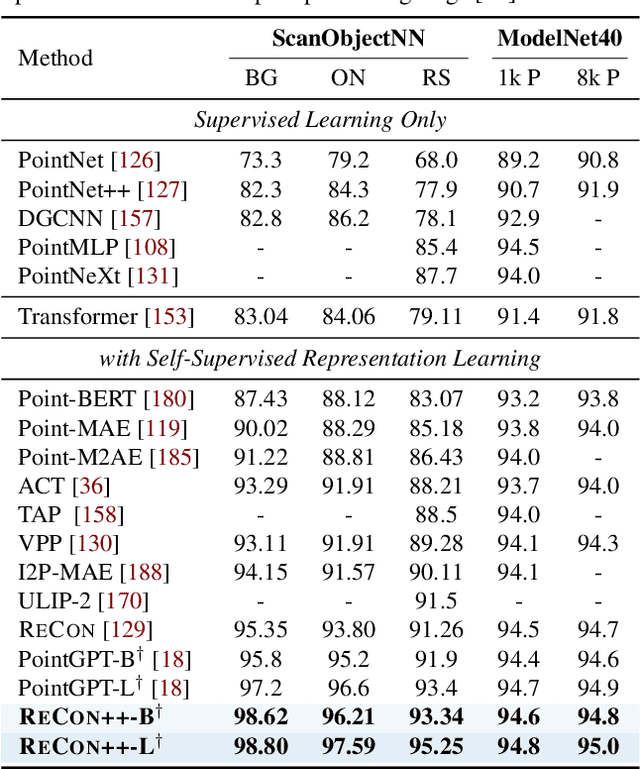


This paper presents ShapeLLM, the first 3D Multimodal Large Language Model (LLM) designed for embodied interaction, exploring a universal 3D object understanding with 3D point clouds and languages. ShapeLLM is built upon an improved 3D encoder by extending ReCon to ReCon++ that benefits from multi-view image distillation for enhanced geometry understanding. By utilizing ReCon++ as the 3D point cloud input encoder for LLMs, ShapeLLM is trained on constructed instruction-following data and tested on our newly human-curated evaluation benchmark, 3D MM-Vet. ReCon++ and ShapeLLM achieve state-of-the-art performance in 3D geometry understanding and language-unified 3D interaction tasks, such as embodied visual grounding.
GeneOH Diffusion: Towards Generalizable Hand-Object Interaction Denoising via Denoising Diffusion
Feb 22, 2024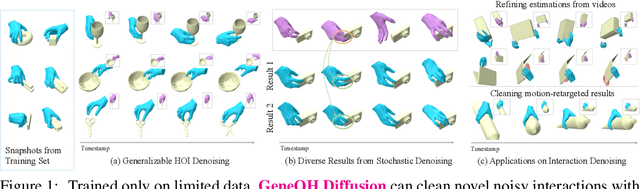
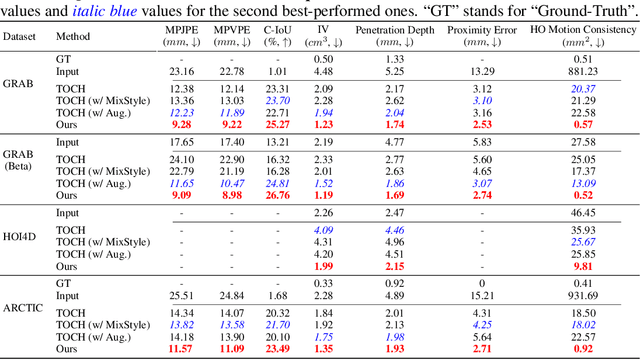
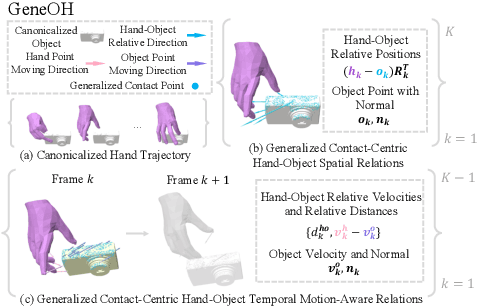

In this work, we tackle the challenging problem of denoising hand-object interactions (HOI). Given an erroneous interaction sequence, the objective is to refine the incorrect hand trajectory to remove interaction artifacts for a perceptually realistic sequence. This challenge involves intricate interaction noise, including unnatural hand poses and incorrect hand-object relations, alongside the necessity for robust generalization to new interactions and diverse noise patterns. We tackle those challenges through a novel approach, GeneOH Diffusion, incorporating two key designs: an innovative contact-centric HOI representation named GeneOH and a new domain-generalizable denoising scheme. The contact-centric representation GeneOH informatively parameterizes the HOI process, facilitating enhanced generalization across various HOI scenarios. The new denoising scheme consists of a canonical denoising model trained to project noisy data samples from a whitened noise space to a clean data manifold and a "denoising via diffusion" strategy which can handle input trajectories with various noise patterns by first diffusing them to align with the whitened noise space and cleaning via the canonical denoiser. Extensive experiments on four benchmarks with significant domain variations demonstrate the superior effectiveness of our method. GeneOH Diffusion also shows promise for various downstream applications. Project website: https://meowuu7.github.io/GeneOH-Diffusion/.
* Accepted to ICLR 2024. Project website: https://meowuu7.github.io/GeneOH-Diffusion/; Huggingface Demo: https://huggingface.co/spaces/xymeow7/gene-hoi-denoising; Code: https://github.com/Meowuu7/GeneOH-Diffusion
LEMMA: Towards LVLM-Enhanced Multimodal Misinformation Detection with External Knowledge Augmentation
Feb 19, 2024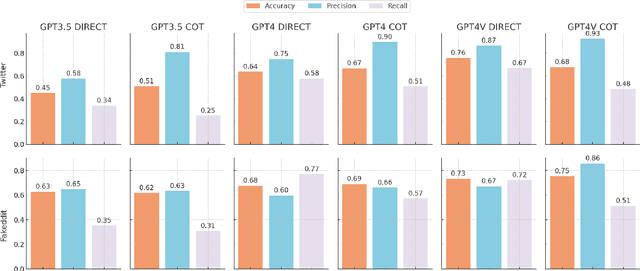
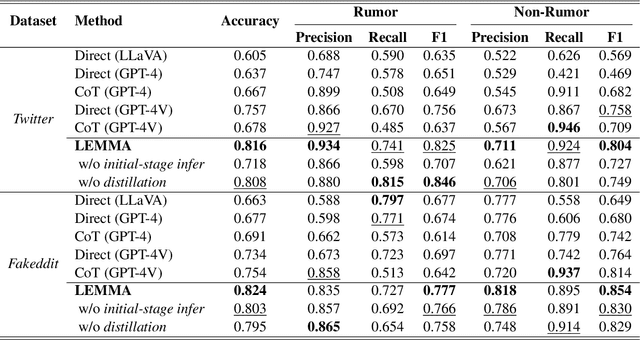
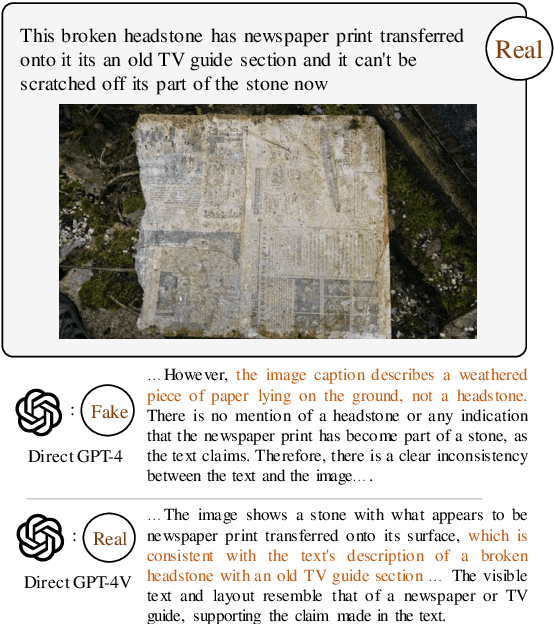
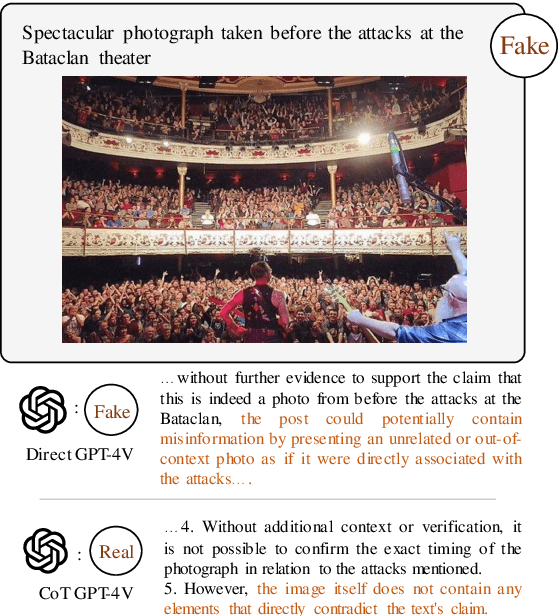
The rise of multimodal misinformation on social platforms poses significant challenges for individuals and societies. Its increased credibility and broader impact compared to textual misinformation make detection complex, requiring robust reasoning across diverse media types and profound knowledge for accurate verification. The emergence of Large Vision Language Model (LVLM) offers a potential solution to this problem. Leveraging their proficiency in processing visual and textual information, LVLM demonstrates promising capabilities in recognizing complex information and exhibiting strong reasoning skills. In this paper, we first investigate the potential of LVLM on multimodal misinformation detection. We find that even though LVLM has a superior performance compared to LLMs, its profound reasoning may present limited power with a lack of evidence. Based on these observations, we propose LEMMA: LVLM-Enhanced Multimodal Misinformation Detection with External Knowledge Augmentation. LEMMA leverages LVLM intuition and reasoning capabilities while augmenting them with external knowledge to enhance the accuracy of misinformation detection. Our method improves the accuracy over the top baseline LVLM by 7% and 13% on Twitter and Fakeddit datasets respectively.