 Add to Chrome
 Add to Firefox
 Add to Edge
MemVLN: Episodic and Procedural Memory for Vision-and-Language Navigation
Jul 26, 2026
Vision-and-Language Navigation in Continuous Environments (VLN-CE) requires agents to maintain long-horizon visual history for trajectory consistency while executing actions with low latency. Existing video-based VLN approaches typically struggle to satisfy both demands simultaneously. To address these challenges, we propose MemVLN, a novel VLN framework that achieves state-of-the-art performance with real-time inference efficiency (14 FPS). MemVLN utilizes a visual encoder to process continuous observations and a Large Language Model (LLM) to interpret instructions and generate actions. Central to our approach is an Episodic Memory management that applies pyramidal resolutions. This mechanism concentrates computation on immediate percepts while retaining compressed long-term history. Complementing to this design, we introduce Procedural Memory for fast action with a compact vocabulary of atomic mid-level actions to bypass auto-regressive decoding latency. Experiments on VLN-CE show that MemVLN-4B surpasses the baseline Qwen3-VL-4B architecture by 5.8\% SR in R2R and 9.7\% SR in RxR, while achieving a 7$\times$ speedup in inference latency.

OmniGameArena: A Unified UE5 Benchmark for VLM Game Agents with Improvement Dynamics
Jun 08, 2026Vision-language model (VLM) agents are increasingly deployed in interactive game environments. Yet game benchmarks for VLM agents typically report a single first-attempt score per (agent, game) pair, focus on single-agent Solo play, and lack unified protocols for evaluating heterogeneous agent classes (commercial VLMs, open-weight VLMs, and specialized game policies) on the same footing. We address these gaps with OmniGameArena, a real-time benchmark of twelve newly built Unreal Engine 5 games spanning Solo (7), PvP (3), and Coop (2) with unified action interfaces, and the Improvement Dynamics Curve (IDC), an agentic-reflection harness in which a tool-using reflector LLM autonomously refines a bounded skill prompt across multiple rounds. Beyond cold-start leaderboard scores, IDC exposes two additional observables for each (agent, game) pair: how the score evolves across reflection rounds, and how the learned skill behaves on held-out task variants. We report these observables for twelve VLM agents on the cold-start leaderboard and four top agents under IDC.
Learning Physics-Based Full-Body Human Reaching and Grasping from Brief Walking References
Mar 10, 2025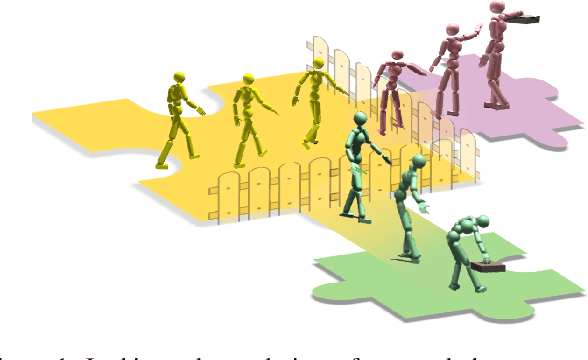

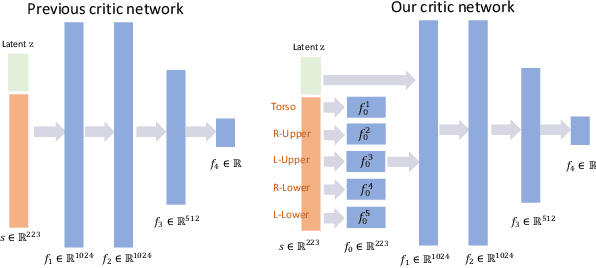
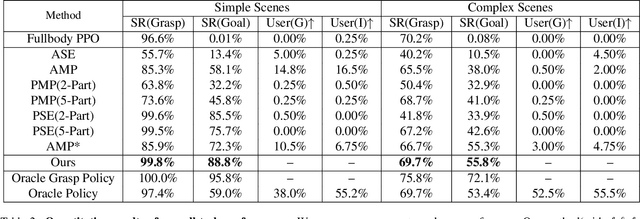
Existing motion generation methods based on mocap data are often limited by data quality and coverage. In this work, we propose a framework that generates diverse, physically feasible full-body human reaching and grasping motions using only brief walking mocap data. Base on the observation that walking data captures valuable movement patterns transferable across tasks and, on the other hand, the advanced kinematic methods can generate diverse grasping poses, which can then be interpolated into motions to serve as task-specific guidance. Our approach incorporates an active data generation strategy to maximize the utility of the generated motions, along with a local feature alignment mechanism that transfers natural movement patterns from walking data to enhance both the success rate and naturalness of the synthesized motions. By combining the fidelity and stability of natural walking with the flexibility and generalizability of task-specific generated data, our method demonstrates strong performance and robust adaptability in diverse scenes and with unseen objects.
FreeMotion: MoCap-Free Human Motion Synthesis with Multimodal Large Language Models
Jun 15, 2024Human motion synthesis is a fundamental task in computer animation. Despite recent progress in this field utilizing deep learning and motion capture data, existing methods are always limited to specific motion categories, environments, and styles. This poor generalizability can be partially attributed to the difficulty and expense of collecting large-scale and high-quality motion data. At the same time, foundation models trained with internet-scale image and text data have demonstrated surprising world knowledge and reasoning ability for various downstream tasks. Utilizing these foundation models may help with human motion synthesis, which some recent works have superficially explored. However, these methods didn't fully unveil the foundation models' potential for this task and only support several simple actions and environments. In this paper, we for the first time, without any motion data, explore open-set human motion synthesis using natural language instructions as user control signals based on MLLMs across any motion task and environment. Our framework can be split into two stages: 1) sequential keyframe generation by utilizing MLLMs as a keyframe designer and animator; 2) motion filling between keyframes through interpolation and motion tracking. Our method can achieve general human motion synthesis for many downstream tasks. The promising results demonstrate the worth of mocap-free human motion synthesis aided by MLLMs and pave the way for future research.