 Add to Chrome
 Add to Firefox
 Add to Edge
PAGE: Towards Practical Human-level Gaze Target Estimation
Jul 06, 2026
Gaze target estimation, the task of predicting where a person is looking in a scene, is crucial to understanding human attention and intent. It is a challenging task that combines high-level understanding of global scene semantics and precise spatial reasoning using human appearance (e.g. pose, eye orientation). As a result, human-level performance remains elusive for existing models, limiting their practical application. To this end, we propose PaGE (Practical Gaze Estimator), a gaze estimation model that explicitly models the complex interaction between scene and head features. Using a PaGE model with a large ViT-H+ backbone as the teacher, we further distill student models with lighter backbones on a much larger and more diverse unlabeled dataset. The architectural improvements and novel training recipe allow PaGE to achieve state-of-the-art performance on several gaze estimation tasks, outperforming humans in 7 out of 9 metrics while reducing the human-AI gap by at least 60% in the remaining 2. The distilled student models retain most of the teacher's performance while being lightweight enough for practical deployment on robots and consumer devices. The code and model checkpoints are available at our project page.

HiSync: Spatio-Temporally Aligning Hand Motion from Wearable IMU and On-Robot Camera for Command Source Identification in Long-Range HRI
Mar 12, 2026Long-range Human-Robot Interaction (HRI) remains underexplored. Within it, Command Source Identification (CSI) - determining who issued a command - is especially challenging due to multi-user and distance-induced sensor ambiguity. We introduce HiSync, an optical-inertial fusion framework that treats hand motion as binding cues by aligning robot-mounted camera optical flow with hand-worn IMU signals. We first elicit a user-defined (N=12) gesture set and collect a multimodal command gesture dataset (N=38) in long-range multi-user HRI scenarios. Next, HiSync extracts frequency-domain hand motion features from both camera and IMU data, and a learned CSINet denoises IMU readings, temporally aligns modalities, and performs distance-aware multi-window fusion to compute cross-modal similarity of subtle, natural gestures, enabling robust CSI. In three-person scenes up to 34m, HiSync achieves 92.32% CSI accuracy, outperforming the prior SOTA by 48.44%. HiSync is also validated on real-robot deployment. By making CSI reliable and natural, HiSync provides a practical primitive and design guidance for public-space HRI.
CORE4D: A 4D Human-Object-Human Interaction Dataset for Collaborative Object REarrangement
Jun 27, 2024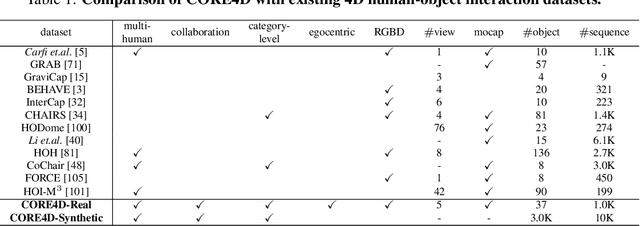
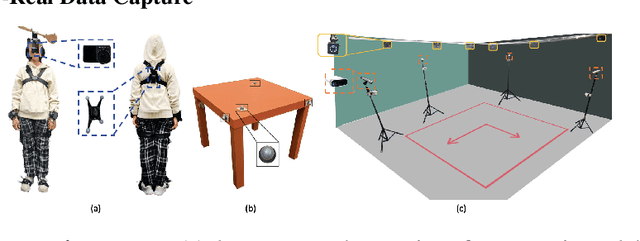
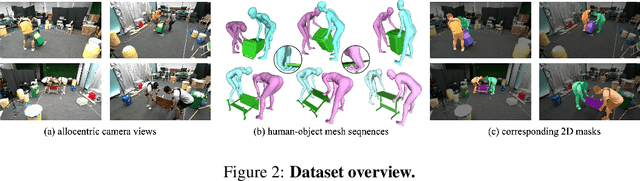
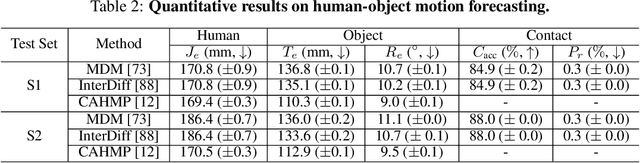
Understanding how humans cooperatively rearrange household objects is critical for VR/AR and human-robot interaction. However, in-depth studies on modeling these behaviors are under-researched due to the lack of relevant datasets. We fill this gap by presenting CORE4D, a novel large-scale 4D human-object-human interaction dataset focusing on collaborative object rearrangement, which encompasses diverse compositions of various object geometries, collaboration modes, and 3D scenes. With 1K human-object-human motion sequences captured in the real world, we enrich CORE4D by contributing an iterative collaboration retargeting strategy to augment motions to a variety of novel objects. Leveraging this approach, CORE4D comprises a total of 11K collaboration sequences spanning 3K real and virtual object shapes. Benefiting from extensive motion patterns provided by CORE4D, we benchmark two tasks aiming at generating human-object interaction: human-object motion forecasting and interaction synthesis. Extensive experiments demonstrate the effectiveness of our collaboration retargeting strategy and indicate that CORE4D has posed new challenges to existing human-object interaction generation methodologies. Our dataset and code are available at https://github.com/leolyliu/CORE4D-Instructions.