 Add to Chrome
 Add to Firefox
 Add to Edge
Focusing on What Matters: Saliency-Harnessing Accurate Routing for Diffusion MoE
Jun 25, 2026
Mixture-of-Experts (MoE) architectures have emerged as a powerful paradigm for scaling diffusion models in visual generation. Recent advancements have focused on adaptively allocating computational resources across diverse tokens to improve efficiency and performance. However, we identify a routing assignment problem in existing diffusion MoE frameworks: the router fails to accurately allocate more computational resources to salient tokens. Our analysis attributes this failure to the router's reliance on noise-corrupted latent features throughout the denoising process. Such stochastic noise obscures the critical structural and textural information, thereby preventing the router from effectively distinguishing salient tokens. To address this, we propose SharpMoE, a post-training framework with a saliency-harnessing accurate routing mechanism, which utilizes clean latent features as a noise-free guidance signal for routing. By bypassing the noise-distorted inputs, SharpMoE provides the router with clear saliency guidance, enabling the identification of salient tokens even in high-noise stages. Furthermore, we introduce a trajectory routing loss to constrain the compute allocation throughout the multi-step denoising trajectory, ensuring precise resource allocation along the generation rollout. Extensive experiments demonstrate that SharpMoE serves as a versatile, plug-and-play solution that further enhances the pretrained, converged MoE models, achieving state-of-the-art performance in visual generation.

Perception, Verdict, and Evolution: Hindsight-Driven Self-Refining Forensics Agent for AI-Generated Image Detection
Jun 25, 2026The rapid advancement of generative models presents a significant challenge to existing deepfake detection methods, particularly given the widespread dissemination of highly realistic AI-generated images. Although Multimodal Large Language Models (MLLMs) show strong potential for this task, existing approaches suffer from two key limitations: insufficient sensitivity to fine-grained forensic artifacts and reliance on static synthetic supervision from frontier models, leading to limited flexibility and high-cost. To address these issues, we propose ForeAgent, an agentic forensics framework for AI-generated image detection with iterative self-evolution. First, ForeAgent adopts a Perception-Verdict architecture that aggregates multi-view cues spanning semantic, spatial, and frequency-domain features, and leverages an MLLM as a verdict module to fuse these signals for a logical-grounded verdict. Second, to enable continual self-improvement, we introduce a Hindsight-Driven Self-Refining strategy following a Sampling-Reflection-Evolution paradigm. The agent performs inference rollouts on training instances. Guided by ground-truth labels as hindsight, it reflects on failure cases and low-quality reasoning trajectories to regenerate higher-quality reasoning traces. These synthesized samples are then strictly filtered through a dual-expert quality gating module. ForeAgent continuously evolves via fine-tuning on self-curated high-quality samples. Extensive experiments demonstrate that ForeAgent achieves state-of-the-art performance on the Chameleon benchmark, reaching 82.18% accuracy (+16.41% over AIDE), and achieves 93.3% mean accuracy on AIGCDetect-Benchmark across 16 generators. In addition, external evaluation shows that ForeAgent produces more consistent and causally grounded reasoning compared to GPT-5 and GPT-5-mini.
Low-resource Language Discrimination Towards Chinese Dialects with Transfer learning and Data Augmentation
Jun 17, 2026Chinese dialects discrimination is a challenging natural language processing task due to scarce annotation resource. In this article, we develop a novel Chinese dialects discrimination framework with transfer learning and data augmentation (CDDTLDA) in order to overcome the shortage of resources. To be more specific, we first use a relatively larger Chinese dialects corpus to train a source-side automatic speech recognition (ASR) model. Then, we adopt a simple but effective data augmentation method (i.e., speed, pitch, and noise disturbance) to augment the target-side low-resource Chinese dialects, and fine-tune another target ASR model based on the previous source-side ASR model. Meanwhile, the potential common semantic features between source-side and target-side ASR models can be captured by using self-attention mechanism. Finally, we extract the hidden semantic representation in the target ASR model to conduct Chinese dialects discrimination. Our extensive experimental results demonstrate that our model significantly outperforms state-of-the-art methods on two benchmark Chinese dialects corpora.
Wan-Image: Pushing the Boundaries of Generative Visual Intelligence
Apr 21, 2026We present Wan-Image, a unified visual generation system explicitly engineered to paradigm-shift image generation models from casual synthesizers into professional-grade productivity tools. While contemporary diffusion models excel at aesthetic generation, they frequently encounter critical bottlenecks in rigorous design workflows that demand absolute controllability, complex typography rendering, and strict identity preservation. To address these challenges, Wan-Image features a natively unified multi-modal architecture by synergizing the cognitive capabilities of large language models with the high-fidelity pixel synthesis of diffusion transformers, which seamlessly translates highly nuanced user intents into precise visual outputs. It is fundamentally powered by large-scale multi-modal data scaling, a systematic fine-grained annotation engine, and curated reinforcement learning data to surpass basic instruction following and unlock expert-level professional capabilities. These include ultra-long complex text rendering, hyper-diverse portrait generation, palette-guided generation, multi-subject identity preservation, coherent sequential visual generation, precise multi-modal interactive editing, native alpha-channel generation, and high-efficiency 4K synthesis. Across diverse human evaluations, Wan-Image exceeds Seedream 5.0 Lite and GPT Image 1.5 in overall performance, reaching parity with Nano Banana Pro in challenging tasks. Ultimately, Wan-Image revolutionizes visual content creation across e-commerce, entertainment, education, and personal productivity, redefining the boundaries of professional visual synthesis.
Wan-Weaver: Interleaved Multi-modal Generation via Decoupled Training
Mar 26, 2026Recent unified models have made unprecedented progress in both understanding and generation. However, while most of them accept multi-modal inputs, they typically produce only single-modality outputs. This challenge of producing interleaved content is mainly due to training data scarcity and the difficulty of modeling long-range cross-modal context. To address this issue, we decompose interleaved generation into textual planning and visual consistency modeling, and introduce a framework consisting of a planner and a visualizer. The planner produces dense textual descriptions for visual content, while the visualizer synthesizes images accordingly. Under this guidance, we construct large-scale textual-proxy interleaved data (where visual content is represented in text) to train the planner, and curate reference-guided image data to train the visualizer. These designs give rise to Wan-Weaver, which exhibits emergent interleaved generation ability with long-range textual coherence and visual consistency. Meanwhile, the integration of diverse understanding and generation data into planner training enables Wan-Weaver to achieve robust task reasoning and generation proficiency. To assess the model's capability in interleaved generation, we further construct a benchmark that spans a wide range of use cases across multiple dimensions. Extensive experiments demonstrate that, even without access to any real interleaved data, Wan-Weaver achieves superior performance over existing methods.
One-Step Sampler for Boltzmann Distributions via Drifting
Mar 18, 2026We present a drifting-based framework for amortized sampling of Boltzmann distributions defined by energy functions. The method trains a one-step neural generator by projecting samples along a Gaussian-smoothed score field from the current model distribution toward the target Boltzmann distribution. For targets specified only up to an unknown normalization constant, we derive a practical target-side drift from a smoothed energy and use two estimators: a local importance-sampling mean-shift estimator and a second-order curvature-corrected approximation. Combined with a mini-batch Gaussian mean-shift estimate of the sampler-side smoothed score, this yields a simple stop-gradient objective for stable one-step training. On a four-mode Gaussian-mixture Boltzmann target, our sampler achieves mean error $0.0754$, covariance error $0.0425$, and RBF MMD $0.0020$. Additional double-well and banana targets show that the same formulation also handles nonconvex and curved low-energy geometries. Overall, the results support drifting as an effective way to amortize iterative sampling from Boltzmann distributions into a single forward pass at test time.
DenseGRPO: From Sparse to Dense Reward for Flow Matching Model Alignment
Jan 28, 2026Recent GRPO-based approaches built on flow matching models have shown remarkable improvements in human preference alignment for text-to-image generation. Nevertheless, they still suffer from the sparse reward problem: the terminal reward of the entire denoising trajectory is applied to all intermediate steps, resulting in a mismatch between the global feedback signals and the exact fine-grained contributions at intermediate denoising steps. To address this issue, we introduce \textbf{DenseGRPO}, a novel framework that aligns human preference with dense rewards, which evaluates the fine-grained contribution of each denoising step. Specifically, our approach includes two key components: (1) we propose to predict the step-wise reward gain as dense reward of each denoising step, which applies a reward model on the intermediate clean images via an ODE-based approach. This manner ensures an alignment between feedback signals and the contributions of individual steps, facilitating effective training; and (2) based on the estimated dense rewards, a mismatch drawback between the uniform exploration setting and the time-varying noise intensity in existing GRPO-based methods is revealed, leading to an inappropriate exploration space. Thus, we propose a reward-aware scheme to calibrate the exploration space by adaptively adjusting a timestep-specific stochasticity injection in the SDE sampler, ensuring a suitable exploration space at all timesteps. Extensive experiments on multiple standard benchmarks demonstrate the effectiveness of the proposed DenseGRPO and highlight the critical role of the valid dense rewards in flow matching model alignment.
Taming OOD Actions for Offline Reinforcement Learning: An Advantage-Based Approach
May 08, 2025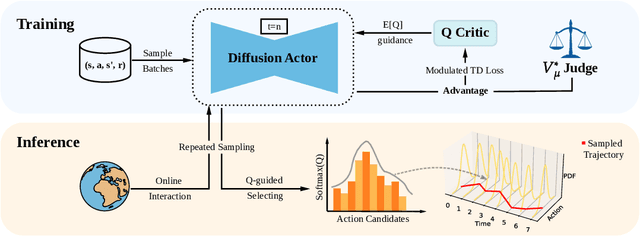

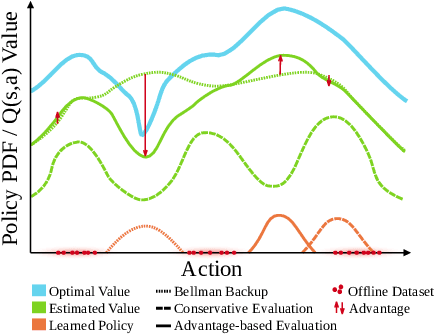
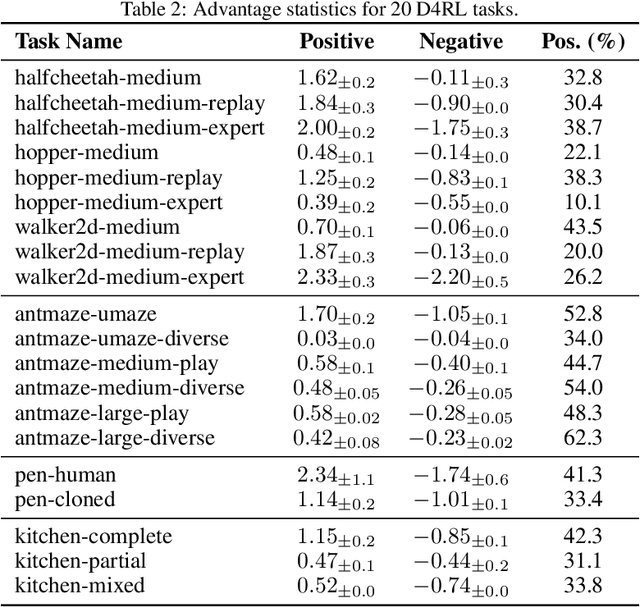
Offline reinforcement learning (RL) aims to learn decision-making policies from fixed datasets without online interactions, providing a practical solution where online data collection is expensive or risky. However, offline RL often suffers from distribution shift, resulting in inaccurate evaluation and substantial overestimation on out-of-distribution (OOD) actions. To address this, existing approaches incorporate conservatism by indiscriminately discouraging all OOD actions, thereby hindering the agent's ability to generalize and exploit beneficial ones. In this paper, we propose Advantage-based Diffusion Actor-Critic (ADAC), a novel method that systematically evaluates OOD actions using the batch-optimal value function. Based on this evaluation, ADAC defines an advantage function to modulate the Q-function update, enabling more precise assessment of OOD action quality. We design a custom PointMaze environment and collect datasets to visually reveal that advantage modulation can effectively identify and select superior OOD actions. Extensive experiments show that ADAC achieves state-of-the-art performance on almost all tasks in the D4RL benchmark, with particularly clear margins on the more challenging tasks.
VIPO: Value Function Inconsistency Penalized Offline Reinforcement Learning
Apr 16, 2025
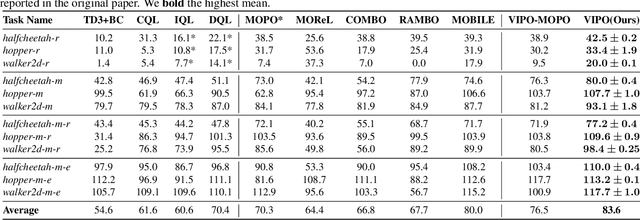
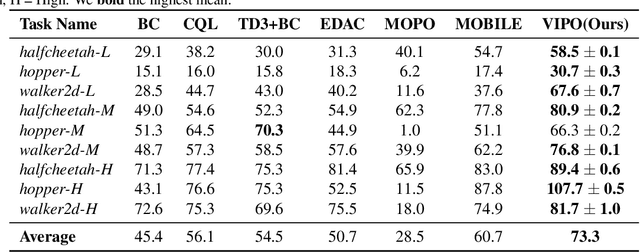
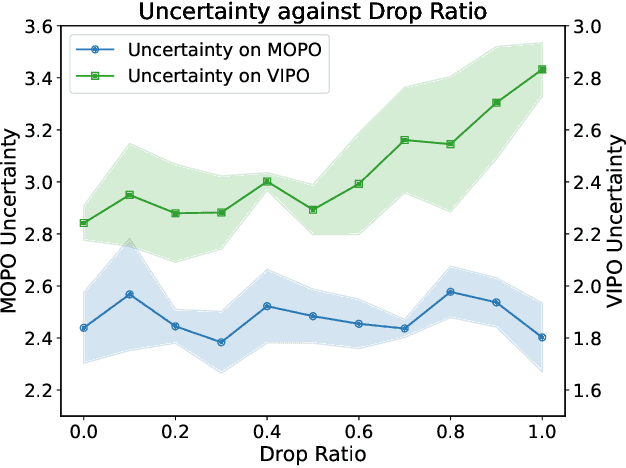
Offline reinforcement learning (RL) learns effective policies from pre-collected datasets, offering a practical solution for applications where online interactions are risky or costly. Model-based approaches are particularly advantageous for offline RL, owing to their data efficiency and generalizability. However, due to inherent model errors, model-based methods often artificially introduce conservatism guided by heuristic uncertainty estimation, which can be unreliable. In this paper, we introduce VIPO, a novel model-based offline RL algorithm that incorporates self-supervised feedback from value estimation to enhance model training. Specifically, the model is learned by additionally minimizing the inconsistency between the value learned directly from the offline data and the one estimated from the model. We perform comprehensive evaluations from multiple perspectives to show that VIPO can learn a highly accurate model efficiently and consistently outperform existing methods. It offers a general framework that can be readily integrated into existing model-based offline RL algorithms to systematically enhance model accuracy. As a result, VIPO achieves state-of-the-art performance on almost all tasks in both D4RL and NeoRL benchmarks.
Wan: Open and Advanced Large-Scale Video Generative Models
Mar 26, 2025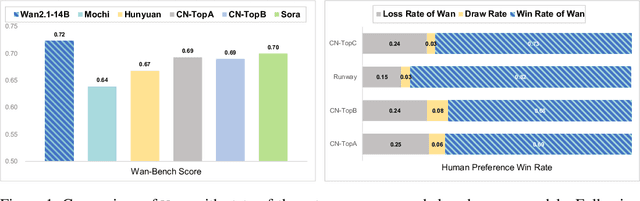
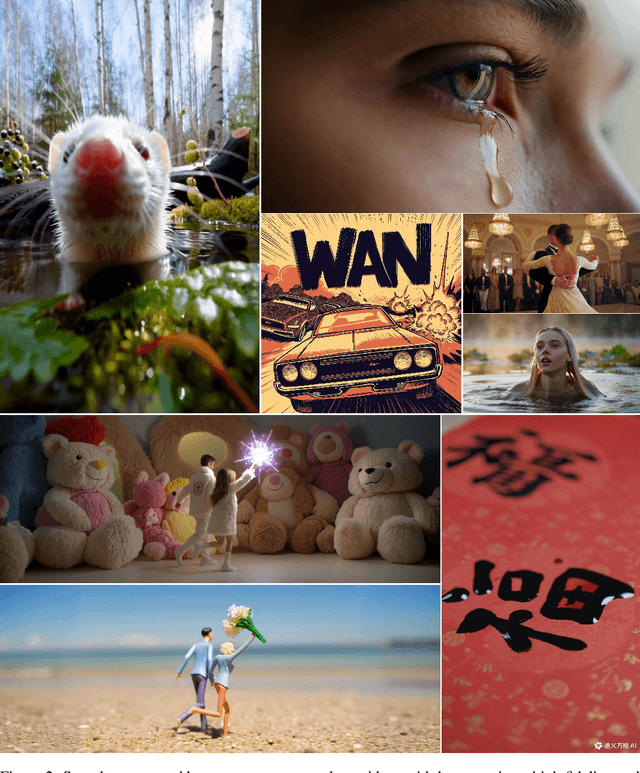
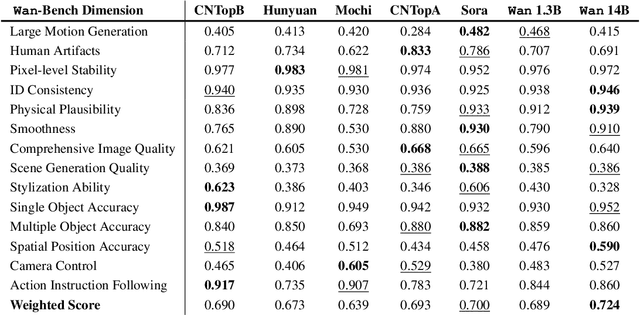
This report presents Wan, a comprehensive and open suite of video foundation models designed to push the boundaries of video generation. Built upon the mainstream diffusion transformer paradigm, Wan achieves significant advancements in generative capabilities through a series of innovations, including our novel VAE, scalable pre-training strategies, large-scale data curation, and automated evaluation metrics. These contributions collectively enhance the model's performance and versatility. Specifically, Wan is characterized by four key features: Leading Performance: The 14B model of Wan, trained on a vast dataset comprising billions of images and videos, demonstrates the scaling laws of video generation with respect to both data and model size. It consistently outperforms the existing open-source models as well as state-of-the-art commercial solutions across multiple internal and external benchmarks, demonstrating a clear and significant performance superiority. Comprehensiveness: Wan offers two capable models, i.e., 1.3B and 14B parameters, for efficiency and effectiveness respectively. It also covers multiple downstream applications, including image-to-video, instruction-guided video editing, and personal video generation, encompassing up to eight tasks. Consumer-Grade Efficiency: The 1.3B model demonstrates exceptional resource efficiency, requiring only 8.19 GB VRAM, making it compatible with a wide range of consumer-grade GPUs. Openness: We open-source the entire series of Wan, including source code and all models, with the goal of fostering the growth of the video generation community. This openness seeks to significantly expand the creative possibilities of video production in the industry and provide academia with high-quality video foundation models. All the code and models are available at https://github.com/Wan-Video/Wan2.1.