 Add to Chrome
 Add to Firefox
 Add to Edge
Kenji Kawaguchi

MGNNI: Multiscale Graph Neural Networks with Implicit Layers
Oct 15, 2022

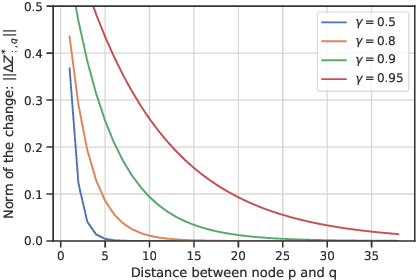
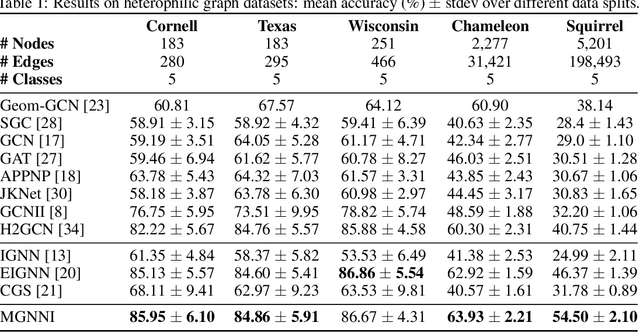
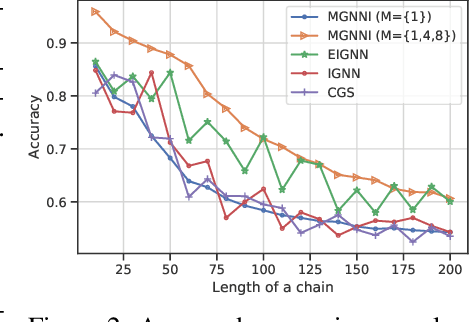
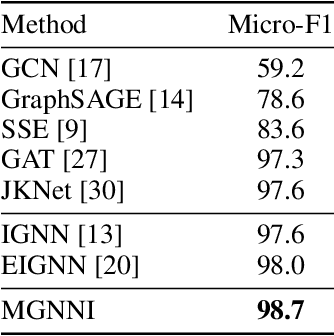
Recently, implicit graph neural networks (GNNs) have been proposed to capture long-range dependencies in underlying graphs. In this paper, we introduce and justify two weaknesses of implicit GNNs: the constrained expressiveness due to their limited effective range for capturing long-range dependencies, and their lack of ability to capture multiscale information on graphs at multiple resolutions. To show the limited effective range of previous implicit GNNs, We first provide a theoretical analysis and point out the intrinsic relationship between the effective range and the convergence of iterative equations used in these models. To mitigate the mentioned weaknesses, we propose a multiscale graph neural network with implicit layers (MGNNI) which is able to model multiscale structures on graphs and has an expanded effective range for capturing long-range dependencies. We conduct comprehensive experiments for both node classification and graph classification to show that MGNNI outperforms representative baselines and has a better ability for multiscale modeling and capturing of long-range dependencies.

Self-Distillation for Further Pre-training of Transformers
Sep 30, 2022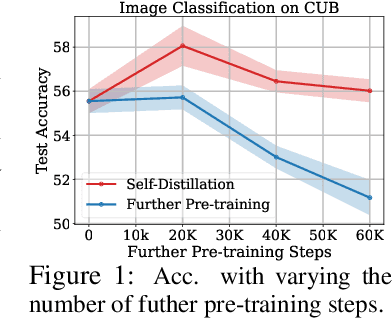
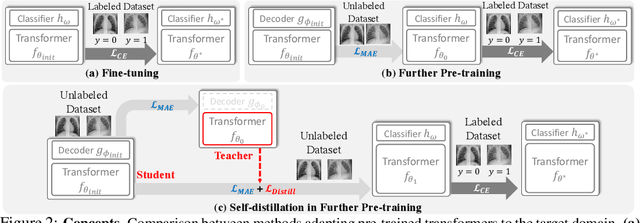
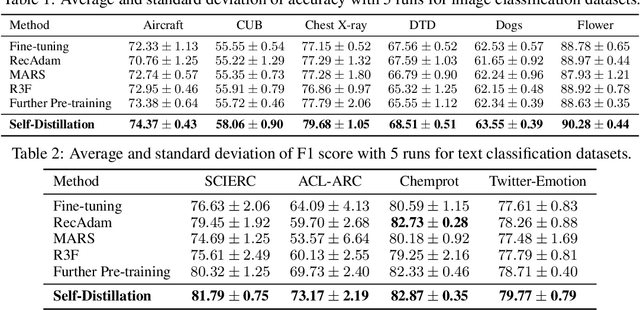
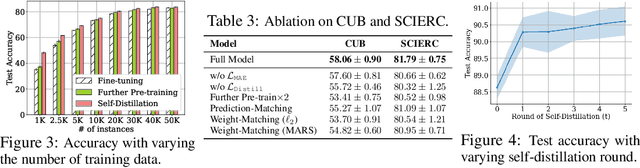
Pre-training a large transformer model on a massive amount of unlabeled data and fine-tuning it on labeled datasets for diverse downstream tasks has proven to be a successful strategy, for a variety of vision and natural language processing tasks. However, direct fine-tuning of the pre-trained model may be suboptimal if there exist large discrepancies across data domains for pre-training and fine-tuning. To tackle this issue, several previous studies have proposed further pre-training strategies, where we continue to pre-train the model on the target unlabeled dataset before fine-tuning. However, all of them solely focus on language models and we empirically find that a Vision Transformer is vulnerable to overfitting as we continue to pretrain the model on target unlabeled data. In order to tackle this limitation, we propose self-distillation as a regularization for a further pre-training stage. Specifically, we first further pre-train the initial pre-trained model on the target unlabeled data and then consider it as a teacher for self-distillation. Then we take the same initial pre-trained model as a student and enforce its hidden representations to be close to those of the teacher while optimizing the student with a masked auto-encoding objective. We empirically validate the efficacy of self-distillation on a variety of benchmark datasets for image and text classification tasks. Experimentally, we show that our proposed method outperforms all the relevant baselines. Theoretically, we analyze the proposed method with a simplified model to understand how self-distillation for further pre-training can potentially help improve the performance of the downstream tasks.
Discrete Key-Value Bottleneck
Jul 22, 2022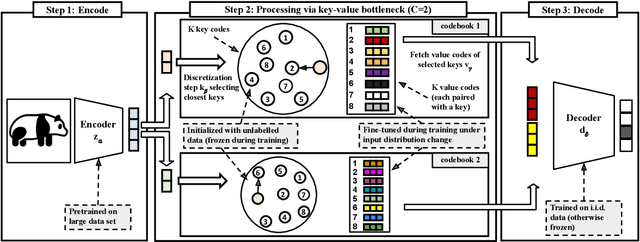
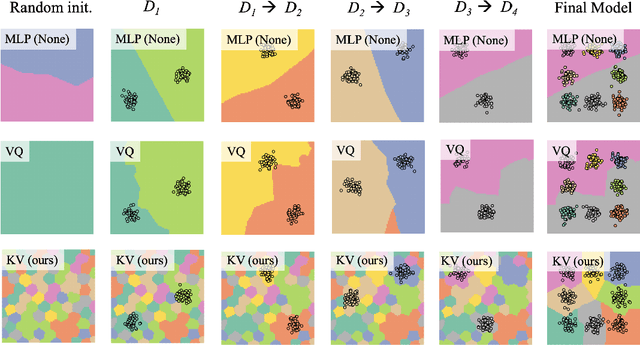
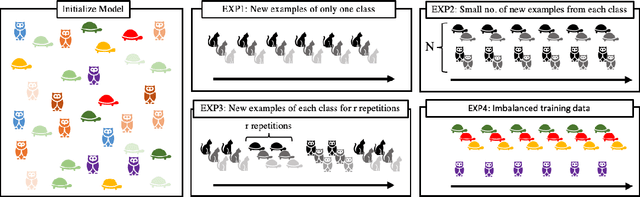
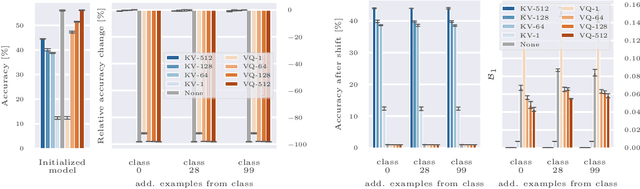
Deep neural networks perform well on prediction and classification tasks in the canonical setting where data streams are i.i.d., labeled data is abundant, and class labels are balanced. Challenges emerge with distribution shifts, including non-stationary or imbalanced data streams. One powerful approach that has addressed this challenge involves self-supervised pretraining of large encoders on volumes of unlabeled data, followed by task-specific tuning. Given a new task, updating the weights of these encoders is challenging as a large number of weights needs to be fine-tuned, and as a result, they forget information about the previous tasks. In the present work, we propose a model architecture to address this issue, building upon a discrete bottleneck containing pairs of separate and learnable (key, value) codes. In this setup, we follow the encode; process the representation via a discrete bottleneck; and decode paradigm, where the input is fed to the pretrained encoder, the output of the encoder is used to select the nearest keys, and the corresponding values are fed to the decoder to solve the current task. The model can only fetch and re-use a limited number of these (key, value) pairs during inference, enabling localized and context-dependent model updates. We theoretically investigate the ability of the proposed model to minimize the effect of the distribution shifts and show that such a discrete bottleneck with (key, value) pairs reduces the complexity of the hypothesis class. We empirically verified the proposed methods' benefits under challenging distribution shift scenarios across various benchmark datasets and show that the proposed model reduces the common vulnerability to non-i.i.d. and non-stationary training distributions compared to various other baselines.
Robustness Implies Generalization via Data-Dependent Generalization Bounds
Jun 27, 2022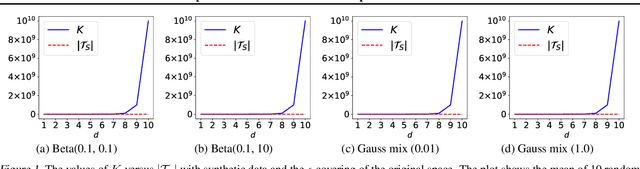
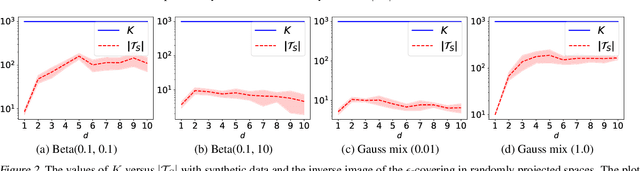
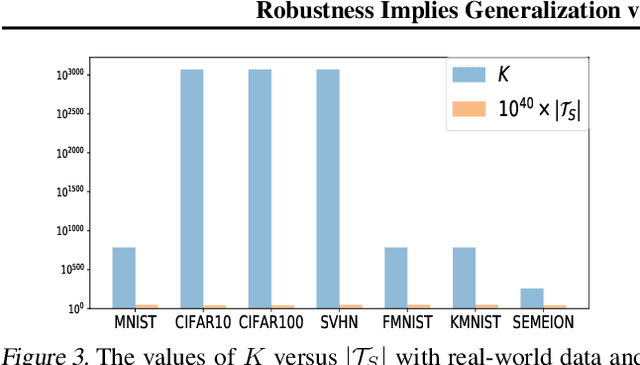
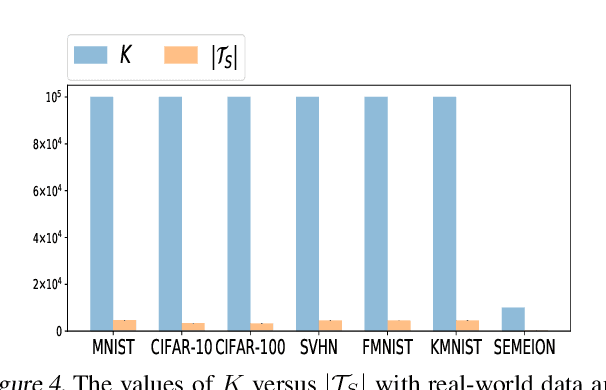
This paper proves that robustness implies generalization via data-dependent generalization bounds. As a result, robustness and generalization are shown to be connected closely in a data-dependent manner. Our bounds improve previous bounds in two directions, to solve an open problem that has seen little development since 2010. The first is to reduce the dependence on the covering number. The second is to remove the dependence on the hypothesis space. We present several examples, including ones for lasso and deep learning, in which our bounds are provably preferable. The experiments on real-world data and theoretical models demonstrate near-exponential improvements in various situations. To achieve these improvements, we do not require additional assumptions on the unknown distribution; instead, we only incorporate an observable and computable property of the training samples. A key technical innovation is an improved concentration bound for multinomial random variables that is of independent interest beyond robustness and generalization.
Set-based Meta-Interpolation for Few-Task Meta-Learning
May 20, 2022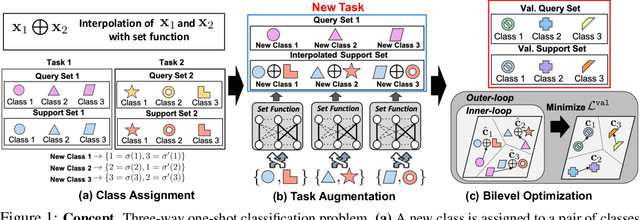
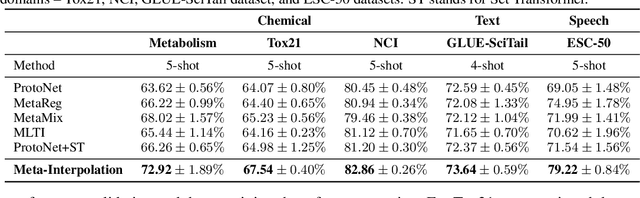
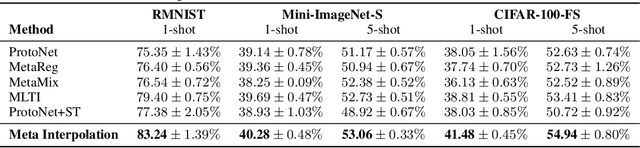
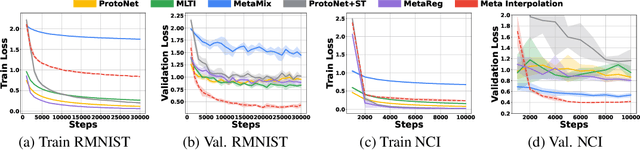
Meta-learning approaches enable machine learning systems to adapt to new tasks given few examples by leveraging knowledge from related tasks. However, a large number of meta-training tasks are still required for generalization to unseen tasks during meta-testing, which introduces a critical bottleneck for real-world problems that come with only few tasks, due to various reasons including the difficulty and cost of constructing tasks. Recently, several task augmentation methods have been proposed to tackle this issue using domain-specific knowledge to design augmentation techniques to densify the meta-training task distribution. However, such reliance on domain-specific knowledge renders these methods inapplicable to other domains. While Manifold Mixup based task augmentation methods are domain-agnostic, we empirically find them ineffective on non-image domains. To tackle these limitations, we propose a novel domain-agnostic task augmentation method, Meta-Interpolation, which utilizes expressive neural set functions to densify the meta-training task distribution using bilevel optimization. We empirically validate the efficacy of Meta-Interpolation on eight datasets spanning across various domains such as image classification, molecule property prediction, text classification and speech recognition. Experimentally, we show that Meta-Interpolation consistently outperforms all the relevant baselines. Theoretically, we prove that task interpolation with the set function regularizes the meta-learner to improve generalization.
Simplicial Embeddings in Self-Supervised Learning and Downstream Classification
Apr 01, 2022


We introduce Simplicial Embeddings (SEMs) as a way to constrain the encoded representations of a self-supervised model to $L$ simplices of $V$ dimensions each using a Softmax operation. This procedure imposes a structure on the representations that reduce their expressivity for training downstream classifiers, which helps them generalize better. Specifically, we show that the temperature $\tau$ of the Softmax operation controls for the SEM representation's expressivity, allowing us to derive a tighter downstream classifier generalization bound than that for classifiers using unnormalized representations. We empirically demonstrate that SEMs considerably improve generalization on natural image datasets such as CIFAR-100 and ImageNet. Finally, we also present evidence of the emergence of semantically relevant features in SEMs, a pattern that is absent from baseline self-supervised models.
EIGNN: Efficient Infinite-Depth Graph Neural Networks
Feb 22, 2022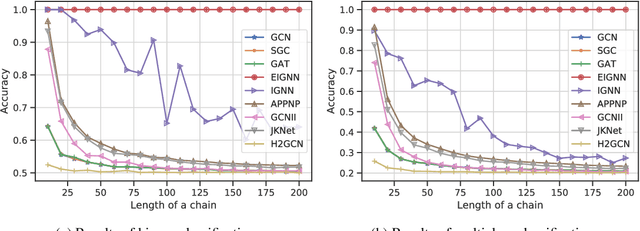
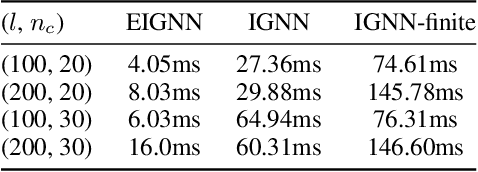
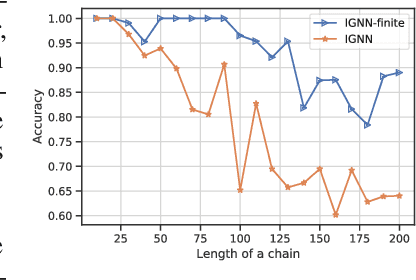
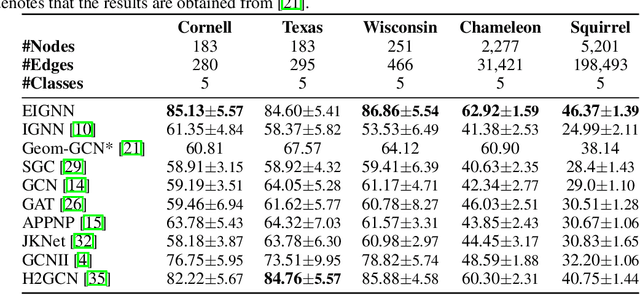
Graph neural networks (GNNs) are widely used for modelling graph-structured data in numerous applications. However, with their inherently finite aggregation layers, existing GNN models may not be able to effectively capture long-range dependencies in the underlying graphs. Motivated by this limitation, we propose a GNN model with infinite depth, which we call Efficient Infinite-Depth Graph Neural Networks (EIGNN), to efficiently capture very long-range dependencies. We theoretically derive a closed-form solution of EIGNN which makes training an infinite-depth GNN model tractable. We then further show that we can achieve more efficient computation for training EIGNN by using eigendecomposition. The empirical results of comprehensive experiments on synthetic and real-world datasets show that EIGNN has a better ability to capture long-range dependencies than recent baselines, and consistently achieves state-of-the-art performance. Furthermore, we show that our model is also more robust against both noise and adversarial perturbations on node features.
Adaptive Discrete Communication Bottlenecks with Dynamic Vector Quantization
Feb 02, 2022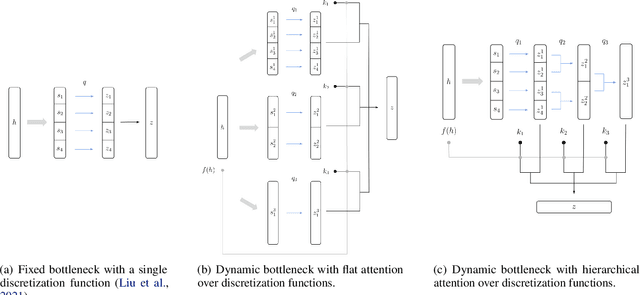
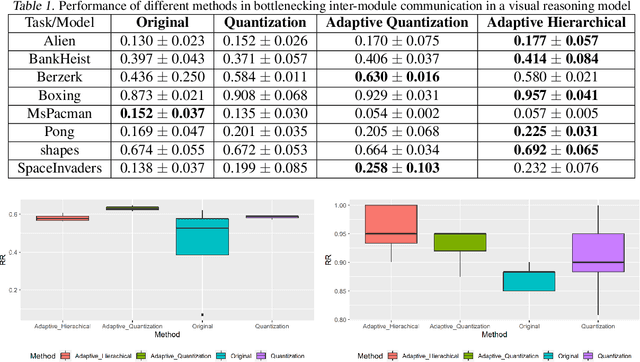
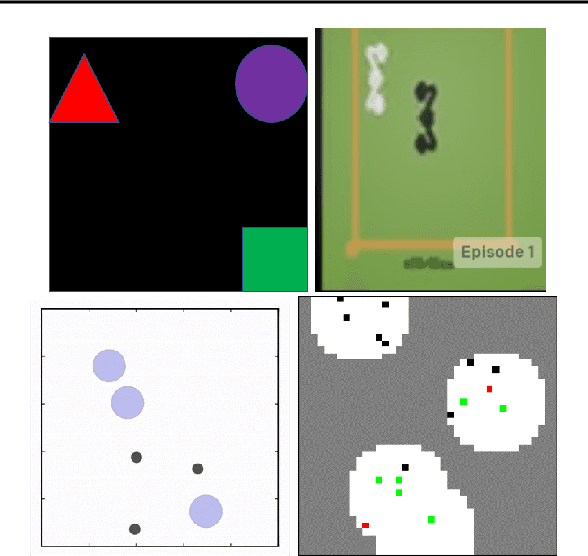
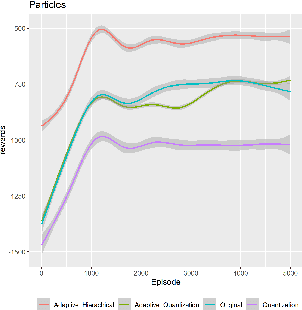
Vector Quantization (VQ) is a method for discretizing latent representations and has become a major part of the deep learning toolkit. It has been theoretically and empirically shown that discretization of representations leads to improved generalization, including in reinforcement learning where discretization can be used to bottleneck multi-agent communication to promote agent specialization and robustness. The discretization tightness of most VQ-based methods is defined by the number of discrete codes in the representation vector and the codebook size, which are fixed as hyperparameters. In this work, we propose learning to dynamically select discretization tightness conditioned on inputs, based on the hypothesis that data naturally contains variations in complexity that call for different levels of representational coarseness. We show that dynamically varying tightness in communication bottlenecks can improve model performance on visual reasoning and reinforcement learning tasks.
Multi-Task Learning as a Bargaining Game
Feb 02, 2022


In Multi-task learning (MTL), a joint model is trained to simultaneously make predictions for several tasks. Joint training reduces computation costs and improves data efficiency; however, since the gradients of these different tasks may conflict, training a joint model for MTL often yields lower performance than its corresponding single-task counterparts. A common method for alleviating this issue is to combine per-task gradients into a joint update direction using a particular heuristic. In this paper, we propose viewing the gradients combination step as a bargaining game, where tasks negotiate to reach an agreement on a joint direction of parameter update. Under certain assumptions, the bargaining problem has a unique solution, known as the Nash Bargaining Solution, which we propose to use as a principled approach to multi-task learning. We describe a new MTL optimization procedure, Nash-MTL, and derive theoretical guarantees for its convergence. Empirically, we show that Nash-MTL achieves state-of-the-art results on multiple MTL benchmarks in various domains.
ExpertNet: A Symbiosis of Classification and Clustering
Jan 17, 2022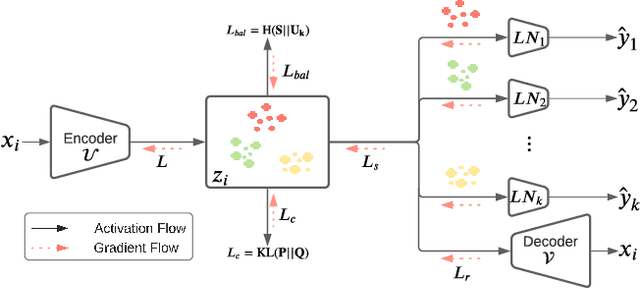
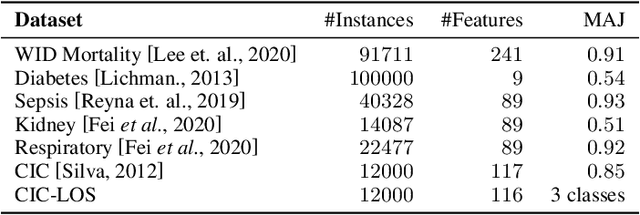

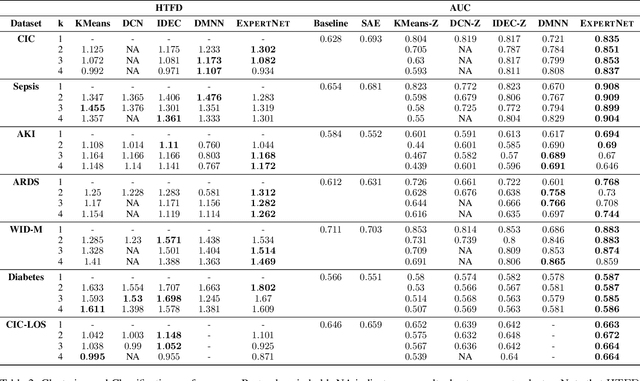
A widely used paradigm to improve the generalization performance of high-capacity neural models is through the addition of auxiliary unsupervised tasks during supervised training. Tasks such as similarity matching and input reconstruction have been shown to provide a beneficial regularizing effect by guiding representation learning. Real data often has complex underlying structures and may be composed of heterogeneous subpopulations that are not learned well with current approaches. In this work, we design ExpertNet, which uses novel training strategies to learn clustered latent representations and leverage them by effectively combining cluster-specific classifiers. We theoretically analyze the effect of clustering on its generalization gap, and empirically show that clustered latent representations from ExpertNet lead to disentangling the intrinsic structure and improvement in classification performance. ExpertNet also meets an important real-world need where classifiers need to be tailored for distinct subpopulations, such as in clinical risk models. We demonstrate the superiority of ExpertNet over state-of-the-art methods on 6 large clinical datasets, where our approach leads to valuable insights on group-specific risks.