 Add to Chrome
 Add to Firefox
 Add to Edge
CoBEV: Elevating Roadside 3D Object Detection with Depth and Height Complementarity
Oct 18, 2023
Roadside camera-driven 3D object detection is a crucial task in intelligent transportation systems, which extends the perception range beyond the limitations of vision-centric vehicles and enhances road safety. While previous studies have limitations in using only depth or height information, we find both depth and height matter and they are in fact complementary. The depth feature encompasses precise geometric cues, whereas the height feature is primarily focused on distinguishing between various categories of height intervals, essentially providing semantic context. This insight motivates the development of Complementary-BEV (CoBEV), a novel end-to-end monocular 3D object detection framework that integrates depth and height to construct robust BEV representations. In essence, CoBEV estimates each pixel's depth and height distribution and lifts the camera features into 3D space for lateral fusion using the newly proposed two-stage complementary feature selection (CFS) module. A BEV feature distillation framework is also seamlessly integrated to further enhance the detection accuracy from the prior knowledge of the fusion-modal CoBEV teacher. We conduct extensive experiments on the public 3D detection benchmarks of roadside camera-based DAIR-V2X-I and Rope3D, as well as the private Supremind-Road dataset, demonstrating that CoBEV not only achieves the accuracy of the new state-of-the-art, but also significantly advances the robustness of previous methods in challenging long-distance scenarios and noisy camera disturbance, and enhances generalization by a large margin in heterologous settings with drastic changes in scene and camera parameters. For the first time, the vehicle AP score of a camera model reaches 80% on DAIR-V2X-I in terms of easy mode. The source code will be made publicly available at https://github.com/MasterHow/CoBEV.

Elevating Skeleton-Based Action Recognition with Efficient Multi-Modality Self-Supervision
Sep 21, 2023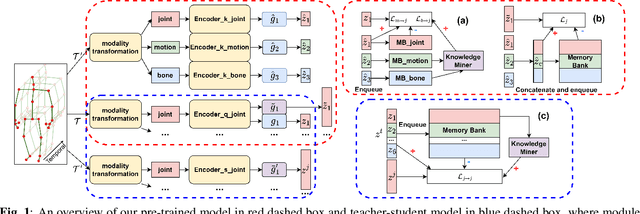
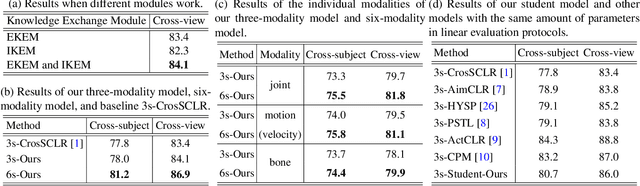
Self-supervised representation learning for human action recognition has developed rapidly in recent years. Most of the existing works are based on skeleton data while using a multi-modality setup. These works overlooked the differences in performance among modalities, which led to the propagation of erroneous knowledge between modalities while only three fundamental modalities, i.e., joints, bones, and motions are used, hence no additional modalities are explored. In this work, we first propose an Implicit Knowledge Exchange Module (IKEM) which alleviates the propagation of erroneous knowledge between low-performance modalities. Then, we further propose three new modalities to enrich the complementary information between modalities. Finally, to maintain efficiency when introducing new modalities, we propose a novel teacher-student framework to distill the knowledge from the secondary modalities into the mandatory modalities considering the relationship constrained by anchors, positives, and negatives, named relational cross-modality knowledge distillation. The experimental results demonstrate the effectiveness of our approach, unlocking the efficient use of skeleton-based multi-modality data. Source code will be made publicly available at https://github.com/desehuileng0o0/IKEM.
Unveiling the Hidden Realm: Self-supervised Skeleton-based Action Recognition in Occluded Environments
Sep 21, 2023
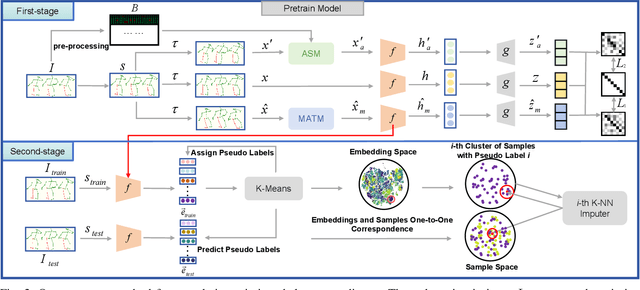
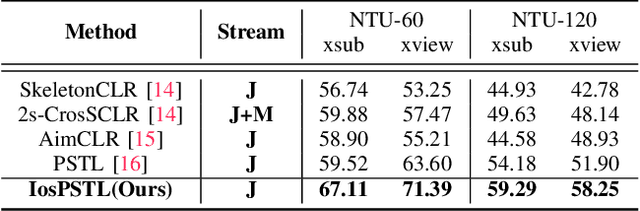
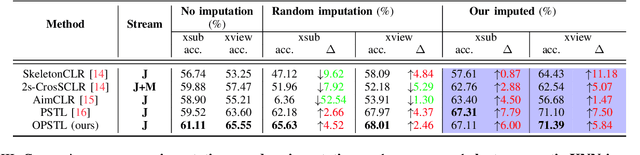
To integrate action recognition methods into autonomous robotic systems, it is crucial to consider adverse situations involving target occlusions. Such a scenario, despite its practical relevance, is rarely addressed in existing self-supervised skeleton-based action recognition methods. To empower robots with the capacity to address occlusion, we propose a simple and effective method. We first pre-train using occluded skeleton sequences, then use k-means clustering (KMeans) on sequence embeddings to group semantically similar samples. Next, we employ K-nearest-neighbor (KNN) to fill in missing skeleton data based on the closest sample neighbors. Imputing incomplete skeleton sequences to create relatively complete sequences as input provides significant benefits to existing skeleton-based self-supervised models. Meanwhile, building on the state-of-the-art Partial Spatio-Temporal Learning (PSTL), we introduce an Occluded Partial Spatio-Temporal Learning (OPSTL) framework. This enhancement utilizes Adaptive Spatial Masking (ASM) for better use of high-quality, intact skeletons. The effectiveness of our imputation methods is verified on the challenging occluded versions of the NTURGB+D 60 and NTURGB+D 120. The source code will be made publicly available at https://github.com/cyfml/OPSTL.
S$^3$-MonoDETR: Supervised Shape&Scale-perceptive Deformable Transformer for Monocular 3D Object Detection
Sep 02, 2023


Recently, transformer-based methods have shown exceptional performance in monocular 3D object detection, which can predict 3D attributes from a single 2D image. These methods typically use visual and depth representations to generate query points on objects, whose quality plays a decisive role in the detection accuracy. However, current unsupervised attention mechanisms without any geometry appearance awareness in transformers are susceptible to producing noisy features for query points, which severely limits the network performance and also makes the model have a poor ability to detect multi-category objects in a single training process. To tackle this problem, this paper proposes a novel "Supervised Shape&Scale-perceptive Deformable Attention" (S$^3$-DA) module for monocular 3D object detection. Concretely, S$^3$-DA utilizes visual and depth features to generate diverse local features with various shapes and scales and predict the corresponding matching distribution simultaneously to impose valuable shape&scale perception for each query. Benefiting from this, S$^3$-DA effectively estimates receptive fields for query points belonging to any category, enabling them to generate robust query features. Besides, we propose a Multi-classification-based Shape$\&$Scale Matching (MSM) loss to supervise the above process. Extensive experiments on KITTI and Waymo Open datasets demonstrate that S$^3$-DA significantly improves the detection accuracy, yielding state-of-the-art performance of single-category and multi-category 3D object detection in a single training process compared to the existing approaches. The source code will be made publicly available at https://github.com/mikasa3lili/S3-MonoDETR.
FocusFlow: Boosting Key-Points Optical Flow Estimation for Autonomous Driving
Aug 14, 2023Key-point-based scene understanding is fundamental for autonomous driving applications. At the same time, optical flow plays an important role in many vision tasks. However, due to the implicit bias of equal attention on all points, classic data-driven optical flow estimation methods yield less satisfactory performance on key points, limiting their implementations in key-point-critical safety-relevant scenarios. To address these issues, we introduce a points-based modeling method that requires the model to learn key-point-related priors explicitly. Based on the modeling method, we present FocusFlow, a framework consisting of 1) a mix loss function combined with a classic photometric loss function and our proposed Conditional Point Control Loss (CPCL) function for diverse point-wise supervision; 2) a conditioned controlling model which substitutes the conventional feature encoder by our proposed Condition Control Encoder (CCE). CCE incorporates a Frame Feature Encoder (FFE) that extracts features from frames, a Condition Feature Encoder (CFE) that learns to control the feature extraction behavior of FFE from input masks containing information of key points, and fusion modules that transfer the controlling information between FFE and CFE. Our FocusFlow framework shows outstanding performance with up to +44.5% precision improvement on various key points such as ORB, SIFT, and even learning-based SiLK, along with exceptional scalability for most existing data-driven optical flow methods like PWC-Net, RAFT, and FlowFormer. Notably, FocusFlow yields competitive or superior performances rivaling the original models on the whole frame. The source code will be available at https://github.com/ZhonghuaYi/FocusFlow_official.
EPCFormer: Expression Prompt Collaboration Transformer for Universal Referring Video Object Segmentation
Aug 08, 2023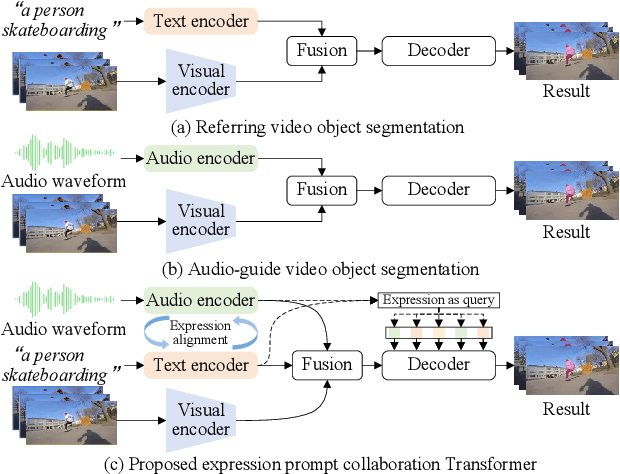
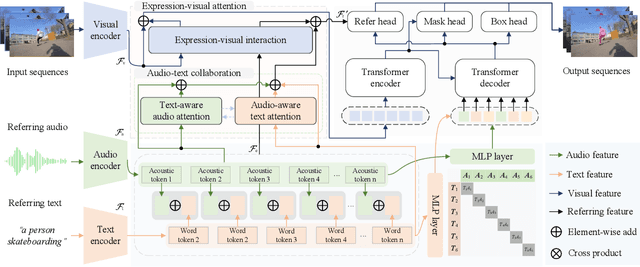
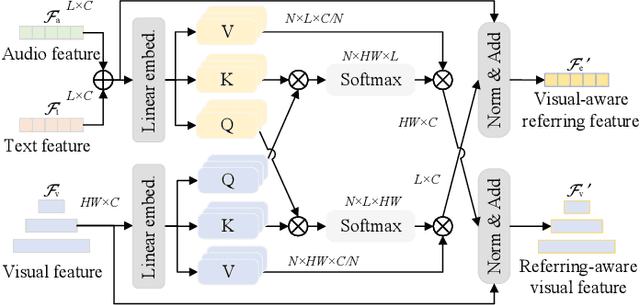
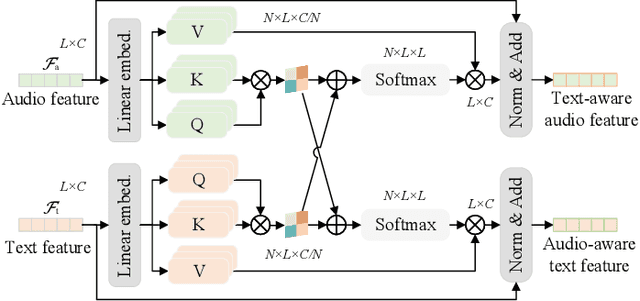
Audio-guided Video Object Segmentation (A-VOS) and Referring Video Object Segmentation (R-VOS) are two highly-related tasks, which both aim to segment specific objects from video sequences according to user-provided expression prompts. However, due to the challenges in modeling representations for different modalities, contemporary methods struggle to strike a balance between interaction flexibility and high-precision localization and segmentation. In this paper, we address this problem from two perspectives: the alignment representation of audio and text and the deep interaction among audio, text, and visual features. First, we propose a universal architecture, the Expression Prompt Collaboration Transformer, herein EPCFormer. Next, we propose an Expression Alignment (EA) mechanism for audio and text expressions. By introducing contrastive learning for audio and text expressions, the proposed EPCFormer realizes comprehension of the semantic equivalence between audio and text expressions denoting the same objects. Then, to facilitate deep interactions among audio, text, and video features, we introduce an Expression-Visual Attention (EVA) mechanism. The knowledge of video object segmentation in terms of the expression prompts can seamlessly transfer between the two tasks by deeply exploring complementary cues between text and audio. Experiments on well-recognized benchmarks demonstrate that our universal EPCFormer attains state-of-the-art results on both tasks. The source code of EPCFormer will be made publicly available at https://github.com/lab206/EPCFormer.
Contrast-augmented Diffusion Model with Fine-grained Sequence Alignment for Markup-to-Image Generation
Aug 02, 2023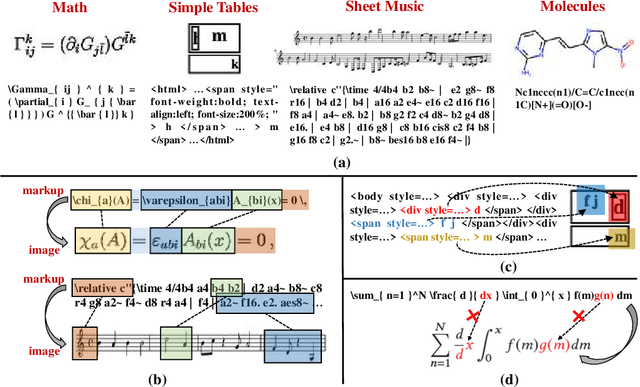
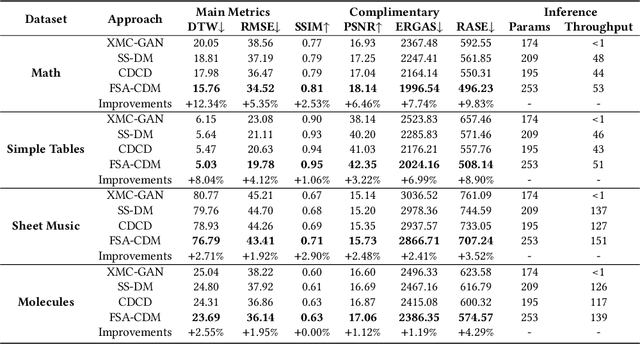
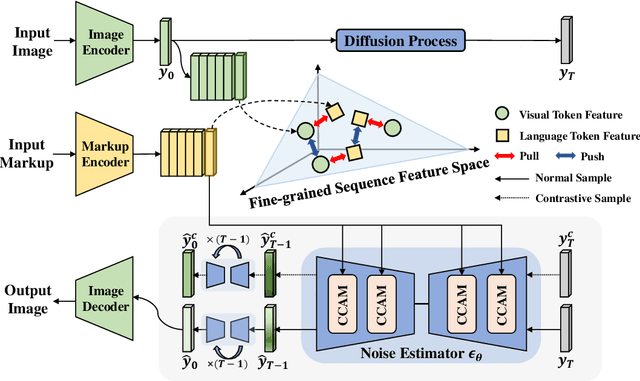
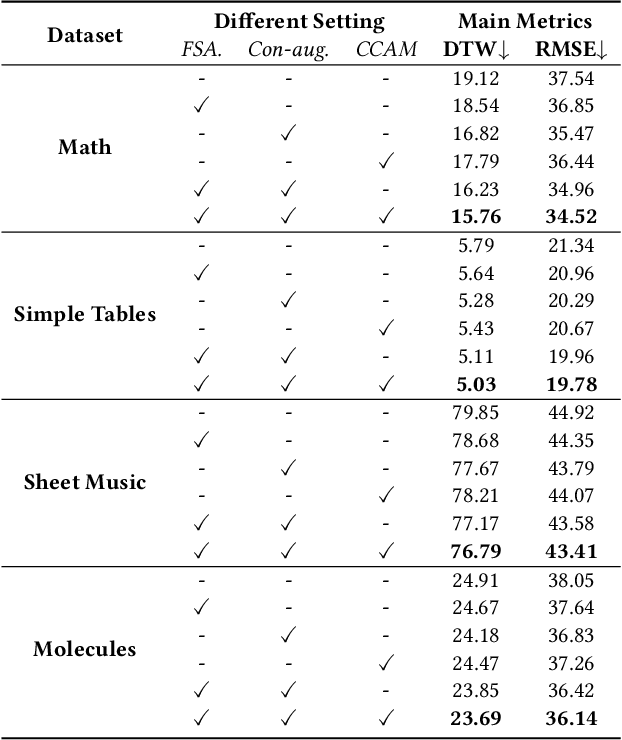
The recently rising markup-to-image generation poses greater challenges as compared to natural image generation, due to its low tolerance for errors as well as the complex sequence and context correlations between markup and rendered image. This paper proposes a novel model named "Contrast-augmented Diffusion Model with Fine-grained Sequence Alignment" (FSA-CDM), which introduces contrastive positive/negative samples into the diffusion model to boost performance for markup-to-image generation. Technically, we design a fine-grained cross-modal alignment module to well explore the sequence similarity between the two modalities for learning robust feature representations. To improve the generalization ability, we propose a contrast-augmented diffusion model to explicitly explore positive and negative samples by maximizing a novel contrastive variational objective, which is mathematically inferred to provide a tighter bound for the model's optimization. Moreover, the context-aware cross attention module is developed to capture the contextual information within markup language during the denoising process, yielding better noise prediction results. Extensive experiments are conducted on four benchmark datasets from different domains, and the experimental results demonstrate the effectiveness of the proposed components in FSA-CDM, significantly exceeding state-of-the-art performance by about 2%-12% DTW improvements. The code will be released at https://github.com/zgj77/FSACDM.
OAFuser: Towards Omni-Aperture Fusion for Light Field Semantic Segmentation of Road Scenes
Jul 28, 2023Light field cameras can provide rich angular and spatial information to enhance image semantic segmentation for scene understanding in the field of autonomous driving. However, the extensive angular information of light field cameras contains a large amount of redundant data, which is overwhelming for the limited hardware resource of intelligent vehicles. Besides, inappropriate compression leads to information corruption and data loss. To excavate representative information, we propose an Omni-Aperture Fusion model (OAFuser), which leverages dense context from the central view and discovers the angular information from sub-aperture images to generate a semantically-consistent result. To avoid feature loss during network propagation and simultaneously streamline the redundant information from the light field camera, we present a simple yet very effective Sub-Aperture Fusion Module (SAFM) to embed sub-aperture images into angular features without any additional memory cost. Furthermore, to address the mismatched spatial information across viewpoints, we present Center Angular Rectification Module (CARM) realized feature resorting and prevent feature occlusion caused by asymmetric information. Our proposed OAFuser achieves state-of-the-art performance on the UrbanLF-Real and -Syn datasets and sets a new record of 84.93% in mIoU on the UrbanLF-Real Extended dataset, with a gain of +4.53%. The source code of OAFuser will be made publicly available at https://github.com/FeiBryantkit/OAFuser.
Open Scene Understanding: Grounded Situation Recognition Meets Segment Anything for Helping People with Visual Impairments
Jul 15, 2023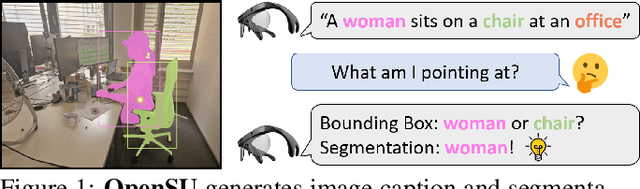
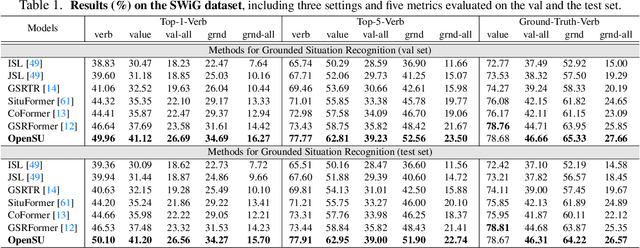
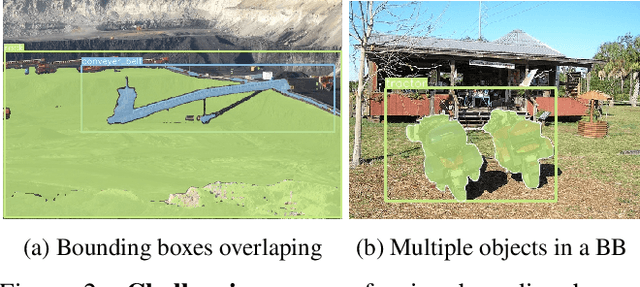
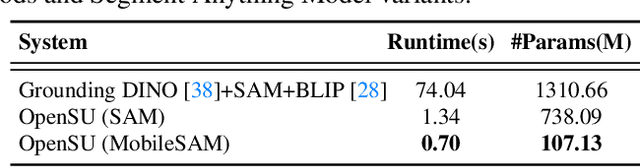
Grounded Situation Recognition (GSR) is capable of recognizing and interpreting visual scenes in a contextually intuitive way, yielding salient activities (verbs) and the involved entities (roles) depicted in images. In this work, we focus on the application of GSR in assisting people with visual impairments (PVI). However, precise localization information of detected objects is often required to navigate their surroundings confidently and make informed decisions. For the first time, we propose an Open Scene Understanding (OpenSU) system that aims to generate pixel-wise dense segmentation masks of involved entities instead of bounding boxes. Specifically, we build our OpenSU system on top of GSR by additionally adopting an efficient Segment Anything Model (SAM). Furthermore, to enhance the feature extraction and interaction between the encoder-decoder structure, we construct our OpenSU system using a solid pure transformer backbone to improve the performance of GSR. In order to accelerate the convergence, we replace all the activation functions within the GSR decoders with GELU, thereby reducing the training duration. In quantitative analysis, our model achieves state-of-the-art performance on the SWiG dataset. Moreover, through field testing on dedicated assistive technology datasets and application demonstrations, the proposed OpenSU system can be used to enhance scene understanding and facilitate the independent mobility of people with visual impairments. Our code will be available at https://github.com/RuipingL/OpenSU.
Tightly-Coupled LiDAR-Visual SLAM Based on Geometric Features for Mobile Agents
Jul 15, 2023The mobile robot relies on SLAM (Simultaneous Localization and Mapping) to provide autonomous navigation and task execution in complex and unknown environments. However, it is hard to develop a dedicated algorithm for mobile robots due to dynamic and challenging situations, such as poor lighting conditions and motion blur. To tackle this issue, we propose a tightly-coupled LiDAR-visual SLAM based on geometric features, which includes two sub-systems (LiDAR and monocular visual SLAM) and a fusion framework. The fusion framework associates the depth and semantics of the multi-modal geometric features to complement the visual line landmarks and to add direction optimization in Bundle Adjustment (BA). This further constrains visual odometry. On the other hand, the entire line segment detected by the visual subsystem overcomes the limitation of the LiDAR subsystem, which can only perform the local calculation for geometric features. It adjusts the direction of linear feature points and filters out outliers, leading to a higher accurate odometry system. Finally, we employ a module to detect the subsystem's operation, providing the LiDAR subsystem's output as a complementary trajectory to our system while visual subsystem tracking fails. The evaluation results on the public dataset M2DGR, gathered from ground robots across various indoor and outdoor scenarios, show that our system achieves more accurate and robust pose estimation compared to current state-of-the-art multi-modal methods.