 Add to Chrome
 Add to Firefox
 Add to Edge
Seeing Touch from Motion: A Unified Modality-Aware Visuo-Tactile Policy with Tactile Motion Correlation
Jun 29, 2026
Visuo-Tactile policies leveraging optical tactile sensors have shown great promise in contact-rich manipulation. These sensors achieve high spatial resolution and multi-dimensional force sensing by utilizing an internal camera to monitor the deformation of their elastic gel surface, thereby indirectly inferring tactile cues. Despite their advantages, extracting fine-grained contact states necessary for contact-rich manipulation remains an open challenge. Existing methods typically use either raw images or cumulative motion fields to represent tactile cues. However, both are prone to perception ambiguity. Raw tactile images mainly capture appearance changes, while cumulative motion fields only reflect the aggregate gel deformation. Consequently, distinct fine-grained contact states can exhibit highly similar patterns, making it difficult to explicitly distinguish subtle contact variations. To address this issue, we explore the dynamic priors of tactile motion and discover that the correlation between transient and cumulative motion can explicitly distinguish fine-grained contact states. Based on this insight, we propose a motion-aware tactile representation to facilitate contact-rich manipulation. Beyond tactile representation, effective fusion of tactile and visual modalities is also critical. Most existing fusion methods either directly concatenate features from each modality or train modality-specific networks separately and fuse their outputs. However, these strategies struggle to simultaneously model cross-modal interactions and preserve modality-specific characteristics. In this work, we take advantage of the Mixture-of-Transformers architecture and propose a unified modality-aware visuo-tactile policy that captures cross-modal complementarity while maintaining modality-specific properties.

CCRC: A Change-Aware Captioning and Reasoning Chain for Image Change Captioning and Segmentation
Jun 27, 2026Understanding and localizing subtle changes between paired images is critical for tasks such as surveillance and image editing. However, traditional Image Change Captioning (ICC) methods lack spatial grounding, limiting their precision. We introduce Image Change Captioning and Segmentation (ICCS), a new multimodal task that jointly requires structured change description and pixel-level localization. To address ICCS, we propose the Change-aware Captioning and Reasoning Chain (CCRC), a dual-chain framework that decouples semantic reasoning from spatial segmentation. The first chain, Chain-of-Change-Captioning (CCC), enhances fine-grained change perception via a visual fusion module based on Multi-Head Change-aware Attention inserted between the visual and language components of a Multimodal Large Language Model (MLLM). CCC also determines whether a change is segmentable. If not, it alone generates the caption. Otherwise, the second chain, Chain-of-Change-Segmenting (CCS), is activated, leveraging spatial priors from CCC and refining masks with a Change-aware Token Refiner for accurate boundary localization. We evaluate CCRC on both synthetic and real-world change detection benchmarks with pixel-level supervision. Experiments show CCRC achieves state-of-the-art performance.
ThinkingVLA: Interleaved Vision and Language Reasoning for Robotic Manipulation
Jun 16, 2026Most Vision-Language-Action (VLA) models map observations directly to actions without explicit reasoning, limiting their capacity for reasoning-intensive long-horizon tasks. To address this, existing approaches adopt Chain-of-Thought (CoT) reasoning to enable subgoal decomposition and spatial anticipation. However, those methods lack a unified architecture for effective cross-modal reasoning and fail to explicitly include inverse reasoning ability based on the target state. We argue that manipulation planning naturally decomposes into prediction, anticipating the next visual state, and inverse dynamics, inferring the actions to reach it. Bridging both requires a unified autoregressive architecture that interleaves textual and visual reasoning in a single generation process. We propose \textbf{ThinkingVLA}, a generative model that realizes this decomposition within a unified Mixture-of-Transformers architecture. ThinkingVLA consists of a forward CoT that identifies the immediate subgoal and guides the visual forecasting; the predicted image then serves as the target state, grounding an inverse CoT that reasons about spatial relationships and action intent based on the predicted image; and the final action is generated conditioned on this full reasoning context. Extensive experiments on simulation and real-world benchmarks demonstrate that ThinkingVLA consistently outperforms state-of-the-art baselines, with particularly large gains on long-horizon manipulation tasks.
ActiveMimic: Egocentric Video Pretraining with Active Perception
Jun 04, 2026Egocentric human video offers a scalable alternative to robot data for pretraining, yet models pretrained on such video consistently underperform those pretrained on robot data. We attribute this gap to a missing signal, the active perception behavior in egocentric videos, where humans continuously reposition their viewpoint during manipulation, inducing camera motion that standard pipelines treat as noise. To address this, we present ActiveMimic, a pretraining framework that recovers synchronized camera and wrist trajectories from a single body-worn RGB camera, models camera motion as a viewpoint action, and jointly learns active perception and manipulation from in-the-wild egocentric human video before adapting to a target robot. Empirically, real-world experiments across tasks with diverse active perception demands show that ActiveMimic consistently surpasses baselines pretrained on human video and matches state-of-the-art models pretrained on robot data. Further analysis provides evidence that active perception capability originates from egocentric human video pretraining rather than robot-specific fine-tuning, confirming active perception as the key to unlocking egocentric human video for robot pretraining.
AVAM: Universal Training-free Adaptive Visual Anchoring Embedded into Multimodal Large Language Model for Multi-image Question Answering
Aug 25, 2025The advancement of Multimodal Large Language Models (MLLMs) has driven significant progress in Visual Question Answering (VQA), evolving from Single to Multi Image VQA (MVQA). However, the increased number of images in MVQA inevitably introduces substantial visual redundancy that is irrelevant to question answering, negatively impacting both accuracy and efficiency. To address this issue, existing methods lack flexibility in controlling the number of compressed visual tokens and tend to produce discrete visual fragments, which hinder MLLMs' ability to comprehend images holistically. In this paper, we propose a straightforward yet universal Adaptive Visual Anchoring strategy, which can be seamlessly integrated into existing MLLMs, offering significant accuracy improvements through adaptive compression. Meanwhile, to balance the results derived from both global and compressed visual input, we further introduce a novel collaborative decoding mechanism, enabling optimal performance. Extensive experiments validate the effectiveness of our method, demonstrating consistent performance improvements across various MLLMs. The code will be publicly available.
Contrast-augmented Diffusion Model with Fine-grained Sequence Alignment for Markup-to-Image Generation
Aug 02, 2023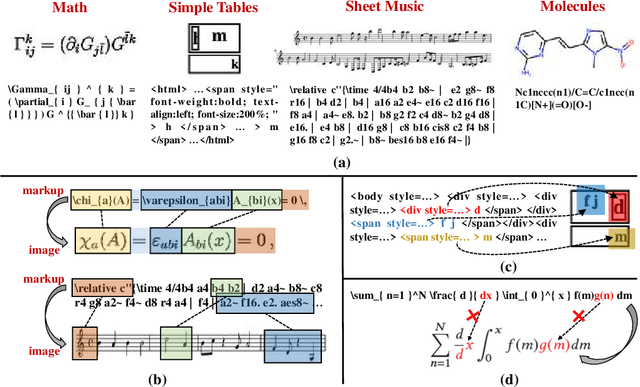
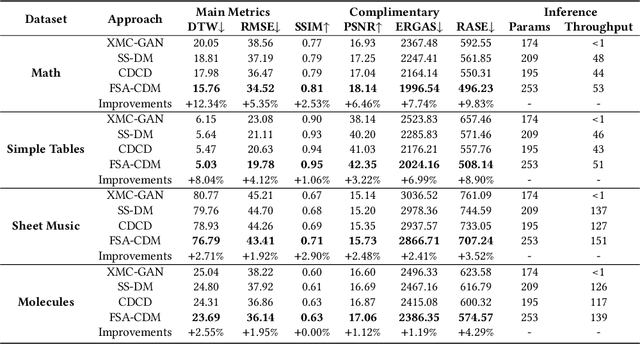
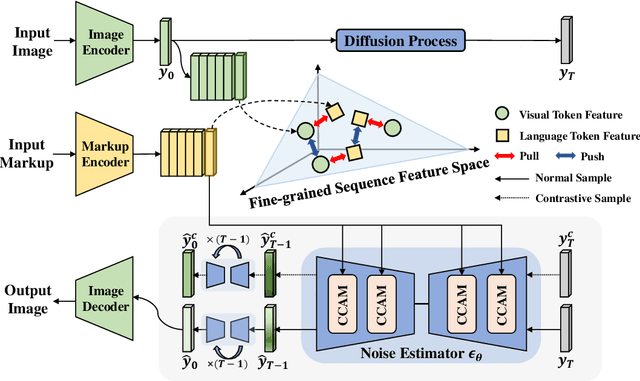
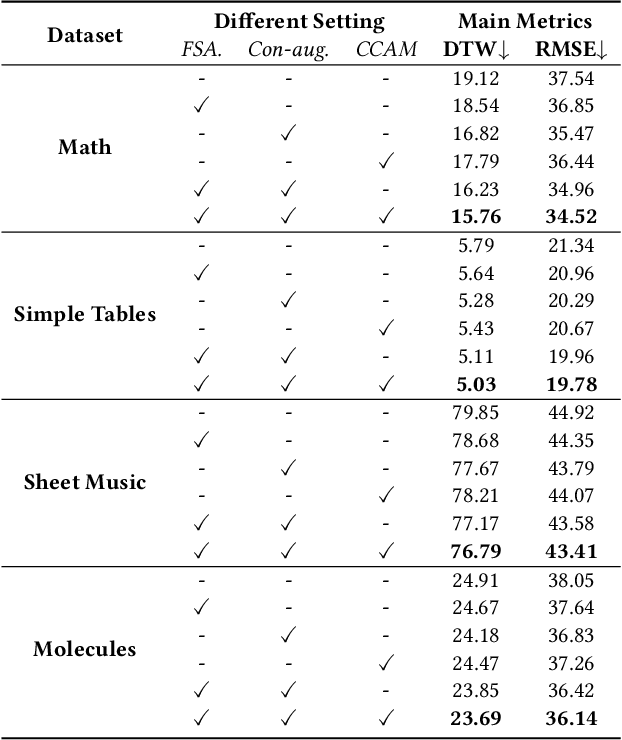
The recently rising markup-to-image generation poses greater challenges as compared to natural image generation, due to its low tolerance for errors as well as the complex sequence and context correlations between markup and rendered image. This paper proposes a novel model named "Contrast-augmented Diffusion Model with Fine-grained Sequence Alignment" (FSA-CDM), which introduces contrastive positive/negative samples into the diffusion model to boost performance for markup-to-image generation. Technically, we design a fine-grained cross-modal alignment module to well explore the sequence similarity between the two modalities for learning robust feature representations. To improve the generalization ability, we propose a contrast-augmented diffusion model to explicitly explore positive and negative samples by maximizing a novel contrastive variational objective, which is mathematically inferred to provide a tighter bound for the model's optimization. Moreover, the context-aware cross attention module is developed to capture the contextual information within markup language during the denoising process, yielding better noise prediction results. Extensive experiments are conducted on four benchmark datasets from different domains, and the experimental results demonstrate the effectiveness of the proposed components in FSA-CDM, significantly exceeding state-of-the-art performance by about 2%-12% DTW improvements. The code will be released at https://github.com/zgj77/FSACDM.