 Add to Chrome
 Add to Firefox
 Add to Edge
SelfCP: Compressing Long Prompt to 1/12 Using the Frozen Large Language Model Itself
May 27, 2024
Long prompt leads to huge hardware costs when using Large Language Models (LLMs). Unfortunately, many tasks, such as summarization, inevitably introduce long task-inputs, and the wide application of in-context learning easily makes the prompt length explode. Inspired by the language understanding ability of LLMs, this paper proposes SelfCP, which uses the LLM \textbf{itself} to \textbf{C}ompress long \textbf{P}rompt into compact virtual tokens. SelfCP applies a general frozen LLM twice, first as an encoder to compress the prompt and then as a decoder to generate responses. Specifically, given a long prompt, we place special tokens within the lengthy segment for compression and signal the LLM to generate $k$ virtual tokens. Afterward, the virtual tokens concatenate with the uncompressed prompt and are fed into the same LLM to generate the response. In general, SelfCP facilitates the unconditional and conditional compression of prompts, fitting both standard tasks and those with specific objectives. Since the encoder and decoder are frozen, SelfCP only contains 17M trainable parameters and allows for convenient adaptation across various backbones. We implement SelfCP with two LLM backbones and evaluate it in both in- and out-domain tasks. Results show that the compressed virtual tokens can substitute $12 \times$ larger original prompts effectively

APrompt4EM: Augmented Prompt Tuning for Generalized Entity Matching
May 08, 2024Generalized Entity Matching (GEM), which aims at judging whether two records represented in different formats refer to the same real-world entity, is an essential task in data management. The prompt tuning paradigm for pre-trained language models (PLMs), including the recent PromptEM model, effectively addresses the challenges of low-resource GEM in practical applications, offering a robust solution when labeled data is scarce. However, existing prompt tuning models for GEM face the challenges of prompt design and information gap. This paper introduces an augmented prompt tuning framework for the challenges, which consists of two main improvements. The first is an augmented contextualized soft token-based prompt tuning method that extracts a guiding soft token benefit for the PLMs' prompt tuning, and the second is a cost-effective information augmentation strategy leveraging large language models (LLMs). Our approach performs well on the low-resource GEM challenges. Extensive experiments show promising advancements of our basic model without information augmentation over existing methods based on moderate-size PLMs (average 5.24%+), and our model with information augmentation achieves comparable performance compared with fine-tuned LLMs, using less than 14% of the API fee.
LATTE3D: Large-scale Amortized Text-To-Enhanced3D Synthesis
Mar 22, 2024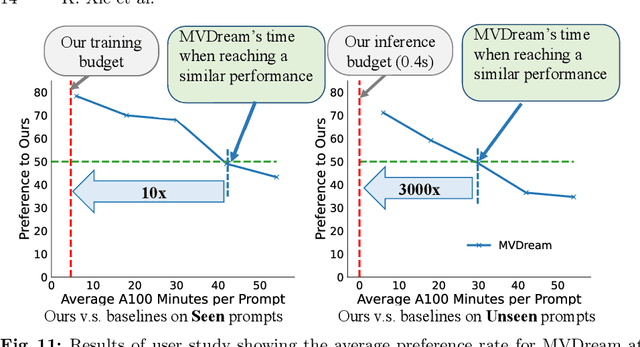
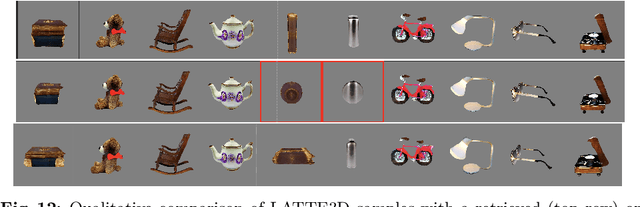
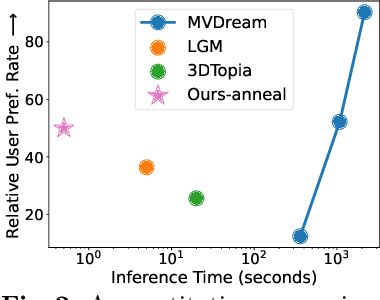
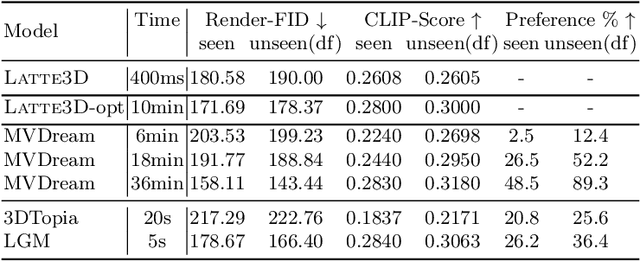
Recent text-to-3D generation approaches produce impressive 3D results but require time-consuming optimization that can take up to an hour per prompt. Amortized methods like ATT3D optimize multiple prompts simultaneously to improve efficiency, enabling fast text-to-3D synthesis. However, they cannot capture high-frequency geometry and texture details and struggle to scale to large prompt sets, so they generalize poorly. We introduce LATTE3D, addressing these limitations to achieve fast, high-quality generation on a significantly larger prompt set. Key to our method is 1) building a scalable architecture and 2) leveraging 3D data during optimization through 3D-aware diffusion priors, shape regularization, and model initialization to achieve robustness to diverse and complex training prompts. LATTE3D amortizes both neural field and textured surface generation to produce highly detailed textured meshes in a single forward pass. LATTE3D generates 3D objects in 400ms, and can be further enhanced with fast test-time optimization.
WebCiteS: Attributed Query-Focused Summarization on Chinese Web Search Results with Citations
Mar 04, 2024Enhancing the attribution in large language models (LLMs) is a crucial task. One feasible approach is to enable LLMs to cite external sources that support their generations. However, existing datasets and evaluation methods in this domain still exhibit notable limitations. In this work, we formulate the task of attributed query-focused summarization (AQFS) and present WebCiteS, a Chinese dataset featuring 7k human-annotated summaries with citations. WebCiteS derives from real-world user queries and web search results, offering a valuable resource for model training and evaluation. Prior works in attribution evaluation do not differentiate between groundedness errors and citation errors. They also fall short in automatically verifying sentences that draw partial support from multiple sources. We tackle these issues by developing detailed metrics and enabling the automatic evaluator to decompose the sentences into sub-claims for fine-grained verification. Our comprehensive evaluation of both open-source and proprietary models on WebCiteS highlights the challenge LLMs face in correctly citing sources, underscoring the necessity for further improvement. The dataset and code will be open-sourced to facilitate further research in this crucial field.
DECIDER: A Rule-Controllable Decoding Strategy for Language Generation by Imitating Dual-System Cognitive Theory
Mar 04, 2024Lexicon-based constrained decoding approaches aim to control the meaning or style of the generated text through certain target concepts. Existing approaches over-focus the targets themselves, leading to a lack of high-level reasoning about how to achieve them. However, human usually tackles tasks by following certain rules that not only focuses on the targets but also on semantically relevant concepts that induce the occurrence of targets. In this work, we present DECIDER, a rule-controllable decoding strategy for constrained language generation inspired by dual-system cognitive theory. Specifically, in DECIDER, a pre-trained language model (PLM) is equiped with a logic reasoner that takes high-level rules as input. Then, the DECIDER allows rule signals to flow into the PLM at each decoding step. Extensive experimental results demonstrate that DECIDER can effectively follow given rules to guide generation direction toward the targets in a more human-like manner.
Increasing SAM Zero-Shot Performance on Multimodal Medical Images Using GPT-4 Generated Descriptive Prompts Without Human Annotation
Feb 24, 2024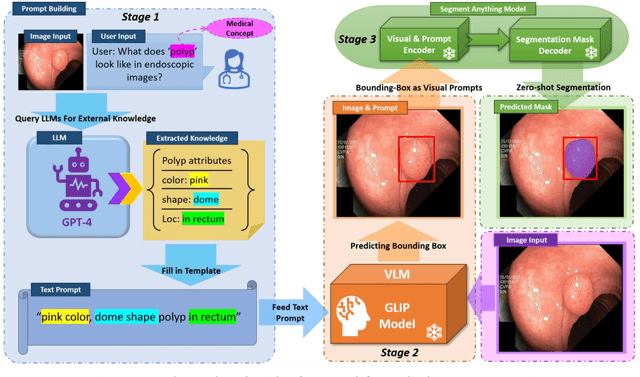
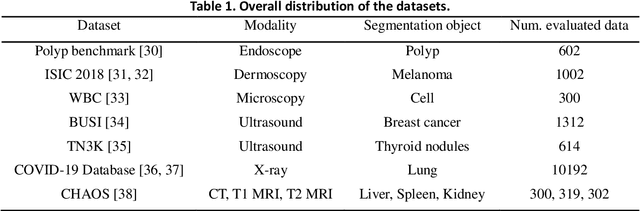
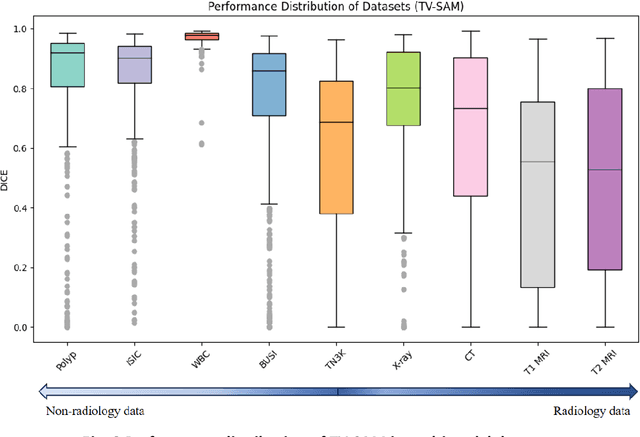
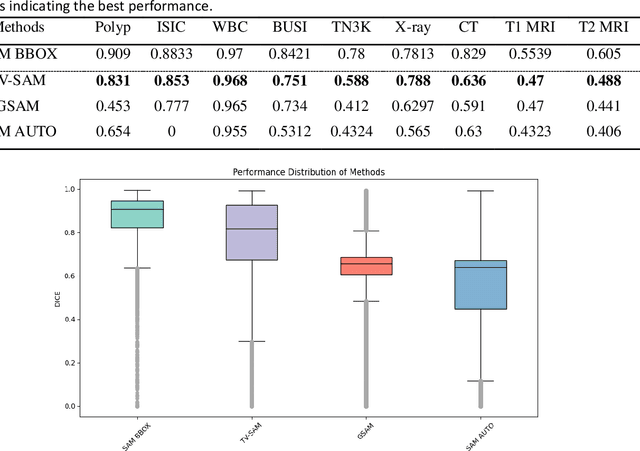
This study develops and evaluates a novel multimodal medical image zero-shot segmentation algorithm named Text-Visual-Prompt SAM (TV-SAM) without any manual annotations. TV-SAM incorporates and integrates large language model GPT-4, Vision Language Model GLIP, and Segment Anything Model (SAM), to autonomously generate descriptive text prompts and visual bounding box prompts from medical images, thereby enhancing SAM for zero-shot segmentation. Comprehensive evaluations are implemented on seven public datasets encompassing eight imaging modalities to demonstrate that TV-SAM can effectively segment unseen targets across various modalities without additional training, significantly outperforming SAM AUTO and GSAM, closely matching the performance of SAM BBOX with gold standard bounding box prompts, and surpassing the state-of-the-art on specific datasets like ISIC and WBC. The study indicates that TV-SAM serves as an effective multimodal medical image zero-shot segmentation algorithm, highlighting the significant contribution of GPT-4 to zero-shot segmentation. By integrating foundational models such as GPT-4, GLIP, and SAM, it could enhance the capability to address complex problems in specialized domains. The code is available at: https://github.com/JZK00/TV-SAM.
Towards Versatile Graph Learning Approach: from the Perspective of Large Language Models
Feb 23, 2024Graph-structured data are the commonly used and have wide application scenarios in the real world. For these diverse applications, the vast variety of learning tasks, graph domains, and complex graph learning procedures present challenges for human experts when designing versatile graph learning approaches. Facing these challenges, large language models (LLMs) offer a potential solution due to the extensive knowledge and the human-like intelligence. This paper proposes a novel conceptual prototype for designing versatile graph learning methods with LLMs, with a particular focus on the "where" and "how" perspectives. From the "where" perspective, we summarize four key graph learning procedures, including task definition, graph data feature engineering, model selection and optimization, deployment and serving. We then explore the application scenarios of LLMs in these procedures across a wider spectrum. In the "how" perspective, we align the abilities of LLMs with the requirements of each procedure. Finally, we point out the promising directions that could better leverage the strength of LLMs towards versatile graph learning methods.
EventRL: Enhancing Event Extraction with Outcome Supervision for Large Language Models
Feb 18, 2024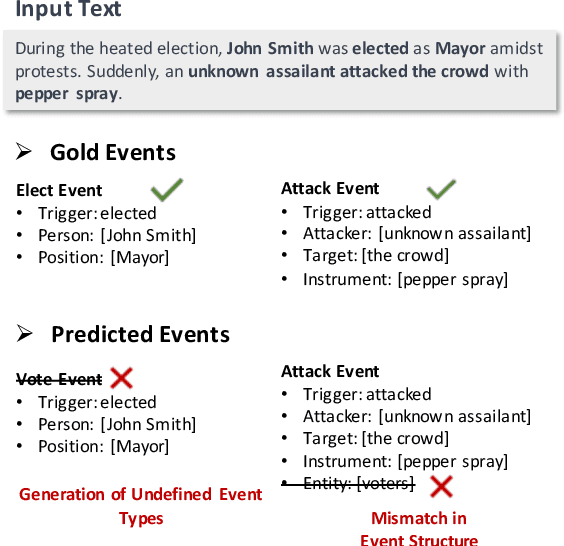
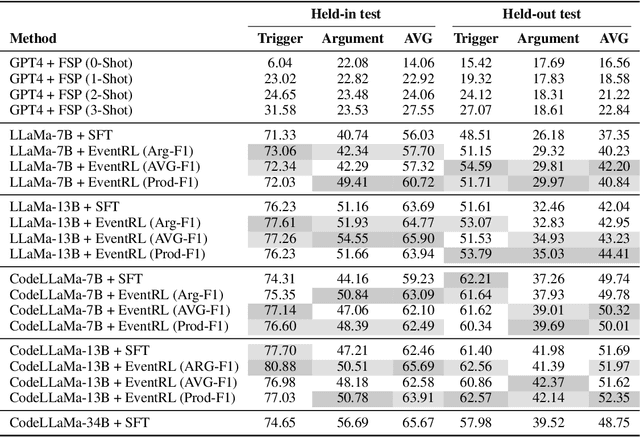
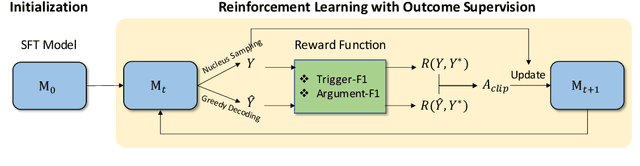
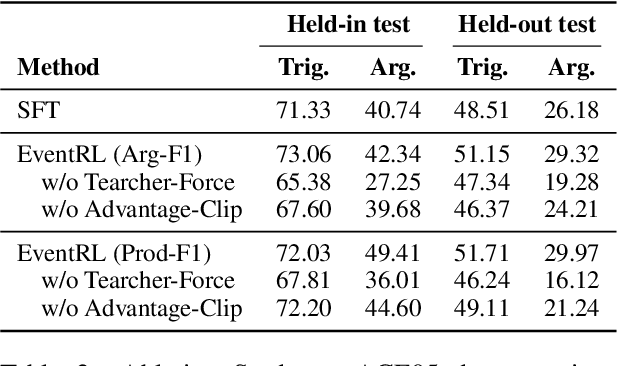
In this study, we present EventRL, a reinforcement learning approach developed to enhance event extraction for large language models (LLMs). EventRL utilizes outcome supervision with specific reward functions to tackle prevalent challenges in LLMs, such as instruction following and hallucination, manifested as the mismatch of event structure and the generation of undefined event types. We evaluate EventRL against existing methods like Few-Shot Prompting (FSP) (based on GPT4) and Supervised Fine-Tuning (SFT) across various LLMs, including GPT-4, LLaMa, and CodeLLaMa models. Our findings show that EventRL significantly outperforms these conventional approaches by improving the performance in identifying and structuring events, particularly in handling novel event types. The study emphasizes the critical role of reward function selection and demonstrates the benefits of incorporating code data for better event extraction. While increasing model size leads to higher accuracy, maintaining the ability to generalize is essential to avoid overfitting.
WildFusion: Learning 3D-Aware Latent Diffusion Models in View Space
Nov 22, 2023Modern learning-based approaches to 3D-aware image synthesis achieve high photorealism and 3D-consistent viewpoint changes for the generated images. Existing approaches represent instances in a shared canonical space. However, for in-the-wild datasets a shared canonical system can be difficult to define or might not even exist. In this work, we instead model instances in view space, alleviating the need for posed images and learned camera distributions. We find that in this setting, existing GAN-based methods are prone to generating flat geometry and struggle with distribution coverage. We hence propose WildFusion, a new approach to 3D-aware image synthesis based on latent diffusion models (LDMs). We first train an autoencoder that infers a compressed latent representation, which additionally captures the images' underlying 3D structure and enables not only reconstruction but also novel view synthesis. To learn a faithful 3D representation, we leverage cues from monocular depth prediction. Then, we train a diffusion model in the 3D-aware latent space, thereby enabling synthesis of high-quality 3D-consistent image samples, outperforming recent state-of-the-art GAN-based methods. Importantly, our 3D-aware LDM is trained without any direct supervision from multiview images or 3D geometry and does not require posed images or learned pose or camera distributions. It directly learns a 3D representation without relying on canonical camera coordinates. This opens up promising research avenues for scalable 3D-aware image synthesis and 3D content creation from in-the-wild image data. See https://katjaschwarz.github.io/wildfusion for videos of our 3D results.
Zero-Shot Digital Rock Image Segmentation with a Fine-Tuned Segment Anything Model
Nov 17, 2023Accurate image segmentation is crucial in reservoir modelling and material characterization, enhancing oil and gas extraction efficiency through detailed reservoir models. This precision offers insights into rock properties, advancing digital rock physics understanding. However, creating pixel-level annotations for complex CT and SEM rock images is challenging due to their size and low contrast, lengthening analysis time. This has spurred interest in advanced semi-supervised and unsupervised segmentation techniques in digital rock image analysis, promising more efficient, accurate, and less labour-intensive methods. Meta AI's Segment Anything Model (SAM) revolutionized image segmentation in 2023, offering interactive and automated segmentation with zero-shot capabilities, essential for digital rock physics with limited training data and complex image features. Despite its advanced features, SAM struggles with rock CT/SEM images due to their absence in its training set and the low-contrast nature of grayscale images. Our research fine-tunes SAM for rock CT/SEM image segmentation, optimizing parameters and handling large-scale images to improve accuracy. Experiments on rock CT and SEM images show that fine-tuning significantly enhances SAM's performance, enabling high-quality mask generation in digital rock image analysis. Our results demonstrate the feasibility and effectiveness of the fine-tuned SAM model (RockSAM) for rock images, offering segmentation without extensive training or complex labelling.