 Add to Chrome
 Add to Firefox
 Add to Edge
Clearer Sight, Fewer Lies: Oriented Pickup Preference Optimization for Multimodal Hallucination Mitigation
Jun 30, 2026
Multimodal Large Language Models (MLLMs) are prone to hallucination as their generation preferences are insufficiently calibrated to visual evidence, causing them to fall back on linguistic priors, rather than faithful grounding. In this work, we start from an empirical observation: when query-relevant visual evidence is explicitly strengthened using the model's own attention, generation becomes more accurate, suggesting that many failures do not arise solely from missing perception, but from an insufficient tendency to trust the evidence the model has already attended to. Motivated by this finding, we propose Oriented Pickup Preference Optimization (\texttt{OPPO}), an evidence-aware alignment objective that learns preferences over the strength of visual evidence, rather than only response quality. Concretely, \texttt{OPPO} contrasts the same faithful response under stronger, anchored, weaker-evidence views, turning naive visual preference into ordered visual-evidence alignment. We further combine this objective with fine-grained span-level and token-level regularization to stabilize the training. Besides, we provide a theoretical analysis showing that ordered evidence margins induce a positive lower bound on local visual sensitivity. Extensive evaluations across hallucination and general-purpose benchmarks demonstrate that \texttt{OPPO} consistently outperforms baseline methods.

Consistency as Inductive Bias: Learning Cross-View Invariance for Robust Multimodal Reasoning
Jun 29, 2026Inductive biases steer learning toward generalizable solutions by encoding task structure. In this work, we identify a crucial missing bias in MLLMs: cross-view consistency, \textit{i.e.}, semantically invariant views of the same instance should lead to the same answer. Standard reinforcement learning with verifiable rewards (RLVR) objectives do not impose this constraint, but instead assign pointwise rewards to each visual input. Even with data augmentation (DA), transformed views are typically rewarded independently, providing little signal once within-view rewards saturate. We propose \textbf{ConsistRoll}, a simple but effective method that injects cross-view consistency into RLVR training by reusing the group-sampling mechanism of GRPO. Specifically, ConsistRoll places original and semantically invariant transformed views in the same generation group, and assigns a joint reward only when paired completions are both correct and consistent. In this way, ConsistRoll turns consistency into an online credit-assignment signal, \textbf{without extra generation overhead and annotations}. Theoretically, we show that cross-view consistency is a valid inductive bias, and ConsistRoll introduces a cross-view correction term absent from DA, penalizing view dependence and alleviating advantage collapse. Comprehensive benchmarks across math, general-purpose, hallucination domains confirm that ConsistRoll achieves robust improvements in multimodal reasoning.
Learning from Fine-Grained Visual Discrepancies: Mitigating Multimodal Hallucinations via In-Context Visual Contrastive Optimization
May 29, 2026Multimodal hallucination remains a persistent challenge for Vision-Language Models (VLMs). Standard textual Direct Preference Optimization (DPO) often fails to mitigate it due to a lack of explicit visual supervision. While existing works introduce visual preference DPO by contrasting original images against negative ones, they suffer from a theoretically inconsistent objective caused by partition function mismatches and rely on coarse-grained negatives that could enable shortcut learning. In this work, we propose In-Context Visual Contrastive Optimization (IC-VCO). By placing contrastive images within a shared multi-image context, IC-VCO ensures a mathematically rigorous objective. We further introduce Visual Contrast Distillation (VCDist), an auxiliary reliability-gated regularizer that encourages consistency between multi-image contrastive training and single-image inference. Finally, we propose a contrastive sample editing strategy that generates hard negatives via precise semantic perturbations. Experiments on five benchmarks demonstrate IC-VCO's best overall performance and the effectiveness of our sample editing strategy. Code and data are available at https://github.com/OPPO-Mente-Lab/IC-VCO.
WebCiteS: Attributed Query-Focused Summarization on Chinese Web Search Results with Citations
Mar 04, 2024Enhancing the attribution in large language models (LLMs) is a crucial task. One feasible approach is to enable LLMs to cite external sources that support their generations. However, existing datasets and evaluation methods in this domain still exhibit notable limitations. In this work, we formulate the task of attributed query-focused summarization (AQFS) and present WebCiteS, a Chinese dataset featuring 7k human-annotated summaries with citations. WebCiteS derives from real-world user queries and web search results, offering a valuable resource for model training and evaluation. Prior works in attribution evaluation do not differentiate between groundedness errors and citation errors. They also fall short in automatically verifying sentences that draw partial support from multiple sources. We tackle these issues by developing detailed metrics and enabling the automatic evaluator to decompose the sentences into sub-claims for fine-grained verification. Our comprehensive evaluation of both open-source and proprietary models on WebCiteS highlights the challenge LLMs face in correctly citing sources, underscoring the necessity for further improvement. The dataset and code will be open-sourced to facilitate further research in this crucial field.
Title2Event: Benchmarking Open Event Extraction with a Large-scale Chinese Title Dataset
Nov 02, 2022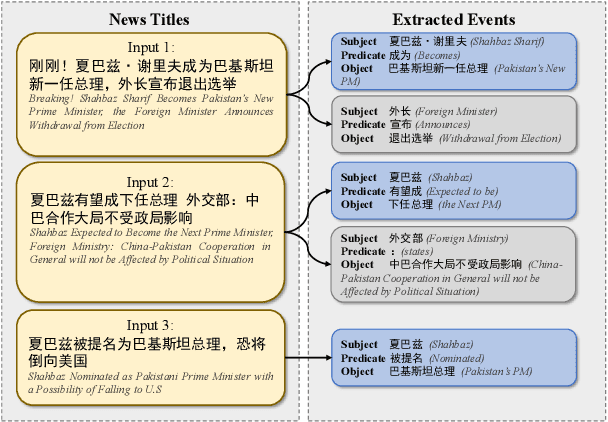
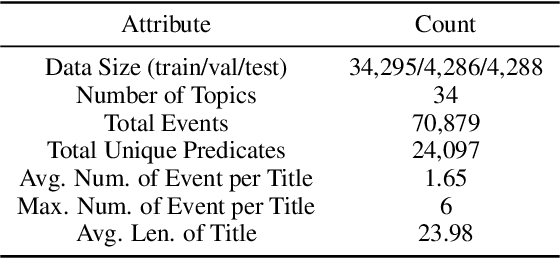
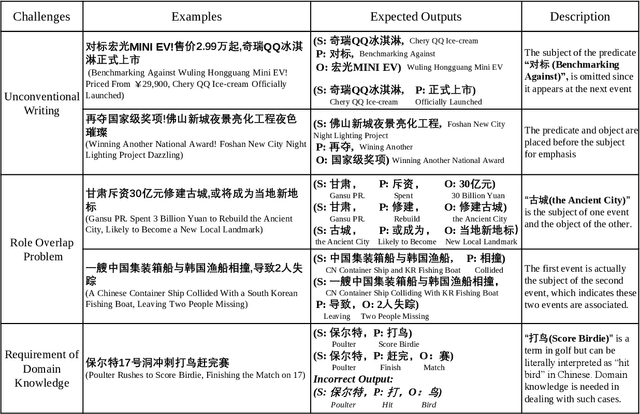

Event extraction (EE) is crucial to downstream tasks such as new aggregation and event knowledge graph construction. Most existing EE datasets manually define fixed event types and design specific schema for each of them, failing to cover diverse events emerging from the online text. Moreover, news titles, an important source of event mentions, have not gained enough attention in current EE research. In this paper, We present Title2Event, a large-scale sentence-level dataset benchmarking Open Event Extraction without restricting event types. Title2Event contains more than 42,000 news titles in 34 topics collected from Chinese web pages. To the best of our knowledge, it is currently the largest manually-annotated Chinese dataset for open event extraction. We further conduct experiments on Title2Event with different models and show that the characteristics of titles make it challenging for event extraction, addressing the significance of advanced study on this problem. The dataset and baseline codes are available at https://open-event-hub.github.io/title2event.