 Add to Chrome
 Add to Firefox
 Add to Edge
AOHP: An Open-Source OS-Level Agent Harness for Personalized, Efficient and Secure Interaction
Jun 22, 2026
AI agents are driving a new software paradigm, with the ability to autonomously call tools, extract information, manage memory, and complete tasks that span applications and data sources. Most existing end-user operating systems, however, are designed for application-centric workflows and offer little native support for AI agents. This mismatch limits the wider adoption of agents and leads to execution overhead and safety risks when running agents on conventional systems. While the concept of agent-native operating systems is emerging, the research community lacks an open testbed to explore the architectural primitives desired for agent-mediated interaction. We present AOHP (Android Open Harness Project), an OS-level agent harness built on the Android Open Source Project (AOSP). The core design principle of AOHP is to treat agents as first-class OS actors, enabling adaptive user interfaces and agent-friendly runtime environments. AOHP preserves the mature Android software and hardware ecosystem while introducing three agent-oriented system mechanisms: personalized service composition, efficient agent interfaces, and secure information flow. Based on preliminary experiments on challenging tasks covering key capabilities of OS agents, AOHP shows clear advantages in task completion (+21.12% completion rate), execution cost (-51.55% token cost), and security-policy compliance.

Efficient On-Device Diffusion LLM Inference with Mobile NPU
Jun 11, 2026Diffusion large language models (dLLMs) accelerate generation by denoising multiple tokens in parallel, making them attractive for latency-sensitive mobile inference. However, repeated denoising introduces substantial computation on smartphones. Mobile neural processing units (NPUs) offer high-throughput dense matrix computation, but efficiently exploiting them remains challenging: token commitment shrinks per-block effective workloads, token revision complicates KV cache reuse, and limited NPU-visible address space incurs costly remapping and data transfer overheads. In this paper, we propose llada.cpp, the first NPU-aware inference framework for accelerating dLLMs on smartphones. llada.cpp aligns block-wise dLLM inference with the execution characteristics of mobile NPUs through three techniques. (1) Multi-Block Speculative Decoding fills the shrinking workload in late-stage current-block decoding with speculative future-block tokens. (2) Dual-Path Progressive Revision keeps committed tokens revisable until stable and refreshes unstable tokens through a CPU-side path without stalling dense NPU execution. (3) Swap-Optimized Memory Runtime compacts NPU-visible address layouts and overlaps data staging with NPU computation to reduce remapping and transfer overheads. We implement llada.cpp as an end-to-end framework and evaluate it across diverse hardware platforms and dLLM workloads. llada.cpp reduces LLaDA-8B generation latency by 17x-42x over the CPU baseline with prefix KV cache reuse, while preserving generation quality.
Executable Agentic Memory for GUI Agent
May 12, 2026Modern GUI agents typically rely on a model-centric and step-wise interaction paradigm, where LLMs must re-interpret the UI and re-decide actions at every screen, which is fragile in long-horizon tasks. In this paper, we propose Executable Agentic Memory (EAM), a structured Knowledge Graph (KG) that shifts GUI planning from free-form generation to a robust retrieval-and-execution process. Our approach includes a sample-efficient memory construction pipeline using state-aware DFS and action-group mining to compress multi-step routines. To ensure efficient planning, we introduce a value-guided graph search where a lightweight Q-function model steers Monte Carlo Tree Search (MCTS) over the KG. We theoretically establish bias-consistency for the Q-model and derive sample complexity bounds for path recovery. Empirically, EAM outperforms state-of-the-art baselines like UI-TARS-7B by up to $19.6\%$ on AndroidWorld, while reducing token costs $6\times$ relative to GPT-4o. With a $2.8$s average latency, EAM enables reliable, quick, and long-horizon GUI automation.
AdamO: A Collapse-Suppressed Optimizer for Offline RL
May 03, 2026Offline reinforcement learning (RL) can fail spectacularly when bootstrapped temporal-difference (TD) updates amplify their own errors, driving the critic toward extreme and unusable Q-values. A key counterintuitive insight of this work is that collapse is not only a property of the backup rule or network architecture: optimizer dynamics themselves can directly trigger or suppress instability. From a control-theoretic viewpoint, we model offline TD learning as a feedback system and analyze Adam-based critic updates. This yields a necessary and sufficient condition for stability of the induced local update dynamics: within the regime we analyze, these dynamics are stable if and only if the spectral radius of the corresponding update operator is strictly below one. Further analysis suggests that standard Adam updates can inadvertently distort the parameter geometry, motivating explicit orthogonality constraints to prevent TD error amplification. To this end, we propose AdamO, an Adam-based optimizer with a decoupled orthogonality correction regulated by a strict task-alignment budget. We prove that this design theoretically guarantees worst-case task safety and preserves Adam's continuous-time dissipative dynamics. Empirically, AdamO is broadly compatible with diverse offline RL baselines, improving stability and returns across a broad suite of benchmarks.
Cloud-Edge Collaborative Large Models for Robust Photovoltaic Power Forecasting
Mar 25, 2026Photovoltaic (PV) power forecasting in edge-enabled grids requires balancing forecasting accuracy, robustness under weather-driven distribution shifts, and strict latency constraints. Existing models work well under normal conditions but often struggle with rare ramp events and unexpected weather changes. Relying solely on cloud-based large models often leads to significant communication delays, which can hinder timely and efficient forecasting in practical grid environments. To address these issues, we propose a condition-adaptive cloud-edge collaborative framework *CAPE* for PV forecasting. *CAPE* consists of three main modules: a site-specific expert model for routine predictions, a lightweight edge-side model for enhanced local inference, and a cloud-based large retrieval model that provides relevant historical cases when needed. These modules are coordinated by a screening module that evaluates uncertainty, out-of-distribution risk, weather mutations, and model disagreement. Furthermore, we employ a Lyapunov-guided routing strategy to dynamically determine when to escalate inference to more powerful models under long-term system constraints. The final forecast is produced through adaptive fusion of the selected model outputs. Experiments on two real-world PV datasets demonstrate that *CAPE* achieves superior performance in terms of forecasting accuracy, robustness, routing quality, and system efficiency.
MANA: Towards Efficient Mobile Ad Detection via Multimodal Agentic UI Navigation
Mar 20, 2026Mobile advertising dominates app monetization but introduces risks ranging from intrusive user experience to malware delivery. Existing detection methods rely either on static analysis, which misses runtime behaviors, or on heuristic UI exploration, which struggles with sparse and obfuscated ads. In this paper, we present MANA, the first agentic multimodal reasoning framework for mobile ad detection. MANA integrates static, visual, temporal, and experiential signals into a reasoning-guided navigation strategy that determines not only how to traverse interfaces but also where to focus, enabling efficient and robust exploration. We implement and evaluate MANA on commercial smartphones over 200 apps, achieving state-of-the-art accuracy and efficiency. Compared to baselines, it improves detection accuracy by 30.5%-56.3% and reduces exploration steps by 29.7%-63.3%. Case studies further demonstrate its ability to uncover obfuscated and malicious ads, underscoring its practicality for mobile ad auditing and its potential for broader runtime UI analysis (e.g., permission abuse). Code and dataset are available at https://github.com/MANA-2026/MANA.
Context Learning for Multi-Agent Discussion
Feb 02, 2026Multi-Agent Discussion (MAD) has garnered increasing attention very recently, where multiple LLM instances collaboratively solve problems via structured discussion. However, we find that current MAD methods easily suffer from discussion inconsistency, LLMs fail to reach a coherent solution, due to the misalignment between their individual contexts.In this paper, we introduce a multi-LLM context learning method (M2CL) that learns a context generator for each agent, capable of dynamically generating context instructions per discussion round via automatic information organization and refinement. Specifically, inspired by our theoretical insights on the context instruction, M2CL train the generators to control context coherence and output discrepancies via a carefully crafted self-adaptive mechanism.It enables LLMs to avoid premature convergence on majority noise and progressively reach the correct consensus. We evaluate M2CL on challenging tasks, including academic reasoning, embodied tasks, and mobile control. The results show that the performance of M2CL significantly surpasses existing methods by 20%--50%, while enjoying favorable transferability and computational efficiency.
Less is More: Clustered Cross-Covariance Control for Offline RL
Jan 28, 2026A fundamental challenge in offline reinforcement learning is distributional shift. Scarce data or datasets dominated by out-of-distribution (OOD) areas exacerbate this issue. Our theoretical analysis and experiments show that the standard squared error objective induces a harmful TD cross covariance. This effect amplifies in OOD areas, biasing optimization and degrading policy learning. To counteract this mechanism, we develop two complementary strategies: partitioned buffer sampling that restricts updates to localized replay partitions, attenuates irregular covariance effects, and aligns update directions, yielding a scheme that is easy to integrate with existing implementations, namely Clustered Cross-Covariance Control for TD (C^4). We also introduce an explicit gradient-based corrective penalty that cancels the covariance induced bias within each update. We prove that buffer partitioning preserves the lower bound property of the maximization objective, and that these constraints mitigate excessive conservatism in extreme OOD areas without altering the core behavior of policy constrained offline reinforcement learning. Empirically, our method showcases higher stability and up to 30% improvement in returns over prior methods, especially with small datasets and splits that emphasize OOD areas.
AgentProg: Empowering Long-Horizon GUI Agents with Program-Guided Context Management
Dec 11, 2025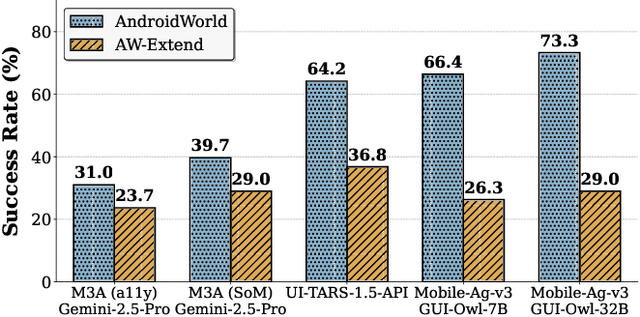
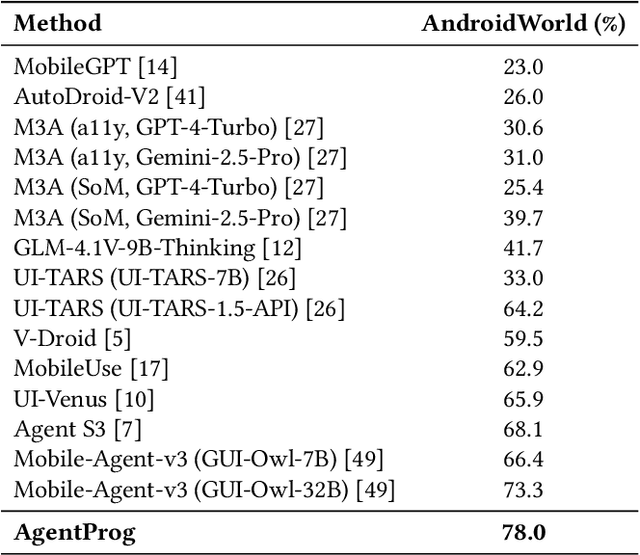
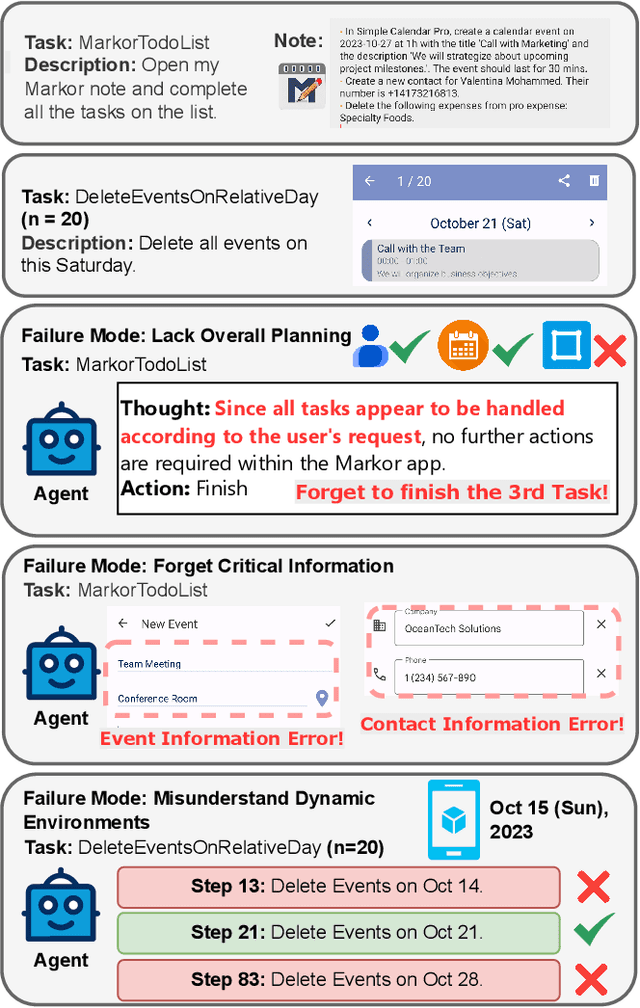
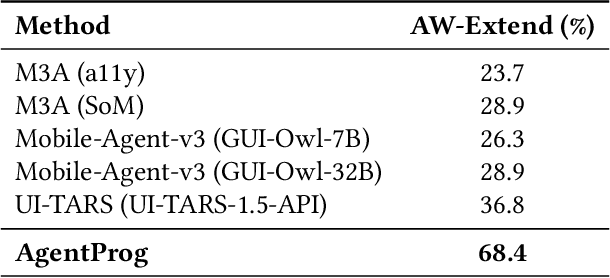
The rapid development of mobile GUI agents has stimulated growing research interest in long-horizon task automation. However, building agents for these tasks faces a critical bottleneck: the reliance on ever-expanding interaction history incurs substantial context overhead. Existing context management and compression techniques often fail to preserve vital semantic information, leading to degraded task performance. We propose AgentProg, a program-guided approach for agent context management that reframes the interaction history as a program with variables and control flow. By organizing information according to the structure of program, this structure provides a principled mechanism to determine which information should be retained and which can be discarded. We further integrate a global belief state mechanism inspired by Belief MDP framework to handle partial observability and adapt to unexpected environmental changes. Experiments on AndroidWorld and our extended long-horizon task suite demonstrate that AgentProg has achieved the state-of-the-art success rates on these benchmarks. More importantly, it maintains robust performance on long-horizon tasks while baseline methods experience catastrophic degradation. Our system is open-sourced at https://github.com/MobileLLM/AgentProg.
Wideband RF Radiance Field Modeling Using Frequency-embedded 3D Gaussian Splatting
May 27, 2025This paper presents an innovative frequency-embedded 3D Gaussian splatting (3DGS) algorithm for wideband radio-frequency (RF) radiance field modeling, offering an advancement over the existing works limited to single-frequency modeling. Grounded in fundamental physics, we uncover the complex relationship between EM wave propagation behaviors and RF frequencies. Inspired by this, we design an EM feature network with attenuation and radiance modules to learn the complex relationships between RF frequencies and the key properties of each 3D Gaussian, specifically the attenuation factor and RF signal intensity. By training the frequency-embedded 3DGS model, we can efficiently reconstruct RF radiance fields at arbitrary unknown frequencies within a given 3D environment. Finally, we propose a large-scale power angular spectrum (PAS) dataset containing 50000 samples ranging from 1 to 100 GHz in 6 indoor environments, and conduct extensive experiments to verify the effectiveness of our method. Our approach achieves an average Structural Similarity Index Measure (SSIM) up to 0.72, and a significant improvement up to 17.8% compared to the current state-of-the-art (SOTA) methods trained on individual test frequencies. Additionally, our method achieves an SSIM of 0.70 without prior training on these frequencies, which represents only a 2.8% performance drop compared to models trained with full PAS data. This demonstrates our model's capability to estimate PAS at unknown frequencies. For related code and datasets, please refer to https://github.com/sim-2-real/Wideband3DGS.