 Add to Chrome
 Add to Firefox
 Add to Edge
Beyond Correctness: Benchmarking and Aligning Response Behaviors in Hybrid-Thinking MLLMs
Aug 13, 2026
Hybrid-thinking multimodal large language models (MLLMs) allow a single model to alternate between deliberative thinking and latency-efficient non-thinking inference. Although these modes differ in reasoning budget, their delivered responses should satisfy the same user-facing standard. Correctness alone may not characterize this response quality; we therefore evaluate task accuracy and response-pattern failures as complementary outcomes. We study this gap through \textbf{response-pattern alignment}: whether thinking and non-thinking interfaces preserve acceptable final-response behavior. We introduce \textbf{PatternEval}, a failure-enriched diagnostic benchmark comprising 2,415 multimodal prompts spanning visual perception and grounding, structured image understanding, and multimodal knowledge reasoning. PatternEval tests four recurrent failures: chain-of-thought leakage, response repetition, logical contradiction, and performative reasoning. Response-pattern failures are widespread across models from different providers, with non-thinking inference exhibiting substantially higher failure rates and thereby creating systematic misalignment between thinking and non-thinking interfaces. Motivated by this diagnosis, we develop \textbf{PatternRM}, a response-level reward model, and \textbf{PatternRL}, which introduces pattern-specific penalties during reinforcement learning. Experiments on Qwen3-VL-4B and Qwen3-VL-8B show that incorporating pattern-specific penalties into reinforcement learning can mitigate cross-mode misalignment while incurring a marginal task performance trade-off. Together, PatternEval and PatternRL provide an evaluation-and-training framework for aligning user-visible response patterns across hybrid-thinking interfaces.

Enhancing Part-Level Point Grounding for Any Open-Source MLLMs
Jun 28, 2026Visual grounding aims to associate free-form textual queries with specific regions in an image. While recent Multimodal Large Language Models (MLLMs) have demonstrated promising capabilities in this domain, they primarily excel at object-level grounding and often struggle with part-level grounding-an essential requirement for fine-grained tasks such as robotic manipulation. In this work, we introduce a general approach that equips any open-source MLLMs with accurate 2D part-level point grounding, offering a more direct alternative to conventional grounding representations. Our method leverages the attention mechanisms inherently present in MLLMs. By synthesizing text-conditioned, grounding-aware queries within intermediate layers via the proposed Q-Synth Module, we capture target-relevant attention patterns and refine them with a lightweight Attention-to-Point Decoder, which converts these patterns into a point-centric heatmap for final prediction. Notably, all original MLLM parameters are frozen, ensuring full preservation of their pre-trained capabilities. Experiments show that our design consistently improves part-level grounding accuracy across datasets and can be seamlessly integrated into any open-source MLLMs.
AdamO: A Collapse-Suppressed Optimizer for Offline RL
May 03, 2026Offline reinforcement learning (RL) can fail spectacularly when bootstrapped temporal-difference (TD) updates amplify their own errors, driving the critic toward extreme and unusable Q-values. A key counterintuitive insight of this work is that collapse is not only a property of the backup rule or network architecture: optimizer dynamics themselves can directly trigger or suppress instability. From a control-theoretic viewpoint, we model offline TD learning as a feedback system and analyze Adam-based critic updates. This yields a necessary and sufficient condition for stability of the induced local update dynamics: within the regime we analyze, these dynamics are stable if and only if the spectral radius of the corresponding update operator is strictly below one. Further analysis suggests that standard Adam updates can inadvertently distort the parameter geometry, motivating explicit orthogonality constraints to prevent TD error amplification. To this end, we propose AdamO, an Adam-based optimizer with a decoupled orthogonality correction regulated by a strict task-alignment budget. We prove that this design theoretically guarantees worst-case task safety and preserves Adam's continuous-time dissipative dynamics. Empirically, AdamO is broadly compatible with diverse offline RL baselines, improving stability and returns across a broad suite of benchmarks.
Cloud-Edge Collaborative Large Models for Robust Photovoltaic Power Forecasting
Mar 25, 2026Photovoltaic (PV) power forecasting in edge-enabled grids requires balancing forecasting accuracy, robustness under weather-driven distribution shifts, and strict latency constraints. Existing models work well under normal conditions but often struggle with rare ramp events and unexpected weather changes. Relying solely on cloud-based large models often leads to significant communication delays, which can hinder timely and efficient forecasting in practical grid environments. To address these issues, we propose a condition-adaptive cloud-edge collaborative framework *CAPE* for PV forecasting. *CAPE* consists of three main modules: a site-specific expert model for routine predictions, a lightweight edge-side model for enhanced local inference, and a cloud-based large retrieval model that provides relevant historical cases when needed. These modules are coordinated by a screening module that evaluates uncertainty, out-of-distribution risk, weather mutations, and model disagreement. Furthermore, we employ a Lyapunov-guided routing strategy to dynamically determine when to escalate inference to more powerful models under long-term system constraints. The final forecast is produced through adaptive fusion of the selected model outputs. Experiments on two real-world PV datasets demonstrate that *CAPE* achieves superior performance in terms of forecasting accuracy, robustness, routing quality, and system efficiency.
FORLER: Federated Offline Reinforcement Learning with Q-Ensemble and Actor Rectification
Feb 02, 2026In Internet-of-Things systems, federated learning has advanced online reinforcement learning (RL) by enabling parallel policy training without sharing raw data. However, interacting with real environments online can be risky and costly, motivating offline federated RL (FRL), where local devices learn from fixed datasets. Despite its promise, offline FRL may break down under low-quality, heterogeneous data. Offline RL tends to get stuck in local optima, and in FRL, one device's suboptimal policy can degrade the aggregated model, i.e., policy pollution. We present FORLER, combining Q-ensemble aggregation on the server with actor rectification on devices. The server robustly merges device Q-functions to curb policy pollution and shift heavy computation off resource-constrained hardware without compromising privacy. Locally, actor rectification enriches policy gradients via a zeroth-order search for high-Q actions plus a bespoke regularizer that nudges the policy toward them. A $δ$-periodic strategy further reduces local computation. We theoretically provide safe policy improvement performance guarantees. Extensive experiments show FORLER consistently outperforms strong baselines under varying data quality and heterogeneity.
Less is More: Clustered Cross-Covariance Control for Offline RL
Jan 28, 2026A fundamental challenge in offline reinforcement learning is distributional shift. Scarce data or datasets dominated by out-of-distribution (OOD) areas exacerbate this issue. Our theoretical analysis and experiments show that the standard squared error objective induces a harmful TD cross covariance. This effect amplifies in OOD areas, biasing optimization and degrading policy learning. To counteract this mechanism, we develop two complementary strategies: partitioned buffer sampling that restricts updates to localized replay partitions, attenuates irregular covariance effects, and aligns update directions, yielding a scheme that is easy to integrate with existing implementations, namely Clustered Cross-Covariance Control for TD (C^4). We also introduce an explicit gradient-based corrective penalty that cancels the covariance induced bias within each update. We prove that buffer partitioning preserves the lower bound property of the maximization objective, and that these constraints mitigate excessive conservatism in extreme OOD areas without altering the core behavior of policy constrained offline reinforcement learning. Empirically, our method showcases higher stability and up to 30% improvement in returns over prior methods, especially with small datasets and splits that emphasize OOD areas.
Efficient Distributed Learning over Decentralized Networks with Convoluted Support Vector Machine
Mar 10, 2025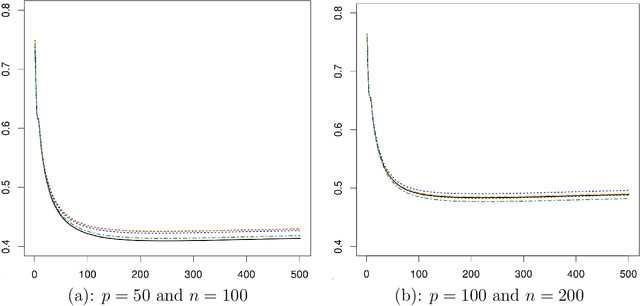
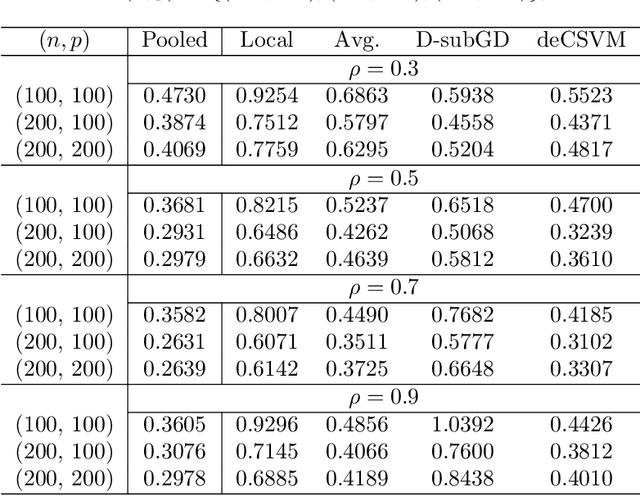
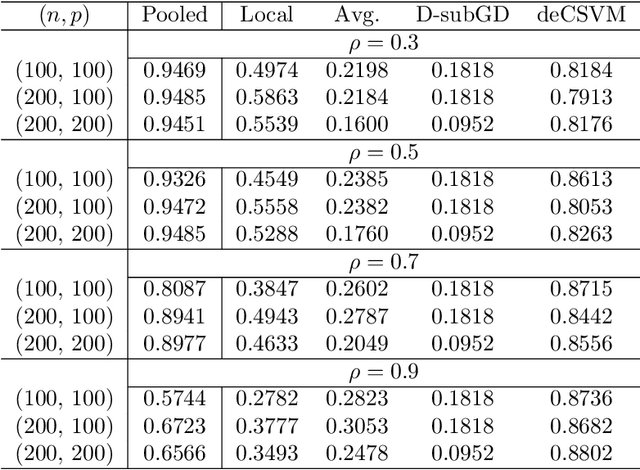
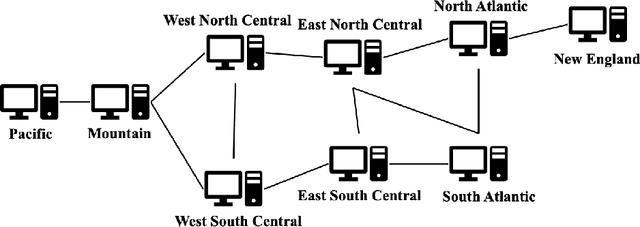
This paper addresses the problem of efficiently classifying high-dimensional data over decentralized networks. Penalized support vector machines (SVMs) are widely used for high-dimensional classification tasks. However, the double nonsmoothness of the objective function poses significant challenges in developing efficient decentralized learning methods. Many existing procedures suffer from slow, sublinear convergence rates. To overcome this limitation, we consider a convolution-based smoothing technique for the nonsmooth hinge loss function. The resulting loss function remains convex and smooth. We then develop an efficient generalized alternating direction method of multipliers (ADMM) algorithm for solving penalized SVM over decentralized networks. Our theoretical contributions are twofold. First, we establish that our generalized ADMM algorithm achieves provable linear convergence with a simple implementation. Second, after a sufficient number of ADMM iterations, the final sparse estimator attains near-optimal statistical convergence and accurately recovers the true support of the underlying parameters. Extensive numerical experiments on both simulated and real-world datasets validate our theoretical findings.
Quantum-Inspired Machine Learning for Molecular Docking
Jan 22, 2024Molecular docking is an important tool for structure-based drug design, accelerating the efficiency of drug development. Complex and dynamic binding processes between proteins and small molecules require searching and sampling over a wide spatial range. Traditional docking by searching for possible binding sites and conformations is computationally complex and results poorly under blind docking. Quantum-inspired algorithms combining quantum properties and annealing show great advantages in solving combinatorial optimization problems. Inspired by this, we achieve an improved in blind docking by using quantum-inspired combined with gradients learned by deep learning in the encoded molecular space. Numerical simulation shows that our method outperforms traditional docking algorithms and deep learning-based algorithms over 10\%. Compared to the current state-of-the-art deep learning-based docking algorithm DiffDock, the success rate of Top-1 (RMSD<2) achieves an improvement from 33\% to 35\% in our same setup. In particular, a 6\% improvement is realized in the high-precision region(RMSD<1) on molecules data unseen in DiffDock, which demonstrates the well-generalized of our method.
ReCLIP: Refine Contrastive Language Image Pre-Training with Source Free Domain Adaptation
Aug 04, 2023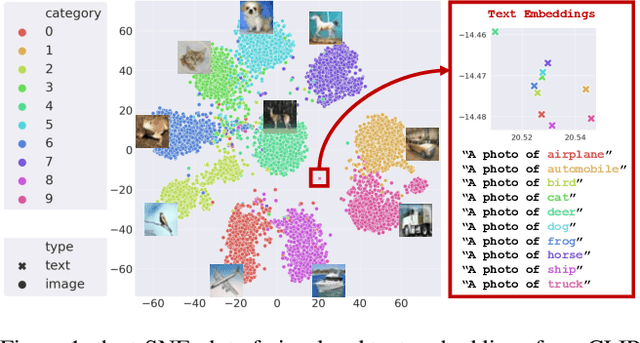
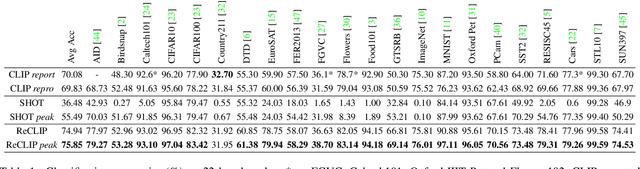
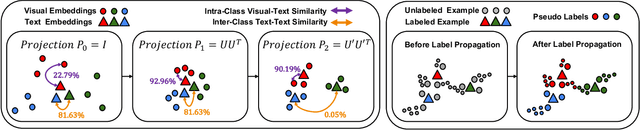
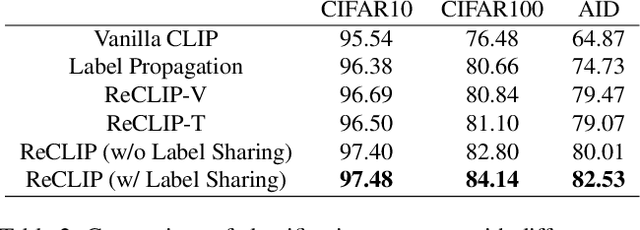
Large-scale Pre-Training Vision-Language Model such as CLIP has demonstrated outstanding performance in zero-shot classification, e.g. achieving 76.3% top-1 accuracy on ImageNet without seeing any example, which leads to potential benefits to many tasks that have no labeled data. However, while applying CLIP to a downstream target domain, the presence of visual and text domain gaps and cross-modality misalignment can greatly impact the model performance. To address such challenges, we propose ReCLIP, the first source-free domain adaptation method for vision-language models, which does not require any source data or target labeled data. ReCLIP first learns a projection space to mitigate the misaligned visual-text embeddings and learns pseudo labels, and then deploys cross-modality self-training with the pseudo labels, to update visual and text encoders, refine labels and reduce domain gaps and misalignments iteratively. With extensive experiments, we demonstrate ReCLIP reduces the average error rate of CLIP from 30.17% to 25.06% on 22 image classification benchmarks.
CameraPose: Weakly-Supervised Monocular 3D Human Pose Estimation by Leveraging In-the-wild 2D Annotations
Jan 08, 2023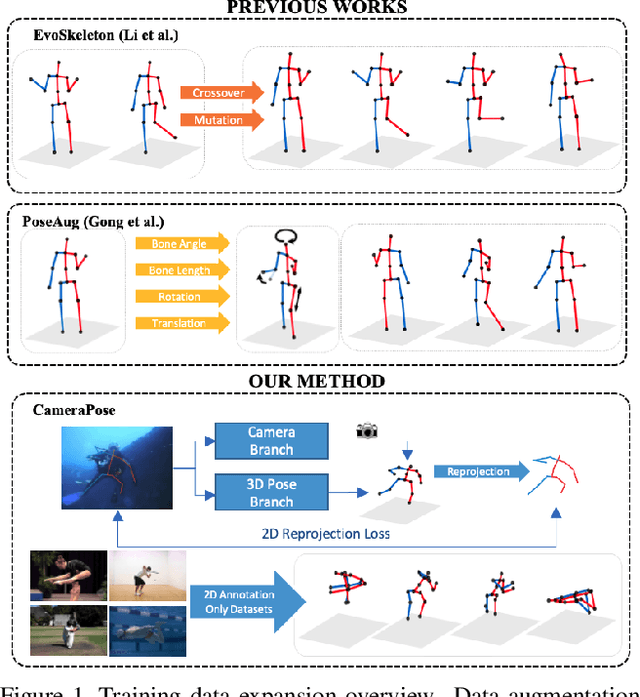
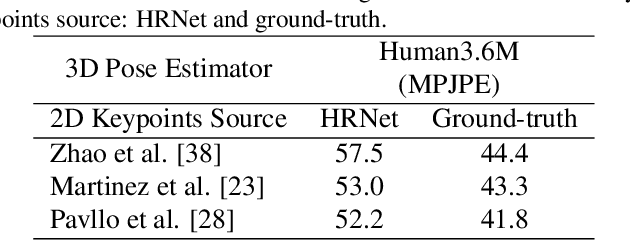
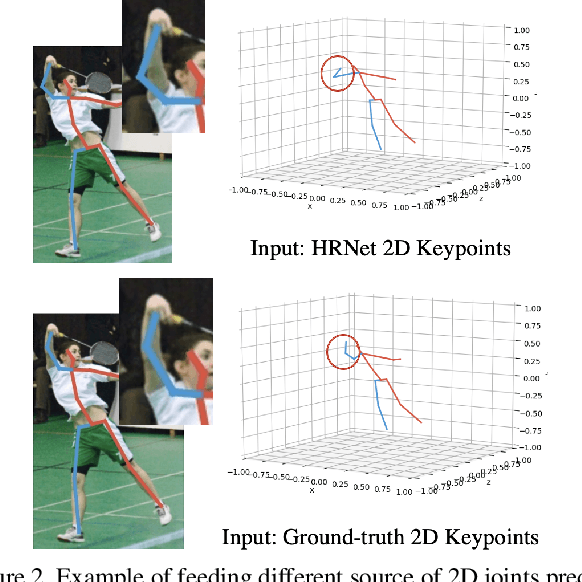
To improve the generalization of 3D human pose estimators, many existing deep learning based models focus on adding different augmentations to training poses. However, data augmentation techniques are limited to the "seen" pose combinations and hard to infer poses with rare "unseen" joint positions. To address this problem, we present CameraPose, a weakly-supervised framework for 3D human pose estimation from a single image, which can not only be applied on 2D-3D pose pairs but also on 2D alone annotations. By adding a camera parameter branch, any in-the-wild 2D annotations can be fed into our pipeline to boost the training diversity and the 3D poses can be implicitly learned by reprojecting back to 2D. Moreover, CameraPose introduces a refinement network module with confidence-guided loss to further improve the quality of noisy 2D keypoints extracted by 2D pose estimators. Experimental results demonstrate that the CameraPose brings in clear improvements on cross-scenario datasets. Notably, it outperforms the baseline method by 3mm on the most challenging dataset 3DPW. In addition, by combining our proposed refinement network module with existing 3D pose estimators, their performance can be improved in cross-scenario evaluation.