 Add to Chrome
 Add to Firefox
 Add to Edge
Waveform Design for OTFS Assisted Simultaneous Acoustic Information and Power Transfer
Jul 20, 2026
Simultaneous acoustic information and power transfer (SAIPT) is a promising technique for supporting self-sustainable Internet of Underwater Things (IoUT) networks through concurrent data transmission and energy supplement. However, existing OFDM-based SAIPT studies are vulnerable to severe multipath propagation and Doppler effects in dynamic underwater acoustic channels. To address this issue, this paper proposes an orthogonal time frequency space (OTFS)-based SAIPT waveform design for dynamic underwater acoustic channels. The acoustic information transfer (AIT) and acoustic power transfer (APT) symbols are jointly designed, while the transducer conversion efficiencies and nonlinear rectifier characteristics are incorporated into the system model. Based on the derived achievable data rate and DC output expressions, a waveform optimization problem is formulated to maximize the harvested DC output under transmit power and minimum data-rate constraints. To solve the resulting non-convex problem, a successive convex approximation (SCA)-based algorithm is developed. Simulation results show that the proposed OTFS-based design outperforms the OFDM-based scheme in terms of DC output in the dynamic transmission scenarios. The effects of key system parameters are also analyzed, confirming the effectiveness of the proposed design in improving acoustic energy transfer efficiency.

Waveform Design for Underwater Simultaneous Acoustic Information and Power Transfer
Jul 02, 2026Simultaneous acoustic information and power transfer (SAIPT) plays a crucial role in enabling self-sustainable and maintenance-free Internet of Underwater Things (IoUT) networks. This paper studies a multicarrier underwater SAIPT system that jointly considers the frequency-dependent characteristics of acoustic transducers and the nonlinear behavior of rectifier circuits. The waveform vector is firstly optimized using the successive convex approximation (SCA) method under constraints on average and peak transmit power for acoustic power transfer (APT). Then, in the SAIPT scenario, both the power splitting factor and waveform vectors are jointly optimized through an alternating optimization (AO) framework based on SCA, subject to transmit power and achievable rate constraints. Simulation results demonstrate that incorporating the transducer's frequency response, rectifier nonlinearity, and the high peak-to-average power ratio (PAPR) of multicarrier waveforms leads to a significant improvement in acoustic energy transfer efficiency. The results also show that the energy harvesting DC output can be further enhanced by properly choosing system parameters, such as the number of subcarriers and subcarrier spacing.
Downlink Performance Analysis of Pinching Antenna Systems: WDMA or NOMA?
May 14, 2026This paper presents an analytical framework for downlink pinching antenna systems (PASS) employing waveguide division multiple access (WDMA) and non-orthogonal multiple access (NOMA). A unified channel model is developed to capture antenna deployment, user spatial distribution, and path loss. Closed-form and single-integral expressions for the outage probability and average achievable rate are derived and validated via Monte Carlo simulations. The results show that NOMA achieves higher spectral efficiency at high transmit signal-to-noise ratio (SNR) due to successive interference cancellation (SIC), whereas WDMA offers more reliable performance at low to moderate SNR but suffers from an outage floor and rate saturation at high SNR. Moreover, WDMA performance is more sensitive to the user spatial distribution due to the spatially dependent inter-waveguide interference. These findings provide design insights for access-scheme selection and antenna placement in PASS.
Hybrid Pinching-Fluid Antenna Assisted Wireless Communications: Modeling and Performance Analysis
May 07, 2026Reconfigurable-antenna systems have received increasing attention for their ability to adapt wireless channels. However, existing architectures exhibit scenario-dependent limitations: fluid antennas provide strong diversity gains in rich-scattering environments but offer limited benefits under line-of-sight (LoS)-dominant conditions, while pinching antennas can effectively reduce path loss by adjusting the radiation point along a waveguide, yet perform poorly in severe non-LoS (NLoS) scenarios. This letter proposes a hybrid pinching-fluid antenna system (HPFAS), where pinching antenna (PA) is employed at the transmitter and a fluid antenna (FA) is used at the receiver to jointly exploit LoS enhancement and spatial diversity. A tractable channel model is developed, and outage probability expressions are derived for both single-user and multi-user scenarios. Simulation results validate the analysis and show that the proposed HPFAS consistently outperforms systems using only pinching antennas or only fluid antennas under various propagation conditions.
MANA: Towards Efficient Mobile Ad Detection via Multimodal Agentic UI Navigation
Mar 20, 2026Mobile advertising dominates app monetization but introduces risks ranging from intrusive user experience to malware delivery. Existing detection methods rely either on static analysis, which misses runtime behaviors, or on heuristic UI exploration, which struggles with sparse and obfuscated ads. In this paper, we present MANA, the first agentic multimodal reasoning framework for mobile ad detection. MANA integrates static, visual, temporal, and experiential signals into a reasoning-guided navigation strategy that determines not only how to traverse interfaces but also where to focus, enabling efficient and robust exploration. We implement and evaluate MANA on commercial smartphones over 200 apps, achieving state-of-the-art accuracy and efficiency. Compared to baselines, it improves detection accuracy by 30.5%-56.3% and reduces exploration steps by 29.7%-63.3%. Case studies further demonstrate its ability to uncover obfuscated and malicious ads, underscoring its practicality for mobile ad auditing and its potential for broader runtime UI analysis (e.g., permission abuse). Code and dataset are available at https://github.com/MANA-2026/MANA.
Context Learning for Multi-Agent Discussion
Feb 02, 2026Multi-Agent Discussion (MAD) has garnered increasing attention very recently, where multiple LLM instances collaboratively solve problems via structured discussion. However, we find that current MAD methods easily suffer from discussion inconsistency, LLMs fail to reach a coherent solution, due to the misalignment between their individual contexts.In this paper, we introduce a multi-LLM context learning method (M2CL) that learns a context generator for each agent, capable of dynamically generating context instructions per discussion round via automatic information organization and refinement. Specifically, inspired by our theoretical insights on the context instruction, M2CL train the generators to control context coherence and output discrepancies via a carefully crafted self-adaptive mechanism.It enables LLMs to avoid premature convergence on majority noise and progressively reach the correct consensus. We evaluate M2CL on challenging tasks, including academic reasoning, embodied tasks, and mobile control. The results show that the performance of M2CL significantly surpasses existing methods by 20%--50%, while enjoying favorable transferability and computational efficiency.
Energy-Efficient Port Selection and Beamforming Design for Integrated Data and Energy Transfer Assisted by Fluid Antennas
Mar 06, 2025Integrated data and energy transfer (IDET) is considered as a key enabler of 6G, as it can provide both wireless energy transfer (WET) and wireless data transfer (WDT) services towards low power devices. Thanks to the extra degree of freedom provided by fluid antenna (FA), incorporating FA into IDET systems presents a promising approach to enhance energy efficiency performance. This paper investigates a FA assisted IDET system, where the transmitter is equipped with multiple FAs and transmits wireless signals to the data receiver (DR) and the energy receiver (ER), which are both equipped with a single traditional antenna. The switching delay and energy consumption induced by port selection are taken into account in IDET system for the first time. We aim to obtain the optimal beamforming vector and the port selection strategy at the transmitter, in order to maximize the short-term and long-term WET efficiency, respectively. The instant sub-optimal solution is obtained by alternatively optimizing the beamforming vector and port selection in each transmission frame, while a novel constrained soft actor critic (C-SAC) algorithm is proposed to find the feasible policy of port selection from the long-term perspective. Simulation results demonstrate that our scheme is able to achieve greater gain in terms of both the short-term and long-term WET efficiency compared to other benchmarks, while not degrading WDT performance.
DuoSpaceNet: Leveraging Both Bird's-Eye-View and Perspective View Representations for 3D Object Detection
May 17, 2024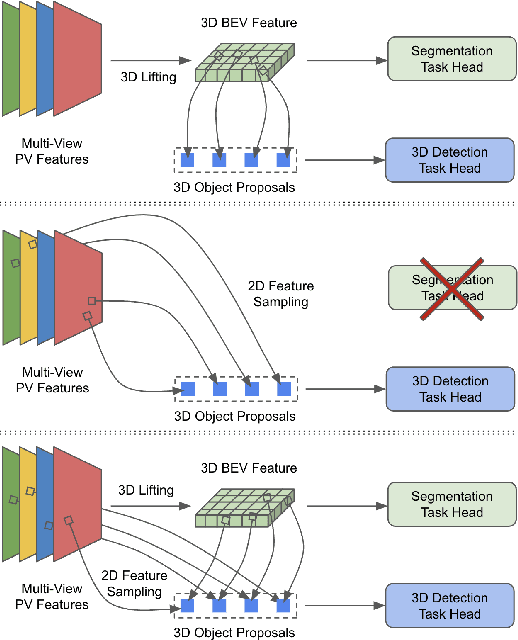
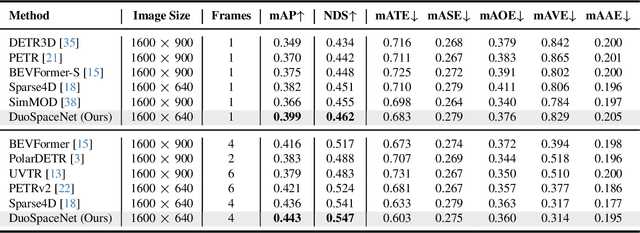


Recent advances in multi-view camera-only 3D object detection either rely on an accurate reconstruction of bird's-eye-view (BEV) 3D features or on traditional 2D perspective view (PV) image features. While both have their own pros and cons, few have found a way to stitch them together in order to benefit from "the best of both worlds". To this end, we explore a duo space (i.e., BEV and PV) 3D perception framework, in conjunction with some useful duo space fusion strategies that allow effective aggregation of the two feature representations. To the best of our knowledge, our proposed method, DuoSpaceNet, is the first to leverage two distinct feature spaces and achieves the state-of-the-art 3D object detection and BEV map segmentation results on nuScenes dataset.
Joint Port Selection and Beamforming Design for Fluid Antenna Assisted Integrated Data and Energy Transfer
Mar 14, 2024
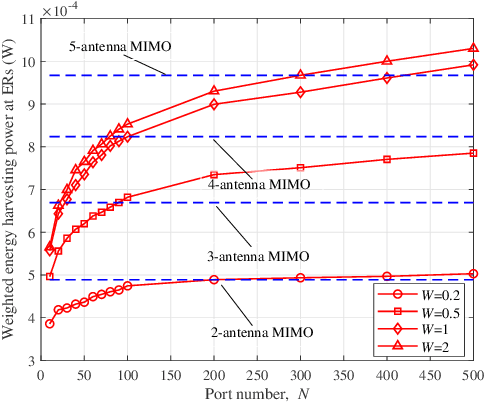
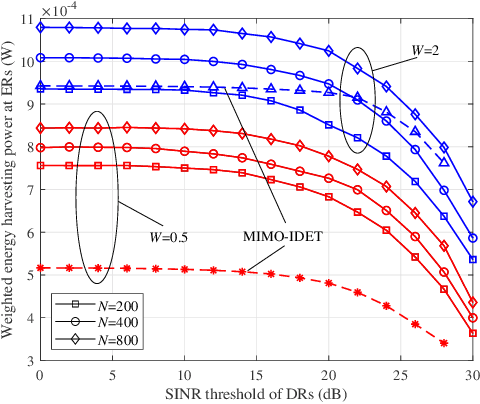
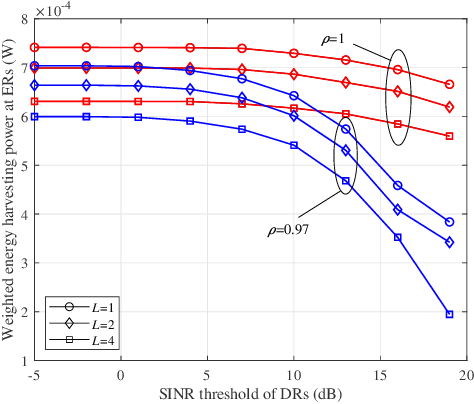
Integrated data and energy transfer (IDET) has been of fundamental importance for providing both wireless data transfer (WDT) and wireless energy transfer (WET) services towards low-power devices. Fluid antenna (FA) is capable of exploiting the huge spatial diversity of the wireless channel to enhance the receive signal strength, which is more suitable for the tiny-size low-power devices having the IDET requirements. In this letter, a multiuser FA assisted IDET system is studied and the weighted energy harvesting power at energy receivers (ERs) is maximized by jointly optimizing the port selection and transmit beamforming design under imperfect channel state information (CSI), while the signal-to-interference-plus-noise ratio (SINR) constraint for each data receiver (DR) is satisfied. An efficient algorithm is proposed to obtain the suboptimal solutions for the non-convex problem. Simulation results evaluate the performance of the FA-IDET system, while also demonstrate that FA outperforms the multi-input-multi-output (MIMO) counterpart in terms of the IDET performance, as long as the port number is large enough.
MGTR: Multi-Granular Transformer for Motion Prediction with LiDAR
Dec 05, 2023Motion prediction has been an essential component of autonomous driving systems since it handles highly uncertain and complex scenarios involving moving agents of different types. In this paper, we propose a Multi-Granular TRansformer (MGTR) framework, an encoder-decoder network that exploits context features in different granularities for different kinds of traffic agents. To further enhance MGTR's capabilities, we leverage LiDAR point cloud data by incorporating LiDAR semantic features from an off-the-shelf LiDAR feature extractor. We evaluate MGTR on Waymo Open Dataset motion prediction benchmark and show that the proposed method achieved state-of-the-art performance, ranking 1st on its leaderboard (https://waymo.com/open/challenges/2023/motion-prediction/).