 Add to Chrome
 Add to Firefox
 Add to Edge
Look Before You Edit: Attention-Guided Camera Placement and Multi-View Alignment for 3D Gaussian Splatting Editing
Jul 22, 2026
Text-driven 3D scene editing with 3D Gaussian Splatting (3DGS) typically applies a 2D diffusion editor to views rendered from fixed training cameras, limiting both the spatial coverage of edits and the user's freedom to target specific objects in complex scenes. We present LB-Edit, a framework that addresses two coupled problems: where to place editing cameras for localized edits, and how to make per-view edits agree with one another so that the 3D scene remains consistent after fine-tuning. First, Attention-Guided Editing Camera Placement (ACP) probes the diffusion model's self- and cross-attention at multiple candidate camera distances to find where attention is well-contained in the region of interest, then places a compact, geometrically diverse editing camera set at that attention-optimal distance. Second, Multi-view Attention Alignment (MAA) steers the editor toward the same edit across views along two axes: it aligns appearance by sharing self-attention features via token-level correspondence, and aligns spatial location by lifting cross-attention maps onto the 3D Gaussians as a shared 3D attention field, suppressing both appearance and spatial drift. Experiments on multi-object and single-object scenes show that our method achieves the highest user preference in instruction fidelity, multi-view consistency, and editing locality, using as few as 5 editing views and reducing latency by up to 7x over existing methods.

Per-Stroke Temporal Control for Text-to-Motion via Action Units and Action-Detection Guidance
Jul 17, 2026Text-to-motion models are competent at the action a prompt names but unreliable at when each stroke lands: four punches alternating left and right rarely return four separable strokes. We introduce typed temporal events called Action Units (AUs) that make the individual stroke -- its body track, action class, time window, and impact timing -- an explicit conditioning signal. We ground a frozen text-to-motion backbone on the AU set through a lightweight gated adapter injecting two streams (per-stroke tokens and a per-frame phase channel), and at inference close residual timing errors with a training-free classifier gradient from a frozen frame-level detector. We measure per-stroke control on StrokeBench, whose prompts specify count, ordering, track, and core-frame placement, paired with an audited stroke corpus. AU grounding markedly raises the rate of correctly placed single strokes over the strongest prior interface, at the best motion quality among text-, interval-, and frame-level baselines. The prompted core frame emerges as a further steerable axis.
Cross-View Yaw Estimation in Location Uncertainty with Line-Aligning Yaw Scoring
Jun 20, 2026Accurate yaw estimation is a bottleneck in cross-view localization between ground view and Bird's Eye View (BEV). Existing methods couple yaw with translation and rely on height or projection assumptions that degrade under large yaw ambiguity. We disentangle yaw from location accuracy and introduce LAYS, a radially invariant line-consensus voting method. By exploiting the radial invariance of our formulation, we achieve sub-degree yaw precision via 3D voting over all candidate poses, while eliminating the need for accurate location. Our key observation is that a ground-image column matched to BEV pixels induces the same yaw across all camera positions along the radial direction of the pixels. LAYS matches BEV pixels to ground columns using feature similarity and accumulates the induced yaw votes into discrete 3D bins, where correct correspondences along the radial line concentrate into a sharp peak for the correct yaw. Experiments on Mapillary, Ford, KITTI, and VIGOR show significant gains under unknown yaw, particularly for normal FoV with unknown yaw (+28$\sim$45\%p), and using LAYS as a yaw prior improves downstream 3-DoF localization.
MobiFuse: A High-Precision On-device Depth Perception System with Multi-Data Fusion
Dec 18, 2024

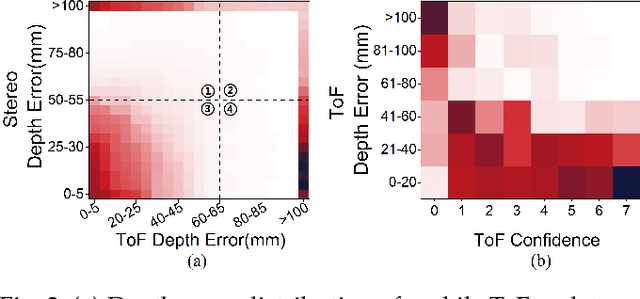
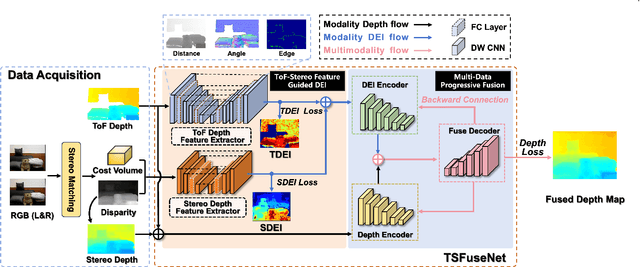
We present MobiFuse, a high-precision depth perception system on mobile devices that combines dual RGB and Time-of-Flight (ToF) cameras. To achieve this, we leverage physical principles from various environmental factors to propose the Depth Error Indication (DEI) modality, characterizing the depth error of ToF and stereo-matching. Furthermore, we employ a progressive fusion strategy, merging geometric features from ToF and stereo depth maps with depth error features from the DEI modality to create precise depth maps. Additionally, we create a new ToF-Stereo depth dataset, RealToF, to train and validate our model. Our experiments demonstrate that MobiFuse excels over baselines by significantly reducing depth measurement errors by up to 77.7%. It also showcases strong generalization across diverse datasets and proves effectiveness in two downstream tasks: 3D reconstruction and 3D segmentation. The demo video of MobiFuse in real-life scenarios is available at the de-identified YouTube link(https://youtu.be/jy-Sp7T1LVs).
Sign Gradient Descent-based Neuronal Dynamics: ANN-to-SNN Conversion Beyond ReLU Network
Jul 01, 2024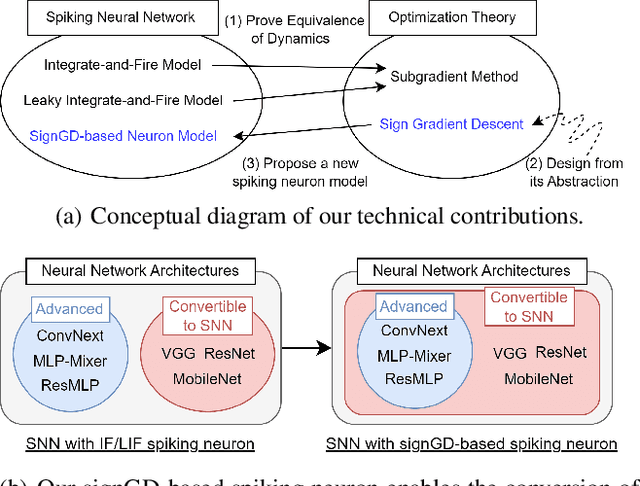
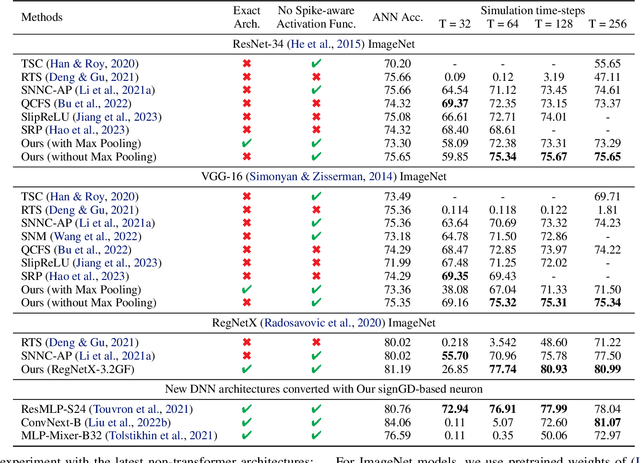

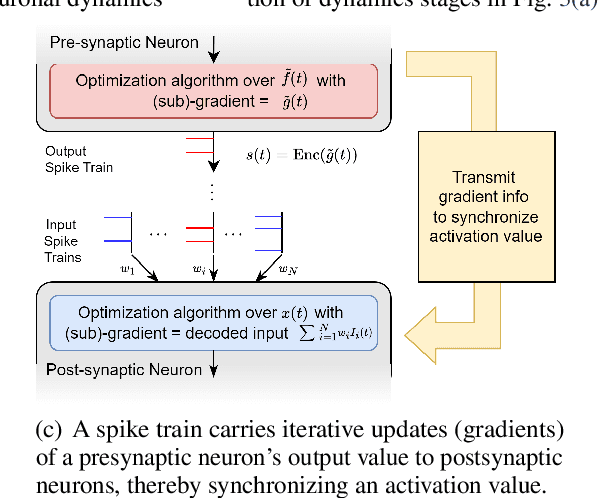
Spiking neural network (SNN) is studied in multidisciplinary domains to (i) enable order-of-magnitudes energy-efficient AI inference and (ii) computationally simulate neuro-scientific mechanisms. The lack of discrete theory obstructs the practical application of SNN by limiting its performance and nonlinearity support. We present a new optimization-theoretic perspective of the discrete dynamics of spiking neurons. We prove that a discrete dynamical system of simple integrate-and-fire models approximates the sub-gradient method over unconstrained optimization problems. We practically extend our theory to introduce a novel sign gradient descent (signGD)-based neuronal dynamics that can (i) approximate diverse nonlinearities beyond ReLU and (ii) advance ANN-to-SNN conversion performance in low time steps. Experiments on large-scale datasets show that our technique achieves (i) state-of-the-art performance in ANN-to-SNN conversion and (ii) is the first to convert new DNN architectures, e.g., ConvNext, MLP-Mixer, and ResMLP. We publicly share our source code at https://github.com/snuhcs/snn_signgd .
Papez: Resource-Efficient Speech Separation with Auditory Working Memory
Jul 01, 2024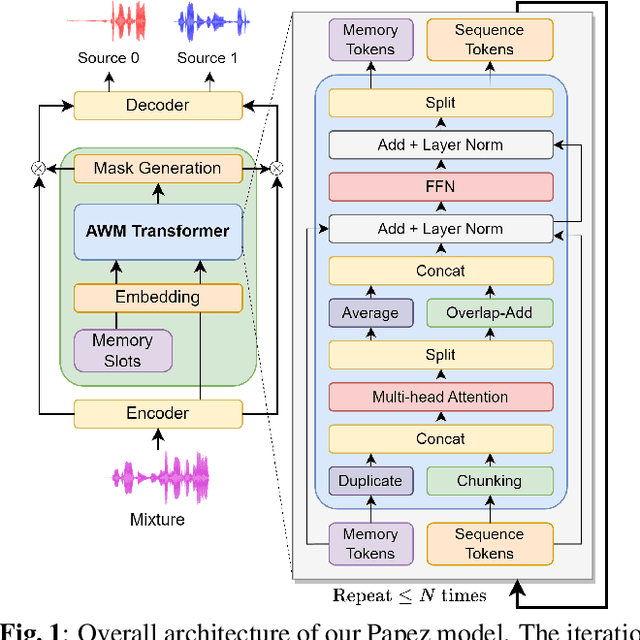
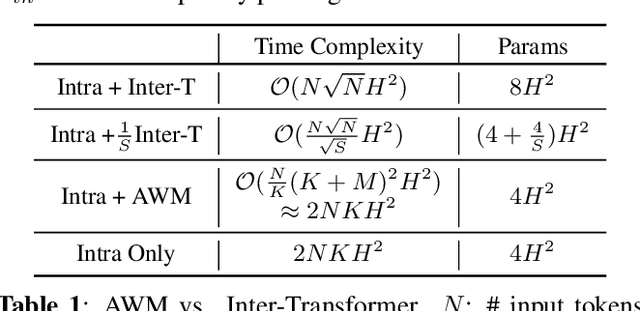
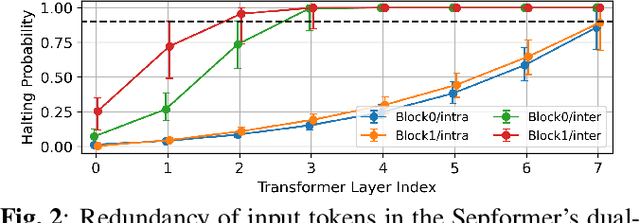
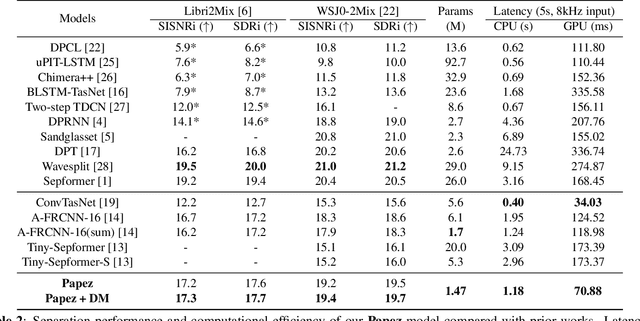
Transformer-based models recently reached state-of-the-art single-channel speech separation accuracy; However, their extreme computational load makes it difficult to deploy them in resource-constrained mobile or IoT devices. We thus present Papez, a lightweight and computation-efficient single-channel speech separation model. Papez is based on three key techniques. We first replace the inter-chunk Transformer with small-sized auditory working memory. Second, we adaptively prune the input tokens that do not need further processing. Finally, we reduce the number of parameters through the recurrent transformer. Our extensive evaluation shows that Papez achieves the best resource and accuracy tradeoffs with a large margin. We publicly share our source code at \texttt{https://github.com/snuhcs/Papez}
Mondrian: On-Device High-Performance Video Analytics with Compressive Packed Inference
Mar 12, 2024In this paper, we present Mondrian, an edge system that enables high-performance object detection on high-resolution video streams. Many lightweight models and system optimization techniques have been proposed for resource-constrained devices, but they do not fully utilize the potential of the accelerators over dynamic, high-resolution videos. To enable such capability, we devise a novel Compressive Packed Inference to minimize per-pixel processing costs by selectively determining the necessary pixels to process and combining them to maximize processing parallelism. In particular, our system quickly extracts ROIs and dynamically shrinks them, reflecting the effect of the fast-changing characteristics of objects and scenes. It then intelligently combines such scaled ROIs into large canvases to maximize the utilization of inference accelerators such as GPU. Evaluation across various datasets, models, and devices shows Mondrian outperforms state-of-the-art baselines (e.g., input rescaling, ROI extractions, ROI extractions+batching) by 15.0-19.7% higher accuracy, leading to $\times$6.65 higher throughput than frame-wise inference for processing various 1080p video streams. We will release the code after the paper review.
Attention-Propagation Network for Egocentric Heatmap to 3D Pose Lifting
Feb 28, 2024We present EgoTAP, a heatmap-to-3D pose lifting method for highly accurate stereo egocentric 3D pose estimation. Severe self-occlusion and out-of-view limbs in egocentric camera views make accurate pose estimation a challenging problem. To address the challenge, prior methods employ joint heatmaps-probabilistic 2D representations of the body pose, but heatmap-to-3D pose conversion still remains an inaccurate process. We propose a novel heatmap-to-3D lifting method composed of the Grid ViT Encoder and the Propagation Network. The Grid ViT Encoder summarizes joint heatmaps into effective feature embedding using self-attention. Then, the Propagation Network estimates the 3D pose by utilizing skeletal information to better estimate the position of obscure joints. Our method significantly outperforms the previous state-of-the-art qualitatively and quantitatively demonstrated by a 23.9\% reduction of error in an MPJPE metric. Our source code is available in GitHub.
Ego3DPose: Capturing 3D Cues from Binocular Egocentric Views
Sep 21, 2023We present Ego3DPose, a highly accurate binocular egocentric 3D pose reconstruction system. The binocular egocentric setup offers practicality and usefulness in various applications, however, it remains largely under-explored. It has been suffering from low pose estimation accuracy due to viewing distortion, severe self-occlusion, and limited field-of-view of the joints in egocentric 2D images. Here, we notice that two important 3D cues, stereo correspondences, and perspective, contained in the egocentric binocular input are neglected. Current methods heavily rely on 2D image features, implicitly learning 3D information, which introduces biases towards commonly observed motions and leads to low overall accuracy. We observe that they not only fail in challenging occlusion cases but also in estimating visible joint positions. To address these challenges, we propose two novel approaches. First, we design a two-path network architecture with a path that estimates pose per limb independently with its binocular heatmaps. Without full-body information provided, it alleviates bias toward trained full-body distribution. Second, we leverage the egocentric view of body limbs, which exhibits strong perspective variance (e.g., a significantly large-size hand when it is close to the camera). We propose a new perspective-aware representation using trigonometry, enabling the network to estimate the 3D orientation of limbs. Finally, we develop an end-to-end pose reconstruction network that synergizes both techniques. Our comprehensive evaluations demonstrate that Ego3DPose outperforms state-of-the-art models by a pose estimation error (i.e., MPJPE) reduction of 23.1% in the UnrealEgo dataset. Our qualitative results highlight the superiority of our approach across a range of scenarios and challenges.
On the Importance of Critical Period in Multi-stage Reinforcement Learning
Aug 09, 2022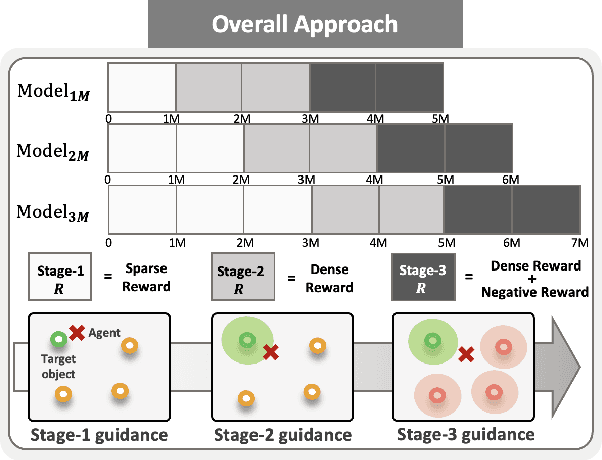
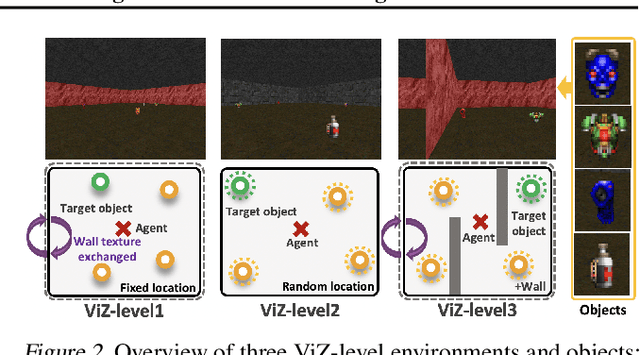
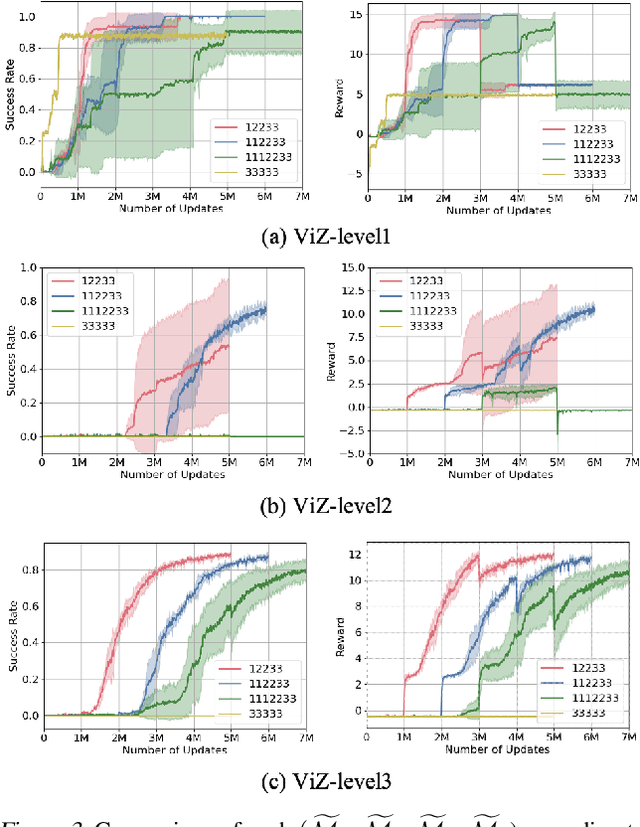
The initial years of an infant's life are known as the critical period, during which the overall development of learning performance is significantly impacted due to neural plasticity. In recent studies, an AI agent, with a deep neural network mimicking mechanisms of actual neurons, exhibited a learning period similar to human's critical period. Especially during this initial period, the appropriate stimuli play a vital role in developing learning ability. However, transforming human cognitive bias into an appropriate shaping reward is quite challenging, and prior works on critical period do not focus on finding the appropriate stimulus. To take a step further, we propose multi-stage reinforcement learning to emphasize finding ``appropriate stimulus" around the critical period. Inspired by humans' early cognitive-developmental stage, we use multi-stage guidance near the critical period, and demonstrate the appropriate shaping reward (stage-2 guidance) in terms of the AI agent's performance, efficiency, and stability.