 Add to Chrome
 Add to Firefox
 Add to Edge
Once for Both: Single Stage of Importance and Sparsity Search for Vision Transformer Compression
Mar 23, 2024
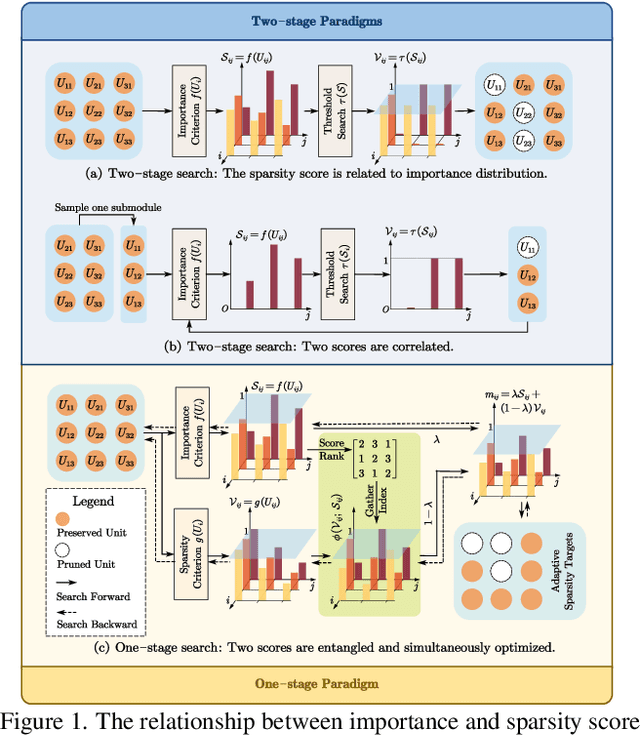

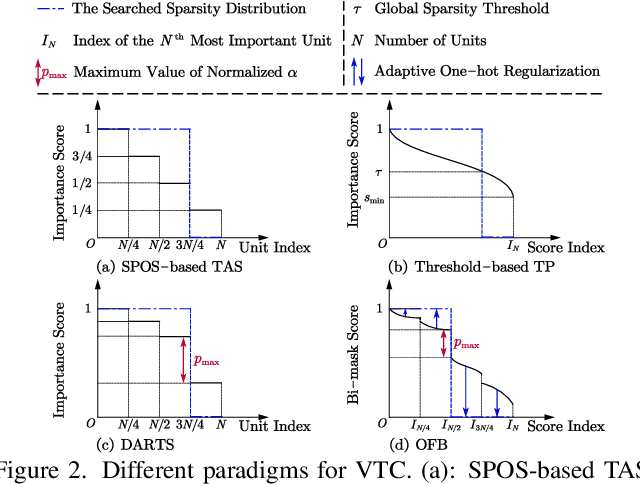
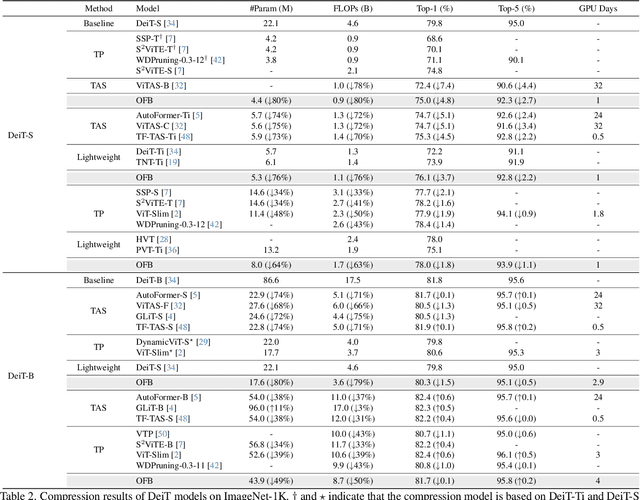
Recent Vision Transformer Compression (VTC) works mainly follow a two-stage scheme, where the importance score of each model unit is first evaluated or preset in each submodule, followed by the sparsity score evaluation according to the target sparsity constraint. Such a separate evaluation process induces the gap between importance and sparsity score distributions, thus causing high search costs for VTC. In this work, for the first time, we investigate how to integrate the evaluations of importance and sparsity scores into a single stage, searching the optimal subnets in an efficient manner. Specifically, we present OFB, a cost-efficient approach that simultaneously evaluates both importance and sparsity scores, termed Once for Both (OFB), for VTC. First, a bi-mask scheme is developed by entangling the importance score and the differentiable sparsity score to jointly determine the pruning potential (prunability) of each unit. Such a bi-mask search strategy is further used together with a proposed adaptive one-hot loss to realize the progressive-and-efficient search for the most important subnet. Finally, Progressive Masked Image Modeling (PMIM) is proposed to regularize the feature space to be more representative during the search process, which may be degraded by the dimension reduction. Extensive experiments demonstrate that OFB can achieve superior compression performance over state-of-the-art searching-based and pruning-based methods under various Vision Transformer architectures, meanwhile promoting search efficiency significantly, e.g., costing one GPU search day for the compression of DeiT-S on ImageNet-1K.

Chain-of-Spot: Interactive Reasoning Improves Large Vision-Language Models
Mar 21, 2024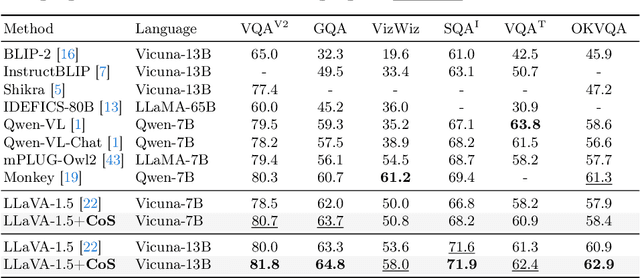
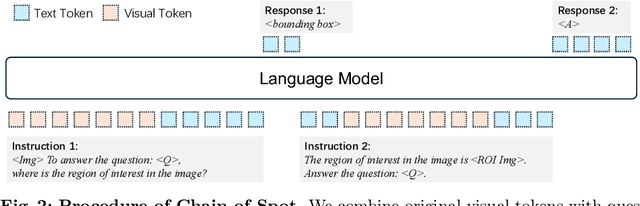
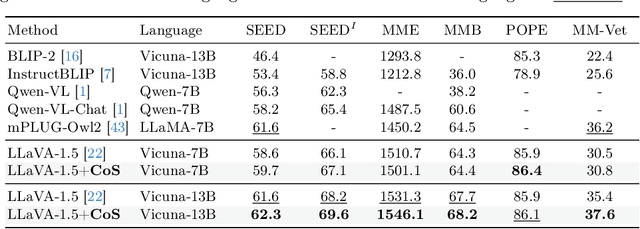
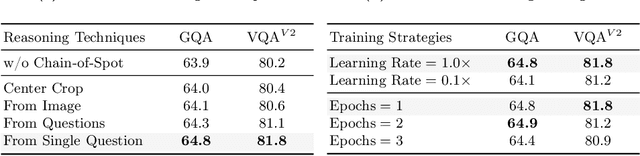
In the realm of vision-language understanding, the proficiency of models in interpreting and reasoning over visual content has become a cornerstone for numerous applications. However, it is challenging for the visual encoder in Large Vision-Language Models (LVLMs) to extract useful features tailored to questions that aid the language model's response. Furthermore, a common practice among existing LVLMs is to utilize lower-resolution images, which restricts the ability for visual recognition. Our work introduces the Chain-of-Spot (CoS) method, which we describe as Interactive Reasoning, a novel approach that enhances feature extraction by focusing on key regions of interest (ROI) within the image, corresponding to the posed questions or instructions. This technique allows LVLMs to access more detailed visual information without altering the original image resolution, thereby offering multi-granularity image features. By integrating Chain-of-Spot with instruct-following LLaVA-1.5 models, the process of image reasoning consistently improves performance across a wide range of multimodal datasets and benchmarks without bells and whistles and achieves new state-of-the-art results. Our empirical findings demonstrate a significant improvement in LVLMs' ability to understand and reason about visual content, paving the way for more sophisticated visual instruction-following applications. Code and models are available at https://github.com/dongyh20/Chain-of-Spot
Learning Dual-Level Deformable Implicit Representation for Real-World Scale Arbitrary Super-Resolution
Mar 16, 2024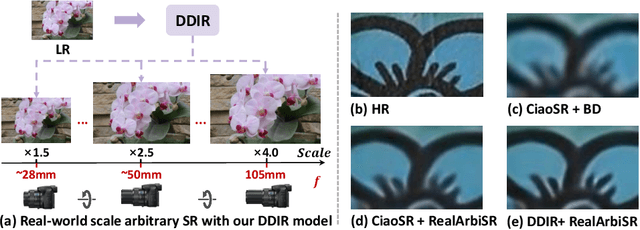
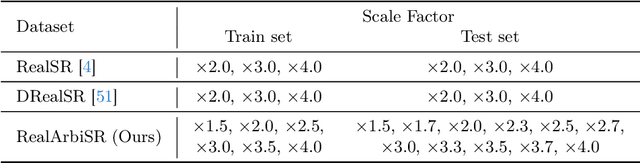
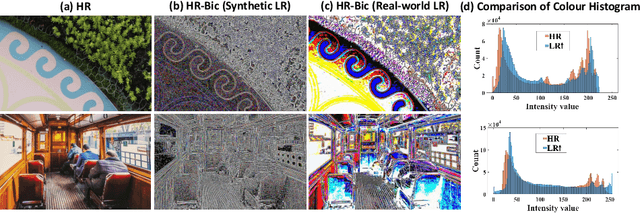
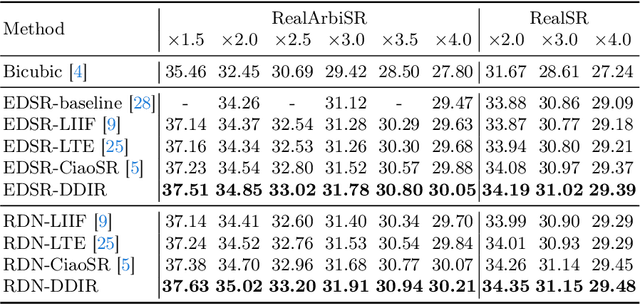
Scale arbitrary super-resolution based on implicit image function gains increasing popularity since it can better represent the visual world in a continuous manner. However, existing scale arbitrary works are trained and evaluated on simulated datasets, where low-resolution images are generated from their ground truths by the simplest bicubic downsampling. These models exhibit limited generalization to real-world scenarios due to the greater complexity of real-world degradations. To address this issue, we build a RealArbiSR dataset, a new real-world super-resolution benchmark with both integer and non-integer scaling factors for the training and evaluation of real-world scale arbitrary super-resolution. Moreover, we propose a Dual-level Deformable Implicit Representation (DDIR) to solve real-world scale arbitrary super-resolution. Specifically, we design the appearance embedding and deformation field to handle both image-level and pixel-level deformations caused by real-world degradations. The appearance embedding models the characteristics of low-resolution inputs to deal with photometric variations at different scales, and the pixel-based deformation field learns RGB differences which result from the deviations between the real-world and simulated degradations at arbitrary coordinates. Extensive experiments show our trained model achieves state-of-the-art performance on the RealArbiSR and RealSR benchmarks for real-world scale arbitrary super-resolution. Our dataset as well as source code will be publicly available.
ManiGaussian: Dynamic Gaussian Splatting for Multi-task Robotic Manipulation
Mar 13, 2024Performing language-conditioned robotic manipulation tasks in unstructured environments is highly demanded for general intelligent robots. Conventional robotic manipulation methods usually learn semantic representation of the observation for action prediction, which ignores the scene-level spatiotemporal dynamics for human goal completion. In this paper, we propose a dynamic Gaussian Splatting method named ManiGaussian for multi-task robotic manipulation, which mines scene dynamics via future scene reconstruction. Specifically, we first formulate the dynamic Gaussian Splatting framework that infers the semantics propagation in the Gaussian embedding space, where the semantic representation is leveraged to predict the optimal robot action. Then, we build a Gaussian world model to parameterize the distribution in our dynamic Gaussian Splatting framework, which provides informative supervision in the interactive environment via future scene reconstruction. We evaluate our ManiGaussian on 10 RLBench tasks with 166 variations, and the results demonstrate our framework can outperform the state-of-the-art methods by 13.1\% in average success rate.
Memory-based Adapters for Online 3D Scene Perception
Mar 11, 2024In this paper, we propose a new framework for online 3D scene perception. Conventional 3D scene perception methods are offline, i.e., take an already reconstructed 3D scene geometry as input, which is not applicable in robotic applications where the input data is streaming RGB-D videos rather than a complete 3D scene reconstructed from pre-collected RGB-D videos. To deal with online 3D scene perception tasks where data collection and perception should be performed simultaneously, the model should be able to process 3D scenes frame by frame and make use of the temporal information. To this end, we propose an adapter-based plug-and-play module for the backbone of 3D scene perception model, which constructs memory to cache and aggregate the extracted RGB-D features to empower offline models with temporal learning ability. Specifically, we propose a queued memory mechanism to cache the supporting point cloud and image features. Then we devise aggregation modules which directly perform on the memory and pass temporal information to current frame. We further propose 3D-to-2D adapter to enhance image features with strong global context. Our adapters can be easily inserted into mainstream offline architectures of different tasks and significantly boost their performance on online tasks. Extensive experiments on ScanNet and SceneNN datasets demonstrate our approach achieves leading performance on three 3D scene perception tasks compared with state-of-the-art online methods by simply finetuning existing offline models, without any model and task-specific designs. \href{https://xuxw98.github.io/Online3D/}{Project page}.
MADTP: Multimodal Alignment-Guided Dynamic Token Pruning for Accelerating Vision-Language Transformer
Mar 05, 2024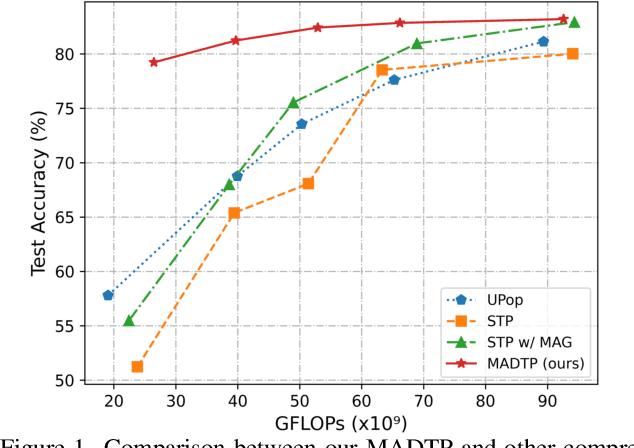
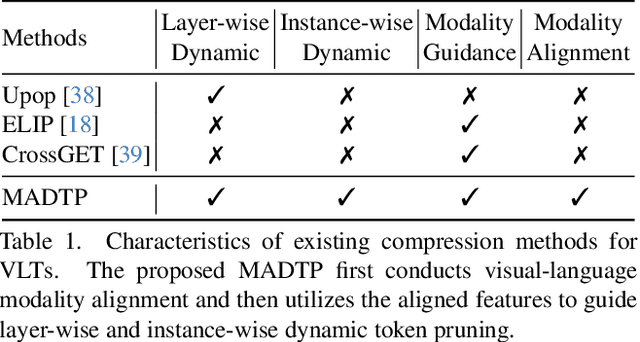
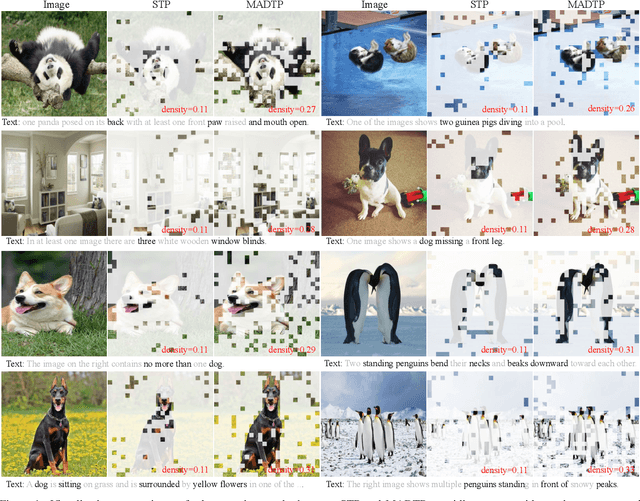
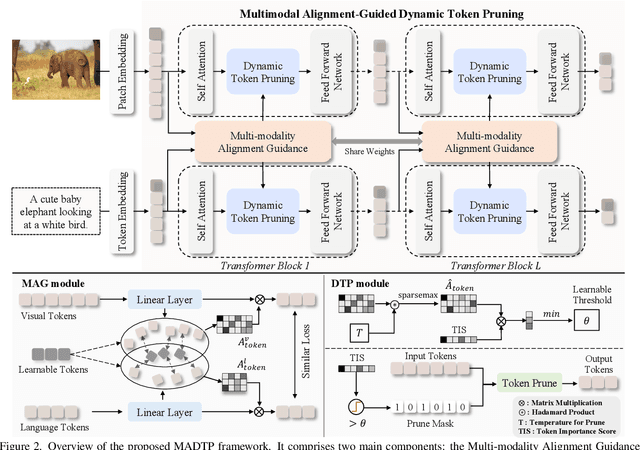
Vision-Language Transformers (VLTs) have shown great success recently, but are meanwhile accompanied by heavy computation costs, where a major reason can be attributed to the large number of visual and language tokens. Existing token pruning research for compressing VLTs mainly follows a single-modality-based scheme yet ignores the critical role of aligning different modalities for guiding the token pruning process, causing the important tokens for one modality to be falsely pruned in another modality branch. Meanwhile, existing VLT pruning works also lack the flexibility to dynamically compress each layer based on different input samples. To this end, we propose a novel framework named Multimodal Alignment-Guided Dynamic Token Pruning (MADTP) for accelerating various VLTs. Specifically, we first introduce a well-designed Multi-modality Alignment Guidance (MAG) module that can align features of the same semantic concept from different modalities, to ensure the pruned tokens are less important for all modalities. We further design a novel Dynamic Token Pruning (DTP) module, which can adaptively adjust the token compression ratio in each layer based on different input instances. Extensive experiments on various benchmarks demonstrate that MADTP significantly reduces the computational complexity of kinds of multimodal models while preserving competitive performance. Notably, when applied to the BLIP model in the NLVR2 dataset, MADTP can reduce the GFLOPs by 80% with less than 4% performance degradation.
* 19 pages, 9 figures, Published in CVPR2024
Path Choice Matters for Clear Attribution in Path Methods
Jan 19, 2024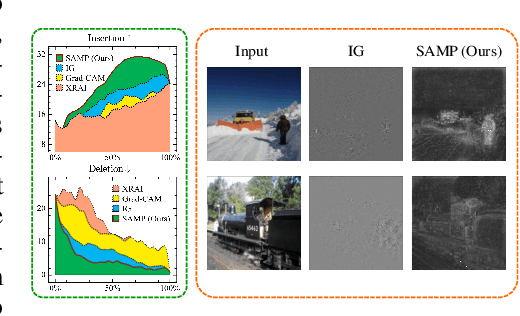
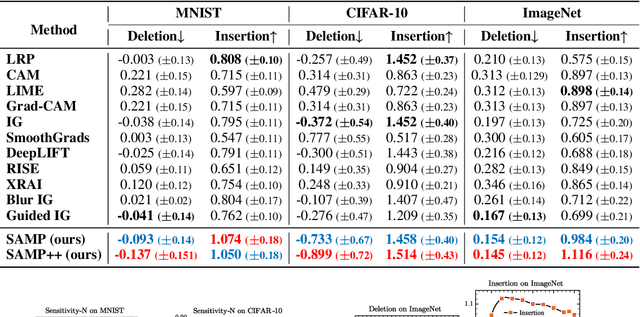
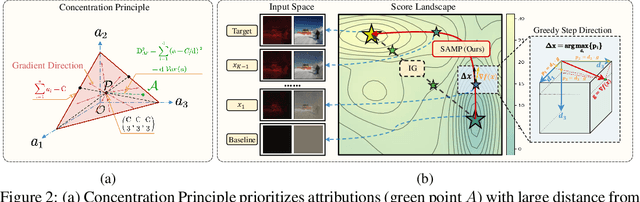
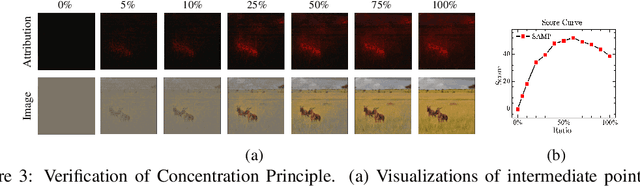
Rigorousness and clarity are both essential for interpretations of DNNs to engender human trust. Path methods are commonly employed to generate rigorous attributions that satisfy three axioms. However, the meaning of attributions remains ambiguous due to distinct path choices. To address the ambiguity, we introduce \textbf{Concentration Principle}, which centrally allocates high attributions to indispensable features, thereby endowing aesthetic and sparsity. We then present \textbf{SAMP}, a model-agnostic interpreter, which efficiently searches the near-optimal path from a pre-defined set of manipulation paths. Moreover, we propose the infinitesimal constraint (IC) and momentum strategy (MS) to improve the rigorousness and optimality. Visualizations show that SAMP can precisely reveal DNNs by pinpointing salient image pixels. We also perform quantitative experiments and observe that our method significantly outperforms the counterparts. Code: https://github.com/zbr17/SAMP.
WorldDreamer: Towards General World Models for Video Generation via Predicting Masked Tokens
Jan 18, 2024World models play a crucial role in understanding and predicting the dynamics of the world, which is essential for video generation. However, existing world models are confined to specific scenarios such as gaming or driving, limiting their ability to capture the complexity of general world dynamic environments. Therefore, we introduce WorldDreamer, a pioneering world model to foster a comprehensive comprehension of general world physics and motions, which significantly enhances the capabilities of video generation. Drawing inspiration from the success of large language models, WorldDreamer frames world modeling as an unsupervised visual sequence modeling challenge. This is achieved by mapping visual inputs to discrete tokens and predicting the masked ones. During this process, we incorporate multi-modal prompts to facilitate interaction within the world model. Our experiments show that WorldDreamer excels in generating videos across different scenarios, including natural scenes and driving environments. WorldDreamer showcases versatility in executing tasks such as text-to-video conversion, image-tovideo synthesis, and video editing. These results underscore WorldDreamer's effectiveness in capturing dynamic elements within diverse general world environments.
OccNeRF: Self-Supervised Multi-Camera Occupancy Prediction with Neural Radiance Fields
Dec 14, 2023


As a fundamental task of vision-based perception, 3D occupancy prediction reconstructs 3D structures of surrounding environments. It provides detailed information for autonomous driving planning and navigation. However, most existing methods heavily rely on the LiDAR point clouds to generate occupancy ground truth, which is not available in the vision-based system. In this paper, we propose an OccNeRF method for self-supervised multi-camera occupancy prediction. Different from bounded 3D occupancy labels, we need to consider unbounded scenes with raw image supervision. To solve the issue, we parameterize the reconstructed occupancy fields and reorganize the sampling strategy. The neural rendering is adopted to convert occupancy fields to multi-camera depth maps, supervised by multi-frame photometric consistency. Moreover, for semantic occupancy prediction, we design several strategies to polish the prompts and filter the outputs of a pretrained open-vocabulary 2D segmentation model. Extensive experiments for both self-supervised depth estimation and semantic occupancy prediction tasks on nuScenes dataset demonstrate the effectiveness of our method.
ThinkBot: Embodied Instruction Following with Thought Chain Reasoning
Dec 14, 2023Embodied Instruction Following (EIF) requires agents to complete human instruction by interacting objects in complicated surrounding environments. Conventional methods directly consider the sparse human instruction to generate action plans for agents, which usually fail to achieve human goals because of the instruction incoherence in action descriptions. On the contrary, we propose ThinkBot that reasons the thought chain in human instruction to recover the missing action descriptions, so that the agent can successfully complete human goals by following the coherent instruction. Specifically, we first design an instruction completer based on large language models to recover the missing actions with interacted objects between consecutive human instruction, where the perceived surrounding environments and the completed sub-goals are considered for instruction completion. Based on the partially observed scene semantic maps, we present an object localizer to infer the position of interacted objects for agents to achieve complex human goals. Extensive experiments in the simulated environment show that our ThinkBot outperforms the state-of-the-art EIF methods by a sizable margin in both success rate and execution efficiency.