 Add to Chrome
 Add to Firefox
 Add to Edge
Advantage-Guided Gate: Reshaping Open-Ended Reasoning for Vision-Based Spatial Intelligence
Aug 08, 2026
Multimodal large language models (MLLMs) have demonstrated significant potential in complex spatial scene understanding and reasoning tasks. However, their open-ended reasoning process is prone to decision errors and error accumulation, leading to instability in answer quality. To address this, we propose an advantage-guided gating framework that dynamically intervenes in and corrects deviations during the reasoning process. Specifically, we model step-by-step reasoning as a finite-horizon decision process and introduce Monte Carlo value evaluation on the reasoning tree to provide intermediate supervision signals. The framework includes Step-Advantage Gate and Trajectory-Advantage Gate, which dynamically select high-value reasoning steps and high-quality complete reasoning trajectories, respectively. During training, we perform supervised learning for the gates using reasoning trees generated via multi-branch sampling, and combine shared-parameter initialization with task-specific heads to achieve cross-task robustness and diversity. During inference, the model greedily selects high-value prefix reasoning steps while choosing the optimal reasoning head based on the problem type, thereby significantly improving the accuracy of the final answer. Furthermore, we constructed the Reasoning-Tree-160k dataset and performed two-stage learning on it. Extensive experiments demonstrate that this advantage-guided gating framework effectively enhances the performance of benchmark MLLMs in visual-based spatial understanding and reasoning tasks. The code is open to the public for research: https://github.com/LingLin-ll/Advantage-Guided-Gate.

MeshTok: Efficient Multi-Scale Tokenization for Scalable PDE Transformers
Jun 03, 2026Conventional patchified Transformers operate on uniform spatial partitions, distributing computational effort evenly across the domain irrespective of local features. This inflexible tokenization scheme is inherently limited in its ability to efficiently represent and process solutions to complex PDEs. To address this, we propose MeshTok, an adaptive mesh refinement (AMR)-inspired tokenization and sequence modeling framework. This method selectively refines spatial regions exhibiting sharp gradients, transient features, or multiscale structures, generating a heterogeneous set of multiscale tokens defined on a fixed simulation grid. These tokens are processed within a unified Transformer sequence, enabling the model to simultaneously capture coarse-grained global context and fine-grained local details without requiring specialized architectural components. Although adaptive refinement moderately increases token count, it promotes a more targeted allocation of computational resources to physically informative regions, which we view as a practical inductive bias rather than a formal optimality guarantee. Experimental evaluations across multiple PDE families and benchmark datasets demonstrate that MeshTok consistently improves the efficiency-accuracy trade-off compared to uniform-grid baselines. This suggests adaptive multiscale tokenization as a scalable and generalizable design principle for neural PDE modeling. Code is available at https://github.com/SCAILab-USTC/MeshTok.
Let There Be Light: Reflection, Refraction and Scattering for Neural Operators
Jun 02, 2026Neural operators learn mappings between infinite-dimensional function spaces and provide a data-driven surrogate modeling paradigm for parametric partial differential equations (PDEs). Existing architectures typically obtain expressivity by parameterizing integral kernels in prescribed transform domains or by applying attention-like interactions over discretized spatial points. While these approaches have achieved substantial progress, they often face a persistent trade-off among physical interpretability, nonlocal spatial communication, mesh scalability, and computational cost. We propose a Light-inspired neural operator(LiNO), an operator-learning architecture whose latent evolution is decomposed into three mechanisms motivated by elementary light transport: reflection, refraction, and scattering. Reflection and refraction act as adaptive pointwise transformations in latent feature space, enabling local feature reorientation and anisotropic modulation, whereas scattering performs input-dependent nonlocal propagation over the physical domain. We first formulate scattering as a normalized pairwise kernel with relative positional bias, and then develop an efficient scattering variant that replaces explicit pairwise interactions with positive-feature global propagation and a local diffusion branch, reducing the dominant spatial complexity from quadratic to linear. This yields a structured neural operator that separates local feature modulation from global spatial communication while retaining a modular and interpretable latent evolution.
Physics-Informed Deformable Gaussian Splatting: Towards Unified Constitutive Laws for Time-Evolving Material Field
Nov 11, 2025Recently, 3D Gaussian Splatting (3DGS), an explicit scene representation technique, has shown significant promise for dynamic novel-view synthesis from monocular video input. However, purely data-driven 3DGS often struggles to capture the diverse physics-driven motion patterns in dynamic scenes. To fill this gap, we propose Physics-Informed Deformable Gaussian Splatting (PIDG), which treats each Gaussian particle as a Lagrangian material point with time-varying constitutive parameters and is supervised by 2D optical flow via motion projection. Specifically, we adopt static-dynamic decoupled 4D decomposed hash encoding to reconstruct geometry and motion efficiently. Subsequently, we impose the Cauchy momentum residual as a physics constraint, enabling independent prediction of each particle's velocity and constitutive stress via a time-evolving material field. Finally, we further supervise data fitting by matching Lagrangian particle flow to camera-compensated optical flow, which accelerates convergence and improves generalization. Experiments on a custom physics-driven dataset as well as on standard synthetic and real-world datasets demonstrate significant gains in physical consistency and monocular dynamic reconstruction quality.
Xinyu AI Search: Enhanced Relevance and Comprehensive Results with Rich Answer Presentations
May 28, 2025Traditional search engines struggle to synthesize fragmented information for complex queries, while generative AI search engines face challenges in relevance, comprehensiveness, and presentation. To address these limitations, we introduce Xinyu AI Search, a novel system that incorporates a query-decomposition graph to dynamically break down complex queries into sub-queries, enabling stepwise retrieval and generation. Our retrieval pipeline enhances diversity through multi-source aggregation and query expansion, while filtering and re-ranking strategies optimize passage relevance. Additionally, Xinyu AI Search introduces a novel approach for fine-grained, precise built-in citation and innovates in result presentation by integrating timeline visualization and textual-visual choreography. Evaluated on recent real-world queries, Xinyu AI Search outperforms eight existing technologies in human assessments, excelling in relevance, comprehensiveness, and insightfulness. Ablation studies validate the necessity of its key sub-modules. Our work presents the first comprehensive framework for generative AI search engines, bridging retrieval, generation, and user-centric presentation.
Physics-informed Temporal Alignment for Auto-regressive PDE Foundation Models
May 16, 2025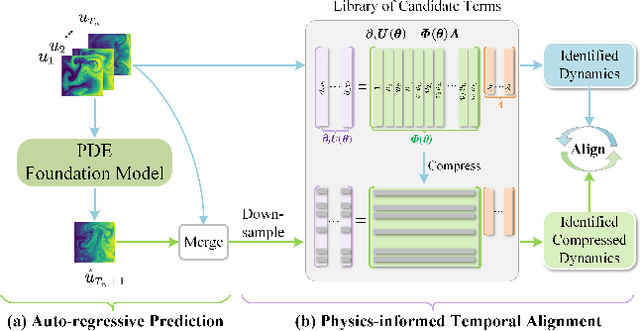
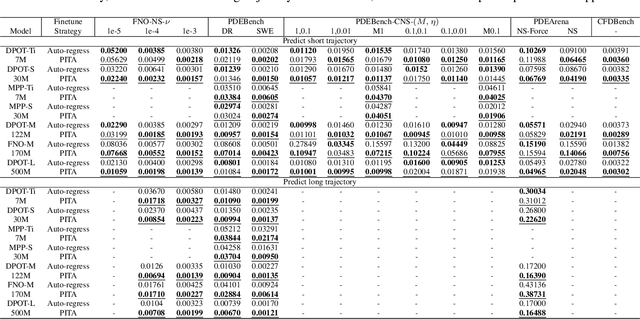
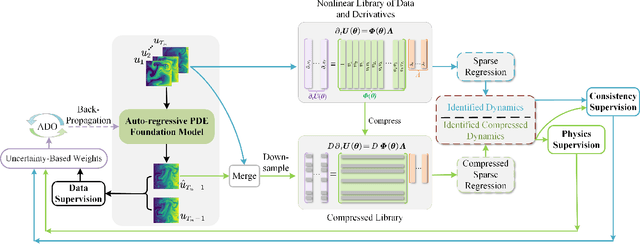
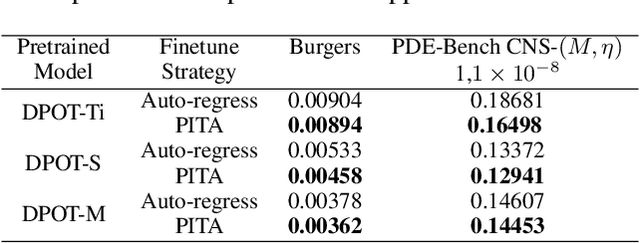
Auto-regressive partial differential equation (PDE) foundation models have shown great potential in handling time-dependent data. However, these models suffer from the shortcut problem deeply rooted in auto-regressive prediction, causing error accumulation. The challenge becomes particularly evident for out-of-distribution data, as the pretraining performance may approach random model initialization for downstream tasks with long-term dynamics. To deal with this problem, we propose physics-informed temporal alignment (PITA), a self-supervised learning framework inspired by inverse problem solving. Specifically, PITA aligns the physical dynamics discovered at different time steps on each given PDE trajectory by integrating physics-informed constraints into the self-supervision signal. The alignment is derived from observation data without relying on known physics priors, indicating strong generalization ability to the out-of-distribution data. Extensive experiments show that PITA significantly enhances the accuracy and robustness of existing foundation models on diverse time-dependent PDE data. The code is available at https://github.com/SCAILab-USTC/PITA.
STSA: Spatial-Temporal Semantic Alignment for Visual Dubbing
Mar 29, 2025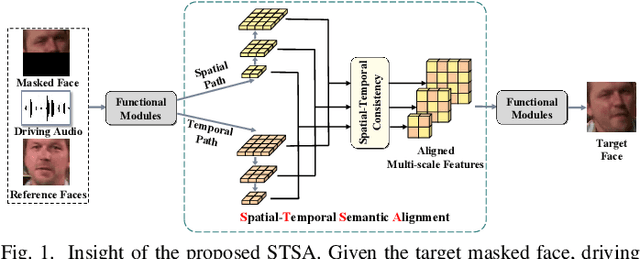
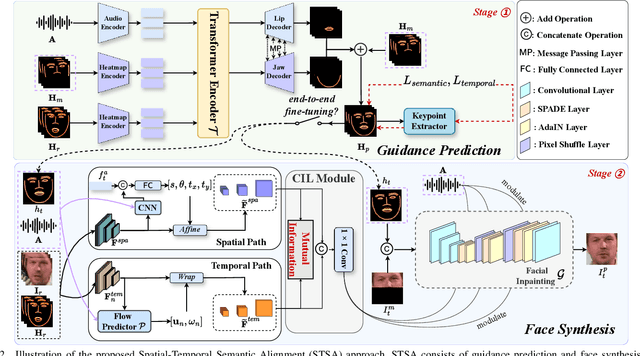
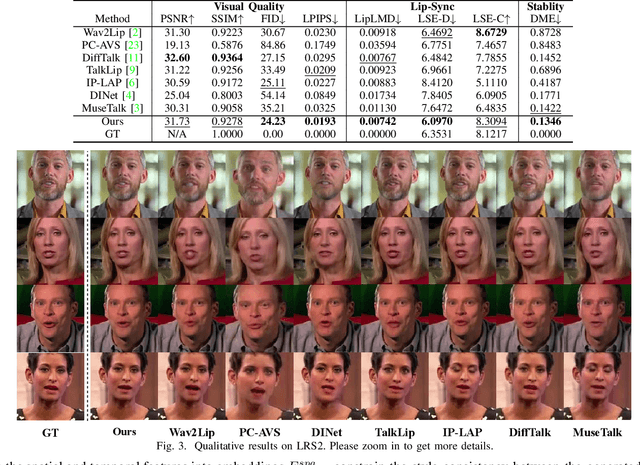
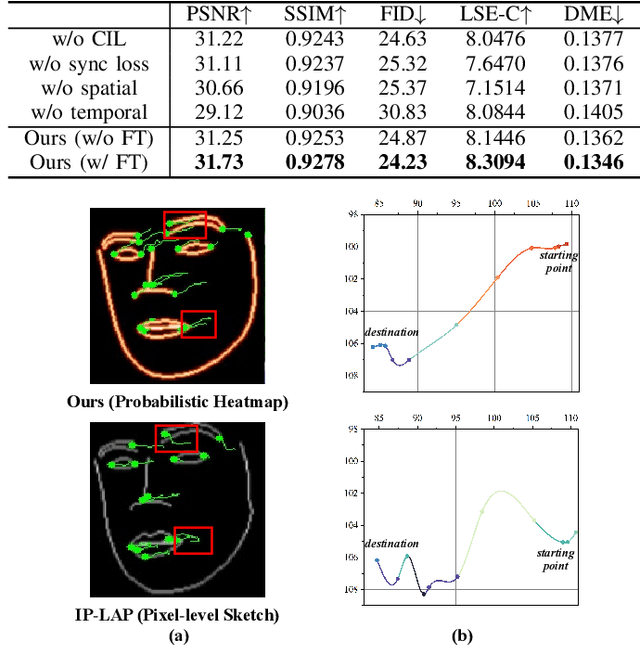
Existing audio-driven visual dubbing methods have achieved great success. Despite this, we observe that the semantic ambiguity between spatial and temporal domains significantly degrades the synthesis stability for the dynamic faces. We argue that aligning the semantic features from spatial and temporal domains is a promising approach to stabilizing facial motion. To achieve this, we propose a Spatial-Temporal Semantic Alignment (STSA) method, which introduces a dual-path alignment mechanism and a differentiable semantic representation. The former leverages a Consistent Information Learning (CIL) module to maximize the mutual information at multiple scales, thereby reducing the manifold differences between spatial and temporal domains. The latter utilizes probabilistic heatmap as ambiguity-tolerant guidance to avoid the abnormal dynamics of the synthesized faces caused by slight semantic jittering. Extensive experimental results demonstrate the superiority of the proposed STSA, especially in terms of image quality and synthesis stability. Pre-trained weights and inference code are available at https://github.com/SCAILab-USTC/STSA.
Solving multiscale elliptic problems by sparse radial basis function neural networks
Sep 01, 2023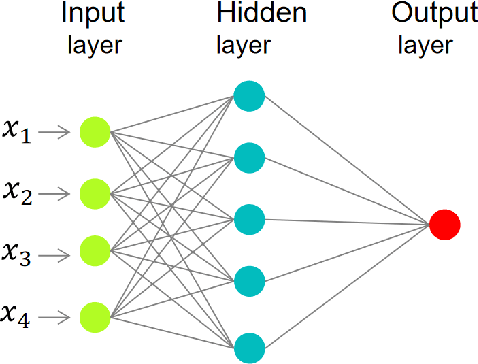
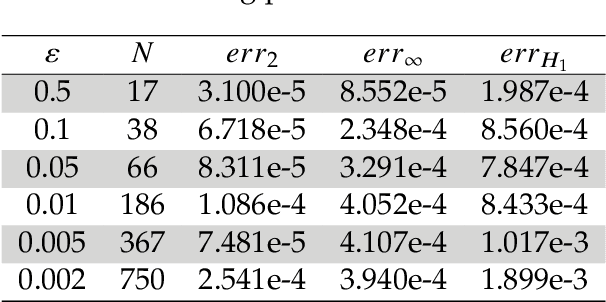
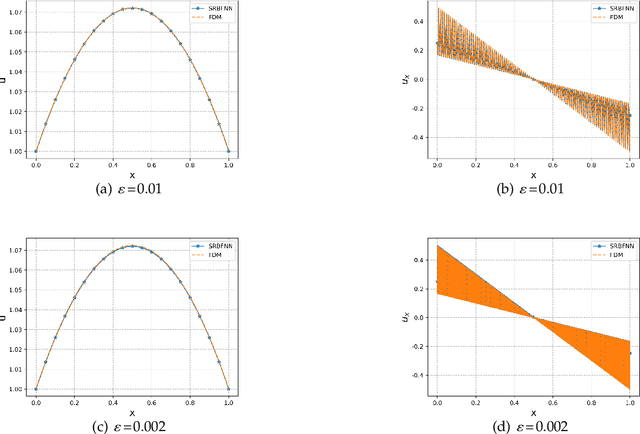

Machine learning has been successfully applied to various fields of scientific computing in recent years. In this work, we propose a sparse radial basis function neural network method to solve elliptic partial differential equations (PDEs) with multiscale coefficients. Inspired by the deep mixed residual method, we rewrite the second-order problem into a first-order system and employ multiple radial basis function neural networks (RBFNNs) to approximate unknown functions in the system. To aviod the overfitting due to the simplicity of RBFNN, an additional regularization is introduced in the loss function. Thus the loss function contains two parts: the $L_2$ loss for the residual of the first-order system and boundary conditions, and the $\ell_1$ regularization term for the weights of radial basis functions (RBFs). An algorithm for optimizing the specific loss function is introduced to accelerate the training process. The accuracy and effectiveness of the proposed method are demonstrated through a collection of multiscale problems with scale separation, discontinuity and multiple scales from one to three dimensions. Notably, the $\ell_1$ regularization can achieve the goal of representing the solution by fewer RBFs. As a consequence, the total number of RBFs scales like $\mathcal{O}(\varepsilon^{-n\tau})$, where $\varepsilon$ is the smallest scale, $n$ is the dimensionality, and $\tau$ is typically smaller than $1$. It is worth mentioning that the proposed method not only has the numerical convergence and thus provides a reliable numerical solution in three dimensions when a classical method is typically not affordable, but also outperforms most other available machine learning methods in terms of accuracy and robustness.
Exploring the Optimal Choice for Generative Processes in Diffusion Models: Ordinary vs Stochastic Differential Equations
Jun 03, 2023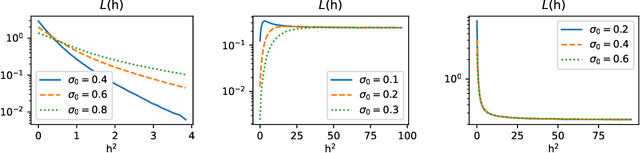

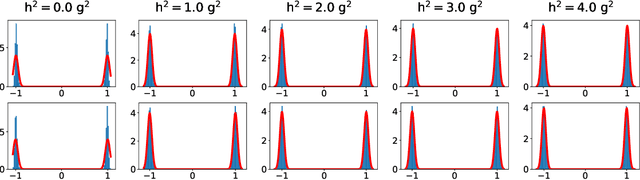
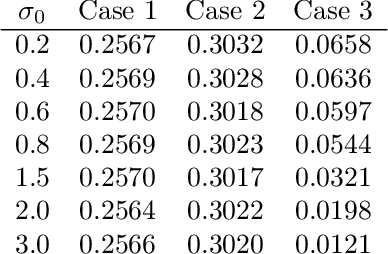
The diffusion model has shown remarkable success in computer vision, but it remains unclear whether ODE-based probability flow or SDE-based diffusion models are superior and under what circumstances. Comparing the two is challenging due to dependencies on data distribution, score training, and other numerical factors. In this paper, we examine the problem mathematically by examining two limiting scenarios: the ODE case and the large diffusion case. We first introduce a pulse-shape error to perturb the score function and analyze error accumulation, with a generalization to arbitrary error. Our findings indicate that when the perturbation occurs at the end of the generative process, the ODE model outperforms the SDE model (with a large diffusion coefficient). However, when the perturbation occurs earlier, the SDE model outperforms the ODE model, and we demonstrate that the error of sample generation due to pulse-shape error can be exponentially suppressed as the diffusion term's magnitude increases to infinity. Numerical validation of this phenomenon is provided using toy models such as Gaussian, Gaussian mixture models, and Swiss roll. Finally, we experiment with MNIST and observe that varying the diffusion coefficient can improve sample quality even when the score function is not well trained.
Quasi-Monte Carlo sampling for machine-learning partial differential equations
Nov 05, 2019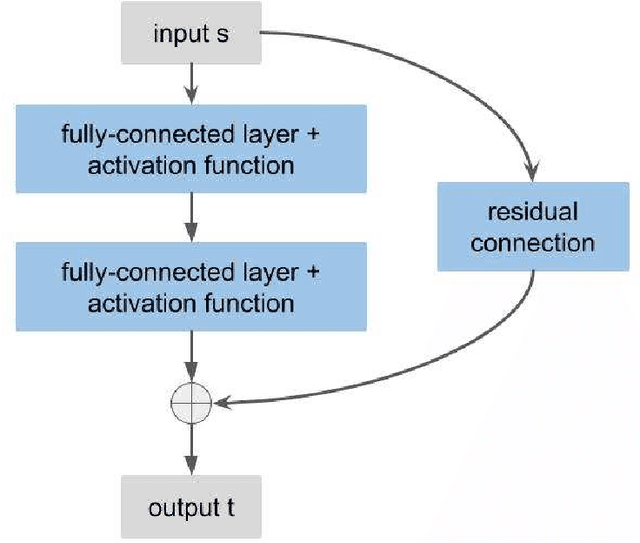
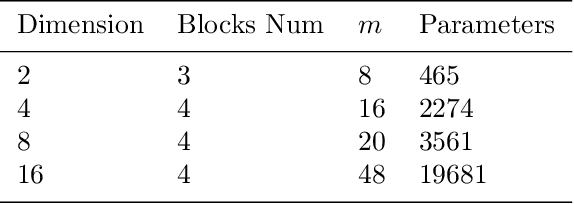
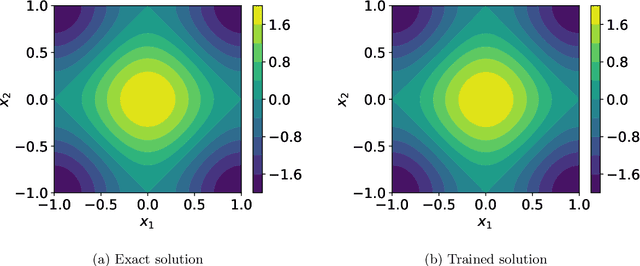
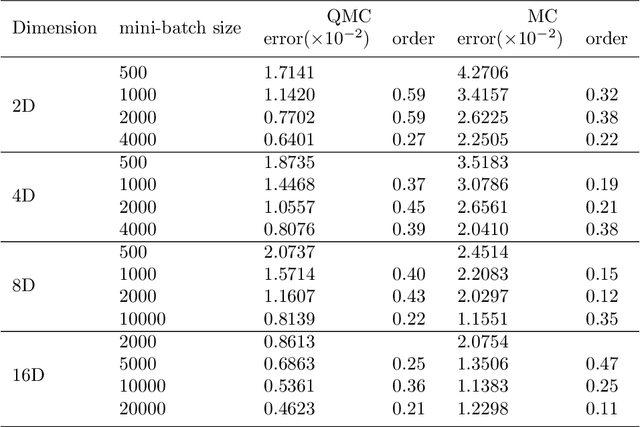
Solving partial differential equations in high dimensions by deep neural network has brought significant attentions in recent years. In many scenarios, the loss function is defined as an integral over a high-dimensional domain. Monte-Carlo method, together with the deep neural network, is used to overcome the curse of dimensionality, while classical methods fail. Often, a deep neural network outperforms classical numerical methods in terms of both accuracy and efficiency. In this paper, we propose to use quasi-Monte Carlo sampling, instead of Monte-Carlo method to approximate the loss function. To demonstrate the idea, we conduct numerical experiments in the framework of deep Ritz method proposed by Weinan E and Bing Yu. For the same accuracy requirement, it is observed that quasi-Monte Carlo sampling reduces the size of training data set by more than two orders of magnitude compared to that of MC method. Under some assumptions, we prove that quasi-Monte Carlo sampling together with the deep neural network generates a convergent series with rate proportional to the approximation accuracy of quasi-Monte Carlo method for numerical integration. Numerically the fitted convergence rate is a bit smaller, but the proposed approach always outperforms Monte Carlo method. It is worth mentioning that the convergence analysis is generic whenever a loss function is approximated by the quasi-Monte Carlo method, although observations here are based on deep Ritz method.