 Add to Chrome
 Add to Firefox
 Add to Edge
Advantage-Guided Gate: Reshaping Open-Ended Reasoning for Vision-Based Spatial Intelligence
Aug 08, 2026
Multimodal large language models (MLLMs) have demonstrated significant potential in complex spatial scene understanding and reasoning tasks. However, their open-ended reasoning process is prone to decision errors and error accumulation, leading to instability in answer quality. To address this, we propose an advantage-guided gating framework that dynamically intervenes in and corrects deviations during the reasoning process. Specifically, we model step-by-step reasoning as a finite-horizon decision process and introduce Monte Carlo value evaluation on the reasoning tree to provide intermediate supervision signals. The framework includes Step-Advantage Gate and Trajectory-Advantage Gate, which dynamically select high-value reasoning steps and high-quality complete reasoning trajectories, respectively. During training, we perform supervised learning for the gates using reasoning trees generated via multi-branch sampling, and combine shared-parameter initialization with task-specific heads to achieve cross-task robustness and diversity. During inference, the model greedily selects high-value prefix reasoning steps while choosing the optimal reasoning head based on the problem type, thereby significantly improving the accuracy of the final answer. Furthermore, we constructed the Reasoning-Tree-160k dataset and performed two-stage learning on it. Extensive experiments demonstrate that this advantage-guided gating framework effectively enhances the performance of benchmark MLLMs in visual-based spatial understanding and reasoning tasks. The code is open to the public for research: https://github.com/LingLin-ll/Advantage-Guided-Gate.

Terraced Compression Method with Automated Threshold Selection for Multidimensional Image Clustering of Heterogeneous Bodies
Apr 03, 2024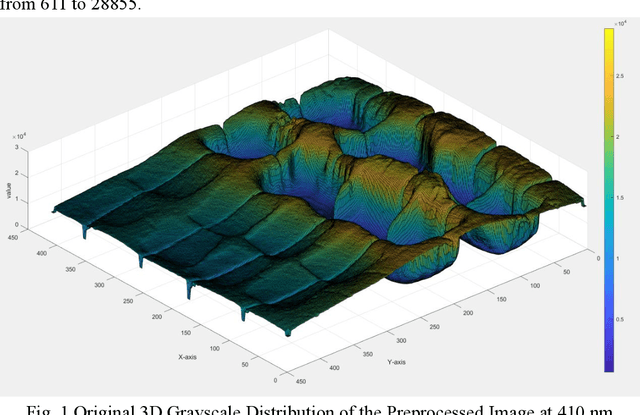
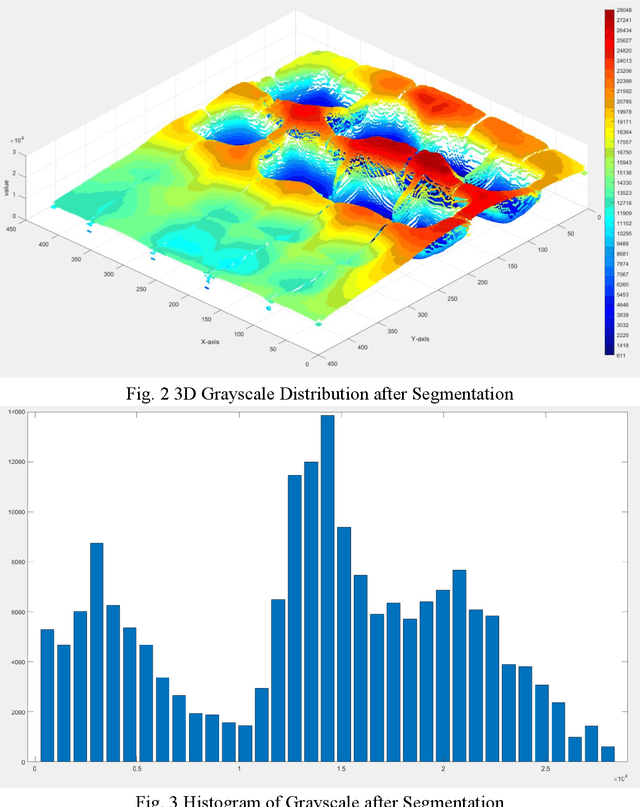
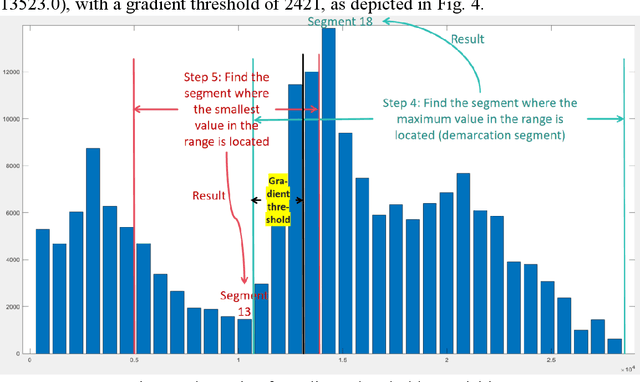
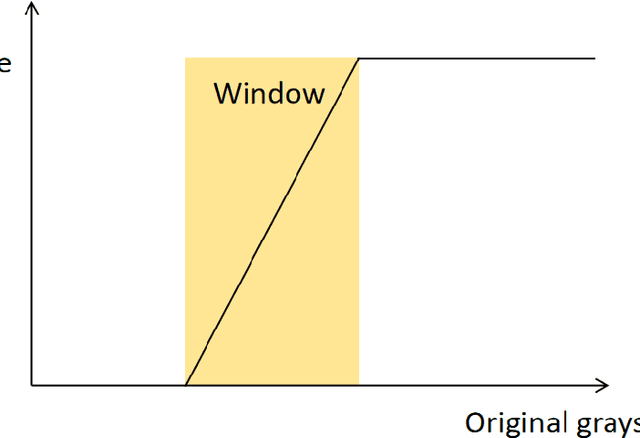
Multispectral transmission imaging provides strong benefits for early breast cancer screening. The frame accumulation method addresses the challenge of low grayscale and signal-to-noise ratio resulting from the strong absorption and scattering of light by breast tissue. This method introduces redundancy in data while improving the grayscale and signal-to-noise ratio of the image. Existing terraced compression algorithms effectively eliminate the data redundancy introduced by frame accumulation but necessitate significant time for manual debugging of threshold values. Hence, this paper proposes an improved terrace compression algorithm. The algorithm necessitates solely the input of the desired heterogeneous body size and autonomously calculates the optimal area threshold and gradient threshold by counting the grayscale and combining its distribution. Experimental acquisition involved multi-wavelength images of heterogeneous bodies exhibiting diverse textures, depths, and thicknesses. Subsequently, the method was applied after pre-processing to determine the thresholds for terraced compression at each wavelength, coupled with a window function for multi-dimensional image clustering. The results illustrate the method's efficacy in detecting and identifying various heterogeneous body types, depths, and thicknesses. This approach is expected to accurately identify the locations and types of breast tumors in the future, thus providing a more dependable tool for early breast cancer screening.
Learn Quasi-stationary Distributions of Finite State Markov Chain
Nov 19, 2021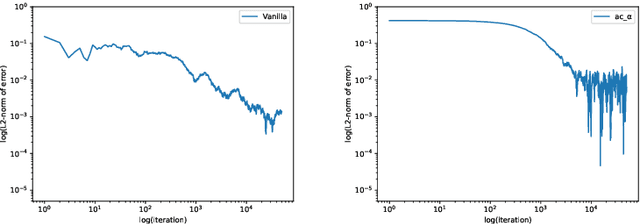
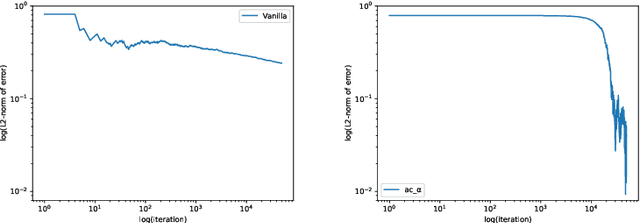
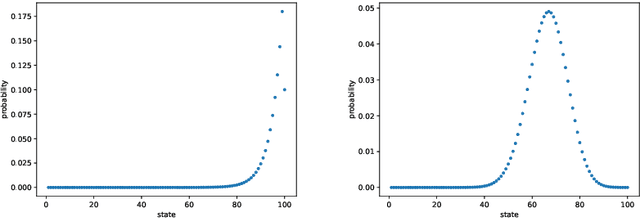
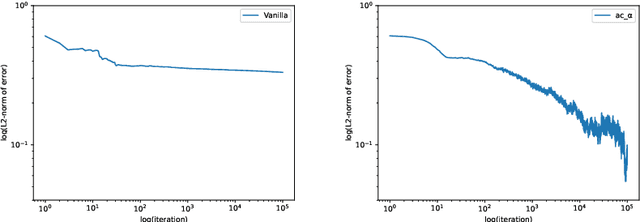
We propose a reinforcement learning (RL) approach to compute the expression of quasi-stationary distribution. Based on the fixed-point formulation of quasi-stationary distribution, we minimize the KL-divergence of two Markovian path distributions induced by the candidate distribution and the true target distribution. To solve this challenging minimization problem by gradient descent, we apply the reinforcement learning technique by introducing the corresponding reward and value functions. We derive the corresponding policy gradient theorem and design an actor-critic algorithm to learn the optimal solution and value function. The numerical examples of finite state Markov chain are tested to demonstrate the new methods
The use of neural networks in the analysis of sleep stages and the diagnosis of narcolepsy
Oct 05, 2017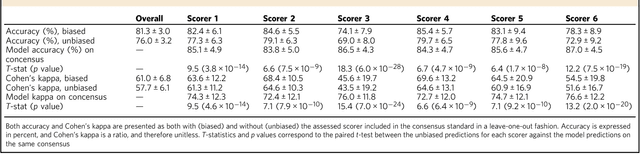
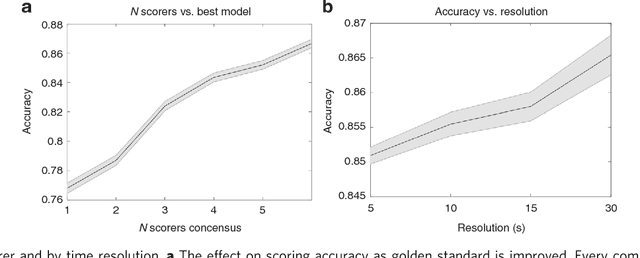

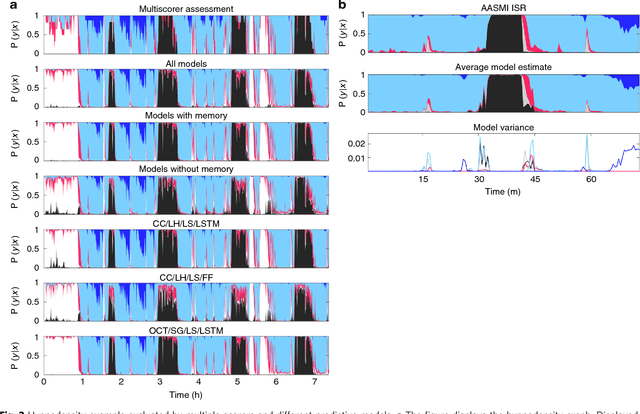
We used neural networks in ~3,000 sleep recordings from over 10 locations to automate sleep stage scoring, producing a probability distribution called an hypnodensity graph. Accuracy was validated in 70 subjects scored by six technicians (gold standard). Our best model performed better than any individual scorer, reaching an accuracy of 0.87 (and 0.95 when predictions are weighed by scorer agreement). It also scores sleep stages down to 5-second instead of the conventional 30-second scoring-epochs. Accuracy did not vary by sleep disorder except for narcolepsy, suggesting scoring difficulties by machine and/or humans. A narcolepsy biomarker was extracted and validated in 105 type-1 narcoleptics versus 331 controls producing a specificity of 0.96 and a sensitivity of 0.91. Similar performances were obtained against a high pretest probability sample of type-2 narcolepsy and idiopathic hypersomnia patients. Addition of HLA-DQB1*06:02 increased specificity to 0.99. Our method streamlines scoring and diagnoses narcolepsy accurately.