 Add to Chrome
 Add to Firefox
 Add to Edge
Multi-Aspect Knowledge Distillation for Language Model with Low-rank Factorization
Apr 03, 2026
Knowledge distillation is an effective technique for pre-trained language model compression. However, existing methods only focus on the knowledge distribution among layers, which may cause the loss of fine-grained information in the alignment process. To address this issue, we introduce the Multi-aspect Knowledge Distillation (MaKD) method, which mimics the self-attention and feed-forward modules in greater depth to capture rich language knowledge information at different aspects. Experimental results demonstrate that MaKD can achieve competitive performance compared with various strong baselines with the same storage parameter budget. In addition, our method also performs well in distilling auto-regressive architecture models.

DoRA: Enhancing Parameter-Efficient Fine-Tuning with Dynamic Rank Distribution
May 28, 2024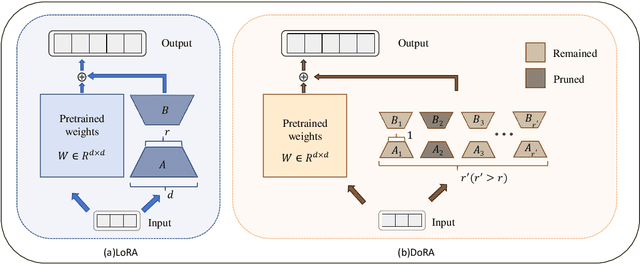

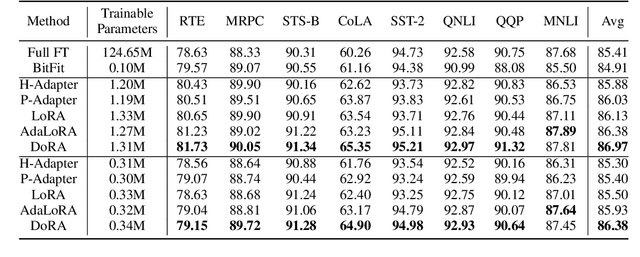
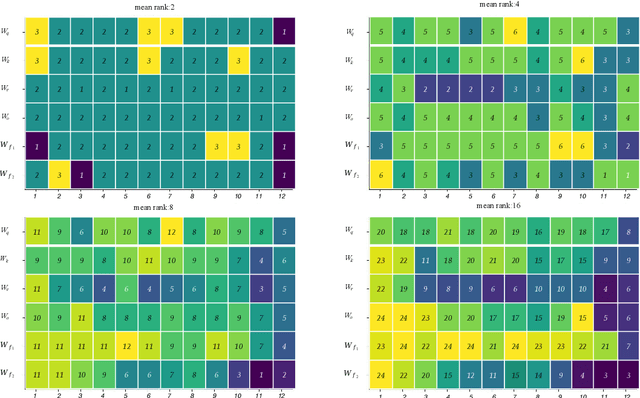
Fine-tuning large-scale pre-trained models is inherently a resource-intensive task. While it can enhance the capabilities of the model, it also incurs substantial computational costs, posing challenges to the practical application of downstream tasks. Existing parameter-efficient fine-tuning (PEFT) methods such as Low-Rank Adaptation (LoRA) rely on a bypass framework that ignores the differential parameter budget requirements across weight matrices, which may lead to suboptimal fine-tuning outcomes. To address this issue, we introduce the Dynamic Low-Rank Adaptation (DoRA) method. DoRA decomposes high-rank LoRA layers into structured single-rank components, allowing for dynamic pruning of parameter budget based on their importance to specific tasks during training, which makes the most of the limited parameter budget. Experimental results demonstrate that DoRA can achieve competitive performance compared with LoRA and full model fine-tuning, and outperform various strong baselines with the same storage parameter budget. Our code is available at https://github.com/MIkumikumi0116/DoRA