 Add to Chrome
 Add to Firefox
 Add to Edge
Byzantine-resilient Federated Learning Employing Normalized Gradients on Non-IID Datasets
Aug 18, 2024
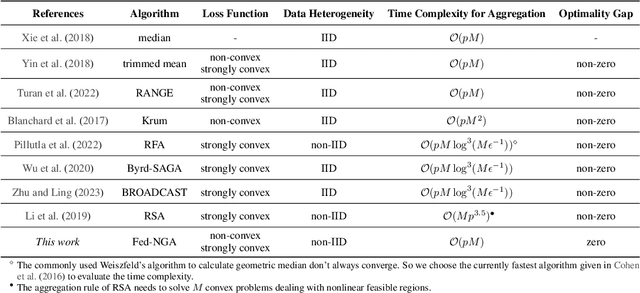
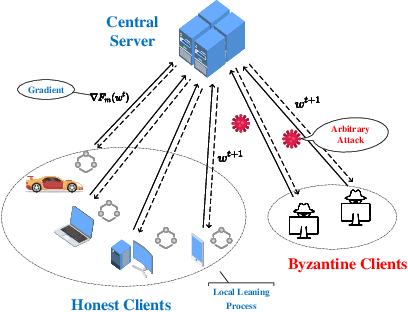
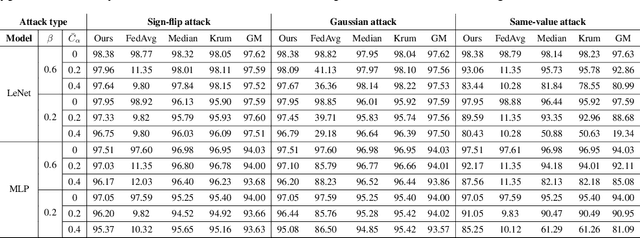
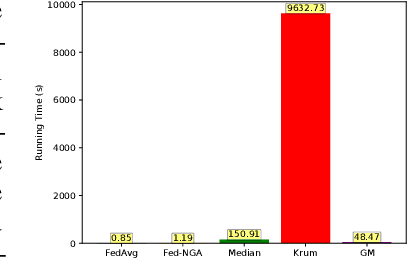
In practical federated learning (FL) systems, the presence of malicious Byzantine attacks and data heterogeneity often introduces biases into the learning process. However, existing Byzantine-robust methods typically only achieve a compromise between adaptability to different loss function types (including both strongly convex and non-convex) and robustness to heterogeneous datasets, but with non-zero optimality gap. Moreover, this compromise often comes at the cost of high computational complexity for aggregation, which significantly slows down the training speed. To address this challenge, we propose a federated learning approach called Federated Normalized Gradients Algorithm (Fed-NGA). Fed-NGA simply normalizes the uploaded local gradients to be unit vectors before aggregation, achieving a time complexity of $\mathcal{O}(pM)$, where $p$ represents the dimension of model parameters and $M$ is the number of participating clients. This complexity scale achieves the best level among all the existing Byzantine-robust methods. Furthermore, through rigorous proof, we demonstrate that Fed-NGA transcends the trade-off between adaptability to loss function type and data heterogeneity and the limitation of non-zero optimality gap in existing literature. Specifically, Fed-NGA can adapt to both non-convex loss functions and non-IID datasets simultaneously, with zero optimality gap at a rate of $\mathcal{O} (1/T^{\frac{1}{2} - \delta})$, where T is the iteration number and $\delta \in (0,\frac{1}{2})$. In cases where the loss function is strongly convex, the zero optimality gap achieving rate can be improved to be linear. Experimental results provide evidence of the superiority of our proposed Fed-NGA on time complexity and convergence performance over baseline methods.

Prioritizing Modalities: Flexible Importance Scheduling in Federated Multimodal Learning
Aug 13, 2024Federated Learning (FL) is a distributed machine learning approach that enables devices to collaboratively train models without sharing their local data, ensuring user privacy and scalability. However, applying FL to real-world data presents challenges, particularly as most existing FL research focuses on unimodal data. Multimodal Federated Learning (MFL) has emerged to address these challenges, leveraging modality-specific encoder models to process diverse datasets. Current MFL methods often uniformly allocate computational frequencies across all modalities, which is inefficient for IoT devices with limited resources. In this paper, we propose FlexMod, a novel approach to enhance computational efficiency in MFL by adaptively allocating training resources for each modality encoder based on their importance and training requirements. We employ prototype learning to assess the quality of modality encoders, use Shapley values to quantify the importance of each modality, and adopt the Deep Deterministic Policy Gradient (DDPG) method from deep reinforcement learning to optimize the allocation of training resources. Our method prioritizes critical modalities, optimizing model performance and resource utilization. Experimental results on three real-world datasets demonstrate that our proposed method significantly improves the performance of MFL models.
TacSL: A Library for Visuotactile Sensor Simulation and Learning
Aug 12, 2024


For both humans and robots, the sense of touch, known as tactile sensing, is critical for performing contact-rich manipulation tasks. Three key challenges in robotic tactile sensing are 1) interpreting sensor signals, 2) generating sensor signals in novel scenarios, and 3) learning sensor-based policies. For visuotactile sensors, interpretation has been facilitated by their close relationship with vision sensors (e.g., RGB cameras). However, generation is still difficult, as visuotactile sensors typically involve contact, deformation, illumination, and imaging, all of which are expensive to simulate; in turn, policy learning has been challenging, as simulation cannot be leveraged for large-scale data collection. We present \textbf{TacSL} (\textit{taxel}), a library for GPU-based visuotactile sensor simulation and learning. \textbf{TacSL} can be used to simulate visuotactile images and extract contact-force distributions over $200\times$ faster than the prior state-of-the-art, all within the widely-used Isaac Gym simulator. Furthermore, \textbf{TacSL} provides a learning toolkit containing multiple sensor models, contact-intensive training environments, and online/offline algorithms that can facilitate policy learning for sim-to-real applications. On the algorithmic side, we introduce a novel online reinforcement-learning algorithm called asymmetric actor-critic distillation (\sysName), designed to effectively and efficiently learn tactile-based policies in simulation that can transfer to the real world. Finally, we demonstrate the utility of our library and algorithms by evaluating the benefits of distillation and multimodal sensing for contact-rich manip ulation tasks, and most critically, performing sim-to-real transfer. Supplementary videos and results are at \url{https://iakinola23.github.io/tacsl/}.
Semantic Communications for 3D Human Face Transmission with Neural Radiance Fields
Jul 19, 2024
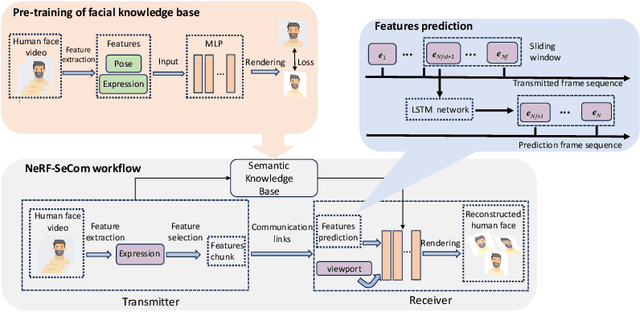
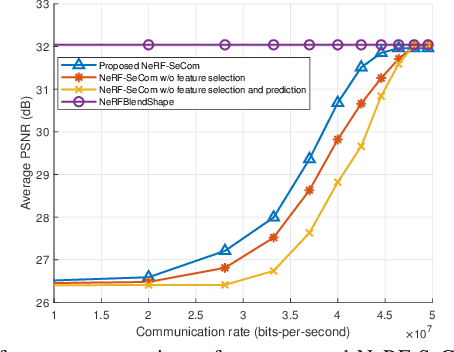
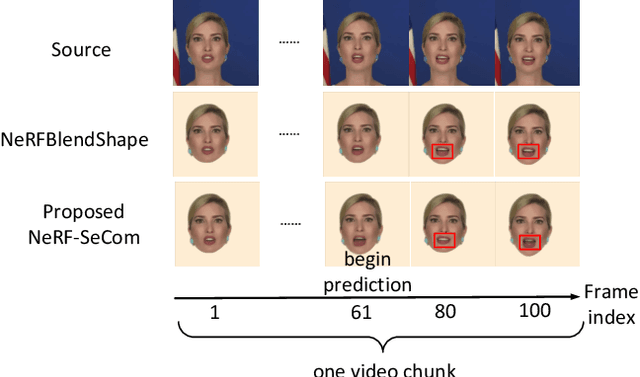
This paper investigates the transmission of three-dimensional (3D) human face content for immersive communication over a rate-constrained transmitter-receiver link. We propose a new framework named NeRF-SeCom, which leverages neural radiance fields (NeRF) and semantic communications to improve the quality of 3D visualizations while minimizing the communication overhead. In the NeRF-SeCom framework, we first train a NeRF face model based on the NeRFBlendShape method, which is pre-shared between the transmitter and receiver as the semantic knowledge base to facilitate the real-time transmission. Next, with knowledge base, the transmitter extracts and sends only the essential semantic features for the receiver to reconstruct 3D face in real time. To optimize the transmission efficiency, we classify the expression features into static and dynamic types. Over each video chunk, static features are transmitted once for all frames, whereas dynamic features are transmitted over a portion of frames to adhere to rate constraints. Additionally, we propose a feature prediction mechanism, which allows the receiver to predict the dynamic features for frames that are not transmitted. Experiments show that our proposed NeRF-SeCom framework significantly outperforms benchmark methods in delivering high-quality 3D visualizations of human faces.
AutoMate: Specialist and Generalist Assembly Policies over Diverse Geometries
Jul 10, 2024
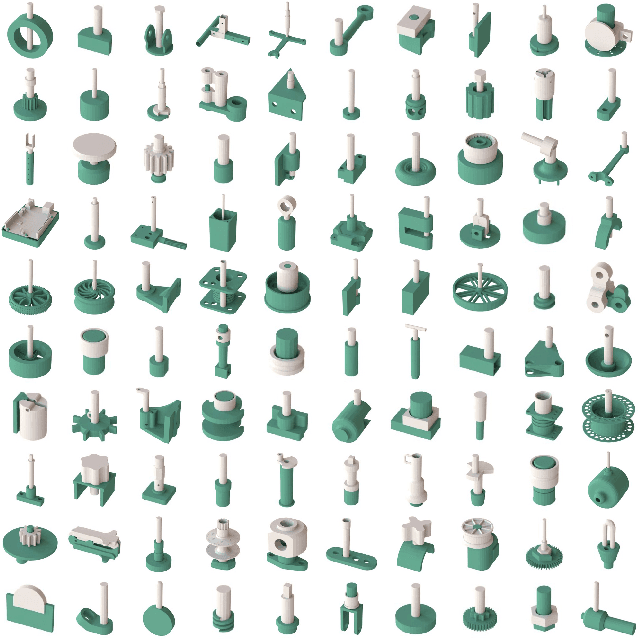
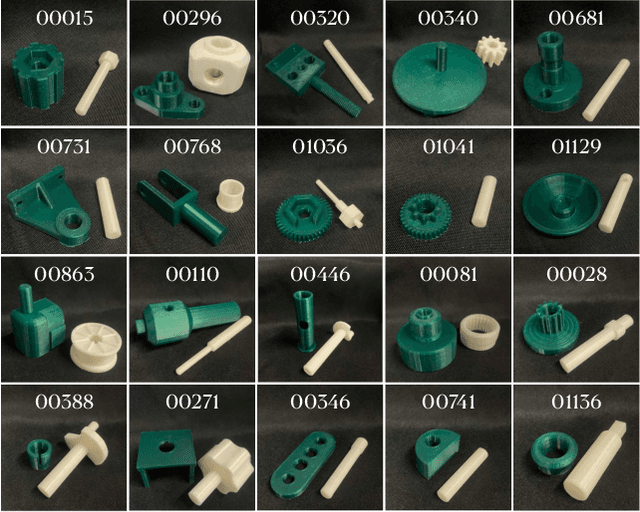

Robotic assembly for high-mixture settings requires adaptivity to diverse parts and poses, which is an open challenge. Meanwhile, in other areas of robotics, large models and sim-to-real have led to tremendous progress. Inspired by such work, we present AutoMate, a learning framework and system that consists of 4 parts: 1) a dataset of 100 assemblies compatible with simulation and the real world, along with parallelized simulation environments for policy learning, 2) a novel simulation-based approach for learning specialist (i.e., part-specific) policies and generalist (i.e., unified) assembly policies, 3) demonstrations of specialist policies that individually solve 80 assemblies with 80% or higher success rates in simulation, as well as a generalist policy that jointly solves 20 assemblies with an 80%+ success rate, and 4) zero-shot sim-to-real transfer that achieves similar (or better) performance than simulation, including on perception-initialized assembly. The key methodological takeaway is that a union of diverse algorithms from manufacturing engineering, character animation, and time-series analysis provides a generic and robust solution for a diverse range of robotic assembly problems.To our knowledge, AutoMate provides the first simulation-based framework for learning specialist and generalist policies over a wide range of assemblies, as well as the first system demonstrating zero-shot sim-to-real transfer over such a range.
I2EKF-LO: A Dual-Iteration Extended Kalman Filter Based LiDAR Odometry
Jul 02, 2024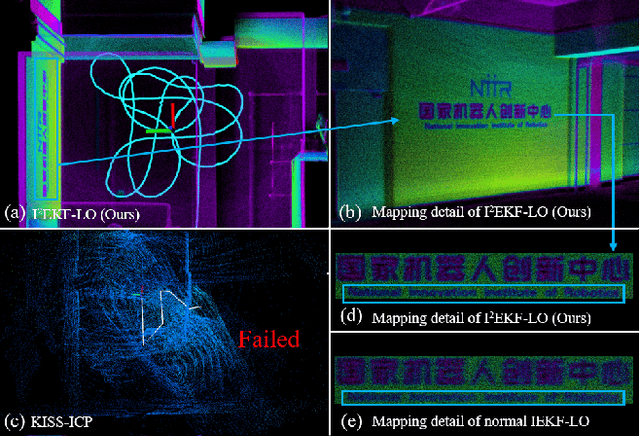
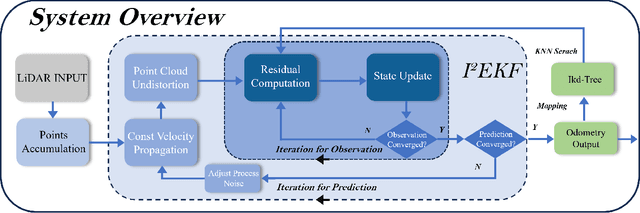
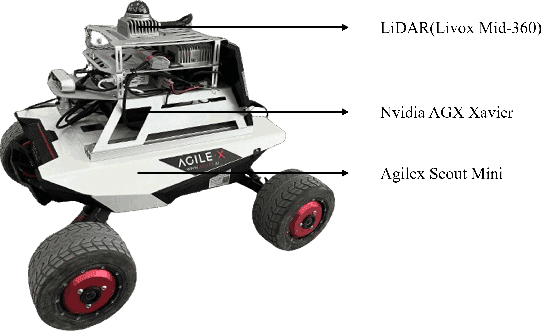
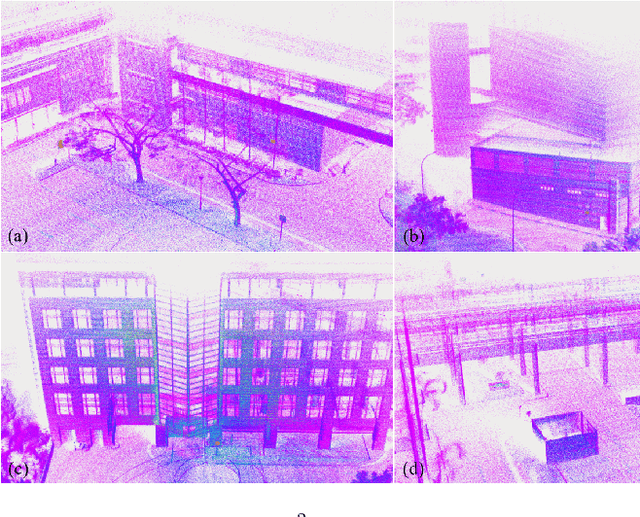
LiDAR odometry is a pivotal technology in the fields of autonomous driving and autonomous mobile robotics. However, most of the current works focus on nonlinear optimization methods, and still existing many challenges in using the traditional Iterative Extended Kalman Filter (IEKF) framework to tackle the problem: IEKF only iterates over the observation equation, relying on a rough estimate of the initial state, which is insufficient to fully eliminate motion distortion in the input point cloud; the system process noise is difficult to be determined during state estimation of the complex motions; and the varying motion models across different sensor carriers. To address these issues, we propose the Dual-Iteration Extended Kalman Filter (I2EKF) and the LiDAR odometry based on I2EKF (I2EKF-LO). This approach not only iterates over the observation equation but also leverages state updates to iteratively mitigate motion distortion in LiDAR point clouds. Moreover, it dynamically adjusts process noise based on the confidence level of prior predictions during state estimation and establishes motion models for different sensor carriers to achieve accurate and efficient state estimation. Comprehensive experiments demonstrate that I2EKF-LO achieves outstanding levels of accuracy and computational efficiency in the realm of LiDAR odometry. Additionally, to foster community development, our code is open-sourced.https://github.com/YWL0720/I2EKF-LO.
Multi-Active-IRS-Assisted Cooperative Sensing: Cramér-Rao Bound and Joint Beamforming Design
Jun 18, 2024This paper studies the multi-intelligent reflecting surface (IRS)-assisted cooperative sensing, in which multiple active IRSs are deployed in a distributed manner to facilitate multi-view target sensing at the non-line-of-sight (NLoS) area of the base station (BS). Different from prior works employing passive IRSs, we leverage active IRSs with the capability of amplifying the reflected signals to overcome the severe multi-hop-reflection path loss in NLoS sensing. In particular, we consider two sensing setups without and with dedicated sensors equipped at active IRSs. In the first case without dedicated sensors at IRSs, we investigate the cooperative sensing at the BS, where the target's direction-of-arrival (DoA) with respect to each IRS is estimated based on the echo signals received at the BS. In the other case with dedicated sensors at IRSs, we consider that each IRS is able to receive echo signals and estimate the target's DoA with respect to itself. For both sensing setups, we first derive the closed-form Cram\'{e}r-Rao bound (CRB) for estimating target DoA. Then, the (maximum) CRB is minimized by jointly optimizing the transmit beamforming at the BS and the reflective beamforming at the multiple IRSs, subject to the constraints on the maximum transmit power at the BS, as well as the maximum amplification power and the maximum power amplification gain constraints at individual active IRSs. To tackle the resulting highly non-convex (max-)CRB minimization problems, we propose two efficient algorithms to obtain high-quality solutions for the two cases with sensing at the BS and at the IRSs, respectively, based on alternating optimization, successive convex approximation, and semi-definite relaxation.
RVT-2: Learning Precise Manipulation from Few Demonstrations
Jun 12, 2024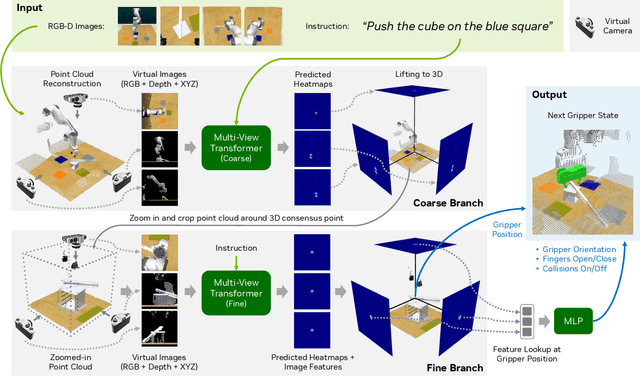
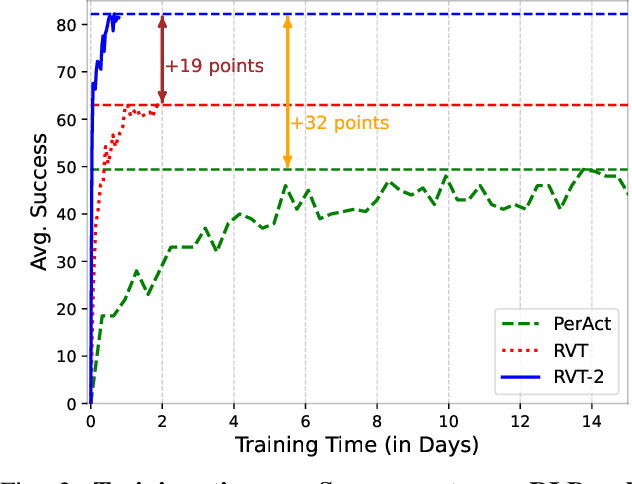
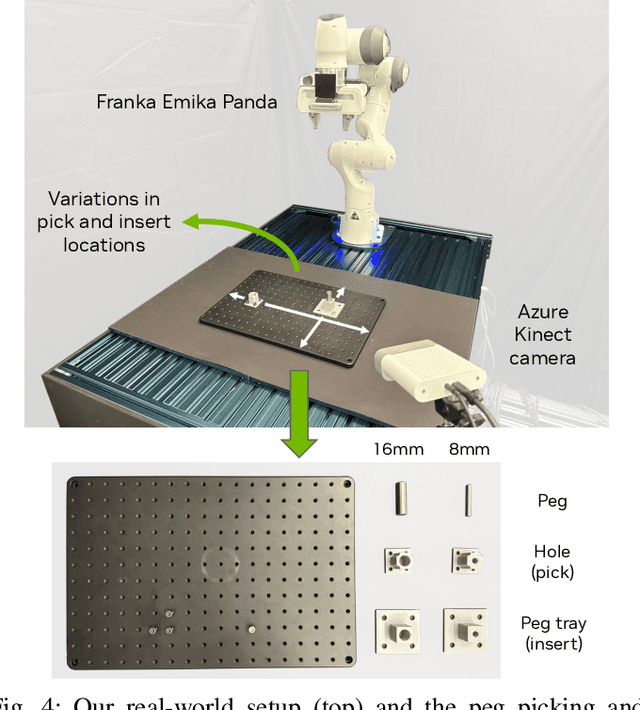
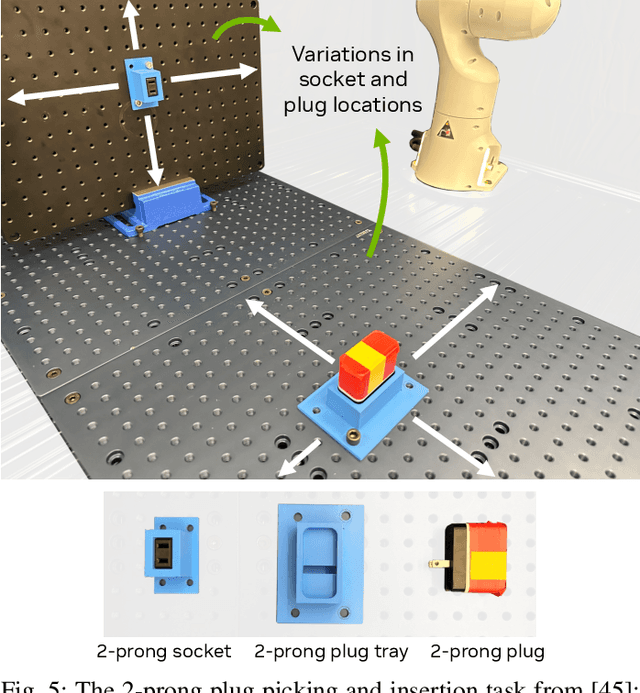
In this work, we study how to build a robotic system that can solve multiple 3D manipulation tasks given language instructions. To be useful in industrial and household domains, such a system should be capable of learning new tasks with few demonstrations and solving them precisely. Prior works, like PerAct and RVT, have studied this problem, however, they often struggle with tasks requiring high precision. We study how to make them more effective, precise, and fast. Using a combination of architectural and system-level improvements, we propose RVT-2, a multitask 3D manipulation model that is 6X faster in training and 2X faster in inference than its predecessor RVT. RVT-2 achieves a new state-of-the-art on RLBench, improving the success rate from 65% to 82%. RVT-2 is also effective in the real world, where it can learn tasks requiring high precision, like picking up and inserting plugs, with just 10 demonstrations. Visual results, code, and trained model are provided at: https://robotic-view-transformer-2.github.io/.
TDT Loss Takes It All: Integrating Temporal Dependencies among Targets into Non-Autoregressive Time Series Forecasting
Jun 07, 2024Learning temporal dependencies among targets (TDT) benefits better time series forecasting, where targets refer to the predicted sequence. Although autoregressive methods model TDT recursively, they suffer from inefficient inference and error accumulation. We argue that integrating TDT learning into non-autoregressive methods is essential for pursuing effective and efficient time series forecasting. In this study, we introduce the differencing approach to represent TDT and propose a parameter-free and plug-and-play solution through an optimization objective, namely TDT Loss. It leverages the proportion of inconsistent signs between predicted and ground truth TDT as an adaptive weight, dynamically balancing target prediction and fine-grained TDT fitting. Importantly, TDT Loss incurs negligible additional cost, with only $\mathcal{O}(n)$ increased computation and $\mathcal{O}(1)$ memory requirements, while significantly enhancing the predictive performance of non-autoregressive models. To assess the effectiveness of TDT loss, we conduct extensive experiments on 7 widely used datasets. The experimental results of plugging TDT loss into 6 state-of-the-art methods show that out of the 168 experiments, 75.00\% and 94.05\% exhibit improvements in terms of MSE and MAE with the maximum 24.56\% and 16.31\%, respectively.
Adaptive Horizon Actor-Critic for Policy Learning in Contact-Rich Differentiable Simulation
May 28, 2024
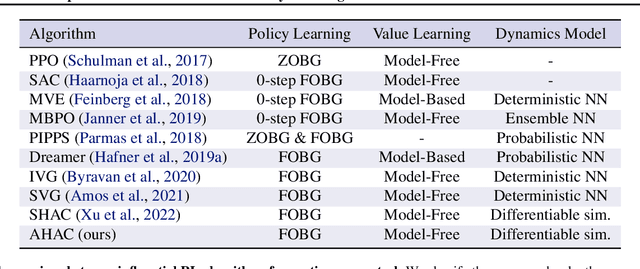
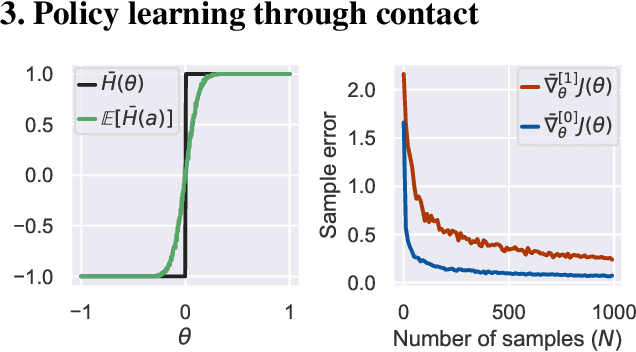

Model-Free Reinforcement Learning~(MFRL), leveraging the policy gradient theorem, has demonstrated considerable success in continuous control tasks. However, these approaches are plagued by high gradient variance due to zeroth-order gradient estimation, resulting in suboptimal policies. Conversely, First-Order Model-Based Reinforcement Learning~(FO-MBRL) methods, employing differentiable simulation, provide gradients with reduced variance but are susceptible to sampling error in scenarios involving stiff dynamics, such as physical contact. This paper investigates the source of this error and introduces Adaptive Horizon Actor-Critic (AHAC), an FO-MBRL algorithm that reduces gradient error by adapting the model-based horizon to avoid stiff dynamics. Empirical findings reveal that AHAC outperforms MFRL baselines, attaining 40\% more reward across a set of locomotion tasks, and efficiently scaling to high-dimensional control environments with improved wall-clock-time efficiency.