 Add to Chrome
 Add to Firefox
 Add to Edge
The Collapse of Heterogeneity in Silicon Philosophers
Apr 26, 2026
Silicon samples are increasingly used as a low-cost substitute for human panels and have been shown to reproduce aggregate human opinion with high fidelity. We show that, in the alignment-relevant domain of philosophy, silicon samples systematically collapse heterogeneity. Using data from $N = {277}$ professional philosophers drawn from PhilPeople profiles, we evaluate seven proprietary and open-source large language models on their ability to replicate individual philosophical positions and to preserve cross-question correlation structures across philosophical domains. We find that language models substantially over-correlate philosophical judgments, producing artificial consensus across domains. This collapse is associated in part with specialist effects, whereby models implicitly assume that domain specialists hold highly similar philosophical views. We assess the robustness of these findings by studying the impact of DPO fine-tuning and by validating results against the full PhilPapers 2020 Survey ($N = {1785}$). We conclude by discussing implications for alignment, evaluation, and the use of silicon samples as substitutes for human judgment. The code of this project can be found at https://github.com/stanford-del/silicon-philosophers.

Unseen Cost of Space Computing: Quantifying LEO Battery Aging via Physics-Driven Modeling
Mar 04, 2026Low Earth Orbit (LEO) satellite constellations in the 6G era are evolving into intelligent in-orbit computational platforms, forming Space Computing Power Networks (SCPNs) to deliver global-scale computing services. However, the intensive computation within SCPN incurs a significant ``unseen cost'': the frequent charge-discharge cycles accelerate the physical degradation of satellites' life-limiting and high-cost batteries, thereby threatening the long-term operational viability of such a system. Existing approaches, often relying on indirect metrics like Depth of Discharge (DoD) and neglecting the complex, nonlinear degradation process of battery aging, fail to accurately quantify this cost. To address this, we introduce a high-fidelity, physics-driven model that quantitatively links computational workload parameters to the nonlinear battery degradation. Building on this model, we formulate a degradation-aware scheduling problem and analyze heuristic policies across different energy regimes. Simulations reveal that the optimal strategy should be adaptive: in solar-rich conditions, a myopic policy maximizing instantaneous solar utilization is superior, whereas under energy scarcity, a reactive policy leveraging real-time battery state significantly extends lifetime.
Service Function Chain Routing in LEO Networks Using Shortest-Path Delay Statistical Stability
Mar 04, 2026Low Earth orbit (LEO) satellite constellations have become a critical enabler for global coverage, utilizing numerous satellites orbiting Earth at high speeds. By decomposing complex network services into lightweight service functions, network function virtualization (NFV) transforms global network services into diverse service function chains (SFCs), coordinated by resource-constrained LEOs. However, the dynamic topology of satellite networks, marked by highly variable inter-satellite link delays, poses significant challenges for designing efficient routing strategies that ensure reliable and low-latency communication. Many existing routing methods suffer from poor scalability and degraded performance, limiting their practical implementation. To address these challenges, this paper proposes a novel SFC routing approach that leverages the statistical properties of network link states to mitigate instability caused by instantaneous modeling in dynamic satellite networks. Through comprehensive simulations on end-to-end shortest-path propagation delays in LEO networks, we identify and validate the statistical stability of multi-hop routes. Building on this insight, we introduce the Stability-Aware Multi-Stage Graph Routing (SA-MSGR) algorithm, which incorporates pre-computed average delays into a multi-stage graph optimization framework. Extensive simulations demonstrate the superior performance of SA-MSGR, achieving significantly lower and more predictable end-to-end SFC delays compared to representative baseline strategies.
Edge Large AI Models: Collaborative Deployment and IoT Applications
May 06, 2025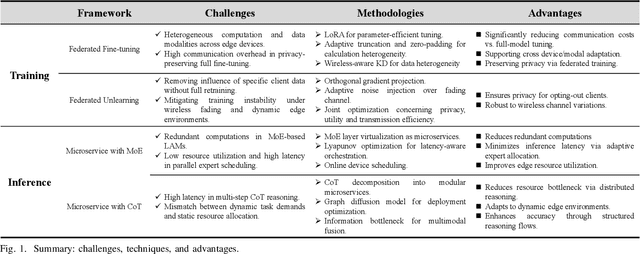
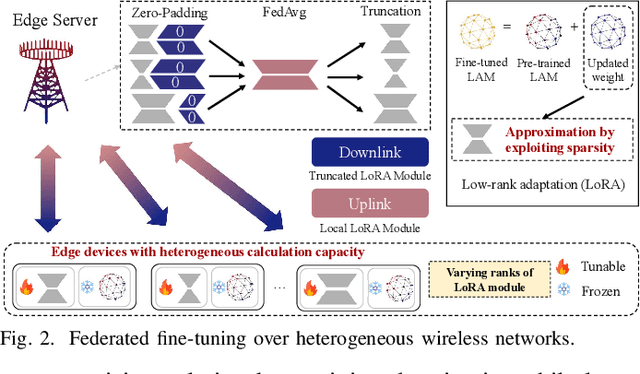
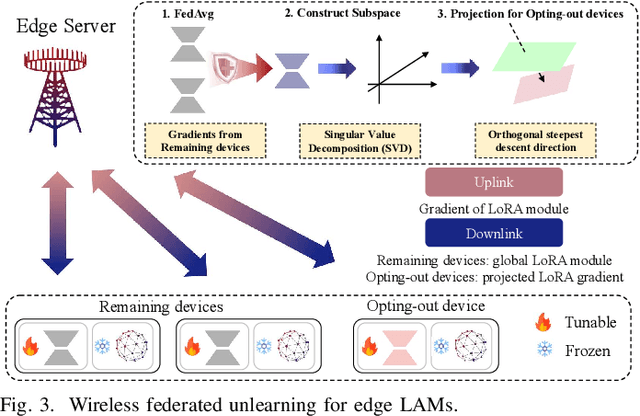
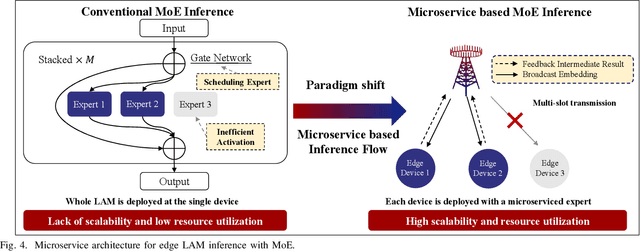
Large artificial intelligence models (LAMs) emulate human-like problem-solving capabilities across diverse domains, modalities, and tasks. By leveraging the communication and computation resources of geographically distributed edge devices, edge LAMs enable real-time intelligent services at the network edge. Unlike conventional edge AI, which relies on small or moderate-sized models for direct feature-to-prediction mappings, edge LAMs leverage the intricate coordination of modular components to enable context-aware generative tasks and multi-modal inference. We shall propose a collaborative deployment framework for edge LAM by characterizing the LAM intelligent capabilities and limited edge network resources. Specifically, we propose a collaborative training framework over heterogeneous edge networks that adaptively decomposes LAMs according to computation resources, data modalities, and training objectives, reducing communication and computation overheads during the fine-tuning process. Furthermore, we introduce a microservice-based inference framework that virtualizes the functional modules of edge LAMs according to their architectural characteristics, thereby improving resource utilization and reducing inference latency. The developed edge LAM will provide actionable solutions to enable diversified Internet-of-Things (IoT) applications, facilitated by constructing mappings from diverse sensor data to token representations and fine-tuning based on domain knowledge.
Edge Large AI Models: Revolutionizing 6G Networks
May 01, 2025Large artificial intelligence models (LAMs) possess human-like abilities to solve a wide range of real-world problems, exemplifying the potential of experts in various domains and modalities. By leveraging the communication and computation capabilities of geographically dispersed edge devices, edge LAM emerges as an enabling technology to empower the delivery of various real-time intelligent services in 6G. Unlike traditional edge artificial intelligence (AI) that primarily supports a single task using small models, edge LAM is featured by the need of the decomposition and distributed deployment of large models, and the ability to support highly generalized and diverse tasks. However, due to limited communication, computation, and storage resources over wireless networks, the vast number of trainable neurons and the substantial communication overhead pose a formidable hurdle to the practical deployment of edge LAMs. In this paper, we investigate the opportunities and challenges of edge LAMs from the perspectives of model decomposition and resource management. Specifically, we propose collaborative fine-tuning and full-parameter training frameworks, alongside a microservice-assisted inference architecture, to enhance the deployment of edge LAM over wireless networks. Additionally, we investigate the application of edge LAM in air-interface designs, focusing on channel prediction and beamforming. These innovative frameworks and applications offer valuable insights and solutions for advancing 6G technology.
Satellite Federated Fine-Tuning for Foundation Models in Space Computing Power Networks
Apr 14, 2025Advancements in artificial intelligence (AI) and low-earth orbit (LEO) satellites have promoted the application of large remote sensing foundation models for various downstream tasks. However, direct downloading of these models for fine-tuning on the ground is impeded by privacy concerns and limited bandwidth. Satellite federated learning (FL) offers a solution by enabling model fine-tuning directly on-board satellites and aggregating model updates without data downloading. Nevertheless, for large foundation models, the computational capacity of satellites is insufficient to support effective on-board fine-tuning in traditional satellite FL frameworks. To address these challenges, we propose a satellite-ground collaborative federated fine-tuning framework. The key of the framework lies in how to reasonably decompose and allocate model components to alleviate insufficient on-board computation capabilities. During fine-tuning, satellites exchange intermediate results with ground stations or other satellites for forward propagation and back propagation, which brings communication challenges due to the special communication topology of space transmission networks, such as intermittent satellite-ground communication, short duration of satellite-ground communication windows, and unstable inter-orbit inter-satellite links (ISLs). To reduce transmission delays, we further introduce tailored communication strategies that integrate both communication and computing resources. Specifically, we propose a parallel intra-orbit communication strategy, a topology-aware satellite-ground communication strategy, and a latency-minimalization inter-orbit communication strategy to reduce space communication costs. Simulation results demonstrate significant reductions in training time with improvements of approximately 33%.
Satellite Edge Artificial Intelligence with Large Models: Architectures and Technologies
Apr 02, 2025Driven by the growing demand for intelligent remote sensing applications, large artificial intelligence (AI) models pre-trained on large-scale unlabeled datasets and fine-tuned for downstream tasks have significantly improved learning performance for various downstream tasks due to their generalization capabilities. However, many specific downstream tasks, such as extreme weather nowcasting (e.g., downburst and tornado), disaster monitoring, and battlefield surveillance, require real-time data processing. Traditional methods via transferring raw data to ground stations for processing often cause significant issues in terms of latency and trustworthiness. To address these challenges, satellite edge AI provides a paradigm shift from ground-based to on-board data processing by leveraging the integrated communication-and-computation capabilities in space computing power networks (Space-CPN), thereby enhancing the timeliness, effectiveness, and trustworthiness for remote sensing downstream tasks. Moreover, satellite edge large AI model (LAM) involves both the training (i.e., fine-tuning) and inference phases, where a key challenge lies in developing computation task decomposition principles to support scalable LAM deployment in resource-constrained space networks with time-varying topologies. In this article, we first propose a satellite federated fine-tuning architecture to split and deploy the modules of LAM over space and ground networks for efficient LAM fine-tuning. We then introduce a microservice-empowered satellite edge LAM inference architecture that virtualizes LAM components into lightweight microservices tailored for multi-task multimodal inference. Finally, we discuss the future directions for enhancing the efficiency and scalability of satellite edge LAM, including task-oriented communication, brain-inspired computing, and satellite edge AI network optimization.
VideoScan: Enabling Efficient Streaming Video Understanding via Frame-level Semantic Carriers
Mar 12, 2025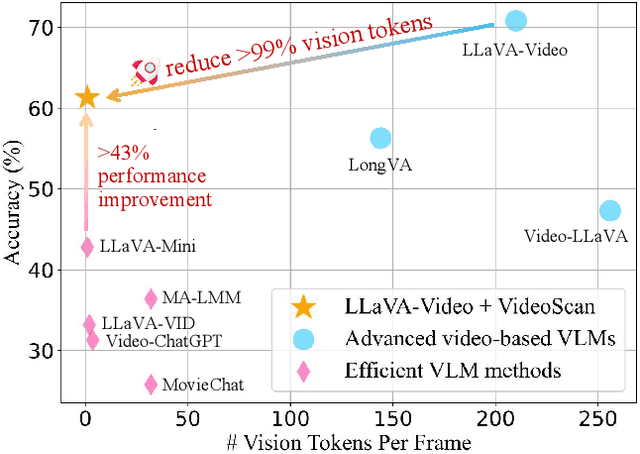
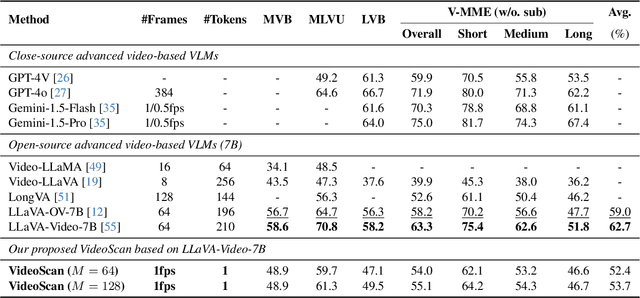

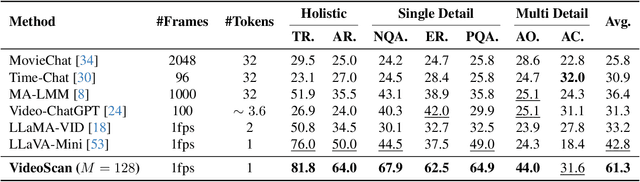
This paper introduces VideoScan, an efficient vision-language model (VLM) inference framework designed for real-time video interaction that effectively comprehends and retains streamed video inputs while delivering rapid and accurate responses. A longstanding challenge in video understanding--particularly for long-term or real-time applications--stems from the substantial computational overhead caused by the extensive length of visual tokens. To address this, VideoScan employs a single semantic carrier token to represent each frame, progressively reducing computational and memory overhead during its two-phase inference process: prefilling and decoding. The embedding of the semantic carrier token is derived from an optimized aggregation of frame-level visual features, ensuring compact yet semantically rich representations. Critically, the corresponding key-value pairs are trained to retain contextual semantics from prior frames, enabling efficient memory management without sacrificing temporal coherence. During inference, the visual tokens of each frame are processed only once during the prefilling phase and subsequently discarded in the decoding stage, eliminating redundant computations. This design ensures efficient VLM inference even under stringent real-time constraints. Comprehensive experiments on diverse offline and online benchmarks demonstrate that LLaVA-Video, supported by our method, achieves up to $\sim 5\times$ and $1.29\times$ speedups compared to its original version and previous efficient streaming video understanding approaches, respectively. Crucially, these improvements are attained while maintaining competitive performance and ensuring stable GPU memory consumption (consistently $\sim 18$GB, independent of video duration).
Brain-Inspired Decentralized Satellite Learning in Space Computing Power Networks
Jan 27, 2025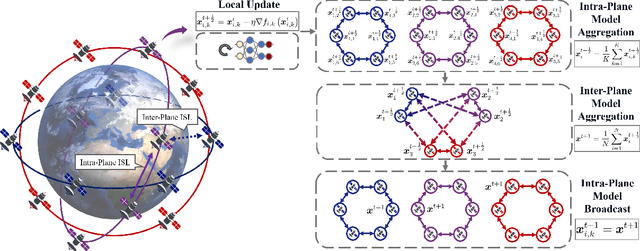
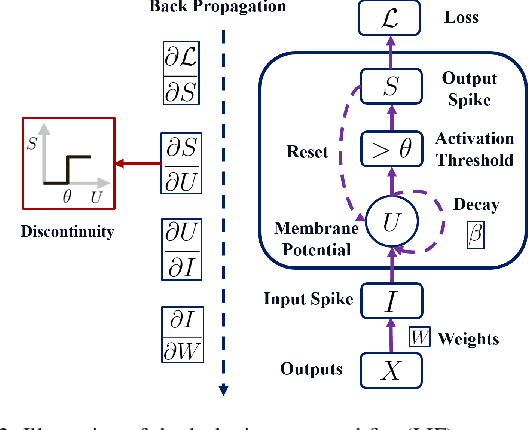
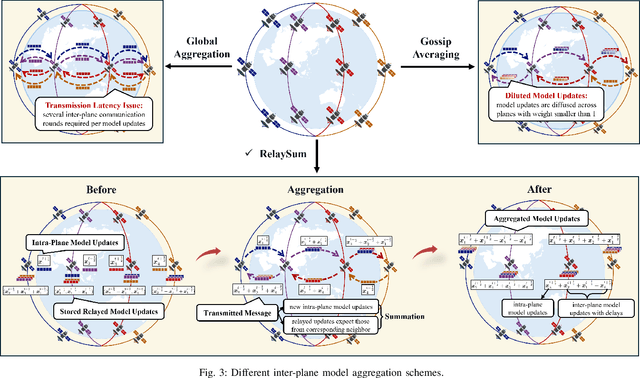
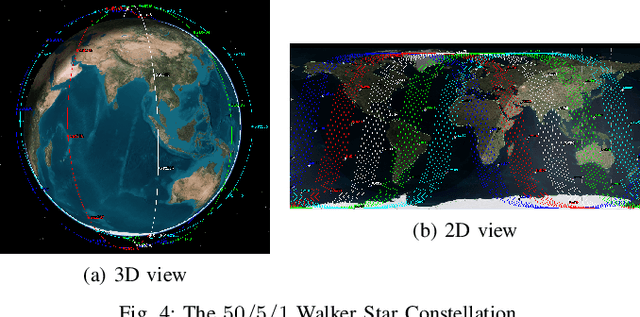
Satellite networks are able to collect massive space information with advanced remote sensing technologies, which is essential for real-time applications such as natural disaster monitoring. However, traditional centralized processing by the ground server incurs a severe timeliness issue caused by the transmission bottleneck of raw data. To this end, Space Computing Power Networks (Space-CPN) emerges as a promising architecture to coordinate the computing capability of satellites and enable on board data processing. Nevertheless, due to the natural limitations of solar panels, satellite power system is difficult to meet the energy requirements for ever-increasing intelligent computation tasks of artificial neural networks. To tackle this issue, we propose to employ spiking neural networks (SNNs), which is supported by the neuromorphic computing architecture, for on-board data processing. The extreme sparsity in its computation enables a high energy efficiency. Furthermore, to achieve effective training of these on-board models, we put forward a decentralized neuromorphic learning framework, where a communication-efficient inter-plane model aggregation method is developed with the inspiration from RelaySum. We provide a theoretical analysis to characterize the convergence behavior of the proposed algorithm, which reveals a network diameter related convergence speed. We then formulate a minimum diameter spanning tree problem on the inter-plane connectivity topology and solve it to further improve the learning performance. Extensive experiments are conducted to evaluate the superiority of the proposed method over benchmarks.
Microservice Deployment in Space Computing Power Networks via Robust Reinforcement Learning
Jan 08, 2025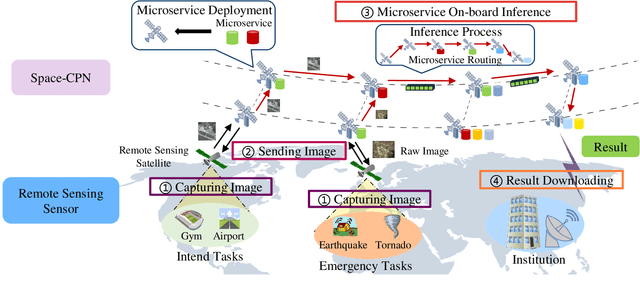
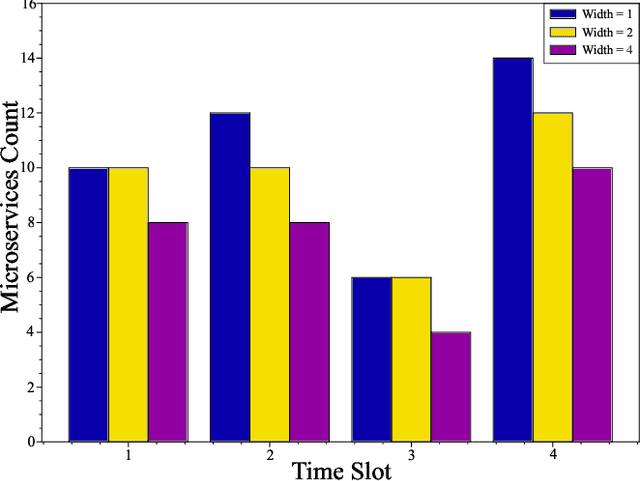
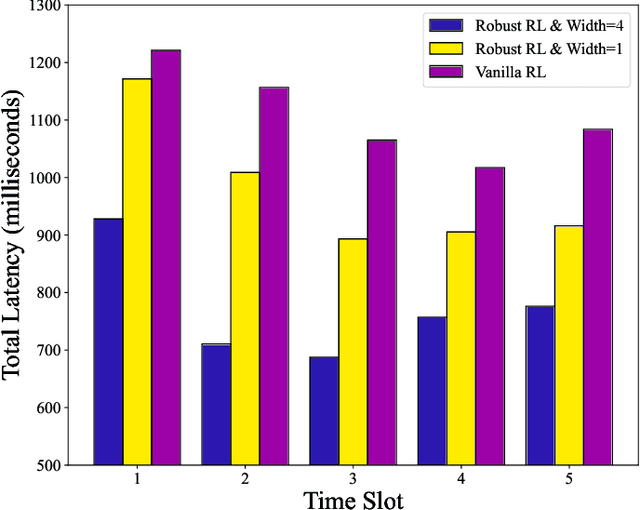
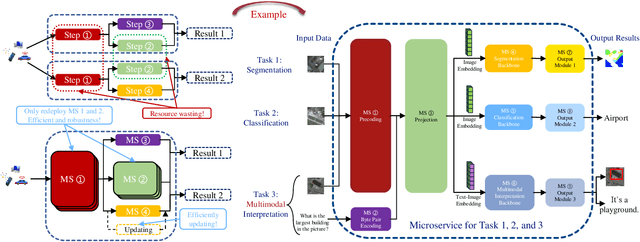
With the growing demand for Earth observation, it is important to provide reliable real-time remote sensing inference services to meet the low-latency requirements. The Space Computing Power Network (Space-CPN) offers a promising solution by providing onboard computing and extensive coverage capabilities for real-time inference. This paper presents a remote sensing artificial intelligence applications deployment framework designed for Low Earth Orbit satellite constellations to achieve real-time inference performance. The framework employs the microservice architecture, decomposing monolithic inference tasks into reusable, independent modules to address high latency and resource heterogeneity. This distributed approach enables optimized microservice deployment, minimizing resource utilization while meeting quality of service and functional requirements. We introduce Robust Optimization to the deployment problem to address data uncertainty. Additionally, we model the Robust Optimization problem as a Partially Observable Markov Decision Process and propose a robust reinforcement learning algorithm to handle the semi-infinite Quality of Service constraints. Our approach yields sub-optimal solutions that minimize accuracy loss while maintaining acceptable computational costs. Simulation results demonstrate the effectiveness of our framework.