 Add to Chrome
 Add to Firefox
 Add to Edge
A Novel Ophthalmic Benchmark for Evaluating Multimodal Large Language Models with Fundus Photographs and OCT Images
Mar 10, 2025
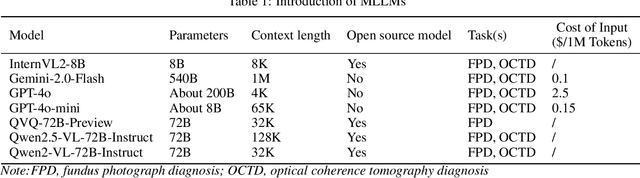
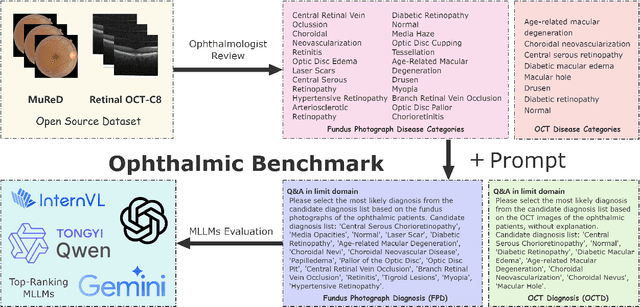
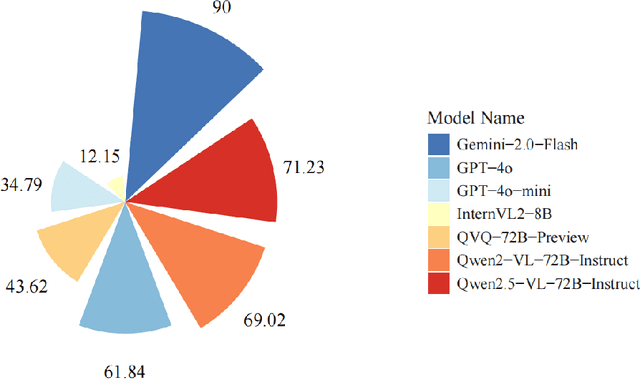
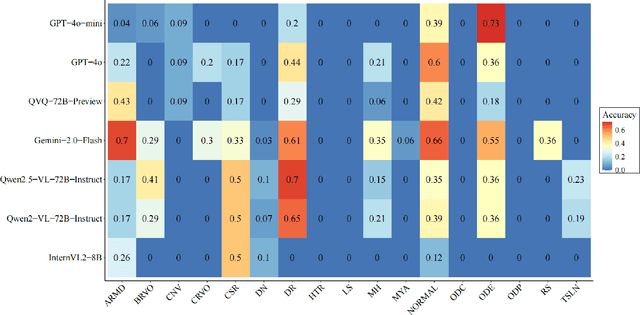
In recent years, large language models (LLMs) have demonstrated remarkable potential across various medical applications. Building on this foundation, multimodal large language models (MLLMs) integrate LLMs with visual models to process diverse inputs, including clinical data and medical images. In ophthalmology, LLMs have been explored for analyzing optical coherence tomography (OCT) reports, assisting in disease classification, and even predicting treatment outcomes. However, existing MLLM benchmarks often fail to capture the complexities of real-world clinical practice, particularly in the analysis of OCT images. Many suffer from limitations such as small sample sizes, a lack of diverse OCT datasets, and insufficient expert validation. These shortcomings hinder the accurate assessment of MLLMs' ability to interpret OCT scans and their broader applicability in ophthalmology. Our dataset, curated through rigorous quality control and expert annotation, consists of 439 fundus images and 75 OCT images. Using a standardized API-based framework, we assessed seven mainstream MLLMs and observed significant variability in diagnostic accuracy across different diseases. While some models performed well in diagnosing conditions such as diabetic retinopathy and age-related macular degeneration, they struggled with others, including choroidal neovascularization and myopia, highlighting inconsistencies in performance and the need for further refinement. Our findings emphasize the importance of developing clinically relevant benchmarks to provide a more accurate assessment of MLLMs' capabilities. By refining these models and expanding their scope, we can enhance their potential to transform ophthalmic diagnosis and treatment.

Benchmarking Chinese Medical LLMs: A Medbench-based Analysis of Performance Gaps and Hierarchical Optimization Strategies
Mar 10, 2025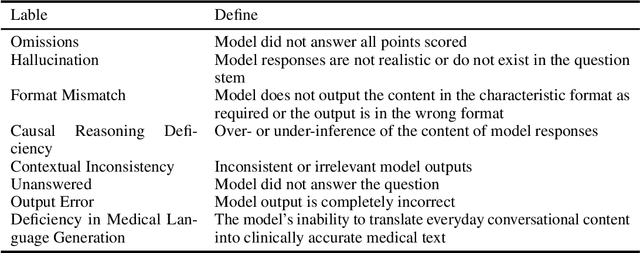
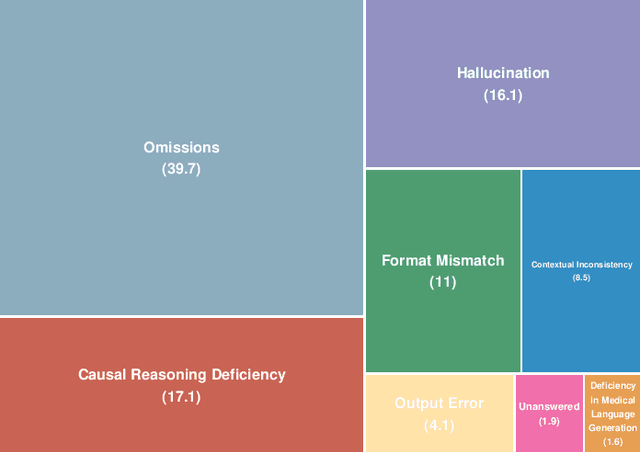
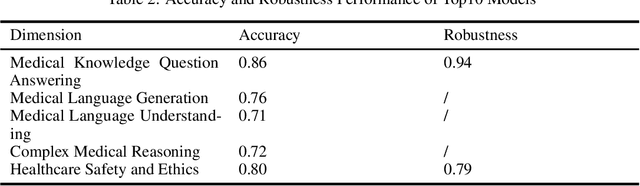
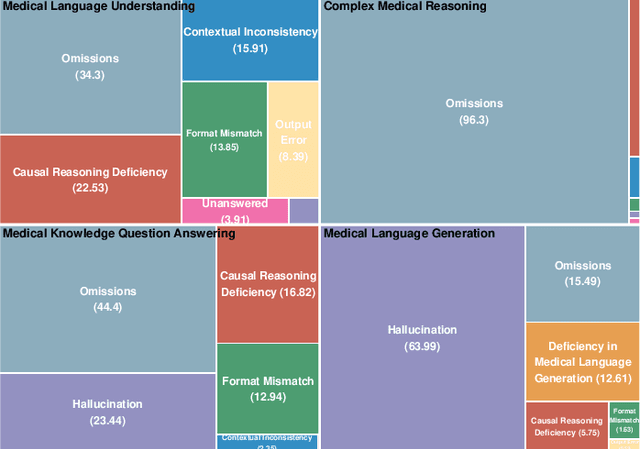
The evaluation and improvement of medical large language models (LLMs) are critical for their real-world deployment, particularly in ensuring accuracy, safety, and ethical alignment. Existing frameworks inadequately dissect domain-specific error patterns or address cross-modal challenges. This study introduces a granular error taxonomy through systematic analysis of top 10 models on MedBench, categorizing incorrect responses into eight types: Omissions, Hallucination, Format Mismatch, Causal Reasoning Deficiency, Contextual Inconsistency, Unanswered, Output Error, and Deficiency in Medical Language Generation. Evaluation of 10 leading models reveals vulnerabilities: despite achieving 0.86 accuracy in medical knowledge recall, critical reasoning tasks show 96.3% omission, while safety ethics evaluations expose alarming inconsistency (robustness score: 0.79) under option shuffled. Our analysis uncovers systemic weaknesses in knowledge boundary enforcement and multi-step reasoning. To address these, we propose a tiered optimization strategy spanning four levels, from prompt engineering and knowledge-augmented retrieval to hybrid neuro-symbolic architectures and causal reasoning frameworks. This work establishes an actionable roadmap for developing clinically robust LLMs while redefining evaluation paradigms through error-driven insights, ultimately advancing the safety and trustworthiness of AI in high-stakes medical environments.
TCM-3CEval: A Triaxial Benchmark for Assessing Responses from Large Language Models in Traditional Chinese Medicine
Mar 10, 2025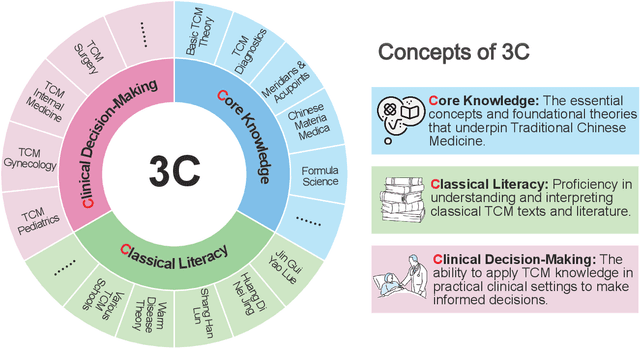
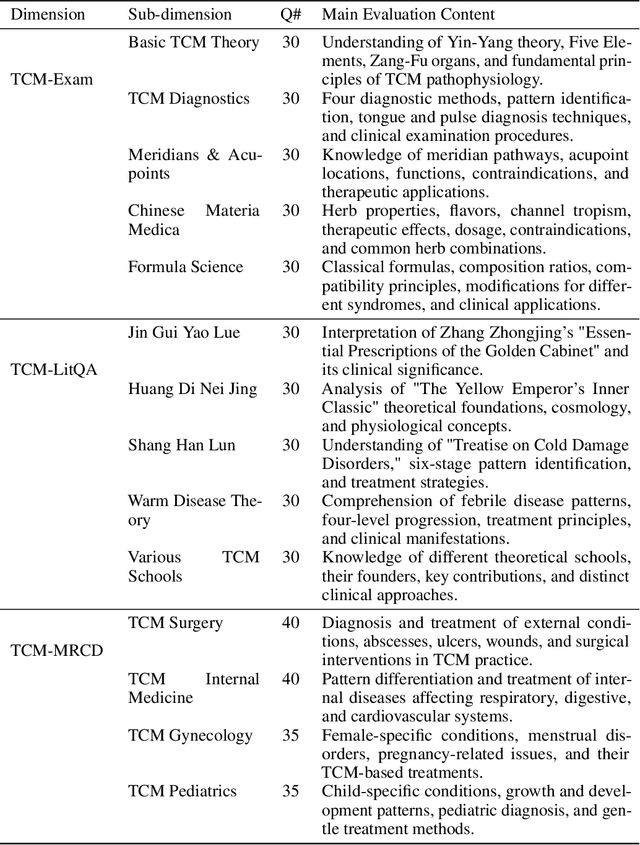
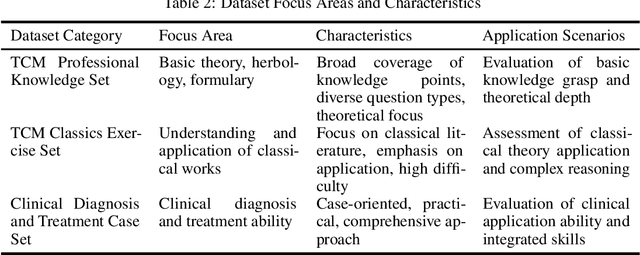
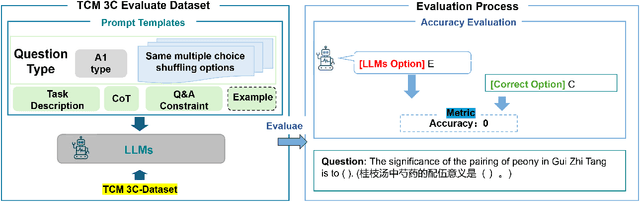
Large language models (LLMs) excel in various NLP tasks and modern medicine, but their evaluation in traditional Chinese medicine (TCM) is underexplored. To address this, we introduce TCM3CEval, a benchmark assessing LLMs in TCM across three dimensions: core knowledge mastery, classical text understanding, and clinical decision-making. We evaluate diverse models, including international (e.g., GPT-4o), Chinese (e.g., InternLM), and medical-specific (e.g., PLUSE). Results show a performance hierarchy: all models have limitations in specialized subdomains like Meridian & Acupoint theory and Various TCM Schools, revealing gaps between current capabilities and clinical needs. Models with Chinese linguistic and cultural priors perform better in classical text interpretation and clinical reasoning. TCM-3CEval sets a standard for AI evaluation in TCM, offering insights for optimizing LLMs in culturally grounded medical domains. The benchmark is available on Medbench's TCM track, aiming to assess LLMs' TCM capabilities in basic knowledge, classic texts, and clinical decision-making through multidimensional questions and real cases.
Adaptive-LIO: Enhancing Robustness and Precision through Environmental Adaptation in LiDAR Inertial Odometry
Mar 07, 2025The emerging Internet of Things (IoT) applications, such as driverless cars, have a growing demand for high-precision positioning and navigation. Nowadays, LiDAR inertial odometry becomes increasingly prevalent in robotics and autonomous driving. However, many current SLAM systems lack sufficient adaptability to various scenarios. Challenges include decreased point cloud accuracy with longer frame intervals under the constant velocity assumption, coupling of erroneous IMU information when IMU saturation occurs, and decreased localization accuracy due to the use of fixed-resolution maps during indoor-outdoor scene transitions. To address these issues, we propose a loosely coupled adaptive LiDAR-Inertial-Odometry named \textbf{Adaptive-LIO}, which incorporates adaptive segmentation to enhance mapping accuracy, adapts motion modality through IMU saturation and fault detection, and adjusts map resolution adaptively using multi-resolution voxel maps based on the distance from the LiDAR center. Our proposed method has been tested in various challenging scenarios, demonstrating the effectiveness of the improvements we introduce. The code is open-source on GitHub: \href{https://github.com/chengwei0427/adaptive_lio}{Adaptive-LIO}.
Robust Multi-View Learning via Representation Fusion of Sample-Level Attention and Alignment of Simulated Perturbation
Mar 06, 2025
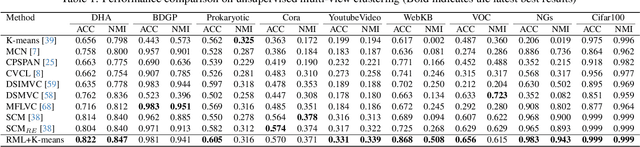

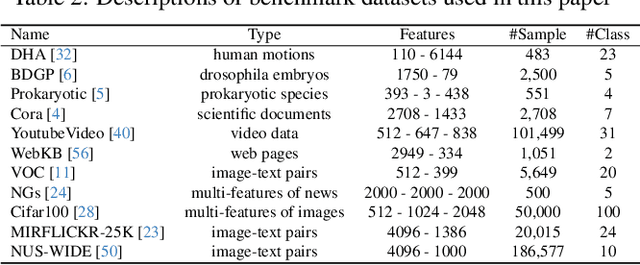
Recently, multi-view learning (MVL) has garnered significant attention due to its ability to fuse discriminative information from multiple views. However, real-world multi-view datasets are often heterogeneous and imperfect, which usually makes MVL methods designed for specific combinations of views lack application potential and limits their effectiveness. To address this issue, we propose a novel robust MVL method (namely RML) with simultaneous representation fusion and alignment. Specifically, we introduce a simple yet effective multi-view transformer fusion network where we transform heterogeneous multi-view data into homogeneous word embeddings, and then integrate multiple views by the sample-level attention mechanism to obtain a fused representation. Furthermore, we propose a simulated perturbation based multi-view contrastive learning framework that dynamically generates the noise and unusable perturbations for simulating imperfect data conditions. The simulated noisy and unusable data obtain two distinct fused representations, and we utilize contrastive learning to align them for learning discriminative and robust representations. Our RML is self-supervised and can also be applied for downstream tasks as a regularization. In experiments, we employ it in unsupervised multi-view clustering, noise-label classification, and as a plug-and-play module for cross-modal hashing retrieval. Extensive comparison experiments and ablation studies validate the effectiveness of RML.
Hierarchically Tunable 6DMA for Wireless Communication and Sensing: Modeling and Performance Optimization
Mar 03, 2025This paper proposes a new hierarchically tunable six-dimensional movable antenna (HT-6DMA) architecture for base station (BS) in future wireless networks. The HT-6DMA BS consists of multiple antenna arrays that can flexibly move on a spherical surface, with their three-dimensional (3D) positions and 3D rotations/orientations efficiently characterized in the global spherical coordinate system (SCS) and their individual local SCSs, respectively. As a result, the 6DMA system is hierarchically tunable in the sense that each array's global position and local rotation can be separately adjusted in a sequential manner with the other being fixed, thus greatly reducing their design complexity and improving the achievable performance. In particular, we consider an HT-6DMA BS serving multiple single-antenna users in the uplink communication or sensing potential unmanned aerial vehicles (UAVs)/drones in a given airway area. Specifically, for the communication scenario, we aim to maximize the average sum rate of communication users in the long term by optimizing the positions and rotations of all 6DMA arrays at the BS. While for the airway sensing scenario, we maximize the minimum received sensing signal power along the airway by optimizing the 6DMA arrays' positions and rotations along with the BS's transmit covariance matrix. Despite that the formulated problems are both non-convex, we propose efficient solutions to them by exploiting the hierarchical tunability of positions/rotations of 6DMA arrays in our proposed model. Numerical results show that the proposed HT-6DMA design significantly outperforms not only the traditional BS with fixed-position antennas (FPAs), but also the existing 6DMA scheme. Furthermore, it is unveiled that the performance gains of HT-6DMA mostly come from the arrays' global position adjustments on the spherical surface, rather than their local rotation adjustments.
Dynamic Noise Preference Optimization for LLM Self-Improvement via Synthetic Data
Feb 08, 2025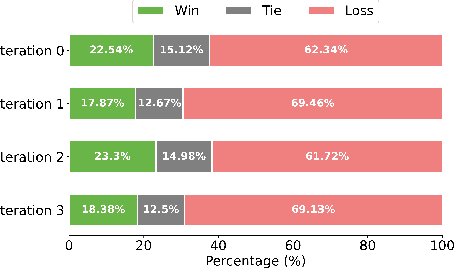
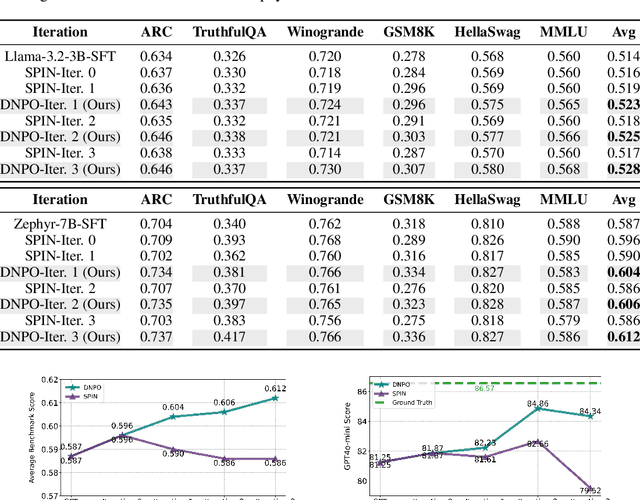
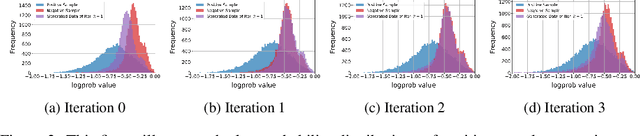
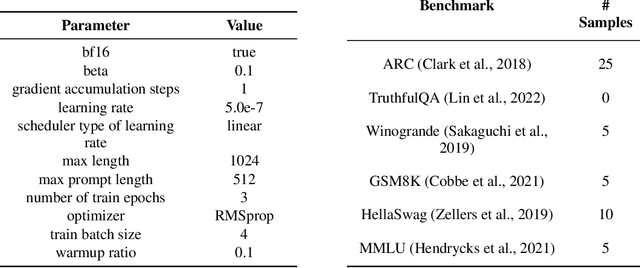
Although LLMs have achieved significant success, their reliance on large volumes of human-annotated data has limited their potential for further scaling. In this situation, utilizing self-generated synthetic data has become crucial for fine-tuning LLMs without extensive human annotation. However, current methods often fail to ensure consistent improvements across iterations, with performance stagnating after only minimal updates. To overcome these challenges, we introduce Dynamic Noise Preference Optimization (DNPO). DNPO employs a dynamic sample labeling mechanism to construct preference pairs for training and introduces controlled, trainable noise into the preference optimization process. Our approach effectively prevents stagnation and enables continuous improvement. In experiments with Zephyr-7B, DNPO consistently outperforms existing methods, showing an average performance boost of 2.6% across multiple benchmarks. Additionally, DNPO shows a significant improvement in model-generated data quality, with a 29.4% win-loss rate gap compared to the baseline in GPT-4 evaluations. This highlights its effectiveness in enhancing model performance through iterative refinement.
UAV-Enabled Secure ISAC Against Dual Eavesdropping Threats: Joint Beamforming and Trajectory Design
Dec 27, 2024
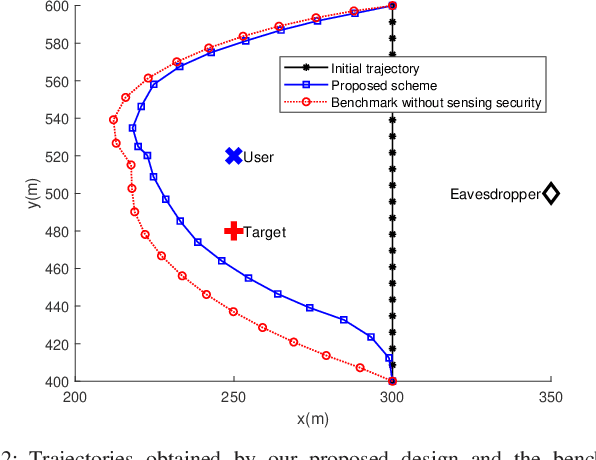
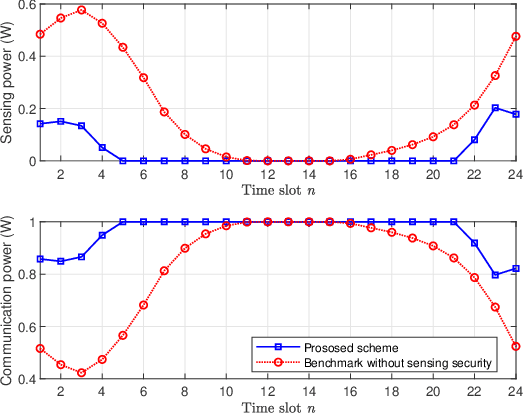
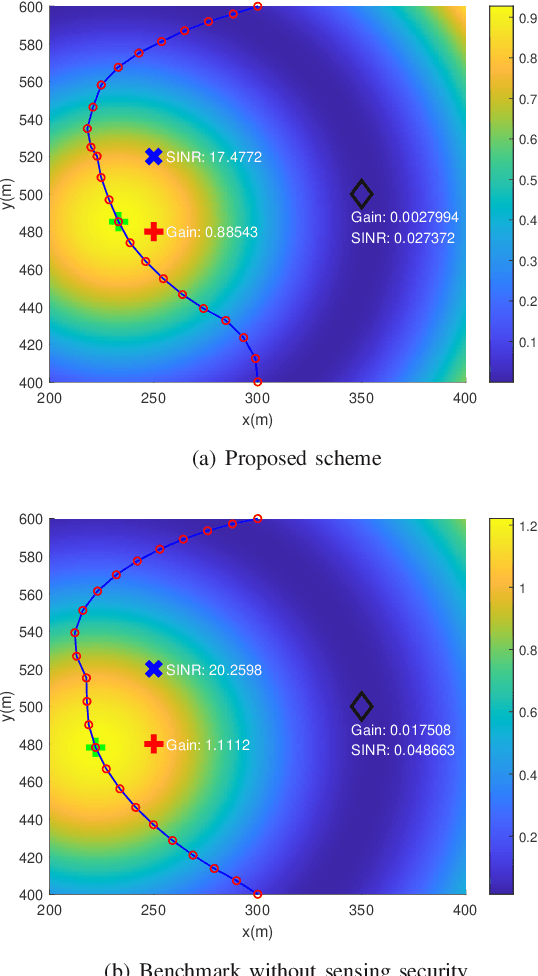
In this work, we study an unmanned aerial vehicle (UAV)-enabled secure integrated sensing and communication (ISAC) system, where a UAV serves as an aerial base station (BS) to simultaneously perform communication with a user and detect a target on the ground, while a dual-functional eavesdropper attempts to intercept the signals for both sensing and communication. Facing the dual eavesdropping threats, we aim to enhance the average achievable secrecy rate for the communication user by jointly designing the UAV trajectory together with the transmit information and sensing beamforming, while satisfying the requirements on sensing performance and sensing security, as well as the UAV power and flight constraints. To address the non-convex nature of the optimization problem, we employ the alternating optimization (AO) strategy, jointly with the successive convex approximation (SCA) and semidefinite relaxation (SDR) methods. Numerical results validate the proposed approach, demonstrating its ability to achieve a high secrecy rate while meeting the required sensing and security constraints.
Selective Kalman Filter: When and How to Fuse Multi-Sensor Information to Overcome Degeneracy in SLAM
Dec 23, 2024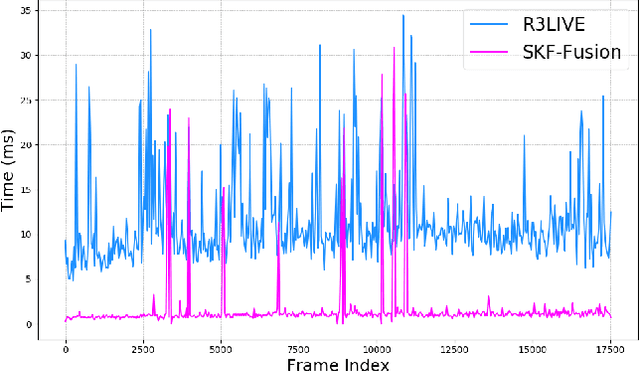
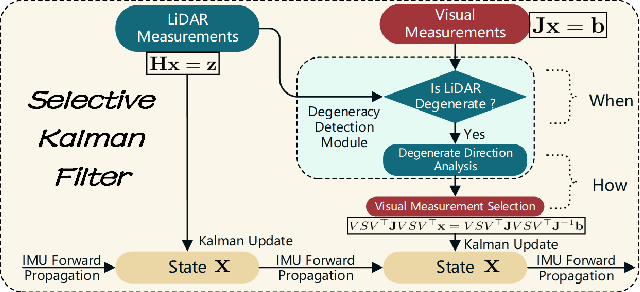
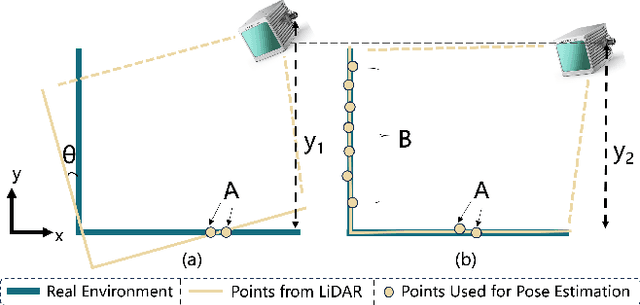
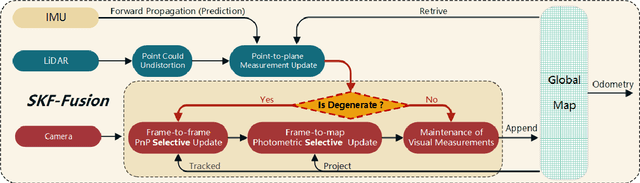
Research trends in SLAM systems are now focusing more on multi-sensor fusion to handle challenging and degenerative environments. However, most existing multi-sensor fusion SLAM methods mainly use all of the data from a range of sensors, a strategy we refer to as the all-in method. This method, while merging the benefits of different sensors, also brings in their weaknesses, lowering the robustness and accuracy and leading to high computational demands. To address this, we propose a new fusion approach -- Selective Kalman Filter -- to carefully choose and fuse information from multiple sensors (using LiDAR and visual observations as examples in this paper). For deciding when to fuse data, we implement degeneracy detection in LiDAR SLAM, incorporating visual measurements only when LiDAR SLAM exhibits degeneracy. Regarding degeneracy detection, we propose an elegant yet straightforward approach to determine the degeneracy of LiDAR SLAM and to identify the specific degenerative direction. This method fully considers the coupled relationship between rotational and translational constraints. In terms of how to fuse data, we use visual measurements only to update the specific degenerative states. As a result, our proposed method improves upon the all-in method by greatly enhancing real-time performance due to less processing visual data, and it introduces fewer errors from visual measurements. Experiments demonstrate that our method for degeneracy detection and fusion, in addressing degeneracy issues, exhibits higher precision and robustness compared to other state-of-the-art methods, and offers enhanced real-time performance relative to the all-in method. The code is openly available.
Large-Scale UWB Anchor Calibration and One-Shot Localization Using Gaussian Process
Dec 22, 2024


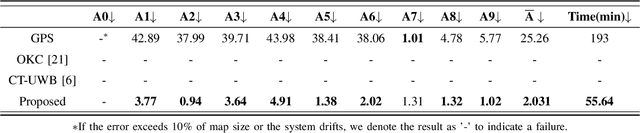
Ultra-wideband (UWB) is gaining popularity with devices like AirTags for precise home item localization but faces significant challenges when scaled to large environments like seaports. The main challenges are calibration and localization in obstructed conditions, which are common in logistics environments. Traditional calibration methods, dependent on line-of-sight (LoS), are slow, costly, and unreliable in seaports and warehouses, making large-scale localization a significant pain point in the industry. To overcome these challenges, we propose a UWB-LiDAR fusion-based calibration and one-shot localization framework. Our method uses Gaussian Processes to estimate anchor position from continuous-time LiDAR Inertial Odometry with sampled UWB ranges. This approach ensures accurate and reliable calibration with just one round of sampling in large-scale areas, I.e., 600x450 square meter. With the LoS issues, UWB-only localization can be problematic, even when anchor positions are known. We demonstrate that by applying a UWB-range filter, the search range for LiDAR loop closure descriptors is significantly reduced, improving both accuracy and speed. This concept can be applied to other loop closure detection methods, enabling cost-effective localization in large-scale warehouses and seaports. It significantly improves precision in challenging environments where UWB-only and LiDAR-Inertial methods fall short, as shown in the video \url{https://youtu.be/oY8jQKdM7lU }. We will open-source our datasets and calibration codes for community use.