 Add to Chrome
 Add to Firefox
 Add to Edge
Structures Facilitate Retrieve, Rerank, and Generate
Jun 02, 2026
Document-grounded dialogue systems (DGDS) utilize knowledge from external documents to answer domain-specific user questions. Existing solutions typically divide documents into independent passages for retrieval and response generation. This approach, however, neither makes good use of structural information within documents nor provides enough (document) context for knowledge selection and responses. This paper proposes SF-Re2G to address such issues systematically. Firstly, we seek to improve a passage representation by contrasting it with others of the same section, thus improving the retrieval performance. Secondly, a structure-enhanced reranker is built, leveraging the fact that multiple grounding passages of one dialog turn tend to be in the same neighborhood. Specifically, candidates from the retrieval are grouped into subgraphs according to the document structure. The reranker will rescore the candidate integrating its group information. Finally, the chosen passages are used for responses, taking into account the subgraph context for better generation. Experimental results on two DGDS datasets validate our method for both Chinese and English.

MiMIC: Mitigating Visual Modality Collapse in Universal Multimodal Retrieval While Avoiding Semantic Misalignment
Apr 23, 2026Universal Multimodal Retrieval (UMR) aims to map different modalities (e.g., visual and textual) into a shared embedding space for multi-modal retrieval. Existing UMR methods can be broadly divided into two categories: early-fusion approaches, such as Marvel, which projects visual features into the language model (LM) space for integrating with text modality, and late-fusion approaches, such as UniVL-DR, which encode visual and textual inputs using separate encoders and obtain fused embeddings through addition. Our pilot study reveals that Marvel exhibits visual modality collapse, which is characterized by the model's tendency to disregard visual features while depending excessively on textual cues. In contrast, although UniVL-DR is less affected by this issue, it is more susceptible to semantic misalignment, where semantically related content is positioned far apart in the embedding space. To address these challenges, we propose MiMIC, which introduces two key innovations: (1) a fusion-in-decoder architecture for effective multimodal integration, and (2) robust training through single modality mixin and random caption dropout. Experiments on the WebQA+ and EVQA+ datasets, where image in documents or queries might lack captions, indicate that MiMIC consistently outperforms both early- and late-fusion baselines.
TrigReason: Trigger-Based Collaboration between Small and Large Reasoning Models
Apr 16, 2026Large Reasoning Models (LRMs) achieve strong performance on complex tasks through extended chains of thought but suffer from high inference latency due to autoregressive reasoning. Recent work explores using Small Reasoning Models (SRMs) to accelerate LRM inference. In this paper, we systematically characterize the capability boundaries of SRMs and identify three common types of reasoning risks: (1) path divergence, where SRMs lack the strategic ability to construct an initial plan, causing reasoning to deviate from the most probable path; (2) cognitive overload, where SRMs fail to solve particularly difficult steps; and (3) recovery inability, where SRMs lack robust self-reflection and error correction mechanisms. To address these challenges, we propose TrigReason, a trigger-based collaborative reasoning framework that replaces continuous polling with selective intervention. TrigReason delegates most reasoning to the SRM and activates LRM intervention only when necessary-during initial strategic planning (strategic priming trigger), upon detecting extraordinary overconfidence (cognitive offload trigger), or when reasoning falls into unproductive loops (intervention request trigger). The evaluation results on AIME24, AIME25, and GPQA-D indicate that TrigReason matches the accuracy of full LRMs and SpecReason, while offloading 1.70x - 4.79x more reasoning steps to SRMs. Under edge-cloud conditions, TrigReason reduces latency by 43.9\% and API cost by 73.3\%. Our code is available at \href{https://github.com/QQQ-yi/TrigReason}{https://github.com/QQQ-yi/TrigReason}
LifeBench: A Benchmark for Long-Horizon Multi-Source Memory
Mar 04, 2026Long-term memory is fundamental for personalized agents capable of accumulating knowledge, reasoning over user experiences, and adapting across time. However, existing memory benchmarks primarily target declarative memory, specifically semantic and episodic types, where all information is explicitly presented in dialogues. In contrast, real-world actions are also governed by non-declarative memory, including habitual and procedural types, and need to be inferred from diverse digital traces. To bridge this gap, we introduce Lifebench, which features densely connected, long-horizon event simulation. It pushes AI agents beyond simple recall, requiring the integration of declarative and non-declarative memory reasoning across diverse and temporally extended contexts. Building such a benchmark presents two key challenges: ensuring data quality and scalability. We maintain data quality by employing real-world priors, including anonymized social surveys, map APIs, and holiday-integrated calendars, thus enforcing fidelity, diversity and behavioral rationality within the dataset. Towards scalability, we draw inspiration from cognitive science and structure events according to their partonomic hierarchy; enabling efficient parallel generation while maintaining global coherence. Performance results show that top-tier, state-of-the-art memory systems reach just 55.2\% accuracy, highlighting the inherent difficulty of long-horizon retrieval and multi-source integration within our proposed benchmark. The dataset and data synthesis code are available at https://github.com/1754955896/LifeBench.
LLM-based Embeddings: Attention Values Encode Sentence Semantics Better Than Hidden States
Feb 02, 2026Sentence representations are foundational to many Natural Language Processing (NLP) applications. While recent methods leverage Large Language Models (LLMs) to derive sentence representations, most rely on final-layer hidden states, which are optimized for next-token prediction and thus often fail to capture global, sentence-level semantics. This paper introduces a novel perspective, demonstrating that attention value vectors capture sentence semantics more effectively than hidden states. We propose Value Aggregation (VA), a simple method that pools token values across multiple layers and token indices. In a training-free setting, VA outperforms other LLM-based embeddings, even matches or surpasses the ensemble-based MetaEOL. Furthermore, we demonstrate that when paired with suitable prompts, the layer attention outputs can be interpreted as aligned weighted value vectors. Specifically, the attention scores of the last token function as the weights, while the output projection matrix ($W_O$) aligns these weighted value vectors with the common space of the LLM residual stream. This refined method, termed Aligned Weighted VA (AlignedWVA), achieves state-of-the-art performance among training-free LLM-based embeddings, outperforming the high-cost MetaEOL by a substantial margin. Finally, we highlight the potential of obtaining strong LLM embedding models through fine-tuning Value Aggregation.
LLMs Meet Isolation Kernel: Lightweight, Learning-free Binary Embeddings for Fast Retrieval
Jan 14, 2026Large language models (LLMs) have recently enabled remarkable progress in text representation. However, their embeddings are typically high-dimensional, leading to substantial storage and retrieval overhead. Although recent approaches such as Matryoshka Representation Learning (MRL) and Contrastive Sparse Representation (CSR) alleviate these issues to some extent, they still suffer from retrieval accuracy degradation. This paper proposes \emph{Isolation Kernel Embedding} or IKE, a learning-free method that transforms an LLM embedding into a binary embedding using Isolation Kernel (IK). IKE is an ensemble of diverse (random) partitions, enabling robust estimation of ideal kernel in the LLM embedding space, thus reducing retrieval accuracy loss as the ensemble grows. Lightweight and based on binary encoding, it offers low memory footprint and fast bitwise computation, lowering retrieval latency. Experiments on multiple text retrieval datasets demonstrate that IKE offers up to 16.7x faster retrieval and 16x lower memory usage than LLM embeddings, while maintaining comparable or better accuracy. Compared to CSR and other compression methods, IKE consistently achieves the best balance between retrieval efficiency and effectiveness.
Retrospex: Language Agent Meets Offline Reinforcement Learning Critic
May 17, 2025Large Language Models (LLMs) possess extensive knowledge and commonsense reasoning capabilities, making them valuable for creating powerful agents. However, existing LLM agent frameworks have not fully utilized past experiences for improvement. This work introduces a new LLM-based agent framework called Retrospex, which addresses this challenge by analyzing past experiences in depth. Unlike previous approaches, Retrospex does not directly integrate experiences into the LLM's context. Instead, it combines the LLM's action likelihood with action values estimated by a Reinforcement Learning (RL) Critic, which is trained on past experiences through an offline ''retrospection'' process. Additionally, Retrospex employs a dynamic action rescoring mechanism that increases the importance of experience-based values for tasks that require more interaction with the environment. We evaluate Retrospex in ScienceWorld, ALFWorld and Webshop environments, demonstrating its advantages over strong, contemporary baselines.
* 17 pages
Corporate Fraud Detection in Rich-yet-Noisy Financial Graph
Feb 26, 2025Corporate fraud detection aims to automatically recognize companies that conduct wrongful activities such as fraudulent financial statements or illegal insider trading. Previous learning-based methods fail to effectively integrate rich interactions in the company network. To close this gap, we collect 18-year financial records in China to form three graph datasets with fraud labels. We analyze the characteristics of the financial graphs, highlighting two pronounced issues: (1) information overload: the dominance of (noisy) non-company nodes over company nodes hinders the message-passing process in Graph Convolution Networks (GCN); and (2) hidden fraud: there exists a large percentage of possible undetected violations in the collected data. The hidden fraud problem will introduce noisy labels in the training dataset and compromise fraud detection results. To handle such challenges, we propose a novel graph-based method, namely, Knowledge-enhanced GCN with Robust Two-stage Learning (${\rm KeGCN}_{R}$), which leverages Knowledge Graph Embeddings to mitigate the information overload and effectively learns rich representations. The proposed model adopts a two-stage learning method to enhance robustness against hidden frauds. Extensive experimental results not only confirm the importance of interactions but also show the superiority of ${\rm KeGCN}_{R}$ over a number of strong baselines in terms of fraud detection effectiveness and robustness.
SynthDoc: Bilingual Documents Synthesis for Visual Document Understanding
Aug 27, 2024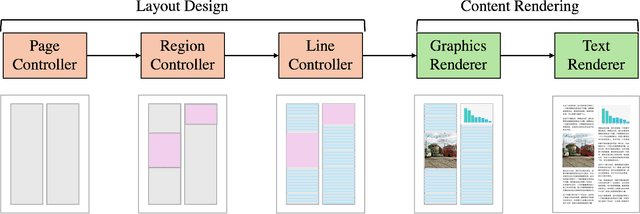
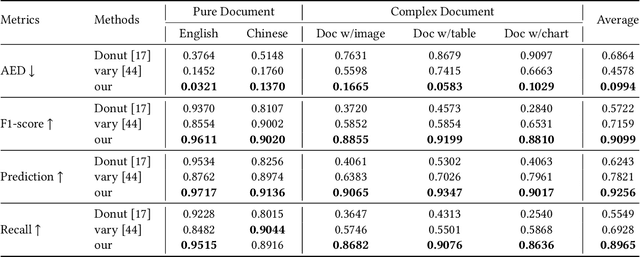
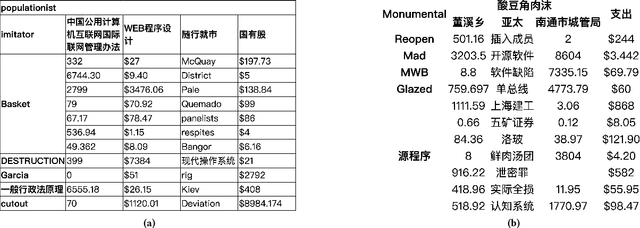
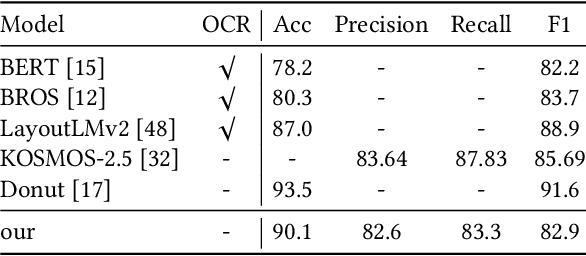
This paper introduces SynthDoc, a novel synthetic document generation pipeline designed to enhance Visual Document Understanding (VDU) by generating high-quality, diverse datasets that include text, images, tables, and charts. Addressing the challenges of data acquisition and the limitations of existing datasets, SynthDoc leverages publicly available corpora and advanced rendering tools to create a comprehensive and versatile dataset. Our experiments, conducted using the Donut model, demonstrate that models trained with SynthDoc's data achieve superior performance in pre-training read tasks and maintain robustness in downstream tasks, despite language inconsistencies. The release of a benchmark dataset comprising 5,000 image-text pairs not only showcases the pipeline's capabilities but also provides a valuable resource for the VDU community to advance research and development in document image recognition. This work significantly contributes to the field by offering a scalable solution to data scarcity and by validating the efficacy of end-to-end models in parsing complex, real-world documents.
Mixed Preference Optimization: Reinforcement Learning with Data Selection and Better Reference Model
Mar 28, 2024Large Language Models (LLMs) have become increasingly popular due to their ability to process and generate natural language. However, as they are trained on massive datasets of text, LLMs can inherit harmful biases and produce outputs that are not aligned with human values. This paper studies two main approaches to LLM alignment: Reinforcement Learning with Human Feedback (RLHF) and contrastive learning-based methods like Direct Preference Optimization (DPO). By analyzing the stability and robustness of RLHF and DPO, we propose MPO (Mixed Preference Optimization), a novel method that mitigates the weaknesses of both approaches. Specifically, we propose a two-stage training procedure: first train DPO on an easy dataset, and then perform RLHF on a difficult set with DPO model being the reference model. Here, the easy and difficult sets are constructed by a well-trained reward model that splits response pairs into those with large gaps of reward (easy), and those with small gaps (difficult). The first stage allows us to obtain a relatively optimal policy (LLM) model quickly, whereas the second stage refines LLM with online RLHF, thus mitigating the distribution shift issue associated with DPO. Experiments are conducted on two public alignment datasets, namely HH-RLHF and TLDR, demonstrating the effectiveness of MPO, both in terms of GPT4 and human evaluation.