 Add to Chrome
 Add to Firefox
 Add to Edge
MedDDC-Eval: Diagnosis-Decoupled Evaluation of Multi-Turn Medical Consultation Agents
Jul 21, 2026
Multi-turn medical consultation agents must decide what to ask, adapt to patient responses, and determine when the collected evidence is sufficient. However, coupled evaluation conflates the quality of the policy-elicited history with policy-specific terminal diagnosis generation: strong generation can compensate for a thin history, while weaker generation can obscure a rich one. We introduce MedDDC-Eval, a diagnosis-decoupled testbed that treats elicited history as the comparison object and holds the history-to-diagnosis mapping constant through a shared frozen reader. Across two held-out sources, a grounded interface and an auditable diagnosis-trajectory-efficiency (D/T/E) harness measure diagnostic usefulness, information acquisition, and efficiency. Directional semantic coverage followed by deterministic one-to-one assignment yields coherent precision-recall counts for open-ended items, with at most one credited match per prediction or reference. Holding histories fixed, changing only the diagnostic reader shifts diagnosis F1 by 2.2-19.0 points and reverses 18% and 36% of pairwise policy orderings on the Record and Dialogue splits. We further apply standard Group Relative Policy Optimization (GRPO) over interactive multi-turn rollouts to post-train Qwen3-32B using diagnosis-result and trajectory feedback. On the 100-case Record and 70-case Dialogue splits, the trained policy improves over its initialization by 9.7 and 4.6 total-score points; removing either primary signal lowers held-out joint performance. These results show that MedDDC-Eval supports controlled attribution, interpretable elicited-history measurement, and evaluation-guided evidence-acquisition policy development.

PACT: Learning Diverse Diagnostic Strategies via Privileged Synthesis and Branch Consensus
Jun 08, 2026Clinical diagnosis requires flexible use of multiple reasoning paradigms under incomplete patient information. Existing LLM-based medical agents show strong medical reasoning ability, but single-paradigm or naively mixed dialogue supervision makes these paradigms difficult to learn without interference. We propose \textbf{PACT} (Periodic Anchor Consensus Training), a framework that couples supervised multi-paradigm dialogue synthesis with consensus-based Branch training. At the data level, \textbf{DPS} (Doctor-Patient-Supervisor) uses complete electronic medical records (EMRs) for quality control while keeping the doctor agent restricted to patient-visible information. This produces validated dialogues under four diagnostic reasoning paradigms without leaking hidden clinical answers. At the training level, PACT trains one paradigm-specific LoRA Branch per paradigm and periodically aggregates Branches into a shared Anchor through sign consensus. We further construct a dynamic multi-turn Chinese medical diagnosis benchmark for interactive consultation. Experiments show that PACT achieves state-of-the-art performance among compared proprietary, medical-specialized, and task-adapted baselines on diagnostic outcome and consultation-process metrics.
C-MIG: Multi-view Information Gain-based Retrieval-Augmented Generation for Clinical Diagnosis Reasoning
May 27, 2026Retrieval-augmented generation combined with reinforcement learning has shown promise for grounding large language models in trustworthy medical evidence. However, existing methods rely on exact-match binary rewards, which in clinical diagnosis cause two issues: (i) semantically relevant but non-verbatim steps receive zero signal, discarding valuable learning signals; and (ii) uni-dimensional rewards cannot effectively supervise heterogeneous reasoning capabilities. To address these issues, we propose C-MIG, a Multi-view Information Gain-based retrieval-augmented generation framework for Clinical diagnosis. C-MIG estimates information gain under a frozen reference model from two complementary views, retrieved-document and document-refinement, to jointly guide what to retrieve and how to refine, alleviating the issues of valuable reward signal loss and credit assignment. We further design a multi-subquery retrieval augmentation strategy that improves knowledge recall coverage in clinical diagnostic scenarios. Comprehensive experiments on four medical benchmarks demonstrate that C-MIG achieves the best performance among all RAG-RL methods on both in-domain and out-of-domain sets, and outperforms state-of-the-art general-purpose LLMs for clinical diagnosis.
EAPO: Entropy-Driven Adaptive Positive-Negative Sample Weighting for Policy Optimization in Open-Ended QA
May 27, 2026Large Reasoning Models are typically trained via reinforcement learning from verifiable rewards (RLVR). However, existing approaches adopt fixed weights for positive and negative samples, and the conclusions hardly generalize to open-ended question answering (QA). In this paper, we systematically investigate the roles of positive and negative samples in reinforcement learning for open-ended QA. We propose a reward-mean-based strategy for distinguishing positive from negative samples, and observe that negative samples predominantly govern response diversity and the performance upper bound, whereas positive samples primarily determine response quality and convergence stability. Building on these observations, we propose EAPO, an Entropy-driven Adaptive Policy Optimization method that adaptively computes the weighting coefficients of positive samples based on the ratio of the current policy entropy to the initial entropy. During the entropy-decreasing phase, the weight assigned to positive samples is reduced to preserve exploration, whereas during the entropy-increasing phase it is amplified to reinforce stability, thereby mitigating entropy collapse. Experiments on two publicly available open-ended medical QA datasets demonstrate that EAPO consistently and substantially outperforms fixed-weight baselines in both response diversity and stability.
Dr. Assistant: Enhancing Clinical Diagnostic Inquiry via Structured Diagnostic Reasoning Data and Reinforcement Learning
Jan 20, 2026Clinical Decision Support Systems (CDSSs) provide reasoning and inquiry guidance for physicians, yet they face notable challenges, including high maintenance costs and low generalization capability. Recently, Large Language Models (LLMs) have been widely adopted in healthcare due to their extensive knowledge reserves, retrieval, and communication capabilities. While LLMs show promise and excel at medical benchmarks, their diagnostic reasoning and inquiry skills are constrained. To mitigate this issue, we propose (1) Clinical Diagnostic Reasoning Data (CDRD) structure to capture abstract clinical reasoning logic, and a pipeline for its construction, and (2) the Dr. Assistant, a clinical diagnostic model equipped with clinical reasoning and inquiry skills. Its training involves a two-stage process: SFT, followed by RL with a tailored reward function. We also introduce a benchmark to evaluate both diagnostic reasoning and inquiry. Our experiments demonstrate that the Dr. Assistant outperforms open-source models and achieves competitive performance to closed-source models, providing an effective solution for clinical diagnostic inquiry guidance.
Breaking the Exploration Bottleneck: Rubric-Scaffolded Reinforcement Learning for General LLM Reasoning
Aug 23, 2025Recent advances in Large Language Models (LLMs) have underscored the potential of Reinforcement Learning (RL) to facilitate the emergence of reasoning capabilities. Despite the encouraging results, a fundamental dilemma persists as RL improvement relies on learning from high-quality samples, yet the exploration for such samples remains bounded by the inherent limitations of LLMs. This, in effect, creates an undesirable cycle in which what cannot be explored cannot be learned. In this work, we propose Rubric-Scaffolded Reinforcement Learning (RuscaRL), a novel instructional scaffolding framework designed to break the exploration bottleneck for general LLM reasoning. Specifically, RuscaRL introduces checklist-style rubrics as (1) explicit scaffolding for exploration during rollout generation, where different rubrics are provided as external guidance within task instructions to steer diverse high-quality responses. This guidance is gradually decayed over time, encouraging the model to internalize the underlying reasoning patterns; (2) verifiable rewards for exploitation during model training, where we can obtain robust LLM-as-a-Judge scores using rubrics as references, enabling effective RL on general reasoning tasks. Extensive experiments demonstrate the superiority of the proposed RuscaRL across various benchmarks, effectively expanding reasoning boundaries under the best-of-N evaluation. Notably, RuscaRL significantly boosts Qwen-2.5-7B-Instruct from 23.6 to 50.3 on HealthBench-500, surpassing GPT-4.1. Furthermore, our fine-tuned variant on Qwen3-30B-A3B-Instruct achieves 61.1 on HealthBench-500, outperforming leading LLMs including OpenAI-o3.
MUSIED: A Benchmark for Event Detection from Multi-Source Heterogeneous Informal Texts
Nov 25, 2022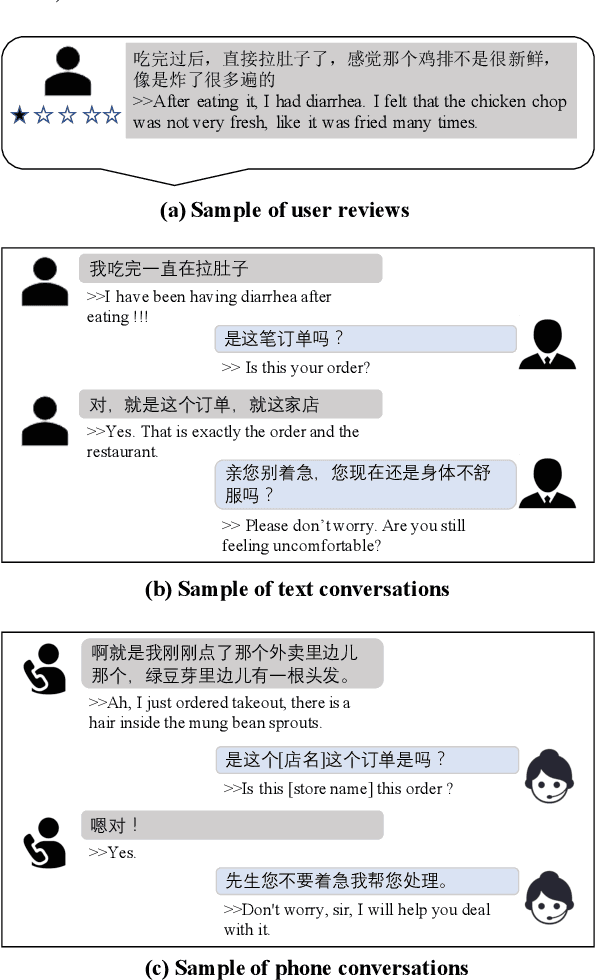



Event detection (ED) identifies and classifies event triggers from unstructured texts, serving as a fundamental task for information extraction. Despite the remarkable progress achieved in the past several years, most research efforts focus on detecting events from formal texts (e.g., news articles, Wikipedia documents, financial announcements). Moreover, the texts in each dataset are either from a single source or multiple yet relatively homogeneous sources. With massive amounts of user-generated text accumulating on the Web and inside enterprises, identifying meaningful events in these informal texts, usually from multiple heterogeneous sources, has become a problem of significant practical value. As a pioneering exploration that expands event detection to the scenarios involving informal and heterogeneous texts, we propose a new large-scale Chinese event detection dataset based on user reviews, text conversations, and phone conversations in a leading e-commerce platform for food service. We carefully investigate the proposed dataset's textual informality and multi-source heterogeneity characteristics by inspecting data samples quantitatively and qualitatively. Extensive experiments with state-of-the-art event detection methods verify the unique challenges posed by these characteristics, indicating that multi-source informal event detection remains an open problem and requires further efforts. Our benchmark and code are released at \url{https://github.com/myeclipse/MUSIED}.