 Add to Chrome
 Add to Firefox
 Add to Edge
SaENeRF: Suppressing Artifacts in Event-based Neural Radiance Fields
Apr 23, 2025
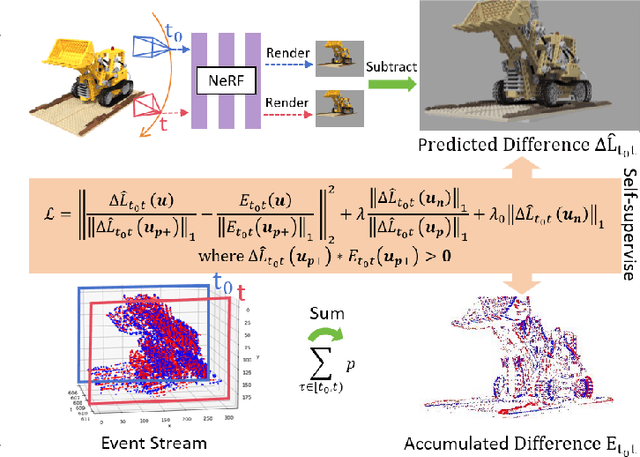
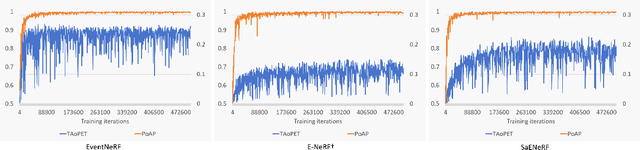
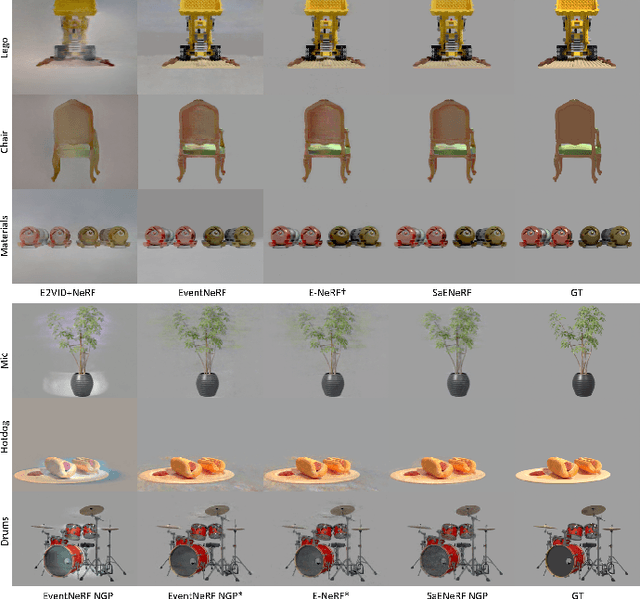
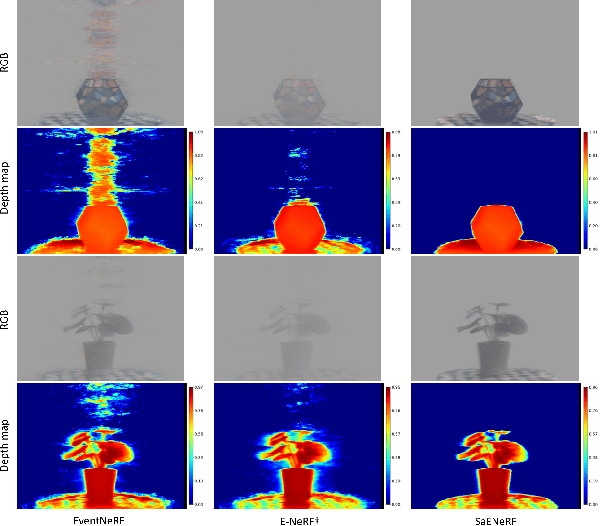
Event cameras are neuromorphic vision sensors that asynchronously capture changes in logarithmic brightness changes, offering significant advantages such as low latency, low power consumption, low bandwidth, and high dynamic range. While these characteristics make them ideal for high-speed scenarios, reconstructing geometrically consistent and photometrically accurate 3D representations from event data remains fundamentally challenging. Current event-based Neural Radiance Fields (NeRF) methods partially address these challenges but suffer from persistent artifacts caused by aggressive network learning in early stages and the inherent noise of event cameras. To overcome these limitations, we present SaENeRF, a novel self-supervised framework that effectively suppresses artifacts and enables 3D-consistent, dense, and photorealistic NeRF reconstruction of static scenes solely from event streams. Our approach normalizes predicted radiance variations based on accumulated event polarities, facilitating progressive and rapid learning for scene representation construction. Additionally, we introduce regularization losses specifically designed to suppress artifacts in regions where photometric changes fall below the event threshold and simultaneously enhance the light intensity difference of non-zero events, thereby improving the visual fidelity of the reconstructed scene. Extensive qualitative and quantitative experiments demonstrate that our method significantly reduces artifacts and achieves superior reconstruction quality compared to existing methods. The code is available at https://github.com/Mr-firework/SaENeRF.

Memory-Augmented Dual-Decoder Networks for Multi-Class Unsupervised Anomaly Detection
Apr 21, 2025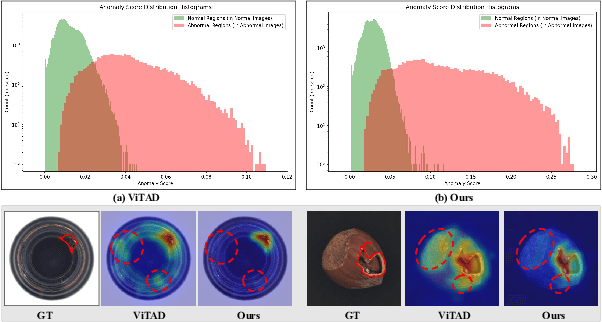
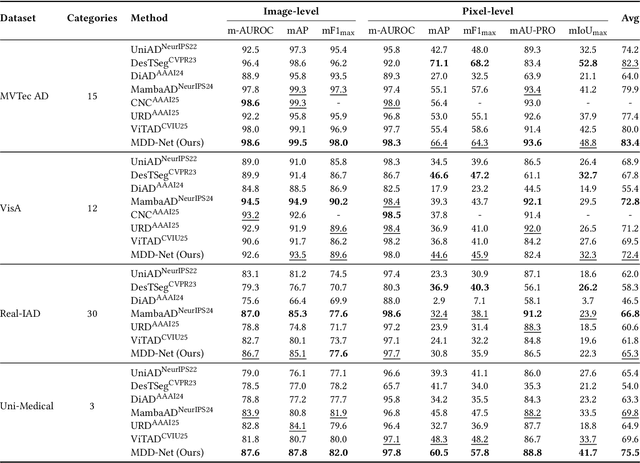
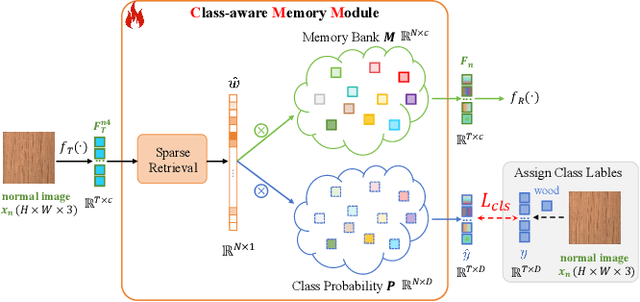
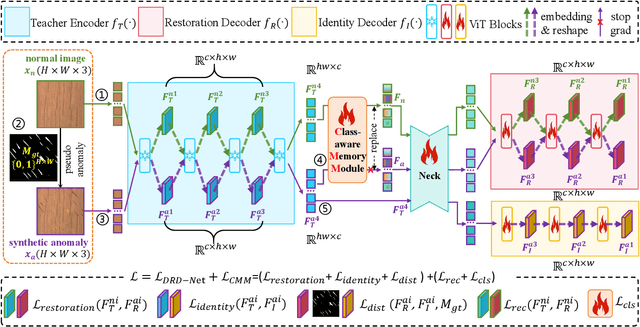
Recent advances in unsupervised anomaly detection (UAD) have shifted from single-class to multi-class scenarios. In such complex contexts, the increasing pattern diversity has brought two challenges to reconstruction-based approaches: (1) over-generalization: anomalies that are subtle or share compositional similarities with normal patterns may be reconstructed with high fidelity, making them difficult to distinguish from normal instances; and (2) insufficient normality reconstruction: complex normal features, such as intricate textures or fine-grained structures, may not be faithfully reconstructed due to the model's limited representational capacity, resulting in false positives. Existing methods typically focus on addressing the former, which unintentionally exacerbate the latter, resulting in inadequate representation of intricate normal patterns. To concurrently address these two challenges, we propose a Memory-augmented Dual-Decoder Networks (MDD-Net). This network includes two critical components: a Dual-Decoder Reverse Distillation Network (DRD-Net) and a Class-aware Memory Module (CMM). Specifically, the DRD-Net incorporates a restoration decoder designed to recover normal features from synthetic abnormal inputs and an identity decoder to reconstruct features that maintain the anomalous semantics. By exploiting the discrepancy between features produced by two decoders, our approach refines anomaly scores beyond the conventional encoder-decoder comparison paradigm, effectively reducing false positives and enhancing localization accuracy. Furthermore, the CMM explicitly encodes and preserves class-specific normal prototypes, actively steering the network away from anomaly reconstruction. Comprehensive experimental results across several benchmarks demonstrate the superior performance of our MDD-Net framework over current SoTA approaches in multi-class UAD tasks.
GPS: Distilling Compact Memories via Grid-based Patch Sampling for Efficient Online Class-Incremental Learning
Apr 15, 2025Online class-incremental learning aims to enable models to continuously adapt to new classes with limited access to past data, while mitigating catastrophic forgetting. Replay-based methods address this by maintaining a small memory buffer of previous samples, achieving competitive performance. For effective replay under constrained storage, recent approaches leverage distilled data to enhance the informativeness of memory. However, such approaches often involve significant computational overhead due to the use of bi-level optimization. Motivated by these limitations, we introduce Grid-based Patch Sampling (GPS), a lightweight and effective strategy for distilling informative memory samples without relying on a trainable model. GPS generates informative samples by sampling a subset of pixels from the original image, yielding compact low-resolution representations that preserve both semantic content and structural information. During replay, these representations are reassembled to support training and evaluation. Experiments on extensive benchmarks demonstrate that GRS can be seamlessly integrated into existing replay frameworks, leading to 3%-4% improvements in average end accuracy under memory-constrained settings, with limited computational overhead.
EBAD-Gaussian: Event-driven Bundle Adjusted Deblur Gaussian Splatting
Apr 14, 2025While 3D Gaussian Splatting (3D-GS) achieves photorealistic novel view synthesis, its performance degrades with motion blur. In scenarios with rapid motion or low-light conditions, existing RGB-based deblurring methods struggle to model camera pose and radiance changes during exposure, reducing reconstruction accuracy. Event cameras, capturing continuous brightness changes during exposure, can effectively assist in modeling motion blur and improving reconstruction quality. Therefore, we propose Event-driven Bundle Adjusted Deblur Gaussian Splatting (EBAD-Gaussian), which reconstructs sharp 3D Gaussians from event streams and severely blurred images. This method jointly learns the parameters of these Gaussians while recovering camera motion trajectories during exposure time. Specifically, we first construct a blur loss function by synthesizing multiple latent sharp images during the exposure time, minimizing the difference between real and synthesized blurred images. Then we use event stream to supervise the light intensity changes between latent sharp images at any time within the exposure period, supplementing the light intensity dynamic changes lost in RGB images. Furthermore, we optimize the latent sharp images at intermediate exposure times based on the event-based double integral (EDI) prior, applying consistency constraints to enhance the details and texture information of the reconstructed images. Extensive experiments on synthetic and real-world datasets show that EBAD-Gaussian can achieve high-quality 3D scene reconstruction under the condition of blurred images and event stream inputs.
Style Quantization for Data-Efficient GAN Training
Mar 31, 2025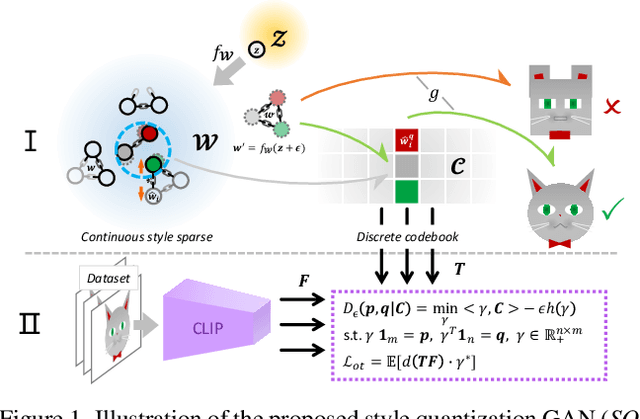
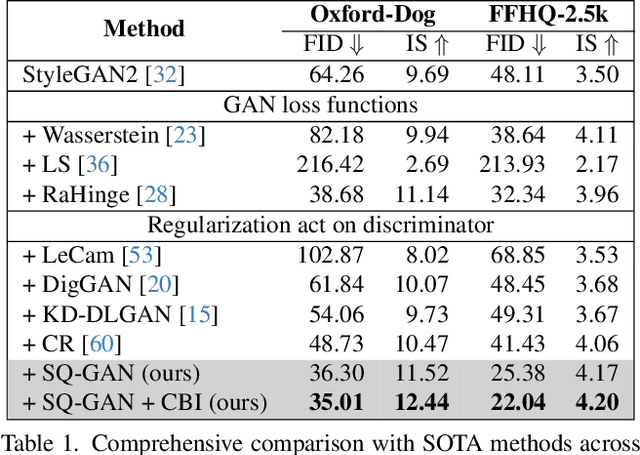
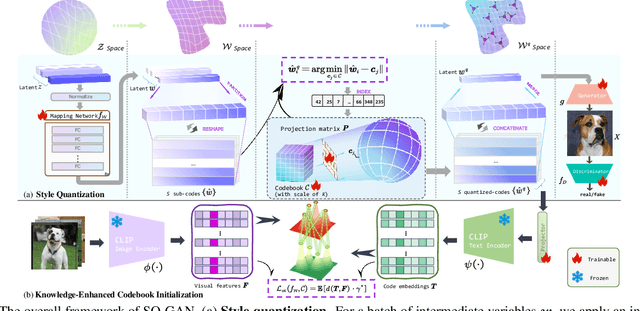
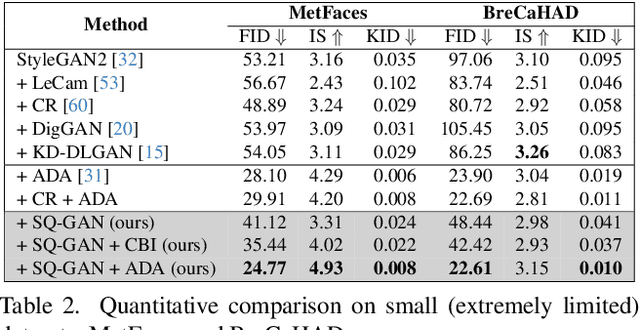
Under limited data setting, GANs often struggle to navigate and effectively exploit the input latent space. Consequently, images generated from adjacent variables in a sparse input latent space may exhibit significant discrepancies in realism, leading to suboptimal consistency regularization (CR) outcomes. To address this, we propose \textit{SQ-GAN}, a novel approach that enhances CR by introducing a style space quantization scheme. This method transforms the sparse, continuous input latent space into a compact, structured discrete proxy space, allowing each element to correspond to a specific real data point, thereby improving CR performance. Instead of direct quantization, we first map the input latent variables into a less entangled ``style'' space and apply quantization using a learnable codebook. This enables each quantized code to control distinct factors of variation. Additionally, we optimize the optimal transport distance to align the codebook codes with features extracted from the training data by a foundation model, embedding external knowledge into the codebook and establishing a semantically rich vocabulary that properly describes the training dataset. Extensive experiments demonstrate significant improvements in both discriminator robustness and generation quality with our method.
Aligning Information Capacity Between Vision and Language via Dense-to-Sparse Feature Distillation for Image-Text Matching
Mar 19, 2025Enabling Visual Semantic Models to effectively handle multi-view description matching has been a longstanding challenge. Existing methods typically learn a set of embeddings to find the optimal match for each view's text and compute similarity. However, the visual and text embeddings learned through these approaches have limited information capacity and are prone to interference from locally similar negative samples. To address this issue, we argue that the information capacity of embeddings is crucial and propose Dense-to-Sparse Feature Distilled Visual Semantic Embedding (D2S-VSE), which enhances the information capacity of sparse text by leveraging dense text distillation. Specifically, D2S-VSE is a two-stage framework. In the pre-training stage, we align images with dense text to enhance the information capacity of visual semantic embeddings. In the fine-tuning stage, we optimize two tasks simultaneously, distilling dense text embeddings to sparse text embeddings while aligning images and sparse texts, enhancing the information capacity of sparse text embeddings. Our proposed D2S-VSE model is extensively evaluated on the large-scale MS-COCO and Flickr30K datasets, demonstrating its superiority over recent state-of-the-art methods.
Ferret: An Efficient Online Continual Learning Framework under Varying Memory Constraints
Mar 15, 2025In the realm of high-frequency data streams, achieving real-time learning within varying memory constraints is paramount. This paper presents Ferret, a comprehensive framework designed to enhance online accuracy of Online Continual Learning (OCL) algorithms while dynamically adapting to varying memory budgets. Ferret employs a fine-grained pipeline parallelism strategy combined with an iterative gradient compensation algorithm, ensuring seamless handling of high-frequency data with minimal latency, and effectively counteracting the challenge of stale gradients in parallel training. To adapt to varying memory budgets, its automated model partitioning and pipeline planning optimizes performance regardless of memory limitations. Extensive experiments across 20 benchmarks and 5 integrated OCL algorithms show Ferret's remarkable efficiency, achieving up to 3.7$\times$ lower memory overhead to reach the same online accuracy compared to competing methods. Furthermore, Ferret consistently outperforms these methods across diverse memory budgets, underscoring its superior adaptability. These findings position Ferret as a premier solution for efficient and adaptive OCL framework in real-time environments.
Asymmetric Visual Semantic Embedding Framework for Efficient Vision-Language Alignment
Mar 10, 2025Learning visual semantic similarity is a critical challenge in bridging the gap between images and texts. However, there exist inherent variations between vision and language data, such as information density, i.e., images can contain textual information from multiple different views, which makes it difficult to compute the similarity between these two modalities accurately and efficiently. In this paper, we propose a novel framework called Asymmetric Visual Semantic Embedding (AVSE) to dynamically select features from various regions of images tailored to different textual inputs for similarity calculation. To capture information from different views in the image, we design a radial bias sampling module to sample image patches and obtain image features from various views, Furthermore, AVSE introduces a novel module for efficient computation of visual semantic similarity between asymmetric image and text embeddings. Central to this module is the presumption of foundational semantic units within the embeddings, denoted as ``meta-semantic embeddings." It segments all embeddings into meta-semantic embeddings with the same dimension and calculates visual semantic similarity by finding the optimal match of meta-semantic embeddings of two modalities. Our proposed AVSE model is extensively evaluated on the large-scale MS-COCO and Flickr30K datasets, demonstrating its superiority over recent state-of-the-art methods.
FAS: Fast ANN-SNN Conversion for Spiking Large Language Models
Feb 06, 2025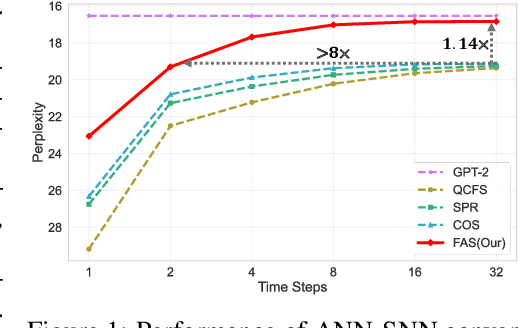
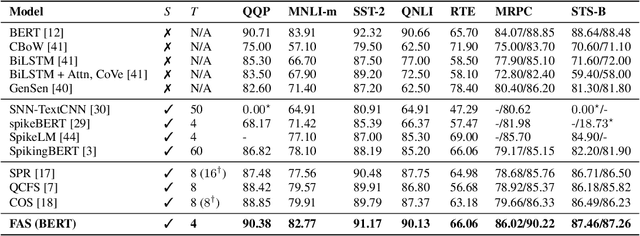
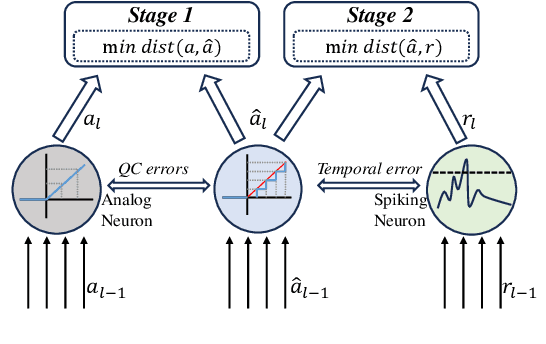
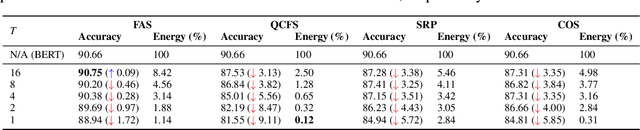
Spiking Large Language Models have been shown as a good alternative to LLMs in various scenarios. Existing methods for creating Spiking LLMs, i.e., direct training and ANN-SNN conversion, often suffer from performance degradation and relatively high computational costs. To address these issues, we propose a novel Fast ANN-SNN conversion strategy (FAS) that transforms LLMs into spiking LLMs in two stages. The first stage employs a full-parameter fine-tuning of pre-trained models, so it does not need any direct training from scratch. The second stage introduces a coarse-to-fine calibration method to reduce conversion errors and improve accuracy. Our experiments on both language and vision-language tasks across four different scales of LLMs demonstrate that FAS can achieve state-of-the-art performance yet with significantly reduced inference latency and computational costs. For example, FAS only takes 8 timesteps to achieve an accuracy of 3% higher than that of the OPT-7B model, while reducing energy consumption by 96.63%.
E-3SFC: Communication-Efficient Federated Learning with Double-way Features Synthesizing
Feb 05, 2025The exponential growth in model sizes has significantly increased the communication burden in Federated Learning (FL). Existing methods to alleviate this burden by transmitting compressed gradients often face high compression errors, which slow down the model's convergence. To simultaneously achieve high compression effectiveness and lower compression errors, we study the gradient compression problem from a novel perspective. Specifically, we propose a systematical algorithm termed Extended Single-Step Synthetic Features Compressing (E-3SFC), which consists of three sub-components, i.e., the Single-Step Synthetic Features Compressor (3SFC), a double-way compression algorithm, and a communication budget scheduler. First, we regard the process of gradient computation of a model as decompressing gradients from corresponding inputs, while the inverse process is considered as compressing the gradients. Based on this, we introduce a novel gradient compression method termed 3SFC, which utilizes the model itself as a decompressor, leveraging training priors such as model weights and objective functions. 3SFC compresses raw gradients into tiny synthetic features in a single-step simulation, incorporating error feedback to minimize overall compression errors. To further reduce communication overhead, 3SFC is extended to E-3SFC, allowing double-way compression and dynamic communication budget scheduling. Our theoretical analysis under both strongly convex and non-convex conditions demonstrates that 3SFC achieves linear and sub-linear convergence rates with aggregation noise. Extensive experiments across six datasets and six models reveal that 3SFC outperforms state-of-the-art methods by up to 13.4% while reducing communication costs by 111.6 times. These findings suggest that 3SFC can significantly enhance communication efficiency in FL without compromising model performance.