 Add to Chrome
 Add to Firefox
 Add to Edge
OneModel: A Unified Foundation for Platform-Scale Multi-Scenario Ranking
Aug 20, 2026
Platform-scale recommender systems often span multiple business streams such as organic recommendation, advertising, and merchant services, where user behaviors form a continuous cross-stream trajectory. Maintaining separate ranking systems fragments user representations and increases engineering cost. We propose \textbf{OneModel}, a unified framework for multi-stream final ranking. OneModel maps heterogeneous behaviors into shared event sequences, learns long-context user representations with an action-oriented backbone, and introduces \emph{Scenario-aware Information Modulation} to balance cross-stream transfer and stream-specific specialization. For production deployment, OneModel further adopts stratified user representation, multi-objective training, and optimized online serving with feature decomposition, user feature prefetching, shared user-tower computation, and graph-level inference optimization. We deploy OneModel in production at \emph{Xiaohongshu}, where it delivers consistent offline gains over strong baselines and scales favorably with context length and model capacity. Online A/B tests improve Time Spent by \textbf{+0.33\%} and Engagement by \textbf{+1.25\%} in Explore Feed, lift advertising value by \textbf{+3.43\%} and CTR by \textbf{+8.18\%} in Feed Advertising, and raise DGMV by \textbf{+1.1867\%} and GPM by \textbf{+2.1585\%} in Merchant Recommendation, validating unified multi-stream ranking as an effective production foundation.

SHARK: A Lightweight Model Compression Approach for Large-scale Recommender Systems
Aug 18, 2023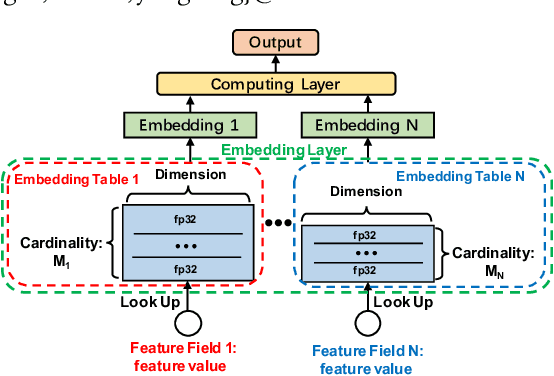
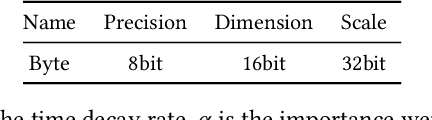

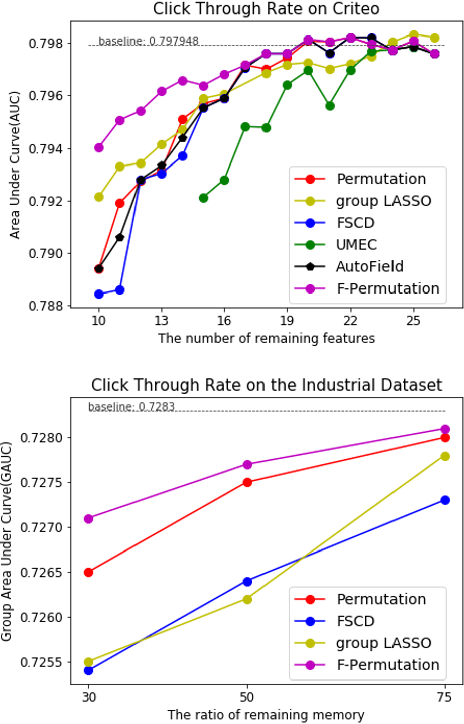
Increasing the size of embedding layers has shown to be effective in improving the performance of recommendation models, yet gradually causing their sizes to exceed terabytes in industrial recommender systems, and hence the increase of computing and storage costs. To save resources while maintaining model performances, we propose SHARK, the model compression practice we have summarized in the recommender system of industrial scenarios. SHARK consists of two main components. First, we use the novel first-order component of Taylor expansion as importance scores to prune the number of embedding tables (feature fields). Second, we introduce a new row-wise quantization method to apply different quantization strategies to each embedding. We conduct extensive experiments on both public and industrial datasets, demonstrating that each component of our proposed SHARK framework outperforms previous approaches. We conduct A/B tests in multiple models on Kuaishou, such as short video, e-commerce, and advertising recommendation models. The results of the online A/B test showed SHARK can effectively reduce the memory footprint of the embedded layer. For the short-video scenarios, the compressed model without any performance drop significantly saves 70% storage and thousands of machines, improves 30\% queries per second (QPS), and has been deployed to serve hundreds of millions of users and process tens of billions of requests every day.