 Add to Chrome
 Add to Firefox
 Add to Edge
MAPPO-PIS: A Multi-Agent Proximal Policy Optimization Method with Prior Intent Sharing for CAVs' Cooperative Decision-Making
Aug 13, 2024
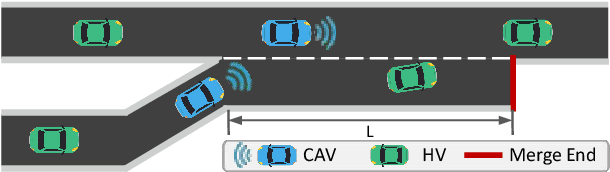
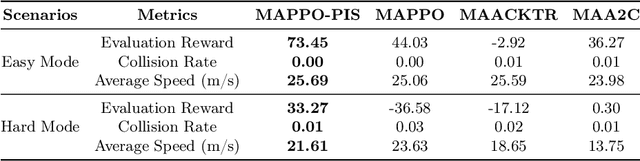
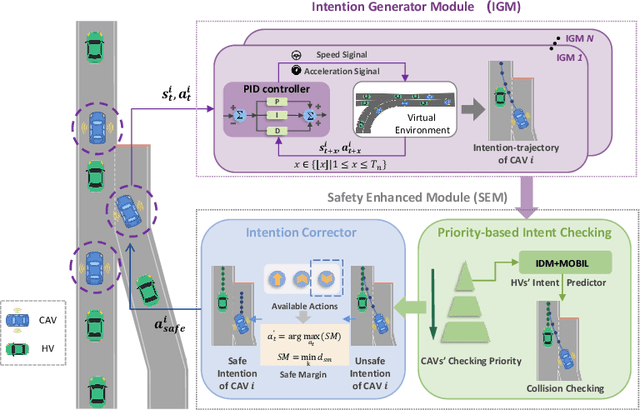
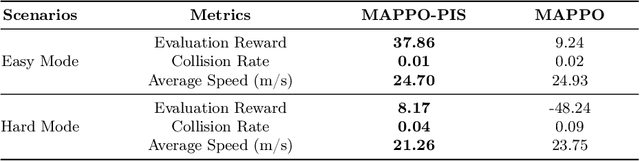
Vehicle-to-Vehicle (V2V) technologies have great potential for enhancing traffic flow efficiency and safety. However, cooperative decision-making in multi-agent systems, particularly in complex human-machine mixed merging areas, remains challenging for connected and autonomous vehicles (CAVs). Intent sharing, a key aspect of human coordination, may offer an effective solution to these decision-making problems, but its application in CAVs is under-explored. This paper presents an intent-sharing-based cooperative method, the Multi-Agent Proximal Policy Optimization with Prior Intent Sharing (MAPPO-PIS), which models the CAV cooperative decision-making problem as a Multi-Agent Reinforcement Learning (MARL) problem. It involves training and updating the agents' policies through the integration of two key modules: the Intention Generator Module (IGM) and the Safety Enhanced Module (SEM). The IGM is specifically crafted to generate and disseminate CAVs' intended trajectories spanning multiple future time-steps. On the other hand, the SEM serves a crucial role in assessing the safety of the decisions made and rectifying them if necessary. Merging area with human-machine mixed traffic flow is selected to validate our method. Results show that MAPPO-PIS significantly improves decision-making performance in multi-agent systems, surpassing state-of-the-art baselines in safety, efficiency, and overall traffic system performance. The code and video demo can be found at: \url{https://github.com/CCCC1dhcgd/A-MAPPO-PIS}.

PointMT: Efficient Point Cloud Analysis with Hybrid MLP-Transformer Architecture
Aug 10, 2024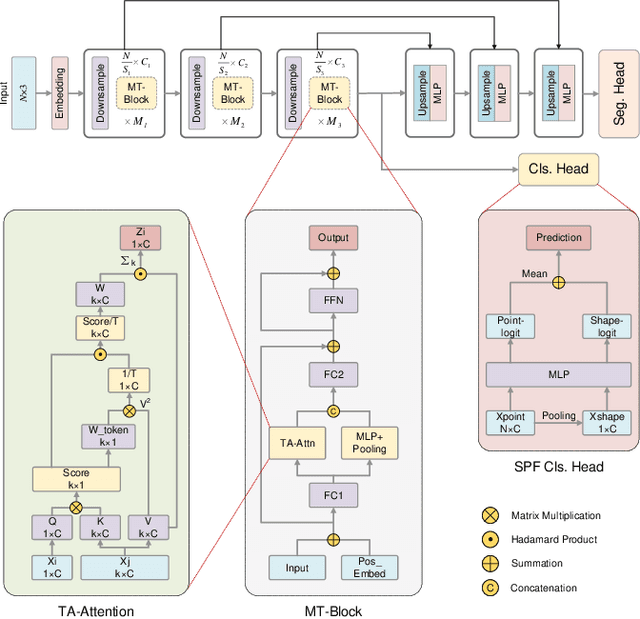
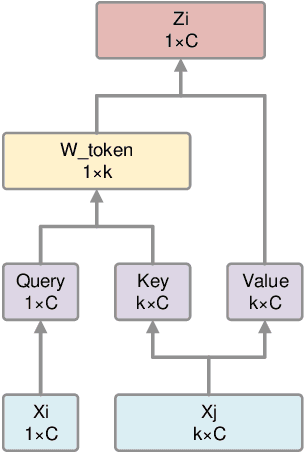
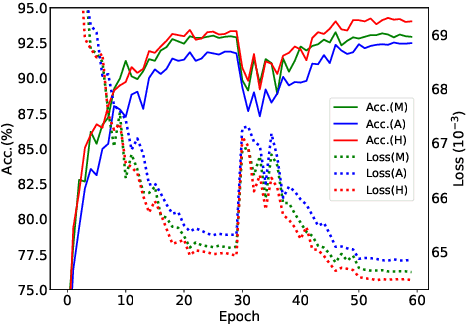
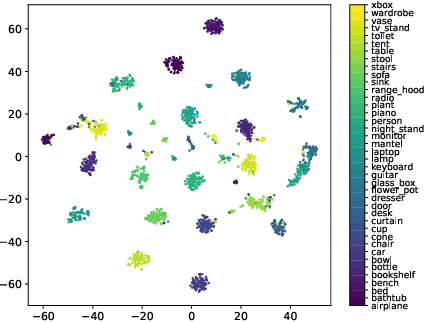
In recent years, point cloud analysis methods based on the Transformer architecture have made significant progress, particularly in the context of multimedia applications such as 3D modeling, virtual reality, and autonomous systems. However, the high computational resource demands of the Transformer architecture hinder its scalability, real-time processing capabilities, and deployment on mobile devices and other platforms with limited computational resources. This limitation remains a significant obstacle to its practical application in scenarios requiring on-device intelligence and multimedia processing. To address this challenge, we propose an efficient point cloud analysis architecture, \textbf{Point} \textbf{M}LP-\textbf{T}ransformer (PointMT). This study tackles the quadratic complexity of the self-attention mechanism by introducing a linear complexity local attention mechanism for effective feature aggregation. Additionally, to counter the Transformer's focus on token differences while neglecting channel differences, we introduce a parameter-free channel temperature adaptation mechanism that adaptively adjusts the attention weight distribution in each channel, enhancing the precision of feature aggregation. To improve the Transformer's slow convergence speed due to the limited scale of point cloud datasets, we propose an MLP-Transformer hybrid module, which significantly enhances the model's convergence speed. Furthermore, to boost the feature representation capability of point tokens, we refine the classification head, enabling point tokens to directly participate in prediction. Experimental results on multiple evaluation benchmarks demonstrate that PointMT achieves performance comparable to state-of-the-art methods while maintaining an optimal balance between performance and accuracy.
Prototypical Partial Optimal Transport for Universal Domain Adaptation
Aug 02, 2024Universal domain adaptation (UniDA) aims to transfer knowledge from a labeled source domain to an unlabeled target domain without requiring the same label sets of both domains. The existence of domain and category shift makes the task challenging and requires us to distinguish "known" samples (i.e., samples whose labels exist in both domains) and "unknown" samples (i.e., samples whose labels exist in only one domain) in both domains before reducing the domain gap. In this paper, we consider the problem from the point of view of distribution matching which we only need to align two distributions partially. A novel approach, dubbed mini-batch Prototypical Partial Optimal Transport (m-PPOT), is proposed to conduct partial distribution alignment for UniDA. In training phase, besides minimizing m-PPOT, we also leverage the transport plan of m-PPOT to reweight source prototypes and target samples, and design reweighted entropy loss and reweighted cross-entropy loss to distinguish "known" and "unknown" samples. Experiments on four benchmarks show that our method outperforms the previous state-of-the-art UniDA methods.
High-Dimensional Fault Tolerance Testing of Highly Automated Vehicles Based on Low-Rank Models
Jul 28, 2024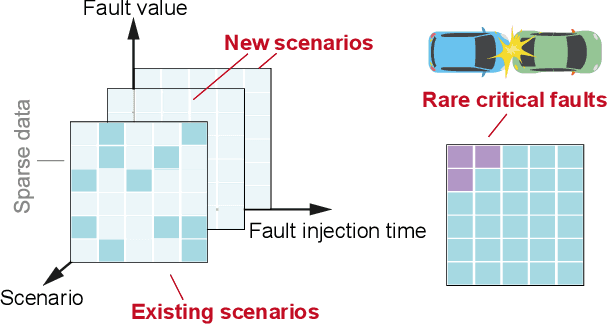
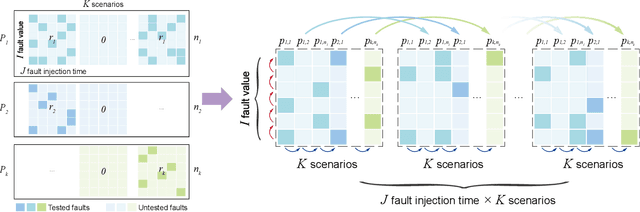
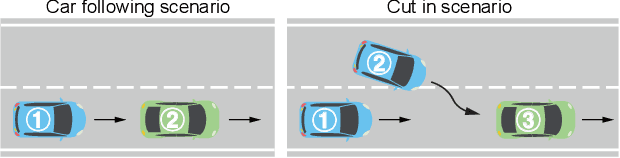
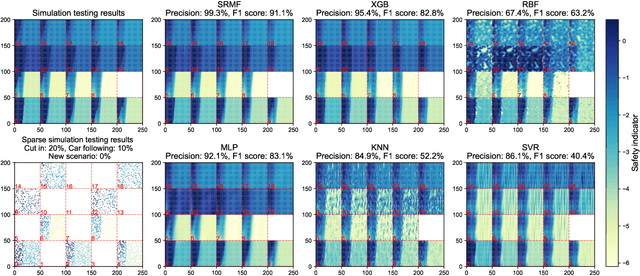
Ensuring fault tolerance of Highly Automated Vehicles (HAVs) is crucial for their safety due to the presence of potentially severe faults. Hence, Fault Injection (FI) testing is conducted by practitioners to evaluate the safety level of HAVs. To fully cover test cases, various driving scenarios and fault settings should be considered. However, due to numerous combinations of test scenarios and fault settings, the testing space can be complex and high-dimensional. In addition, evaluating performance in all newly added scenarios is resource-consuming. The rarity of critical faults that can cause security problems further strengthens the challenge. To address these challenges, we propose to accelerate FI testing under the low-rank Smoothness Regularized Matrix Factorization (SRMF) framework. We first organize the sparse evaluated data into a structured matrix based on its safety values. Then the untested values are estimated by the correlation captured by the matrix structure. To address high dimensionality, a low-rank constraint is imposed on the testing space. To exploit the relationships between existing scenarios and new scenarios and capture the local regularity of critical faults, three types of smoothness regularization are further designed as a complement. We conduct experiments on car following and cut in scenarios. The results indicate that SRMF has the lowest prediction error in various scenarios and is capable of predicting rare critical faults compared to other machine learning models. In addition, SRMF can achieve 1171 acceleration rate, 99.3% precision and 91.1% F1 score in identifying critical faults. To the best of our knowledge, this is the first work to introduce low-rank models to FI testing of HAVs.
Channel-Aware Low-Rank Adaptation in Time Series Forecasting
Jul 24, 2024
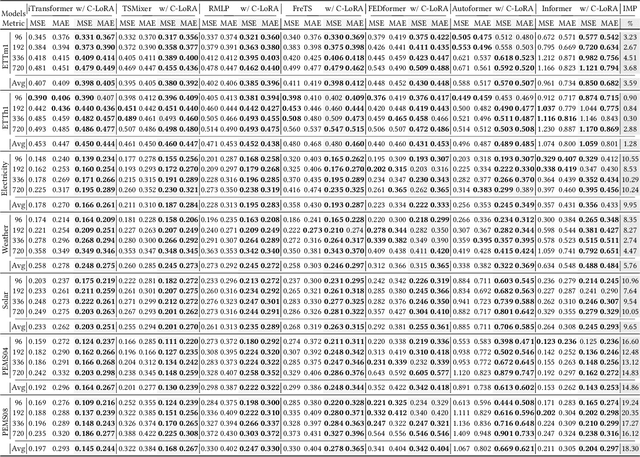
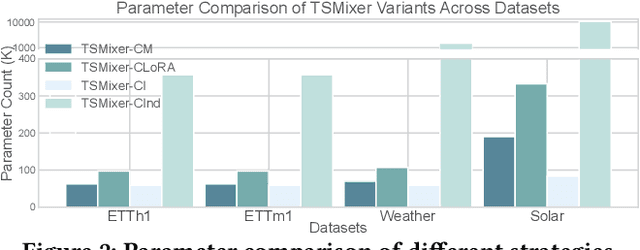
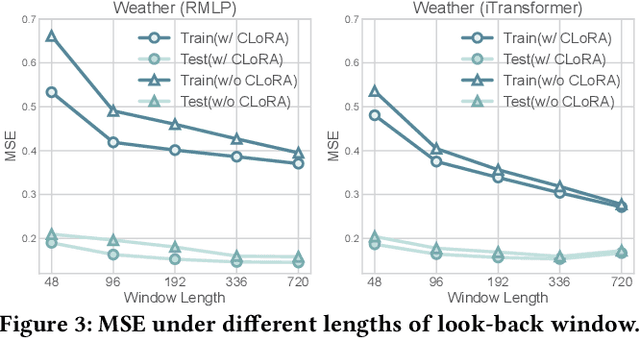
The balance between model capacity and generalization has been a key focus of recent discussions in long-term time series forecasting. Two representative channel strategies are closely associated with model expressivity and robustness, including channel independence (CI) and channel dependence (CD). The former adopts individual channel treatment and has been shown to be more robust to distribution shifts, but lacks sufficient capacity to model meaningful channel interactions. The latter is more expressive for representing complex cross-channel dependencies, but is prone to overfitting. To balance the two strategies, we present a channel-aware low-rank adaptation method to condition CD models on identity-aware individual components. As a plug-in solution, it is adaptable for a wide range of backbone architectures. Extensive experiments show that it can consistently and significantly improve the performance of both CI and CD models with demonstrated efficiency and flexibility. The code is available at https://github.com/tongnie/C-LoRA.
OE-BevSeg: An Object Informed and Environment Aware Multimodal Framework for Bird's-eye-view Vehicle Semantic Segmentation
Jul 18, 2024Bird's-eye-view (BEV) semantic segmentation is becoming crucial in autonomous driving systems. It realizes ego-vehicle surrounding environment perception by projecting 2D multi-view images into 3D world space. Recently, BEV segmentation has made notable progress, attributed to better view transformation modules, larger image encoders, or more temporal information. However, there are still two issues: 1) a lack of effective understanding and enhancement of BEV space features, particularly in accurately capturing long-distance environmental features and 2) recognizing fine details of target objects. To address these issues, we propose OE-BevSeg, an end-to-end multimodal framework that enhances BEV segmentation performance through global environment-aware perception and local target object enhancement. OE-BevSeg employs an environment-aware BEV compressor. Based on prior knowledge about the main composition of the BEV surrounding environment varying with the increase of distance intervals, long-sequence global modeling is utilized to improve the model's understanding and perception of the environment. From the perspective of enriching target object information in segmentation results, we introduce the center-informed object enhancement module, using centerness information to supervise and guide the segmentation head, thereby enhancing segmentation performance from a local enhancement perspective. Additionally, we designed a multimodal fusion branch that integrates multi-view RGB image features with radar/LiDAR features, achieving significant performance improvements. Extensive experiments show that, whether in camera-only or multimodal fusion BEV segmentation tasks, our approach achieves state-of-the-art results by a large margin on the nuScenes dataset for vehicle segmentation, demonstrating superior applicability in the field of autonomous driving.
Hierarchical and Decoupled BEV Perception Learning Framework for Autonomous Driving
Jul 17, 2024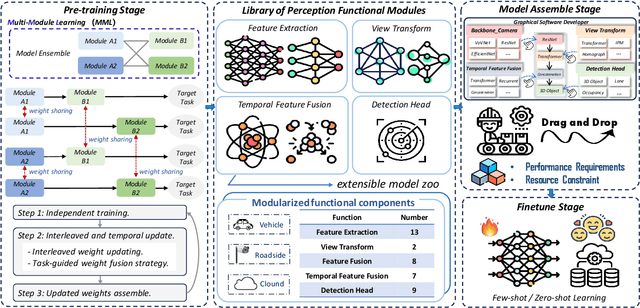
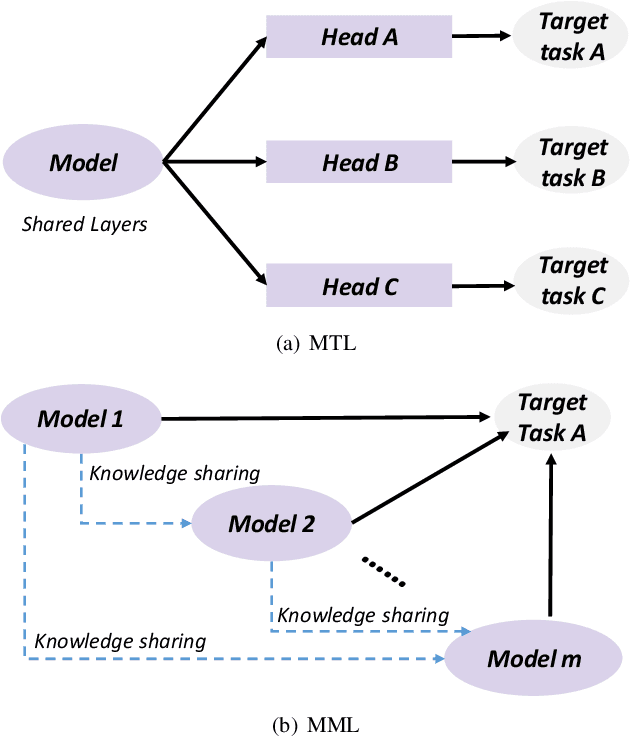
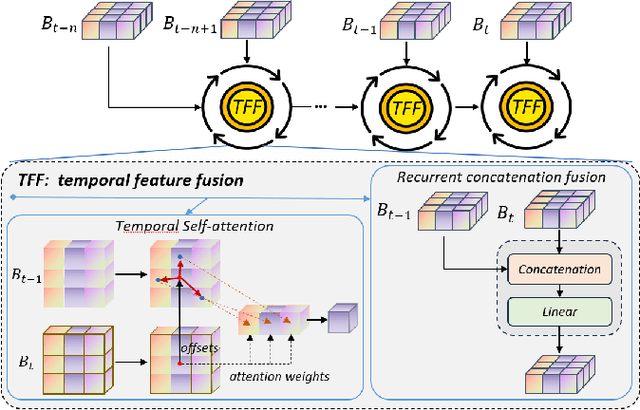
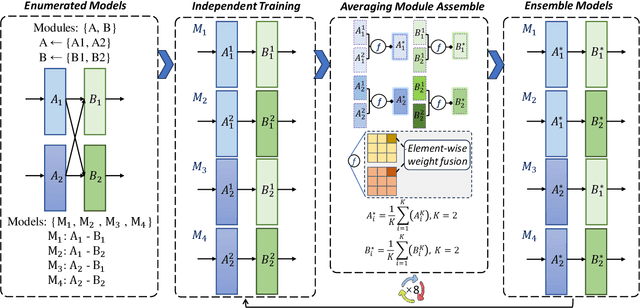
Perception is essential for autonomous driving system. Recent approaches based on Bird's-eye-view (BEV) and deep learning have made significant progress. However, there exists challenging issues including lengthy development cycles, poor reusability, and complex sensor setups in perception algorithm development process. To tackle the above challenges, this paper proposes a novel hierarchical Bird's-eye-view (BEV) perception paradigm, aiming to provide a library of fundamental perception modules and user-friendly graphical interface, enabling swift construction of customized models. We conduct the Pretrain-Finetune strategy to effectively utilize large scale public datasets and streamline development processes. Specifically, we present a Multi-Module Learning (MML) approach, enhancing performance through synergistic and iterative training of multiple models. Extensive experimental results on the Nuscenes dataset demonstrate that our approach renders significant improvement over the traditional training method.
Flow to Rare Events: An Application of Normalizing Flow in Temporal Importance Sampling for Automated Vehicle Validation
Jul 10, 2024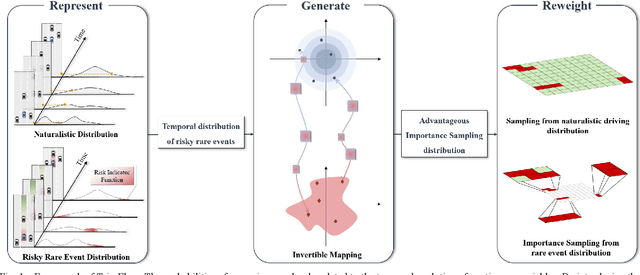
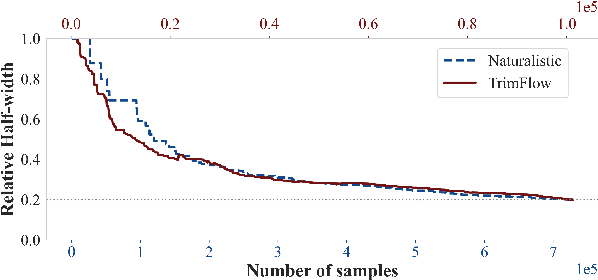
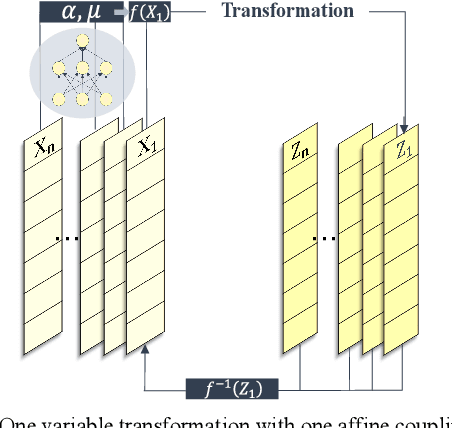
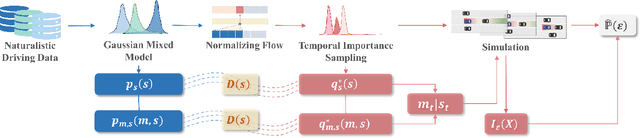
Automated Vehicle (AV) validation based on simulated testing requires unbiased evaluation and high efficiency. One effective solution is to increase the exposure to risky rare events while reweighting the probability measure. However, characterizing the distribution of risky events is particularly challenging due to the paucity of samples and the temporality of continuous scenario variables. To solve it, we devise a method to represent, generate, and reweight the distribution of risky rare events. We decompose the temporal evolution of continuous variables into distribution components based on conditional probability. By introducing the Risk Indicator Function, the distribution of risky rare events is theoretically precipitated out of naturalistic driving distribution. This targeted distribution is practically generated via Normalizing Flow, which achieves exact and tractable probability evaluation of intricate distribution. The rare event distribution is then demonstrated as the advantageous Importance Sampling distribution. We also promote the technique of temporal Importance Sampling. The combined method, named as TrimFlow, is executed to estimate the collision rate of Car-following scenarios as a tentative practice. The results showed that sampling background vehicle maneuvers from rare event distribution could evolve testing scenarios to hazardous states. TrimFlow reduced 86.1% of tests compared to generating testing scenarios according to their exposure in the naturalistic driving environment. In addition, the TrimFlow method is not limited to one specific type of functional scenario.
PointViG: A Lightweight GNN-based Model for Efficient Point Cloud Analysis
Jul 01, 2024In the domain of point cloud analysis, despite the significant capabilities of Graph Neural Networks (GNNs) in managing complex 3D datasets, existing approaches encounter challenges like high computational costs and scalability issues with extensive scenarios. These limitations restrict the practical deployment of GNNs, notably in resource-constrained environments. To address these issues, this study introduce <b>Point<\b> <b>Vi<\b>sion <b>G<\b>NN (PointViG), an efficient framework for point cloud analysis. PointViG incorporates a lightweight graph convolutional module to efficiently aggregate local features and mitigate over-smoothing. For large-scale point cloud scenes, we propose an adaptive dilated graph convolution technique that searches for sparse neighboring nodes within a dilated neighborhood based on semantic correlation, thereby expanding the receptive field and ensuring computational efficiency. Experiments demonstrate that PointViG achieves performance comparable to state-of-the-art models while balancing performance and complexity. On the ModelNet40 classification task, PointViG achieved 94.3% accuracy with 1.5M parameters. For the S3DIS segmentation task, it achieved an mIoU of 71.7% with 5.3M parameters. These results underscore the potential and efficiency of PointViG in point cloud analysis.
Time-optimal Flight in Cluttered Environments via Safe Reinforcement Learning
Jun 28, 2024This paper addresses the problem of guiding a quadrotor through a predefined sequence of waypoints in cluttered environments, aiming to minimize the flight time while avoiding collisions. Previous approaches either suffer from prolonged computational time caused by solving complex non-convex optimization problems or are limited by the inherent smoothness of polynomial trajectory representations, thereby restricting the flexibility of movement. In this work, we present a safe reinforcement learning approach for autonomous drone racing with time-optimal flight in cluttered environments. The reinforcement learning policy, trained using safety and terminal rewards specifically designed to enforce near time-optimal and collision-free flight, outperforms current state-of-the-art algorithms. Additionally, experimental results demonstrate the efficacy of the proposed approach in achieving both minimum flight time and obstacle avoidance objectives in complex environments, with a commendable $66.7\%$ success rate in unseen, challenging settings.