 Add to Chrome
 Add to Firefox
 Add to Edge
Towards Lawful Autonomous Driving: Deriving Scenario-Aware Driving Requirements from Traffic Laws and Regulations
Apr 27, 2026
Driving in compliance with traffic laws and regulations is a basic requirement for human drivers, yet autonomous vehicles (AVs) can violate these requirements in diverse real-world scenarios. To encode law compliance into AV systems, conventional approaches use formal logic languages to explicitly specify behavioral constraints, but this process is labor-intensive, hard to scale, and costly to maintain. With recent advances in artificial intelligence, it is promising to leverage large language models (LLMs) to derive legal requirements from traffic laws and regulations. However, without explicitly grounding and reasoning in structured traffic scenarios, LLMs often retrieve irrelevant provisions or miss applicable ones, yielding imprecise requirements. To address this, we propose a novel pipeline that grounds LLM reasoning in a traffic scenario taxonomy through node-wise anchors that encode hierarchical semantics. On Chinese traffic laws and OnSite dataset (5,897 scenarios), our method improves law-scenario matching by 29.1\% and increases the accuracy of derived mandatory and prohibitive requirements by 36.9\% and 38.2\%, respectively. We further demonstrate real-world applicability by constructing a law-compliance layer for AV navigation and developing an onboard, real-time compliance monitor for in-field testing, providing a solid foundation for future AV development, deployment, and regulatory oversight.

OVPD: A Virtual-Physical Fusion Testing Dataset of OnSite Auton-omous Driving Challenge
Apr 22, 2026The rapid iteration of autonomous driving algorithms has created a growing demand for high-fidelity, replayable, and diagnosable testing data. However, many public datasets lack real vehicle dynamics feedback and closed-loop interaction with surrounding traffic and road infrastructure, limiting their ability to reflect deployment readiness. To address this gap, we present OVPD (OnSite Virtual-Physical Dataset), a virtual-physical fusion testing dataset released from the 2025 OnSite Autonomous Driving Challenge. Centered on real-vehicle-in-the-loop testing, OVPD integrates virtual background traffic with vehicle-infrastructure perception to build controllable and interactive closed-loop test environments on a proving ground. The dataset contains 20 testing clips from 20 teams over a scenario chain of 15 atomic scenarios, totaling nearly 3 hours of multi-modal data, including vehicle trajectories and states, control commands, and digital-twin-rendered surround-view observations. OVPD supports long-tail planning and decision-making validation, open-loop or platform-enabled closed-loop evaluation, and comprehensive assessment across safety, efficiency, comfort, rule compliance, and traffic impact, providing actionable evidence for failure diagnosis and iterative improvement. The dataset is available via: https://huggingface.co/datasets/Yuhang253820/Onsite_OPVD
MAPPO-PIS: A Multi-Agent Proximal Policy Optimization Method with Prior Intent Sharing for CAVs' Cooperative Decision-Making
Aug 13, 2024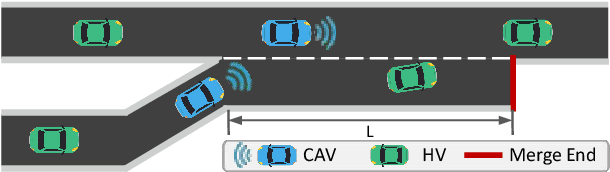
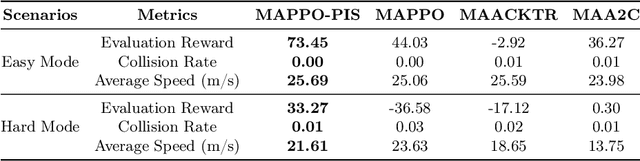
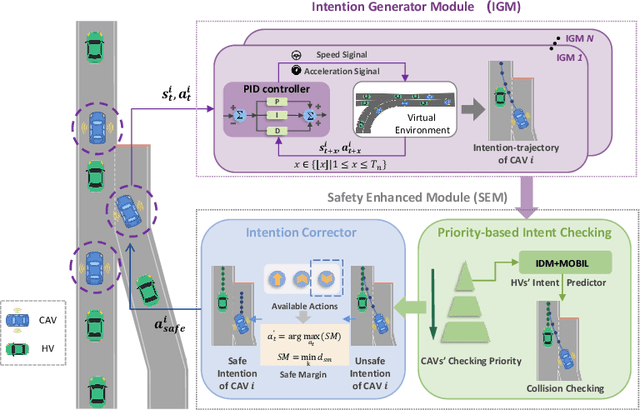
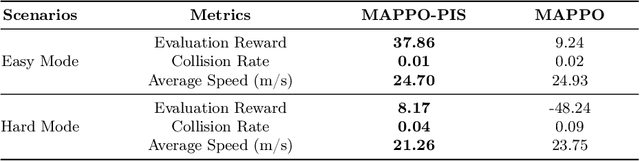
Vehicle-to-Vehicle (V2V) technologies have great potential for enhancing traffic flow efficiency and safety. However, cooperative decision-making in multi-agent systems, particularly in complex human-machine mixed merging areas, remains challenging for connected and autonomous vehicles (CAVs). Intent sharing, a key aspect of human coordination, may offer an effective solution to these decision-making problems, but its application in CAVs is under-explored. This paper presents an intent-sharing-based cooperative method, the Multi-Agent Proximal Policy Optimization with Prior Intent Sharing (MAPPO-PIS), which models the CAV cooperative decision-making problem as a Multi-Agent Reinforcement Learning (MARL) problem. It involves training and updating the agents' policies through the integration of two key modules: the Intention Generator Module (IGM) and the Safety Enhanced Module (SEM). The IGM is specifically crafted to generate and disseminate CAVs' intended trajectories spanning multiple future time-steps. On the other hand, the SEM serves a crucial role in assessing the safety of the decisions made and rectifying them if necessary. Merging area with human-machine mixed traffic flow is selected to validate our method. Results show that MAPPO-PIS significantly improves decision-making performance in multi-agent systems, surpassing state-of-the-art baselines in safety, efficiency, and overall traffic system performance. The code and video demo can be found at: \url{https://github.com/CCCC1dhcgd/A-MAPPO-PIS}.