 Add to Chrome
 Add to Firefox
 Add to Edge
Unifying Value Alignment and Assignment in Cross-Domain Offline Reinforcement Learning with Heterogeneous Datasets
May 24, 2026
Cross-domain offline reinforcement learning (RL) aims to learn a policy in the target domain with a limited target domain dataset and a source domain dataset that exhibits a dynamics shift. Training directly on the original source dataset typically leads to performance collapse. Recent studies perform data filtering from the perspective of dynamics alignment or value alignment to enable efficient policy transfer. However, these studies are typically validated on single-domain or single-behavior-policy source datasets. In this work, we explore a more general heterogeneous cross-domain offline RL setting, where the source datasets may be collected from multiple source domains by diverse behavior policies. We first uncover a critical yet overlooked issue in this setting: value misassignment. Empirically and theoretically, we demonstrate that value misassignment can undermine value alignment, mislead data filtering toward selecting suboptimal samples, and loosen the suboptimality gap, thereby degrading the agent's performance. To address this issue, we propose V2A, which integrates dynamics alignment, value alignment, and value assignment. V2A first employs temporally-consistent modality representation learning to extract dynamics modalities from the source dataset, followed by modality-aware advantage learning to rectify value alignment. Finally, it adopts a data filtering paradigm to selectively share source data for policy learning. Empirical results show that V2A significantly outperforms strong baseline methods under general heterogeneous cross-domain offline RL settings.

Debiased Model-based Representations for Sample-efficient Continuous Control
May 12, 2026Model-based representations recently stand out as a promising framework that embeds latent dynamics information into the representations for downstream off-policy actor-critic learning. It implicitly combines the advantages of both model-free and model-based approaches while avoiding the training costs associated with model-based methods. Nevertheless, existing model-based representation methods can fail to capture sufficient information about relevant variables and can overfit to early experiences in the replay buffer. These incur biases in representation and actor-critic learning, leading to inferior performance. To address this, we propose Debiased model-based Representations for Q-learning, tagged DR.Q algorithm. DR.Q explicitly maximizes the mutual information between the representations of the current state-action pair and the next state besides minimizing their deviations, and samples transitions with faded prioritized experience replay. We evaluate DR.Q on numerous continuous control benchmarks with a single set of hyperparameters, and the results demonstrate that DR.Q can match or surpass recent strong baselines, sometimes outperforming them by a large margin. Our code is available at https://github.com/dmksjfl/DR.Q.
UI-Voyager: A Self-Evolving GUI Agent Learning via Failed Experience
Mar 25, 2026Autonomous mobile GUI agents have attracted increasing attention along with the advancement of Multimodal Large Language Models (MLLMs). However, existing methods still suffer from inefficient learning from failed trajectories and ambiguous credit assignment under sparse rewards for long-horizon GUI tasks. To that end, we propose UI-Voyager, a novel two-stage self-evolving mobile GUI agent. In the first stage, we employ Rejection Fine-Tuning (RFT), which enables the continuous co-evolution of data and models in a fully autonomous loop. The second stage introduces Group Relative Self-Distillation (GRSD), which identifies critical fork points in group rollouts and constructs dense step-level supervision from successful trajectories to correct failed ones. Extensive experiments on AndroidWorld show that our 4B model achieves an 81.0% Pass@1 success rate, outperforming numerous recent baselines and exceeding human-level performance. Ablation and case studies further verify the effectiveness of GRSD. Our method represents a significant leap toward efficient, self-evolving, and high-performance mobile GUI automation without expensive manual data annotation.
Model-based Offline RL via Robust Value-Aware Model Learning with Implicitly Differentiable Adaptive Weighting
Mar 09, 2026Model-based offline reinforcement learning (RL) aims to enhance offline RL with a dynamics model that facilitates policy exploration. However, \textit{model exploitation} could occur due to inevitable model errors, degrading algorithm performance. Adversarial model learning offers a theoretical framework to mitigate model exploitation by solving a maximin formulation. Within such a paradigm, RAMBO~\citep{rigter2022rambo} has emerged as a representative and most popular method that provides a practical implementation with model gradient. However, we empirically reveal that severe Q-value underestimation and gradient explosion can occur in RAMBO with only slight hyperparameter tuning, suggesting that it tends to be overly conservative and suffers from unstable model updates. To address these issues, we propose \textbf{RO}bust value-aware \textbf{M}odel learning with \textbf{I}mplicitly differentiable adaptive weighting (ROMI). Instead of updating the dynamics model with model gradient, ROMI introduces a novel robust value-aware model learning approach. This approach requires the dynamics model to predict future states with values close to the minimum Q-value within a scale-adjustable state uncertainty set, enabling controllable conservatism and stable model updates. To further improve out-of-distribution (OOD) generalization during multi-step rollouts, we propose implicitly differentiable adaptive weighting, a bi-level optimization scheme that adaptively achieves dynamics- and value-aware model learning. Empirical results on D4RL and NeoRL datasets show that ROMI significantly outperforms RAMBO and achieves competitive or superior performance compared to other state-of-the-art methods on datasets where RAMBO typically underperforms. Code is available at https://github.com/zq2r/ROMI.git.
Temporal Difference Learning with Constrained Initial Representations
Feb 12, 2026Recently, there have been numerous attempts to enhance the sample efficiency of off-policy reinforcement learning (RL) agents when interacting with the environment, including architecture improvements and new algorithms. Despite these advances, they overlook the potential of directly constraining the initial representations of the input data, which can intuitively alleviate the distribution shift issue and stabilize training. In this paper, we introduce the Tanh function into the initial layer to fulfill such a constraint. We theoretically unpack the convergence property of the temporal difference learning with the Tanh function under linear function approximation. Motivated by theoretical insights, we present our Constrained Initial Representations framework, tagged CIR, which is made up of three components: (i) the Tanh activation along with normalization methods to stabilize representations; (ii) the skip connection module to provide a linear pathway from the shallow layer to the deep layer; (iii) the convex Q-learning that allows a more flexible value estimate and mitigates potential conservatism. Empirical results show that CIR exhibits strong performance on numerous continuous control tasks, even being competitive or surpassing existing strong baseline methods.
Cross-Domain Offline Policy Adaptation via Selective Transition Correction
Feb 05, 2026It remains a critical challenge to adapt policies across domains with mismatched dynamics in reinforcement learning (RL). In this paper, we study cross-domain offline RL, where an offline dataset from another similar source domain can be accessed to enhance policy learning upon a target domain dataset. Directly merging the two datasets may lead to suboptimal performance due to potential dynamics mismatches. Existing approaches typically mitigate this issue through source domain transition filtering or reward modification, which, however, may lead to insufficient exploitation of the valuable source domain data. Instead, we propose to modify the source domain data into the target domain data. To that end, we leverage an inverse policy model and a reward model to correct the actions and rewards of source transitions, explicitly achieving alignment with the target dynamics. Since limited data may result in inaccurate model training, we further employ a forward dynamics model to retain corrected samples that better match the target dynamics than the original transitions. Consequently, we propose the Selective Transition Correction (STC) algorithm, which enables reliable usage of source domain data for policy adaptation. Experiments on various environments with dynamics shifts demonstrate that STC achieves superior performance against existing baselines.
ProAct: Agentic Lookahead in Interactive Environments
Feb 05, 2026Existing Large Language Model (LLM) agents struggle in interactive environments requiring long-horizon planning, primarily due to compounding errors when simulating future states. To address this, we propose ProAct, a framework that enables agents to internalize accurate lookahead reasoning through a two-stage training paradigm. First, we introduce Grounded LookAhead Distillation (GLAD), where the agent undergoes supervised fine-tuning on trajectories derived from environment-based search. By compressing complex search trees into concise, causal reasoning chains, the agent learns the logic of foresight without the computational overhead of inference-time search. Second, to further refine decision accuracy, we propose the Monte-Carlo Critic (MC-Critic), a plug-and-play auxiliary value estimator designed to enhance policy-gradient algorithms like PPO and GRPO. By leveraging lightweight environment rollouts to calibrate value estimates, MC-Critic provides a low-variance signal that facilitates stable policy optimization without relying on expensive model-based value approximation. Experiments on both stochastic (e.g., 2048) and deterministic (e.g., Sokoban) environments demonstrate that ProAct significantly improves planning accuracy. Notably, a 4B parameter model trained with ProAct outperforms all open-source baselines and rivals state-of-the-art closed-source models, while demonstrating robust generalization to unseen environments. The codes and models are available at https://github.com/GreatX3/ProAct
EntroPIC: Towards Stable Long-Term Training of LLMs via Entropy Stabilization with Proportional-Integral Control
Nov 19, 2025Long-term training of large language models (LLMs) requires maintaining stable exploration to prevent the model from collapsing into sub-optimal behaviors. Entropy is crucial in this context, as it controls exploration and helps avoid premature convergence to sub-optimal solutions. However, existing reinforcement learning methods struggle to maintain an appropriate level of entropy, as the training process involves a mix of positive and negative samples, each affecting entropy in different ways across steps. To address this, we propose Entropy stablilization via Proportional-Integral Control (EntroPIC), a novel method that adaptively adjusts the influence of positive and negative samples by dynamically tuning their loss coefficients. This approach stabilizes entropy throughout training, ensuring efficient exploration and steady progress. We provide a comprehensive theoretical analysis for both on-policy and off-policy learning settings, demonstrating that EntroPIC is effective at controlling entropy in large-scale LLM training. Experimental results show that our method successfully maintains desired entropy levels, enabling stable and optimal RL training for LLMs.
PROF: An LLM-based Reward Code Preference Optimization Framework for Offline Imitation Learning
Nov 14, 2025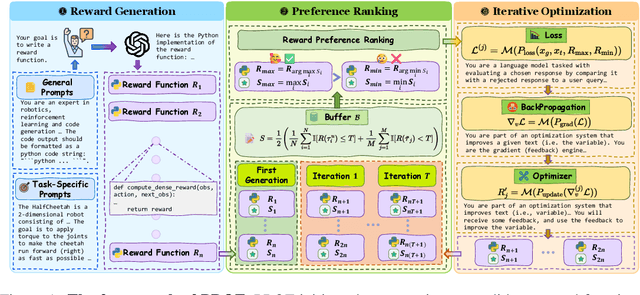
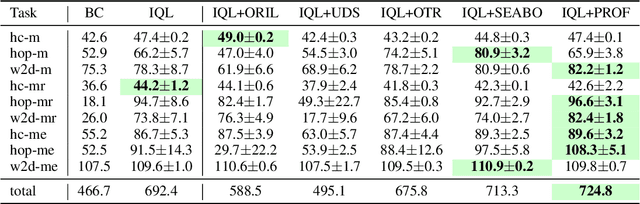
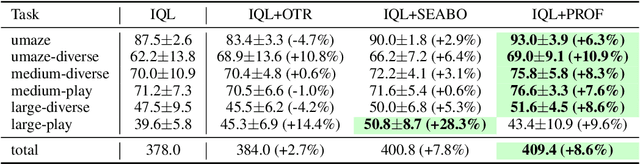
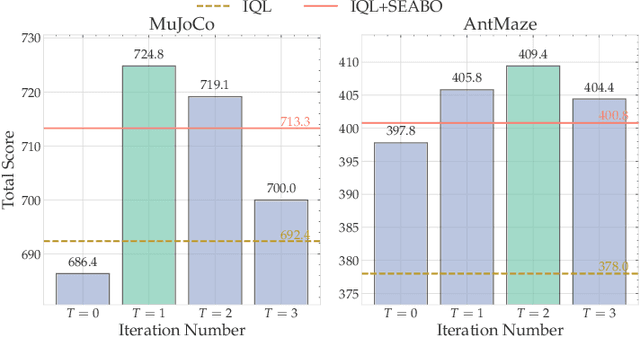
Offline imitation learning (offline IL) enables training effective policies without requiring explicit reward annotations. Recent approaches attempt to estimate rewards for unlabeled datasets using a small set of expert demonstrations. However, these methods often assume that the similarity between a trajectory and an expert demonstration is positively correlated with the reward, which oversimplifies the underlying reward structure. We propose PROF, a novel framework that leverages large language models (LLMs) to generate and improve executable reward function codes from natural language descriptions and a single expert trajectory. We propose Reward Preference Ranking (RPR), a novel reward function quality assessment and ranking strategy without requiring environment interactions or RL training. RPR calculates the dominance scores of the reward functions, where higher scores indicate better alignment with expert preferences. By alternating between RPR and text-based gradient optimization, PROF fully automates the selection and refinement of optimal reward functions for downstream policy learning. Empirical results on D4RL demonstrate that PROF surpasses or matches recent strong baselines across numerous datasets and domains, highlighting the effectiveness of our approach.
ADG: Ambient Diffusion-Guided Dataset Recovery for Corruption-Robust Offline Reinforcement Learning
May 29, 2025Real-world datasets collected from sensors or human inputs are prone to noise and errors, posing significant challenges for applying offline reinforcement learning (RL). While existing methods have made progress in addressing corrupted actions and rewards, they remain insufficient for handling corruption in high-dimensional state spaces and for cases where multiple elements in the dataset are corrupted simultaneously. Diffusion models, known for their strong denoising capabilities, offer a promising direction for this problem-but their tendency to overfit noisy samples limits their direct applicability. To overcome this, we propose Ambient Diffusion-Guided Dataset Recovery (ADG), a novel approach that pioneers the use of diffusion models to tackle data corruption in offline RL. First, we introduce Ambient Denoising Diffusion Probabilistic Models (DDPM) from approximated distributions, which enable learning on partially corrupted datasets with theoretical guarantees. Second, we use the noise-prediction property of Ambient DDPM to distinguish between clean and corrupted data, and then use the clean subset to train a standard DDPM. Third, we employ the trained standard DDPM to refine the previously identified corrupted data, enhancing data quality for subsequent offline RL training. A notable strength of ADG is its versatility-it can be seamlessly integrated with any offline RL algorithm. Experiments on a range of benchmarks, including MuJoCo, Kitchen, and Adroit, demonstrate that ADG effectively mitigates the impact of corrupted data and improves the robustness of offline RL under various noise settings, achieving state-of-the-art results.