 Add to Chrome
 Add to Firefox
 Add to Edge
AgRefactor: Self-Evolving Agentic Workflow for HLS Compatibility and Performance
Jun 29, 2026
High-Level Synthesis (HLS) provides a fast path from concepts to silicon, but converting real-world software into synthesizable HLS code remains challenging due to restrictive language support and the gap between software and hardware programming practices. Existing automated and LLM-based refactoring approaches partially address this problem, yet they often lack flexibility, struggle to scale, and incur high computational costs. We introduce AgRefactor, an LLM-based multi-agent workflow for refactoring software into HLS-compatible programs. AgRefactor incorporates a self-evolving memory system that accumulates and retrieves factual and strategic knowledge across tasks, improving robustness and efficiency on unseen programs. To reduce cost and enhance scalability, it integrates automated refactoring tools, enabling agents to balance LLM-driven rewrites with efficient tool-based transformations. On 9 out of 11 challenging real-world benchmarks, which are 5-10x longer than the most complex cases studied in prior work, AgRefactor outperforms or matches the state-of-the-art automated refactoring tool and a strong LLM-based baseline built on the same framework backbone. Further agentic performance optimization yields a 6.51x geometric mean speedup over the SoTA pragma tuning tool and a 1.20x speedup over optimized open-source designs with less than 20% extra resources. AgRefactor is fully-automated and open-sourced.

HarnessBridge: Learnable Bidirectional Controller for LLM Agent Harness
Jun 11, 2026Large language models are increasingly deployed as agents for long-horizon tasks, yet their performance is shaped not only by model capability and environment design, but also by the harness that mediates agent--environment interaction. Existing harnesses are largely manually engineered, making them difficult to scale as trajectories grow longer and interactions become more complex. In this work, we ask whether harness can be generated by a learnable plug-in module that can be trained in an end-to-end fashion. We introduce HarnessBridge, a lightweight learnable harness controller that parameterizes the agent--environment interface as a bidirectional projection. HarnessBridge learns two bidirectional projections: observation projection, which distills raw trajectories into compact, decision-relevant states, and action projection, which converts proposed actions into executable transitions or trajectory-grounded rejections. We train HarnessBridge on a harness supervision dataset via unified instruction tuning. On Terminal-Bench~2.0 and SWE-bench Verified, HarnessBridge matches or surpasses strong specialized harnesses while substantially reducing token usage and trajectory length, and generalizes from smaller generators to larger commercial models.
H$^{2}$MT: Semantic Hierarchy-Aware Hierarchical Memory Transformer
May 24, 2026Transformer-based LLMs achieve strong results on many language tasks; however, long inputs remain challenging because context windows are finite, and prefill latency and memory grow rapidly with prompt length. Flat token-stream processing and chunk-based retrieval can therefore spend substantial computation and context budget on text unrelated to the query. Offline-indexed RAG additionally introduces external storage and index management overhead, and typically appends retrieved evidence as raw text, increasing prefill cost and latency. H^{2}MT makes long-context inference structure-aware: it builds a semantic hierarchy offline, computes a memory embedding for each node via bottom-up post-order aggregation, and routes queries coarse-to-fine at inference to prune irrelevant branches early. On LongBench QA (NarrativeQA, HotpotQA, QASPER) and two structured technical-document settings, H MT achieves favorable quality efficiency trade-offs, delivering competitive ROUGE-L and F1 (where applicable) with lower peak GPU memory and time-to-first-token (TTFT) than prompt compression, memory-token methods, and retrieval-augmented generation baselines.
Understand and Accelerate Memory Processing Pipeline for Disaggregated LLM Inference
Mar 30, 2026Modern large language models (LLMs) increasingly depends on efficient long-context processing and generation mechanisms, including sparse attention, retrieval-augmented generation (RAG), and compressed contextual memory, to support complex reasoning. We show that these optimizations can be unified into a four-step memory processing pipeline: Prepare Memory, Compute Relevancy, Retrieval, and Apply to Inference. Through systematic profiling, we identify a 22%-97% memory processing overhead in LLM inference and strong heterogeneity in its computational characteristics. Motivated by this insight, we argue that \textbf{heterogeneous systems} are well-suited to accelerate memory processing and thus end-to-end inference. We demonstrate this approach on a GPU-FPGA system by offloading sparse, irregular, and memory-bounded operations to FPGAs while retaining compute-intensive operations on GPUs. Evaluated on an AMD MI210 GPU and an Alveo U55C FPGA, our system is $1.04\sim2.2\times$ faster and requires $1.11\sim4.7\times$ less energy across multiple LLM inference optimizations than the GPU baseline (similar results hold on NVIDIA A100). These results establish heterogeneous systems as a practical direction for efficient LLM memory processing and inform future heterogeneous hardware design.
AI+HW 2035: Shaping the Next Decade
Mar 05, 2026Artificial intelligence (AI) and hardware (HW) are advancing at unprecedented rates, yet their trajectories have become inseparably intertwined. The global research community lacks a cohesive, long-term vision to strategically coordinate the development of AI and HW. This fragmentation constrains progress toward holistic, sustainable, and adaptive AI systems capable of learning, reasoning, and operating efficiently across cloud, edge, and physical environments. The future of AI depends not only on scaling intelligence, but on scaling efficiency, achieving exponential gains in intelligence per joule, rather than unbounded compute consumption. Addressing this grand challenge requires rethinking the entire computing stack. This vision paper lays out a 10-year roadmap for AI+HW co-design and co-development, spanning algorithms, architectures, systems, and sustainability. We articulate key insights that redefine scaling around energy efficiency, system-level integration, and cross-layer optimization. We identify key challenges and opportunities, candidly assess potential obstacles and pitfalls, and propose integrated solutions grounded in algorithmic innovation, hardware advances, and software abstraction. Looking ahead, we define what success means in 10 years: achieving a 1000x improvement in efficiency for AI training and inference; enabling energy-aware, self-optimizing systems that seamlessly span cloud, edge, and physical AI; democratizing access to advanced AI infrastructure; and embedding human-centric principles into the design of intelligent systems. Finally, we outline concrete action items for academia, industry, government, and the broader community, calling for coordinated national initiatives, shared infrastructure, workforce development, cross-agency collaboration, and sustained public-private partnerships to ensure that AI+HW co-design becomes a unifying long-term mission.
ARLArena: A Unified Framework for Stable Agentic Reinforcement Learning
Feb 25, 2026Agentic reinforcement learning (ARL) has rapidly gained attention as a promising paradigm for training agents to solve complex, multi-step interactive tasks. Despite encouraging early results, ARL remains highly unstable, often leading to training collapse. This instability limits scalability to larger environments and longer interaction horizons, and constrains systematic exploration of algorithmic design choices. In this paper, we first propose ARLArena, a stable training recipe and systematic analysis framework that examines training stability in a controlled and reproducible setting. ARLArena first constructs a clean and standardized testbed. Then, we decompose policy gradient into four core design dimensions and assess the performance and stability of each dimension. Through this fine-grained analysis, we distill a unified perspective on ARL and propose SAMPO, a stable agentic policy optimization method designed to mitigate the dominant sources of instability in ARL. Empirically, SAMPO achieves consistently stable training and strong performance across diverse agentic tasks. Overall, this study provides a unifying policy gradient perspective for ARL and offers practical guidance for building stable and reproducible LLM-based agent training pipelines.
FlexLLM: Composable HLS Library for Flexible Hybrid LLM Accelerator Design
Jan 22, 2026We present FlexLLM, a composable High-Level Synthesis (HLS) library for rapid development of domain-specific LLM accelerators. FlexLLM exposes key architectural degrees of freedom for stage-customized inference, enabling hybrid designs that tailor temporal reuse and spatial dataflow differently for prefill and decode, and provides a comprehensive quantization suite to support accurate low-bit deployment. Using FlexLLM, we build a complete inference system for the Llama-3.2 1B model in under two months with only 1K lines of code. The system includes: (1) a stage-customized accelerator with hardware-efficient quantization (12.68 WikiText-2 PPL) surpassing SpinQuant baseline, and (2) a Hierarchical Memory Transformer (HMT) plug-in for efficient long-context processing. On the AMD U280 FPGA at 16nm, the accelerator achieves 1.29$\times$ end-to-end speedup, 1.64$\times$ higher decode throughput, and 3.14$\times$ better energy efficiency than an NVIDIA A100 GPU (7nm) running BF16 inference; projected results on the V80 FPGA at 7nm reach 4.71$\times$, 6.55$\times$, and 4.13$\times$, respectively. In long-context scenarios, integrating the HMT plug-in reduces prefill latency by 23.23$\times$ and extends the context window by 64$\times$, delivering 1.10$\times$/4.86$\times$ lower end-to-end latency and 5.21$\times$/6.27$\times$ higher energy efficiency on the U280/V80 compared to the A100 baseline. FlexLLM thus bridges algorithmic innovation in LLM inference and high-performance accelerators with minimal manual effort.
Report for NSF Workshop on AI for Electronic Design Automation
Jan 20, 2026This report distills the discussions and recommendations from the NSF Workshop on AI for Electronic Design Automation (EDA), held on December 10, 2024 in Vancouver alongside NeurIPS 2024. Bringing together experts across machine learning and EDA, the workshop examined how AI-spanning large language models (LLMs), graph neural networks (GNNs), reinforcement learning (RL), neurosymbolic methods, etc.-can facilitate EDA and shorten design turnaround. The workshop includes four themes: (1) AI for physical synthesis and design for manufacturing (DFM), discussing challenges in physical manufacturing process and potential AI applications; (2) AI for high-level and logic-level synthesis (HLS/LLS), covering pragma insertion, program transformation, RTL code generation, etc.; (3) AI toolbox for optimization and design, discussing frontier AI developments that could potentially be applied to EDA tasks; and (4) AI for test and verification, including LLM-assisted verification tools, ML-augmented SAT solving, security/reliability challenges, etc. The report recommends NSF to foster AI/EDA collaboration, invest in foundational AI for EDA, develop robust data infrastructures, promote scalable compute infrastructure, and invest in workforce development to democratize hardware design and enable next-generation hardware systems. The workshop information can be found on the website https://ai4eda-workshop.github.io/.
LUT-LLM: Efficient Large Language Model Inference with Memory-based Computations on FPGAs
Nov 09, 2025The rapid progress of large language models (LLMs) has advanced numerous applications, yet efficient single-batch inference remains vital for on-device intelligence. While FPGAs offer fine-grained data control and high energy efficiency, recent GPU optimizations have narrowed their advantage, especially under arithmetic-based computation. To overcome this, we leverage FPGAs' abundant on-chip memory to shift LLM inference from arithmetic- to memory-based computation through table lookups. We present LUT-LLM, the first FPGA accelerator enabling 1B+ LLM inference via vector-quantized memory operations. Our analysis identifies activation-weight co-quantization as the most effective scheme, supported by (1) bandwidth-aware parallel centroid search, (2) efficient 2D table lookups, and (3) a spatial-temporal hybrid design minimizing data caching. Implemented on an AMD V80 FPGA for a customized Qwen 3 1.7B model, LUT-LLM achieves 1.66x lower latency than AMD MI210 and 1.72x higher energy efficiency than NVIDIA A100, scaling to 32B models with 2.16x efficiency gain over A100.
LLM-DSE: Searching Accelerator Parameters with LLM Agents
May 18, 2025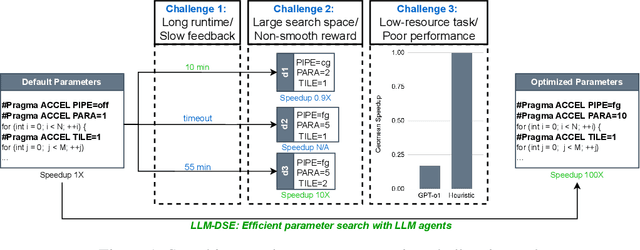
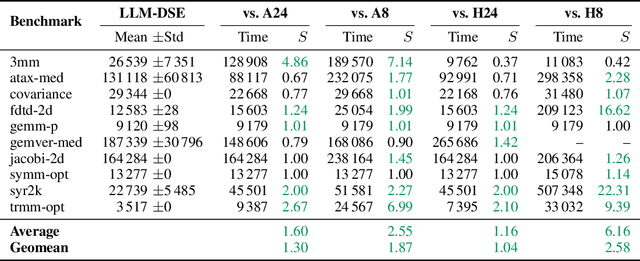
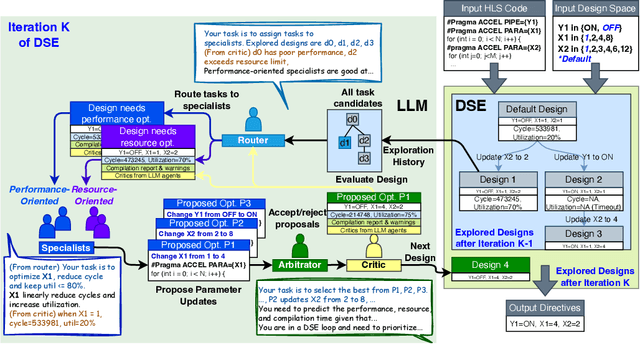
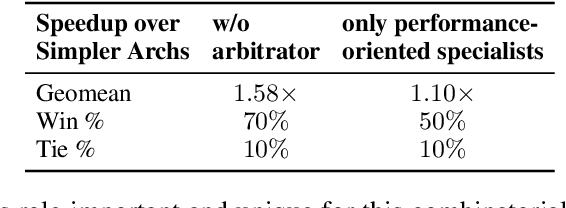
Even though high-level synthesis (HLS) tools mitigate the challenges of programming domain-specific accelerators (DSAs) by raising the abstraction level, optimizing hardware directive parameters remains a significant hurdle. Existing heuristic and learning-based methods struggle with adaptability and sample efficiency.We present LLM-DSE, a multi-agent framework designed specifically for optimizing HLS directives. Combining LLM with design space exploration (DSE), our explorer coordinates four agents: Router, Specialists, Arbitrator, and Critic. These multi-agent components interact with various tools to accelerate the optimization process. LLM-DSE leverages essential domain knowledge to identify efficient parameter combinations while maintaining adaptability through verbal learning from online interactions. Evaluations on the HLSyn dataset demonstrate that LLM-DSE achieves substantial $2.55\times$ performance gains over state-of-the-art methods, uncovering novel designs while reducing runtime. Ablation studies validate the effectiveness and necessity of the proposed agent interactions. Our code is open-sourced here: https://github.com/Nozidoali/LLM-DSE.