 Add to Chrome
 Add to Firefox
 Add to Edge
Less Experts, Faster Decoding: Cost-Aware Speculative Decoding for Mixture-of-Experts
Jul 14, 2026
Sparse Mixture-of-Experts (MoE) models have become an important approach for scaling Large Language Models (LLMs), but their inference efficiency depends strongly on expert activation patterns. Speculative decoding (SD) accelerates autoregressive generation by verifying multiple draft tokens in parallel, yet existing draft selection strategies primarily optimize acceptance likelihood. In large-scale MoE models, however, selecting draft tokens also determines the union of experts activated during verification. We observe that confidence-driven SD can introduce \textit{expert scattering}: high-probability draft tokens may route to disjoint experts, increasing expert-weight memory traffic and reducing the speedup from speculation. Motivated by this observation, we revisit draft-tree selection under the non-uniform memory-cost structure of MoE inference. We propose \textsc{EcoSpec}, a cost-aware speculative decoding framework that incorporates predicted marginal expert activation cost into draft selection. With a lightweight expert predictor and a dynamic expert buffer, \textsc{EcoSpec} favors draft paths that preserve high acceptance likelihood while reusing experts already covered by the current verification set, without modifying the target-model verification rule. We evaluate \textsc{EcoSpec} on three large-scale MoE models, including DeepSeek-V3.1 (671B), Qwen3-235B-A22B, and GPT-OSS-120B, across reasoning, coding, question-answering, and dialogue benchmarks. \textsc{EcoSpec} consistently reduces active expert footprints and improves end-to-end decoding speed, achieving up to $1.62\times$ speedup. These results show that accounting for expert activation cost is important for efficient speculative decoding in large-scale MoE models.

AdaPLD: Adaptive Retrieval and Reuse for Efficient Model-Free Speculative Decoding
Jun 04, 2026Speculative decoding accelerates generation by verifying multiple drafted tokens in a single target-model forward pass, reducing sequential decoding iterations. Model-free variants avoid auxiliary draft models by reusing text and model states already available during generation, but their speedup depends on the reliability of the constructed drafts. We identify two limitations of existing reuse-based methods: lexically anchored retrieval has limited recall under surface-form variation, and deterministic span copying can be brittle when the retrieved context does not uniquely determine the continuation. We propose \emph{AdaPLD}, a training-free method that adaptively improves both retrieval and draft construction. AdaPLD preserves high-precision lexical reuse while using semantic similarity to recover additional reuse opportunities when lexical matching fails. It further constructs branched reuse hypotheses to account for continuation uncertainty, rather than relying on a single copied span. Across diverse benchmarks, AdaPLD reduces target-model forward passes and achieves up to $3.10\times$ decoding speedup.
Zero-Shot Detection of LLM-Generated Text via Implicit Reward Model
Apr 23, 2026Large language models (LLMs) have demonstrated remarkable capabilities across various tasks. However, their ability to generate human-like text has raised concerns about potential misuse. This underscores the need for reliable and effective methods to detect LLM-generated text. In this paper, we propose IRM, a novel zero-shot approach that leverages Implicit Reward Models for LLM-generated text detection. Such implicit reward models can be derived from publicly available instruction-tuned and base models. Previous reward-based method relies on preference construction and task-specific fine-tuning. In comparison, IRM requires neither preference collection nor additional training. We evaluate IRM on the DetectRL benchmark and demonstrate that IRM can achieve superior detection performance, outperforms existing zero-shot and supervised methods in LLM-generated text detection.
MASS-RAG: Multi-Agent Synthesis Retrieval-Augmented Generation
Apr 21, 2026Large language models (LLMs) are widely used in retrieval-augmented generation (RAG) to incorporate external knowledge at inference time. However, when retrieved contexts are noisy, incomplete, or heterogeneous, a single generation process often struggles to reconcile evidence effectively. We propose \textbf{MASS-RAG}, a multi-agent synthesis approach to retrieval-augmented generation that structures evidence processing into multiple role-specialized agents. MASS-RAG applies distinct agents for evidence summarization, evidence extraction, and reasoning over retrieved documents, and combines their outputs through a dedicated synthesis stage to produce the final answer. This design exposes multiple intermediate evidence views, allowing the model to compare and integrate complementary information before answer generation. Experiments on four benchmarks show that MASS-RAG consistently improves performance over strong RAG baselines, particularly in settings where relevant evidence is distributed across retrieved contexts.
EmergentBridge: Improving Zero-Shot Cross-Modal Transfer in Unified Multimodal Embedding Models
Apr 14, 2026Unified multimodal embedding spaces underpin practical applications such as cross-modal retrieval and zero-shot recognition. In many real deployments, however, supervision is available only for a small subset of modality pairs (e.g., image--text), leaving \emph{unpaired} modality pairs (e.g., audio$\leftrightarrow$depth, infrared$\leftrightarrow$audio) weakly connected and thus performing poorly on zero-shot transfer. Addressing this sparse-pairing regime is therefore essential for scaling unified embedding systems to new tasks without curating exhaustive pairwise data. We propose \textbf{EmergentBridge}, an embedding-level bridging framework that improves performance on these unpaired pairs \emph{without requiring exhaustive pairwise supervision}. Our key observation is that naively aligning a new modality to a synthesized proxy embedding can introduce \emph{gradient interference}, degrading the anchor-alignment structure that existing retrieval/classification relies on. EmergentBridge addresses this by (i) learning a mapping that produces a \emph{noisy bridge anchor} (a proxy embedding of an already-aligned modality) from an anchor embedding, and (ii) enforcing proxy alignment only in the subspace orthogonal to the anchor-alignment direction, preserving anchor alignment while strengthening non-anchor connectivity. Across nine datasets spanning multiple modalities, EmergentBridge consistently outperforms prior binding baselines on zero-shot classification and retrieval, demonstrating strong emergent alignment.
FlashBack:Efficient Retrieval-Augmented Language Modeling for Long Context Inference
May 07, 2024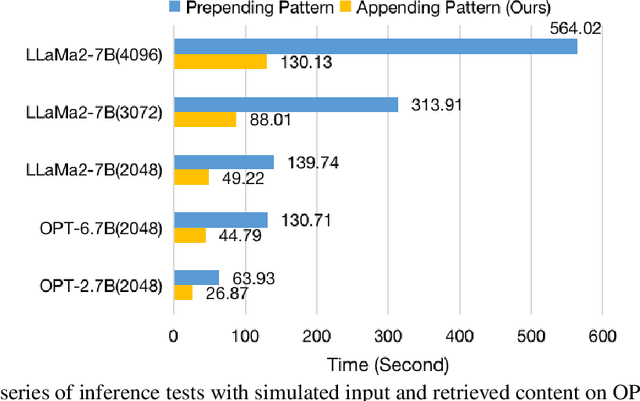
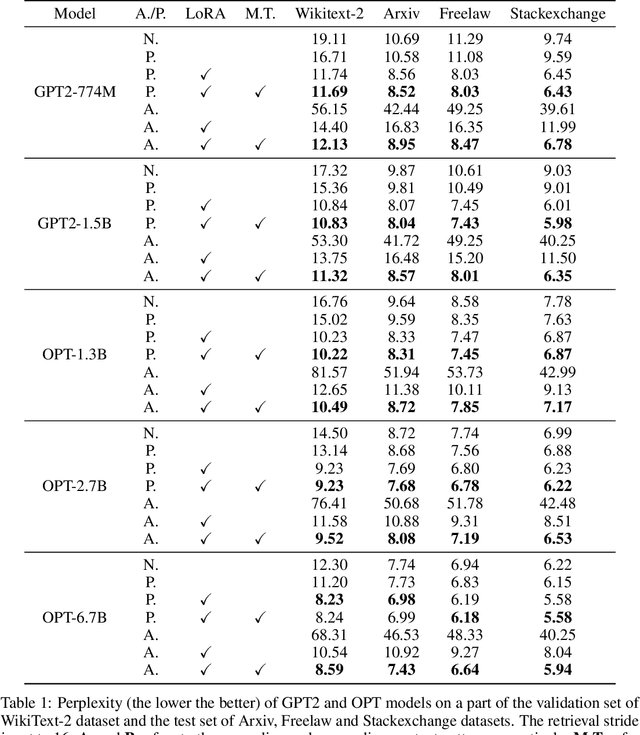
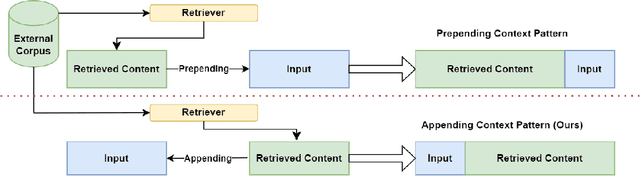
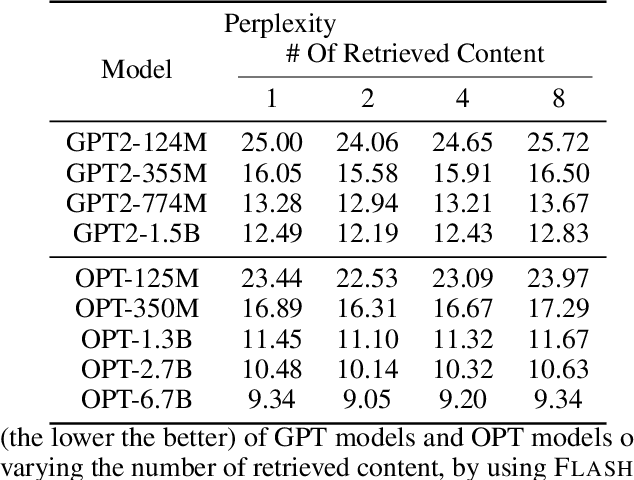
Retrieval-Augmented Language Modeling (RALM) by integrating large language models (LLM) with relevant documents from an external corpus is a proven method for enabling the LLM to generate information beyond the scope of its pre-training corpus. Previous work using utilizing retrieved content by simply prepending retrieved contents to the input poses a high runtime issue, which degrades the inference efficiency of the LLMs because they fail to use the Key-Value (KV) cache efficiently. In this paper, we propose \textsc{FlashBack}, a modular RALM designed to improve the inference efficiency of RALM with appending context pattern while maintaining decent performance after specific fine-tuning without heavily destruct the knowledge integrity of the LLM. \textsc{FlashBack} appends retrieved documents at the end of the context for efficiently utilizing the KV cache instead of prepending them. Our experiment shows that the inference speed of \textsc{FlashBack} is up to $4\times$ faster than the prepending method on a 7B LLM (Llama 2). Via bypassing unnecessary re-computation, it demonstrates an advancement by achieving significantly faster inference speed, and this heightened efficiency will substantially reduce inferential cost. Our code will be publicly available.
MindLLM: Pre-training Lightweight Large Language Model from Scratch, Evaluations and Domain Applications
Oct 29, 2023



Large Language Models (LLMs) have demonstrated remarkable performance across various natural language tasks, marking significant strides towards general artificial intelligence. While general artificial intelligence is leveraged by developing increasingly large-scale models, there could be another branch to develop lightweight custom models that better serve certain domains, taking into account the high cost of training and deploying LLMs and the scarcity of resources. In this paper, we present MindLLM, a novel series of bilingual lightweight large language models, trained from scratch, alleviating such burdens by offering models with 1.3 billion and 3 billion parameters. A thorough account of experiences accrued during large model development is given, covering every step of the process, including data construction, model architecture, evaluation, and applications. Such insights are hopefully valuable for fellow academics and developers. MindLLM consistently matches or surpasses the performance of other open-source larger models on some public benchmarks. We also introduce an innovative instruction tuning framework tailored for smaller models to enhance their capabilities efficiently. Moreover, we explore the application of MindLLM in specific vertical domains such as law and finance, underscoring the agility and adaptability of our lightweight models.