 Add to Chrome
 Add to Firefox
 Add to Edge
ABot-3DWorld 0: A Universal World Model to Explore Any 3D Space
Jul 14, 2026
We present ABot-3DWorld 0, a universal multimodal 3D world model that turns text, image, and video inputs into high-fidelity, explorable 3D worlds. At the heart of our framework is a unified Spatial Generative Primitive (SGP), a compact tuple of a high-quality panorama and a spatial point cloud that delivers an efficient description of any 3D space. Multimodal inputs are first lifted into this primitive; a 3D-consistent panoramic video generator then explores the primitive along a planned trajectory; finally, our panoramic video reconstruction engine converts the generated video into a clean, photorealistic 3D Gaussian Splatting (3DGS) world. This pipeline covers two regimes: rich inputs (multi-view sets, casual video) are lifted into the SGP through a geometry-rigorous recovery that mirrors the observed scene, while a single image or sentence is completed generatively into a creative world. The result is one low-barrier engine for general 3D content creation that further anchors generated worlds to geographic points of interest, enabling map-native spatial exploration at consumer scale. Experiments show that ABot-3DWorld 0 sets the state of the art among open-source methods and demonstrates stronger scene fidelity than Marble under rich multimodal inputs.

ABot-Earth 0.5: Generative 3D Earth Model
Jun 08, 2026We present ABot-Earth 0.5, a generative 3D framework designed to synthesize vast, seamless 3D environments from ubiquitous, geospatially referenced satellite imagery. To achieve this, we propose a novel generative model formulated directly with the 3D Gaussian Splatting (3DGS) representation. The model is trained on a diverse corpus of existing real-world urban reconstructions, learning to generate realistic geometry and textures. At inference, it synthesizes novel 3D scenes conditioned solely on satellite imagery at a scalable rate of under 10 minutes per square kilometer, while demonstrating exceptional realism. The framework is designed for accessibility, with integrated hierarchical level-of-detail (LOD) structures that permit real-time, interactive visualization on web-based map engines. This high-fidelity simulation sandbox effectively mitigates the sim-to-real domain gap, enabling critical downstream Embodied AI applications like closed-loop UAV navigation. By providing an ultra-low-cost and high-efficiency solution, ABot-Earth 0.5 significantly lowers the technical and financial barriers to large-scale 3D reconstruction and empowers the future of global digital earth visualization.
See It, Say It, Sorted: An Iterative Training-Free Framework for Visually-Grounded Multimodal Reasoning in LVLMs
Feb 25, 2026Recent large vision-language models (LVLMs) have demonstrated impressive reasoning ability by generating long chain-of-thought (CoT) responses. However, CoT reasoning in multimodal contexts is highly vulnerable to visual hallucination propagation: once an intermediate reasoning step becomes inconsistent with the visual evidence, subsequent steps-even if logically valid-can still lead to incorrect final answers. Existing solutions attempt to mitigate this issue by training models to "think with images" via reinforcement learning (RL). While effective, these methods are costly, model-specific, and difficult to generalize across architectures. Differently, we present a lightweight method that bypasses RL training and provides an iterative, training-free, plug-and-play framework for visually-grounded multimodal reasoning. Our key idea is to supervise each reasoning step at test time with visual evidence, ensuring that every decoded token is justified by corresponding visual cues. Concretely, we construct a textual visual-evidence pool that guides the model's reasoning generation. When existing evidence is insufficient, a visual decider module dynamically extracts additional relevant evidence from the image based on the ongoing reasoning context, expanding the pool until the model achieves sufficient visual certainty to terminate reasoning and produce the final answer. Extensive experiments on multiple LVLM backbones and benchmarks demonstrate the effectiveness of our approach. Our method achieves 16.5%-29.5% improvements on TreeBench and 13.7% RH-AUC gains on RH-Bench, substantially reducing hallucination rates while improving reasoning accuracy without additional training.
Don't Shake the Wheel: Momentum-Aware Planning in End-to-End Autonomous Driving
Mar 05, 2025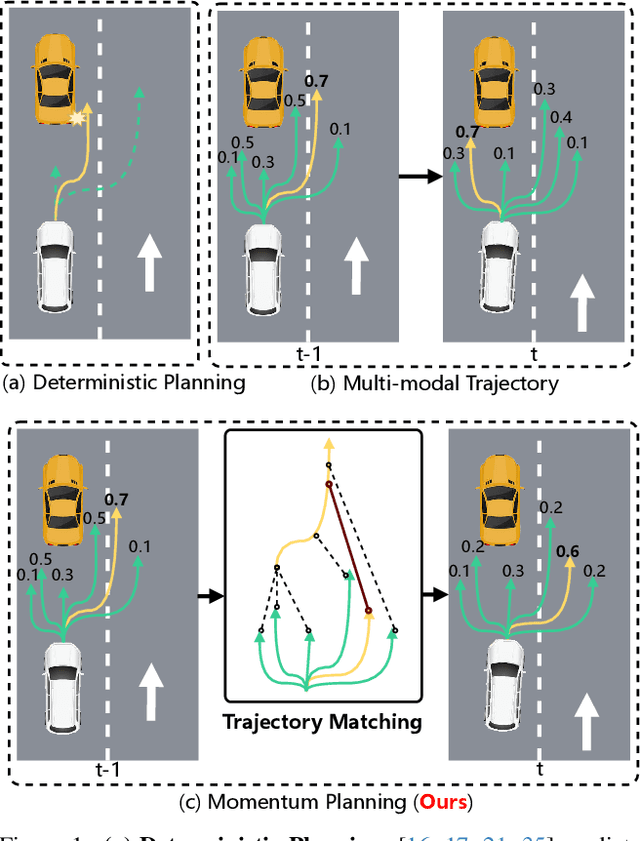


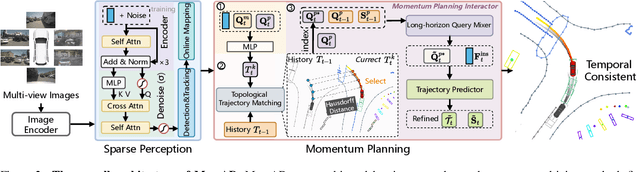
End-to-end autonomous driving frameworks enable seamless integration of perception and planning but often rely on one-shot trajectory prediction, which may lead to unstable control and vulnerability to occlusions in single-frame perception. To address this, we propose the Momentum-Aware Driving (MomAD) framework, which introduces trajectory momentum and perception momentum to stabilize and refine trajectory predictions. MomAD comprises two core components: (1) Topological Trajectory Matching (TTM) employs Hausdorff Distance to select the optimal planning query that aligns with prior paths to ensure coherence;(2) Momentum Planning Interactor (MPI) cross-attends the selected planning query with historical queries to expand static and dynamic perception files. This enriched query, in turn, helps regenerate long-horizon trajectory and reduce collision risks. To mitigate noise arising from dynamic environments and detection errors, we introduce robust instance denoising during training, enabling the planning model to focus on critical signals and improve its robustness. We also propose a novel Trajectory Prediction Consistency (TPC) metric to quantitatively assess planning stability. Experiments on the nuScenes dataset demonstrate that MomAD achieves superior long-term consistency (>=3s) compared to SOTA methods. Moreover, evaluations on the curated Turning-nuScenes shows that MomAD reduces the collision rate by 26% and improves TPC by 0.97m (33.45%) over a 6s prediction horizon, while closedloop on Bench2Drive demonstrates an up to 16.3% improvement in success rate.