 Add to Chrome
 Add to Firefox
 Add to Edge
Multimodal Referring Segmentation: A Survey
Aug 01, 2025
Multimodal referring segmentation aims to segment target objects in visual scenes, such as images, videos, and 3D scenes, based on referring expressions in text or audio format. This task plays a crucial role in practical applications requiring accurate object perception based on user instructions. Over the past decade, it has gained significant attention in the multimodal community, driven by advances in convolutional neural networks, transformers, and large language models, all of which have substantially improved multimodal perception capabilities. This paper provides a comprehensive survey of multimodal referring segmentation. We begin by introducing this field's background, including problem definitions and commonly used datasets. Next, we summarize a unified meta architecture for referring segmentation and review representative methods across three primary visual scenes, including images, videos, and 3D scenes. We further discuss Generalized Referring Expression (GREx) methods to address the challenges of real-world complexity, along with related tasks and practical applications. Extensive performance comparisons on standard benchmarks are also provided. We continually track related works at https://github.com/henghuiding/Awesome-Multimodal-Referring-Segmentation.

Towards Omnimodal Expressions and Reasoning in Referring Audio-Visual Segmentation
Jul 30, 2025Referring audio-visual segmentation (RAVS) has recently seen significant advancements, yet challenges remain in integrating multimodal information and deeply understanding and reasoning about audiovisual content. To extend the boundaries of RAVS and facilitate future research in this field, we propose Omnimodal Referring Audio-Visual Segmentation (OmniAVS), a new dataset containing 2,098 videos and 59,458 multimodal referring expressions. OmniAVS stands out with three key innovations: (1) 8 types of multimodal expressions that flexibly combine text, speech, sound, and visual cues; (2) an emphasis on understanding audio content beyond just detecting their presence; and (3) the inclusion of complex reasoning and world knowledge in expressions. Furthermore, we introduce Omnimodal Instructed Segmentation Assistant (OISA), to address the challenges of multimodal reasoning and fine-grained understanding of audiovisual content in OmniAVS. OISA uses MLLM to comprehend complex cues and perform reasoning-based segmentation. Extensive experiments show that OISA outperforms existing methods on OmniAVS and achieves competitive results on other related tasks.
MOVE: Motion-Guided Few-Shot Video Object Segmentation
Jul 29, 2025This work addresses motion-guided few-shot video object segmentation (FSVOS), which aims to segment dynamic objects in videos based on a few annotated examples with the same motion patterns. Existing FSVOS datasets and methods typically focus on object categories, which are static attributes that ignore the rich temporal dynamics in videos, limiting their application in scenarios requiring motion understanding. To fill this gap, we introduce MOVE, a large-scale dataset specifically designed for motion-guided FSVOS. Based on MOVE, we comprehensively evaluate 6 state-of-the-art methods from 3 different related tasks across 2 experimental settings. Our results reveal that current methods struggle to address motion-guided FSVOS, prompting us to analyze the associated challenges and propose a baseline method, Decoupled Motion Appearance Network (DMA). Experiments demonstrate that our approach achieves superior performance in few shot motion understanding, establishing a solid foundation for future research in this direction.
CharaConsist: Fine-Grained Consistent Character Generation
Jul 15, 2025
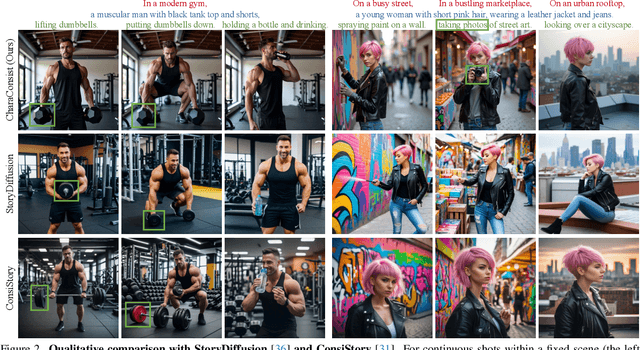
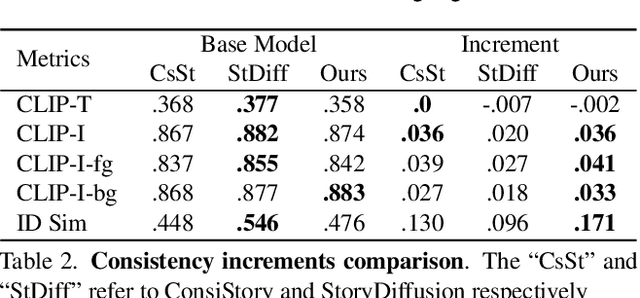
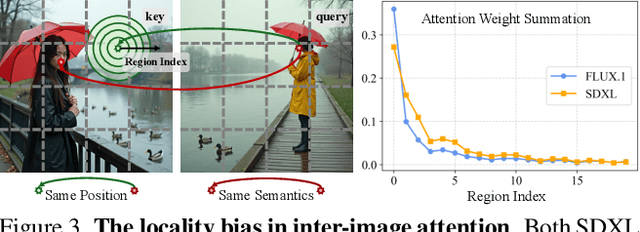
In text-to-image generation, producing a series of consistent contents that preserve the same identity is highly valuable for real-world applications. Although a few works have explored training-free methods to enhance the consistency of generated subjects, we observe that they suffer from the following problems. First, they fail to maintain consistent background details, which limits their applicability. Furthermore, when the foreground character undergoes large motion variations, inconsistencies in identity and clothing details become evident. To address these problems, we propose CharaConsist, which employs point-tracking attention and adaptive token merge along with decoupled control of the foreground and background. CharaConsist enables fine-grained consistency for both foreground and background, supporting the generation of one character in continuous shots within a fixed scene or in discrete shots across different scenes. Moreover, CharaConsist is the first consistent generation method tailored for text-to-image DiT model. Its ability to maintain fine-grained consistency, combined with the larger capacity of latest base model, enables it to produce high-quality visual outputs, broadening its applicability to a wider range of real-world scenarios. The source code has been released at https://github.com/Murray-Wang/CharaConsist
AnyI2V: Animating Any Conditional Image with Motion Control
Jul 03, 2025Recent advancements in video generation, particularly in diffusion models, have driven notable progress in text-to-video (T2V) and image-to-video (I2V) synthesis. However, challenges remain in effectively integrating dynamic motion signals and flexible spatial constraints. Existing T2V methods typically rely on text prompts, which inherently lack precise control over the spatial layout of generated content. In contrast, I2V methods are limited by their dependence on real images, which restricts the editability of the synthesized content. Although some methods incorporate ControlNet to introduce image-based conditioning, they often lack explicit motion control and require computationally expensive training. To address these limitations, we propose AnyI2V, a training-free framework that animates any conditional images with user-defined motion trajectories. AnyI2V supports a broader range of modalities as the conditional image, including data types such as meshes and point clouds that are not supported by ControlNet, enabling more flexible and versatile video generation. Additionally, it supports mixed conditional inputs and enables style transfer and editing via LoRA and text prompts. Extensive experiments demonstrate that the proposed AnyI2V achieves superior performance and provides a new perspective in spatial- and motion-controlled video generation. Code is available at https://henghuiding.com/AnyI2V/.
Progressive Scaling Visual Object Tracking
May 26, 2025In this work, we propose a progressive scaling training strategy for visual object tracking, systematically analyzing the influence of training data volume, model size, and input resolution on tracking performance. Our empirical study reveals that while scaling each factor leads to significant improvements in tracking accuracy, naive training suffers from suboptimal optimization and limited iterative refinement. To address this issue, we introduce DT-Training, a progressive scaling framework that integrates small teacher transfer and dual-branch alignment to maximize model potential. The resulting scaled tracker consistently outperforms state-of-the-art methods across multiple benchmarks, demonstrating strong generalization and transferability of the proposed method. Furthermore, we validate the broader applicability of our approach to additional tasks, underscoring its versatility beyond tracking.
SAMA: Towards Multi-Turn Referential Grounded Video Chat with Large Language Models
May 24, 2025Achieving fine-grained spatio-temporal understanding in videos remains a major challenge for current Video Large Multimodal Models (Video LMMs). Addressing this challenge requires mastering two core capabilities: video referring understanding, which captures the semantics of video regions, and video grounding, which segments object regions based on natural language descriptions. However, most existing approaches tackle these tasks in isolation, limiting progress toward unified, referentially grounded video interaction. We identify a key bottleneck in the lack of high-quality, unified video instruction data and a comprehensive benchmark for evaluating referentially grounded video chat. To address these challenges, we contribute in three core aspects: dataset, model, and benchmark. First, we introduce SAMA-239K, a large-scale dataset comprising 15K videos specifically curated to enable joint learning of video referring understanding, grounding, and multi-turn video chat. Second, we propose the SAMA model, which incorporates a versatile spatio-temporal context aggregator and a Segment Anything Model to jointly enhance fine-grained video comprehension and precise grounding capabilities. Finally, we establish SAMA-Bench, a meticulously designed benchmark consisting of 5,067 questions from 522 videos, to comprehensively evaluate the integrated capabilities of Video LMMs in multi-turn, spatio-temporal referring understanding and grounded dialogue. Extensive experiments and benchmarking results show that SAMA not only achieves strong performance on SAMA-Bench but also sets a new state-of-the-art on general grounding benchmarks, while maintaining highly competitive performance on standard visual understanding benchmarks.
Open-set Anomaly Segmentation in Complex Scenarios
Apr 28, 2025Precise segmentation of out-of-distribution (OoD) objects, herein referred to as anomalies, is crucial for the reliable deployment of semantic segmentation models in open-set, safety-critical applications, such as autonomous driving. Current anomalous segmentation benchmarks predominantly focus on favorable weather conditions, resulting in untrustworthy evaluations that overlook the risks posed by diverse meteorological conditions in open-set environments, such as low illumination, dense fog, and heavy rain. To bridge this gap, this paper introduces the ComsAmy, a challenging benchmark specifically designed for open-set anomaly segmentation in complex scenarios. ComsAmy encompasses a wide spectrum of adverse weather conditions, dynamic driving environments, and diverse anomaly types to comprehensively evaluate the model performance in realistic open-world scenarios. Our extensive evaluation of several state-of-the-art anomalous segmentation models reveals that existing methods demonstrate significant deficiencies in such challenging scenarios, highlighting their serious safety risks for real-world deployment. To solve that, we propose a novel energy-entropy learning (EEL) strategy that integrates the complementary information from energy and entropy to bolster the robustness of anomaly segmentation under complex open-world environments. Additionally, a diffusion-based anomalous training data synthesizer is proposed to generate diverse and high-quality anomalous images to enhance the existing copy-paste training data synthesizer. Extensive experimental results on both public and ComsAmy benchmarks demonstrate that our proposed diffusion-based synthesizer with energy and entropy learning (DiffEEL) serves as an effective and generalizable plug-and-play method to enhance existing models, yielding an average improvement of around 4.96% in $\rm{AUPRC}$ and 9.87% in $\rm{FPR}_{95}$.
PVUW 2025 Challenge Report: Advances in Pixel-level Understanding of Complex Videos in the Wild
Apr 15, 2025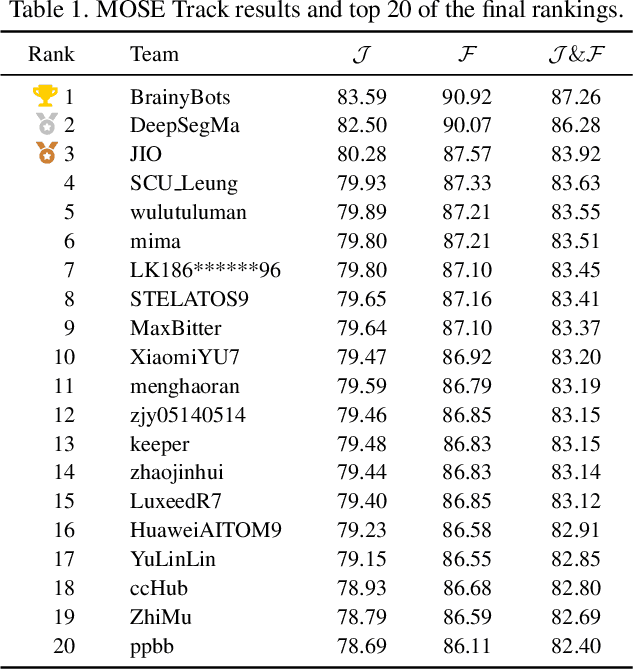
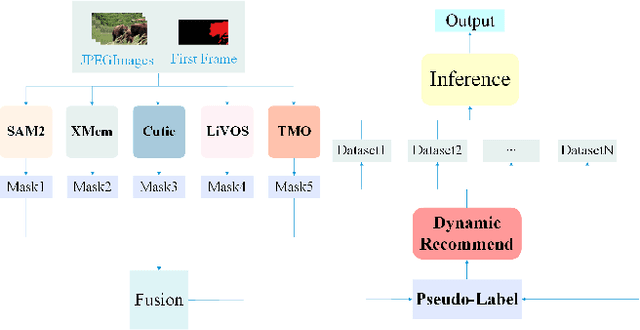
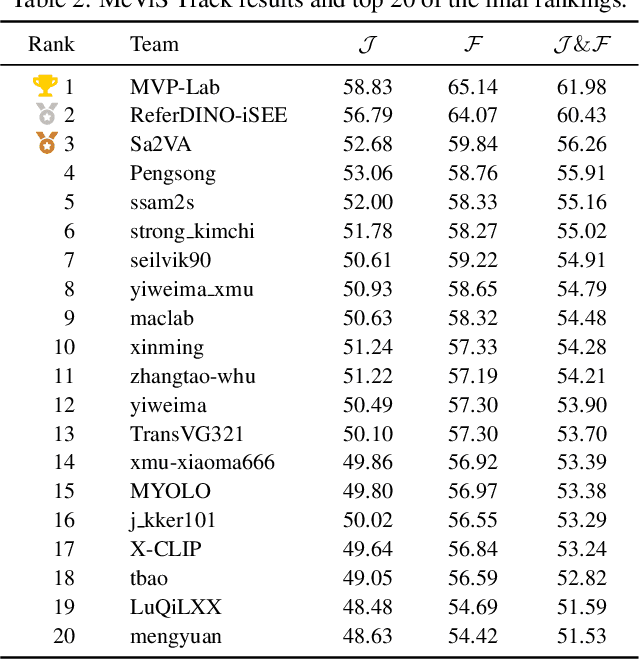
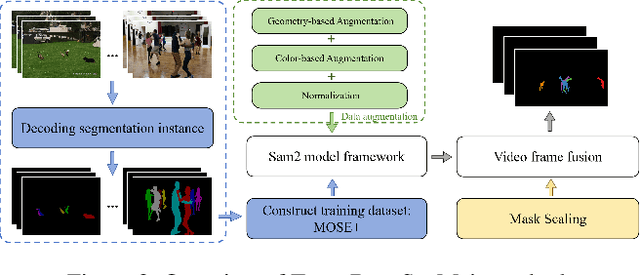
This report provides a comprehensive overview of the 4th Pixel-level Video Understanding in the Wild (PVUW) Challenge, held in conjunction with CVPR 2025. It summarizes the challenge outcomes, participating methodologies, and future research directions. The challenge features two tracks: MOSE, which focuses on complex scene video object segmentation, and MeViS, which targets motion-guided, language-based video segmentation. Both tracks introduce new, more challenging datasets designed to better reflect real-world scenarios. Through detailed evaluation and analysis, the challenge offers valuable insights into the current state-of-the-art and emerging trends in complex video segmentation. More information can be found on the workshop website: https://pvuw.github.io/.
Exploiting Temporal State Space Sharing for Video Semantic Segmentation
Mar 26, 2025Video semantic segmentation (VSS) plays a vital role in understanding the temporal evolution of scenes. Traditional methods often segment videos frame-by-frame or in a short temporal window, leading to limited temporal context, redundant computations, and heavy memory requirements. To this end, we introduce a Temporal Video State Space Sharing (TV3S) architecture to leverage Mamba state space models for temporal feature sharing. Our model features a selective gating mechanism that efficiently propagates relevant information across video frames, eliminating the need for a memory-heavy feature pool. By processing spatial patches independently and incorporating shifted operation, TV3S supports highly parallel computation in both training and inference stages, which reduces the delay in sequential state space processing and improves the scalability for long video sequences. Moreover, TV3S incorporates information from prior frames during inference, achieving long-range temporal coherence and superior adaptability to extended sequences. Evaluations on the VSPW and Cityscapes datasets reveal that our approach outperforms current state-of-the-art methods, establishing a new standard for VSS with consistent results across long video sequences. By achieving a good balance between accuracy and efficiency, TV3S shows a significant advancement in spatiotemporal modeling, paving the way for efficient video analysis. The code is publicly available at https://github.com/Ashesham/TV3S.git.