 Add to Chrome
 Add to Firefox
 Add to Edge
PSDesigner: Automated Graphic Design with a Human-Like Creative Workflow
Mar 26, 2026
Graphic design is a creative and innovative process that plays a crucial role in applications such as e-commerce and advertising. However, developing an automated design system that can faithfully translate user intentions into editable design files remains an open challenge. Although recent studies have leveraged powerful text-to-image models and MLLMs to assist graphic design, they typically simplify professional workflows, resulting in limited flexibility and intuitiveness. To address these limitations, we propose PSDesigner, an automated graphic design system that emulates the creative workflow of human designers. Building upon multiple specialized components, PSDesigner collects theme-related assets based on user instructions, and autonomously infers and executes tool calls to manipulate design files, such as integrating new assets or refining inferior elements. To endow the system with strong tool-use capabilities, we construct a design dataset, CreativePSD, which contains a large amount of high-quality PSD design files annotated with operation traces across a wide range of design scenarios and artistic styles, enabling models to learn expert design procedures. Extensive experiments demonstrate that PSDesigner outperforms existing methods across diverse graphic design tasks, empowering non-specialists to conveniently create production-quality designs.

GlyphPrinter: Region-Grouped Direct Preference Optimization for Glyph-Accurate Visual Text Rendering
Mar 16, 2026Generating accurate glyphs for visual text rendering is essential yet challenging. Existing methods typically enhance text rendering by training on a large amount of high-quality scene text images, but the limited coverage of glyph variations and excessive stylization often compromise glyph accuracy, especially for complex or out-of-domain characters. Some methods leverage reinforcement learning to alleviate this issue, yet their reward models usually depend on text recognition systems that are insensitive to fine-grained glyph errors, so images with incorrect glyphs may still receive high rewards. Inspired by Direct Preference Optimization (DPO), we propose GlyphPrinter, a preference-based text rendering method that eliminates reliance on explicit reward models. However, the standard DPO objective only models overall preference between two samples, which is insufficient for visual text rendering where glyph errors typically occur in localized regions. To address this issue, we construct the GlyphCorrector dataset with region-level glyph preference annotations and propose Region-Grouped DPO (R-GDPO), a region-based objective that optimizes inter- and intra-sample preferences over annotated regions, substantially enhancing glyph accuracy. Furthermore, we introduce Regional Reward Guidance, an inference strategy that samples from an optimal distribution with controllable glyph accuracy. Extensive experiments demonstrate that the proposed GlyphPrinter outperforms existing methods in glyph accuracy while maintaining a favorable balance between stylization and precision.
Free-Form Scene Editor: Enabling Multi-Round Object Manipulation like in a 3D Engine
Nov 17, 2025Recent advances in text-to-image (T2I) diffusion models have significantly improved semantic image editing, yet most methods fall short in performing 3D-aware object manipulation. In this work, we present FFSE, a 3D-aware autoregressive framework designed to enable intuitive, physically-consistent object editing directly on real-world images. Unlike previous approaches that either operate in image space or require slow and error-prone 3D reconstruction, FFSE models editing as a sequence of learned 3D transformations, allowing users to perform arbitrary manipulations, such as translation, scaling, and rotation, while preserving realistic background effects (e.g., shadows, reflections) and maintaining global scene consistency across multiple editing rounds. To support learning of multi-round 3D-aware object manipulation, we introduce 3DObjectEditor, a hybrid dataset constructed from simulated editing sequences across diverse objects and scenes, enabling effective training under multi-round and dynamic conditions. Extensive experiments show that the proposed FFSE significantly outperforms existing methods in both single-round and multi-round 3D-aware editing scenarios.
AnyI2V: Animating Any Conditional Image with Motion Control
Jul 03, 2025Recent advancements in video generation, particularly in diffusion models, have driven notable progress in text-to-video (T2V) and image-to-video (I2V) synthesis. However, challenges remain in effectively integrating dynamic motion signals and flexible spatial constraints. Existing T2V methods typically rely on text prompts, which inherently lack precise control over the spatial layout of generated content. In contrast, I2V methods are limited by their dependence on real images, which restricts the editability of the synthesized content. Although some methods incorporate ControlNet to introduce image-based conditioning, they often lack explicit motion control and require computationally expensive training. To address these limitations, we propose AnyI2V, a training-free framework that animates any conditional images with user-defined motion trajectories. AnyI2V supports a broader range of modalities as the conditional image, including data types such as meshes and point clouds that are not supported by ControlNet, enabling more flexible and versatile video generation. Additionally, it supports mixed conditional inputs and enables style transfer and editing via LoRA and text prompts. Extensive experiments demonstrate that the proposed AnyI2V achieves superior performance and provides a new perspective in spatial- and motion-controlled video generation. Code is available at https://henghuiding.com/AnyI2V/.
Free-Form Motion Control: A Synthetic Video Generation Dataset with Controllable Camera and Object Motions
Jan 03, 2025Controlling the movements of dynamic objects and the camera within generated videos is a meaningful yet challenging task. Due to the lack of datasets with comprehensive motion annotations, existing algorithms can not simultaneously control the motions of both camera and objects, resulting in limited controllability over generated contents. To address this issue and facilitate the research in this field, we introduce a Synthetic Dataset for Free-Form Motion Control (SynFMC). The proposed SynFMC dataset includes diverse objects and environments and covers various motion patterns according to specific rules, simulating common and complex real-world scenarios. The complete 6D pose information facilitates models learning to disentangle the motion effects from objects and the camera in a video. To validate the effectiveness and generalization of SynFMC, we further propose a method, Free-Form Motion Control (FMC). FMC enables independent or simultaneous control of object and camera movements, producing high-fidelity videos. Moreover, it is compatible with various personalized text-to-image (T2I) models for different content styles. Extensive experiments demonstrate that the proposed FMC outperforms previous methods across multiple scenarios.
A Survey of Multimodal-Guided Image Editing with Text-to-Image Diffusion Models
Jun 20, 2024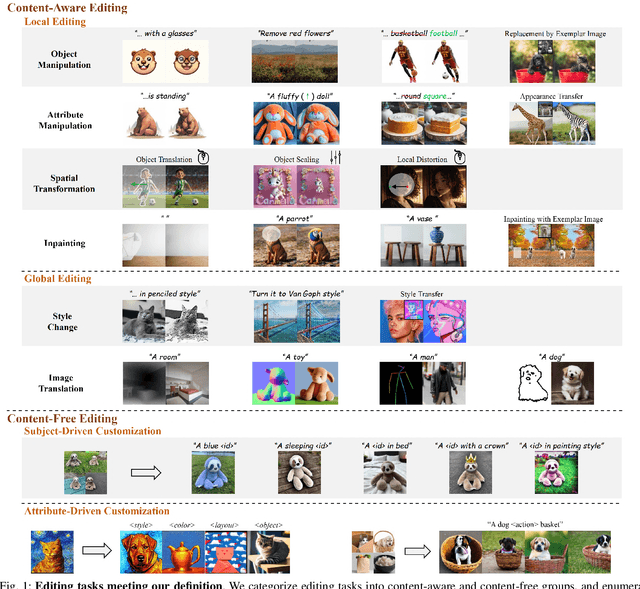
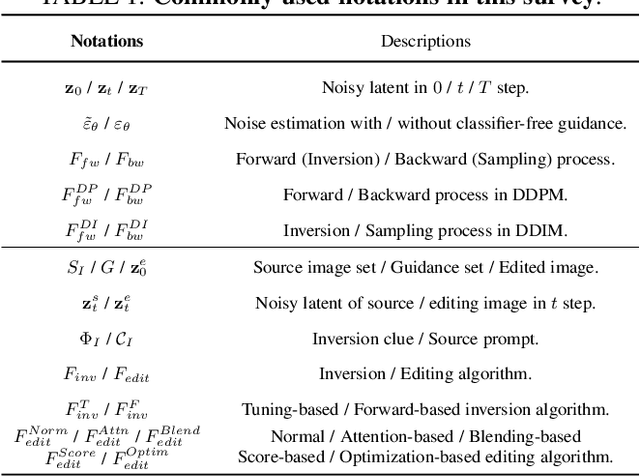
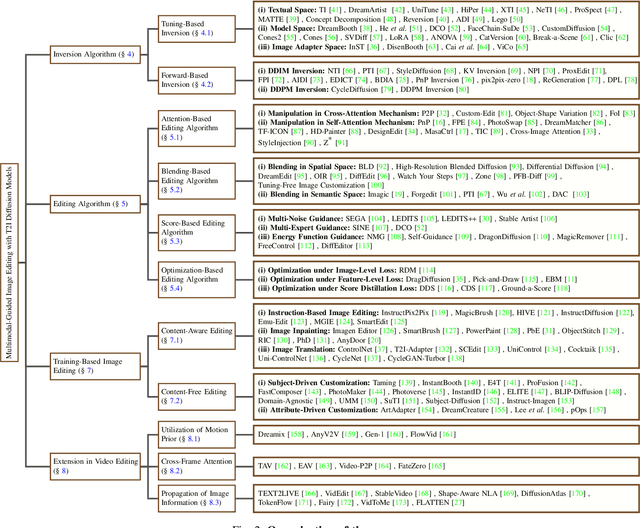
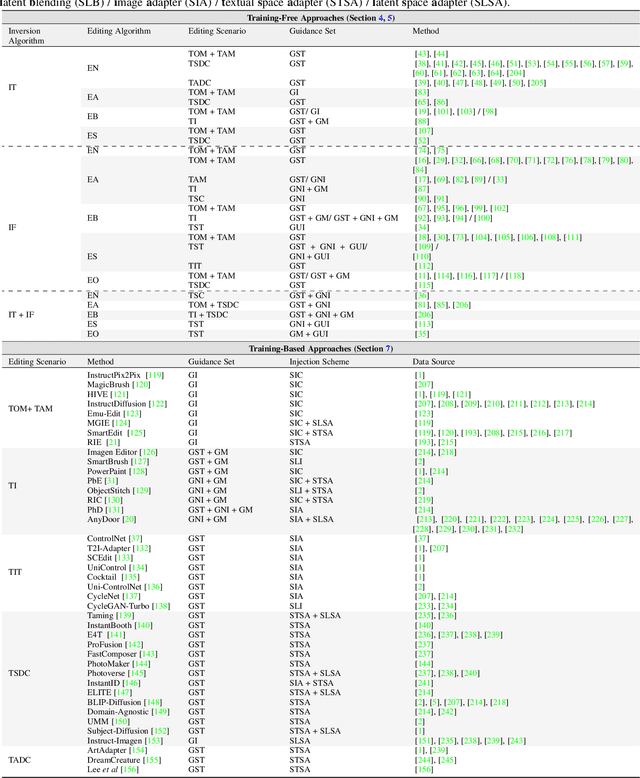
Image editing aims to edit the given synthetic or real image to meet the specific requirements from users. It is widely studied in recent years as a promising and challenging field of Artificial Intelligence Generative Content (AIGC). Recent significant advancement in this field is based on the development of text-to-image (T2I) diffusion models, which generate images according to text prompts. These models demonstrate remarkable generative capabilities and have become widely used tools for image editing. T2I-based image editing methods significantly enhance editing performance and offer a user-friendly interface for modifying content guided by multimodal inputs. In this survey, we provide a comprehensive review of multimodal-guided image editing techniques that leverage T2I diffusion models. First, we define the scope of image editing from a holistic perspective and detail various control signals and editing scenarios. We then propose a unified framework to formalize the editing process, categorizing it into two primary algorithm families. This framework offers a design space for users to achieve specific goals. Subsequently, we present an in-depth analysis of each component within this framework, examining the characteristics and applicable scenarios of different combinations. Given that training-based methods learn to directly map the source image to target one under user guidance, we discuss them separately, and introduce injection schemes of source image in different scenarios. Additionally, we review the application of 2D techniques to video editing, highlighting solutions for inter-frame inconsistency. Finally, we discuss open challenges in the field and suggest potential future research directions. We keep tracing related works at https://github.com/xinchengshuai/Awesome-Image-Editing.