 Add to Chrome
 Add to Firefox
 Add to Edge
LAD-COD: Language-Aligned Dense Perception for Camouflaged Object Detection
Aug 08, 2026
Camouflaged object detection (COD) aims to segment objects that exhibit high visual similarity to their surroundings, which reduces foreground-background discriminability and weakens boundary evidence across appearance, texture, and structure. Such limitations motivate the use of instruction-conditioned semantics as top-down guidance for identifying which weak visual cues are relevant to the target. Recent segmentation systems built on large multimodal models (LMMs) demonstrate this possibility through instruction-conditioned target embeddings that guide mask decoding. However, in this language-to-mask paradigm, the generated target embedding conditions mainly the mask decoder, leaving the dense visual features that must preserve low-contrast boundaries and fine local structure without explicit guidance. We propose Language-Aligned Dense perception for COD (LAD-COD), a framework that aligns top-down semantic target guidance with bottom-up hierarchical visual features. Instead of fully adapting a large generic image encoder, LAD-COD learns a trainable hierarchical visual branch that captures camouflage-sensitive texture, boundary, and contextual information. To align these features with the target embedding, LAD-COD applies Language-Aligned Dual Visual Fusion (LADVF), which extends the embedding beyond sparse prompting to query patch-level language-aligned features and to gate their residual integration with the hierarchical features. This design allows semantic information to guide localization while preserving the fine structural details needed for camouflage segmentation. Experiments on CAMO, COD10K, and NC4K show that LAD-COD obtains the best reported value in all 12 dataset-metric comparisons.

STAC: Selective Spatiotemporal Aggregation and Compression for Video Reasoning Segmentation
Jul 03, 2026Video reasoning segmentation demands pixel-accurate object tracking across hundreds of frames under complex natural language queries, producing dense spatiotemporal tokens whose quadratic self-attention cost makes long-video processing prohibitive. Existing methods address this through token compression, yet typically operate on encoder features lacking temporal context, constraining selection before content redundancy can be reliably assessed. Informed compression requires contextual awareness, but acquiring that awareness at full resolution incurs the same quadratic cost compression aims to reduce. State-space models resolve this constraint, as their linear recurrence selectively conditions each token on temporal context at $\mathcal{O}(T)$ cost, producing representations where content redundancy becomes assessable. Building on this, Selective SpatioTemporal Aggregation and Compression (STAC) enriches features via decoupled bidirectional spatial and causal temporal scanning, leveraging recurrence-derived redundancy for hierarchical compression with adaptive thresholds optimised with segmentation objective. STAC achieves 85% token reduction and 1.8$\times$ speedup while surpassing compression-free baselines on reasoning segmentation benchmarks in a zero-shot streaming-compatible setting. Code is available \href{https://github.com/MCG-NKU/nku-video}{here}.
A Comprehensive Survey on Video Scene Parsing:Advances, Challenges, and Prospects
Jun 16, 2025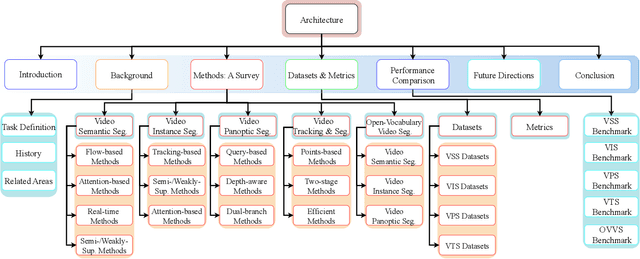
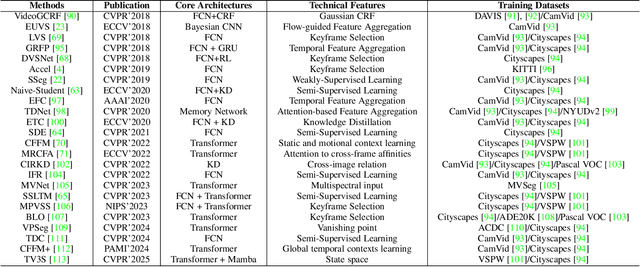
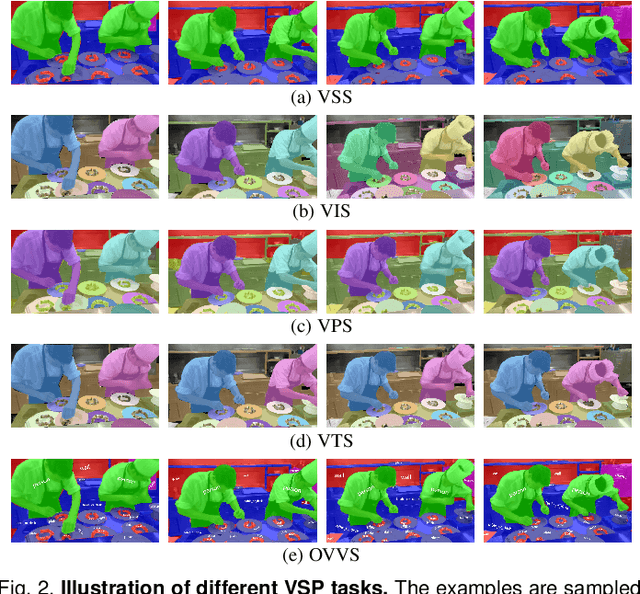
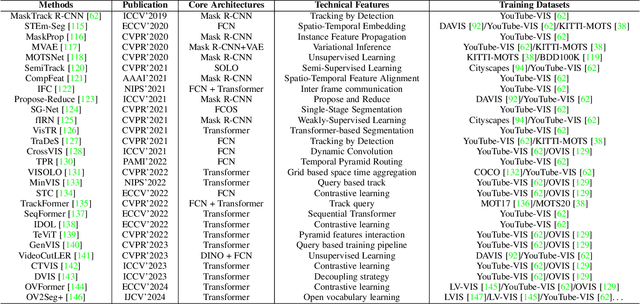
Video Scene Parsing (VSP) has emerged as a cornerstone in computer vision, facilitating the simultaneous segmentation, recognition, and tracking of diverse visual entities in dynamic scenes. In this survey, we present a holistic review of recent advances in VSP, covering a wide array of vision tasks, including Video Semantic Segmentation (VSS), Video Instance Segmentation (VIS), Video Panoptic Segmentation (VPS), as well as Video Tracking and Segmentation (VTS), and Open-Vocabulary Video Segmentation (OVVS). We systematically analyze the evolution from traditional hand-crafted features to modern deep learning paradigms -- spanning from fully convolutional networks to the latest transformer-based architectures -- and assess their effectiveness in capturing both local and global temporal contexts. Furthermore, our review critically discusses the technical challenges, ranging from maintaining temporal consistency to handling complex scene dynamics, and offers a comprehensive comparative study of datasets and evaluation metrics that have shaped current benchmarking standards. By distilling the key contributions and shortcomings of state-of-the-art methodologies, this survey highlights emerging trends and prospective research directions that promise to further elevate the robustness and adaptability of VSP in real-world applications.
Exploiting Temporal State Space Sharing for Video Semantic Segmentation
Mar 26, 2025Video semantic segmentation (VSS) plays a vital role in understanding the temporal evolution of scenes. Traditional methods often segment videos frame-by-frame or in a short temporal window, leading to limited temporal context, redundant computations, and heavy memory requirements. To this end, we introduce a Temporal Video State Space Sharing (TV3S) architecture to leverage Mamba state space models for temporal feature sharing. Our model features a selective gating mechanism that efficiently propagates relevant information across video frames, eliminating the need for a memory-heavy feature pool. By processing spatial patches independently and incorporating shifted operation, TV3S supports highly parallel computation in both training and inference stages, which reduces the delay in sequential state space processing and improves the scalability for long video sequences. Moreover, TV3S incorporates information from prior frames during inference, achieving long-range temporal coherence and superior adaptability to extended sequences. Evaluations on the VSPW and Cityscapes datasets reveal that our approach outperforms current state-of-the-art methods, establishing a new standard for VSS with consistent results across long video sequences. By achieving a good balance between accuracy and efficiency, TV3S shows a significant advancement in spatiotemporal modeling, paving the way for efficient video analysis. The code is publicly available at https://github.com/Ashesham/TV3S.git.