 Add to Chrome
 Add to Firefox
 Add to Edge
Mask World Model: Predicting What Matters for Robust Robot Policy Learning
Apr 22, 2026
World models derived from large-scale video generative pre-training have emerged as a promising paradigm for generalist robot policy learning. However, standard approaches often focus on high-fidelity RGB video prediction, this can result in overfitting to irrelevant factors, such as dynamic backgrounds and illumination changes. These distractions reduce the model's ability to generalize, ultimately leading to unreliable and fragile control policies. To address this, we introduce the Mask World Model (MWM), which leverages video diffusion architectures to predict the evolution of semantic masks instead of pixels. This shift imposes a geometric information bottleneck, forcing the model to capture essential physical dynamics and contact relations while filtering out visual noise. We seamlessly integrate this mask dynamics backbone with a diffusion-based policy head to enable robust end-to-end control. Extensive evaluations demonstrate the superiority of MWM on the LIBERO and RLBench simulation benchmarks, significantly outperforming the state-of-the-art RGB-based world models. Furthermore, real-world experiments and robustness evaluation (via random token pruning) reveal that MWM exhibits superior generalization capabilities and robust resilience to texture information loss.

A Survey on Long Video Generation: Challenges, Methods, and Prospects
Mar 25, 2024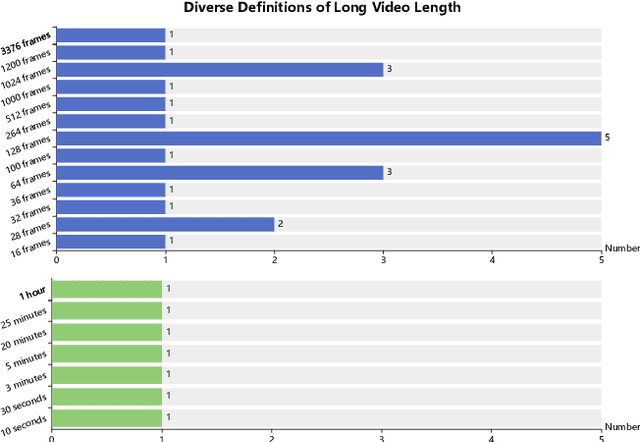


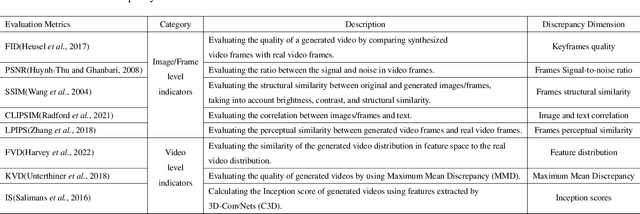
Video generation is a rapidly advancing research area, garnering significant attention due to its broad range of applications. One critical aspect of this field is the generation of long-duration videos, which presents unique challenges and opportunities. This paper presents the first survey of recent advancements in long video generation and summarises them into two key paradigms: divide and conquer temporal autoregressive. We delve into the common models employed in each paradigm, including aspects of network design and conditioning techniques. Furthermore, we offer a comprehensive overview and classification of the datasets and evaluation metrics which are crucial for advancing long video generation research. Concluding with a summary of existing studies, we also discuss the emerging challenges and future directions in this dynamic field. We hope that this survey will serve as an essential reference for researchers and practitioners in the realm of long video generation.