 Add to Chrome
 Add to Firefox
 Add to Edge
J-Miner: Recovering Executable Decision Knowledge from Language-Model Classifiers
Aug 17, 2026
Large language models can be fine-tuned into specialized classifiers that perform well across diverse text tasks and make complex judgments, but they typically expose only final labels, leaving the decision knowledge acquired through fine-tuning implicit within the model. We study how to mine this internal decision knowledge from a fine-tuned classifier and encode it in an executable representation that can be inspected, validated, and reused beyond the source classifier. We introduce J-Miner, which mines text-level named concepts by aggregating vocabulary-aligned internal signals across layers and token positions, and uses the classifier's own predictions to learn executable decision rules over them. This process distills local internal readouts into an explicit classifier-level knowledge representation. Across multiple classification tasks, J-Miner rules reproduce up to 98.3\% of source-classifier decisions and achieve 6.0--29.5 percentage points higher behavioral fidelity than equally compact rules learned from input words. Further analysis shows that the named concepts reflect internal semantic evidence associated with task decisions, while the learned rules consolidate these distributed signals into inspectable decision structures. The resulting decision knowledge also transfers to lightweight standalone students: using about 1/24 as many parameters as the source classifiers, they reconstruct and execute the representation from raw text while retaining 99.8\% of the source classifiers' mean task accuracy. These findings show that task-specific decision knowledge can be faithfully represented in an explicit, executable form and reused beyond the classifier in which it was learned.

Multiview Scene Graph
Oct 15, 2024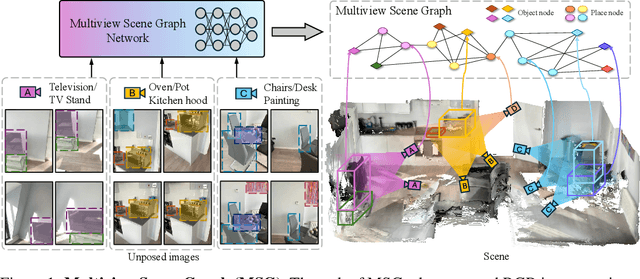
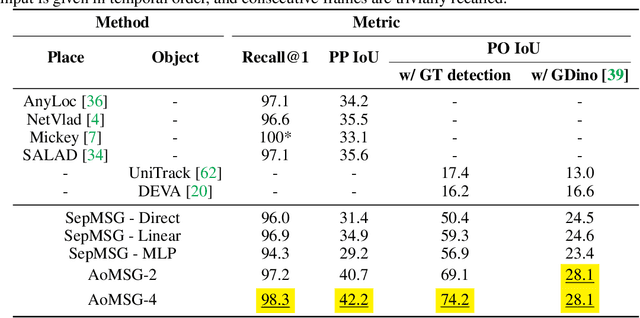
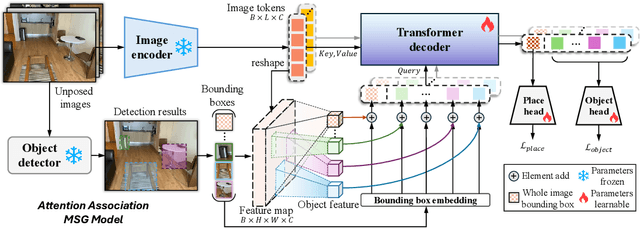
A proper scene representation is central to the pursuit of spatial intelligence where agents can robustly reconstruct and efficiently understand 3D scenes. A scene representation is either metric, such as landmark maps in 3D reconstruction, 3D bounding boxes in object detection, or voxel grids in occupancy prediction, or topological, such as pose graphs with loop closures in SLAM or visibility graphs in SfM. In this work, we propose to build Multiview Scene Graphs (MSG) from unposed images, representing a scene topologically with interconnected place and object nodes. The task of building MSG is challenging for existing representation learning methods since it needs to jointly address both visual place recognition, object detection, and object association from images with limited fields of view and potentially large viewpoint changes. To evaluate any method tackling this task, we developed an MSG dataset and annotation based on a public 3D dataset. We also propose an evaluation metric based on the intersection-over-union score of MSG edges. Moreover, we develop a novel baseline method built on mainstream pretrained vision models, combining visual place recognition and object association into one Transformer decoder architecture. Experiments demonstrate our method has superior performance compared to existing relevant baselines.
Towards Generalizable Tumor Synthesis
Feb 29, 2024Tumor synthesis enables the creation of artificial tumors in medical images, facilitating the training of AI models for tumor detection and segmentation. However, success in tumor synthesis hinges on creating visually realistic tumors that are generalizable across multiple organs and, furthermore, the resulting AI models being capable of detecting real tumors in images sourced from different domains (e.g., hospitals). This paper made a progressive stride toward generalizable tumor synthesis by leveraging a critical observation: early-stage tumors (< 2cm) tend to have similar imaging characteristics in computed tomography (CT), whether they originate in the liver, pancreas, or kidneys. We have ascertained that generative AI models, e.g., Diffusion Models, can create realistic tumors generalized to a range of organs even when trained on a limited number of tumor examples from only one organ. Moreover, we have shown that AI models trained on these synthetic tumors can be generalized to detect and segment real tumors from CT volumes, encompassing a broad spectrum of patient demographics, imaging protocols, and healthcare facilities.
Editing Out-of-domain GAN Inversion via Differential Activations
Jul 17, 2022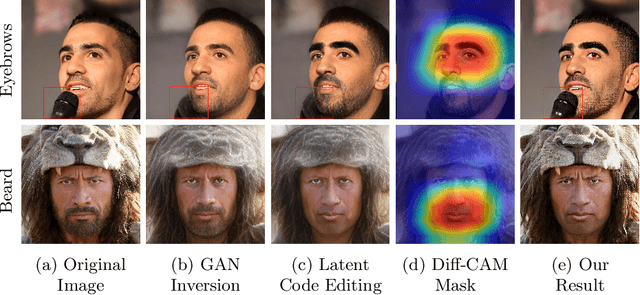

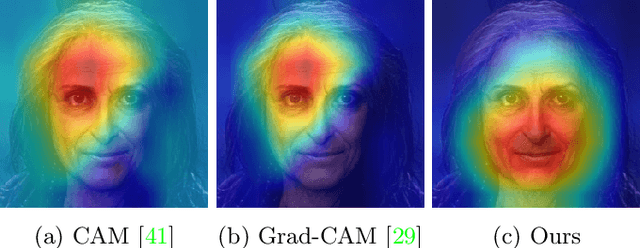
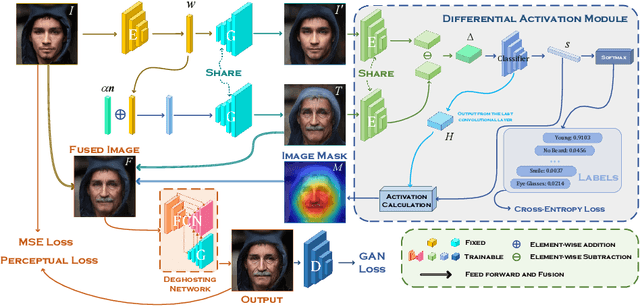
Despite the demonstrated editing capacity in the latent space of a pretrained GAN model, inverting real-world images is stuck in a dilemma that the reconstruction cannot be faithful to the original input. The main reason for this is that the distributions between training and real-world data are misaligned, and because of that, it is unstable of GAN inversion for real image editing. In this paper, we propose a novel GAN prior based editing framework to tackle the out-of-domain inversion problem with a composition-decomposition paradigm. In particular, during the phase of composition, we introduce a differential activation module for detecting semantic changes from a global perspective, \ie, the relative gap between the features of edited and unedited images. With the aid of the generated Diff-CAM mask, a coarse reconstruction can intuitively be composited by the paired original and edited images. In this way, the attribute-irrelevant regions can be survived in almost whole, while the quality of such an intermediate result is still limited by an unavoidable ghosting effect. Consequently, in the decomposition phase, we further present a GAN prior based deghosting network for separating the final fine edited image from the coarse reconstruction. Extensive experiments exhibit superiorities over the state-of-the-art methods, in terms of qualitative and quantitative evaluations. The robustness and flexibility of our method is also validated on both scenarios of single attribute and multi-attribute manipulations.