 Add to Chrome
 Add to Firefox
 Add to Edge
Lightweight Method for Interactive 3D Medical Image Segmentation with Multi-Round Result Fusion
Dec 11, 2024
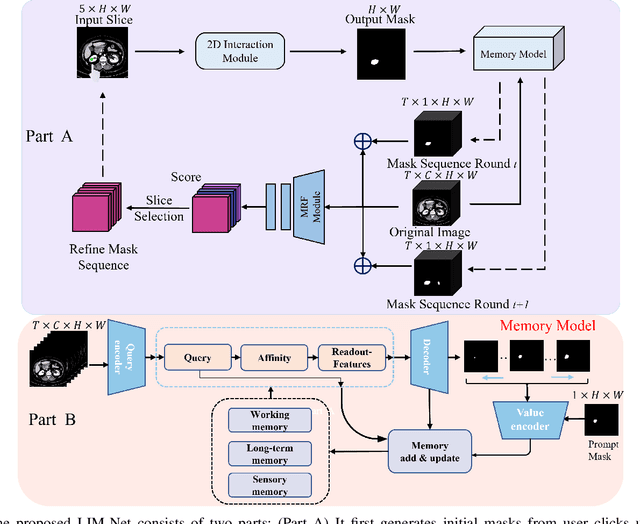

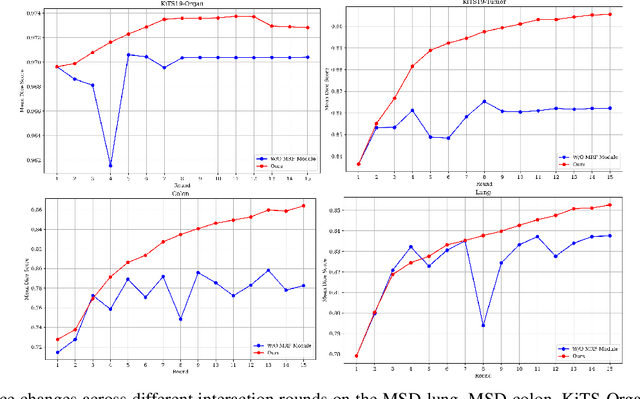
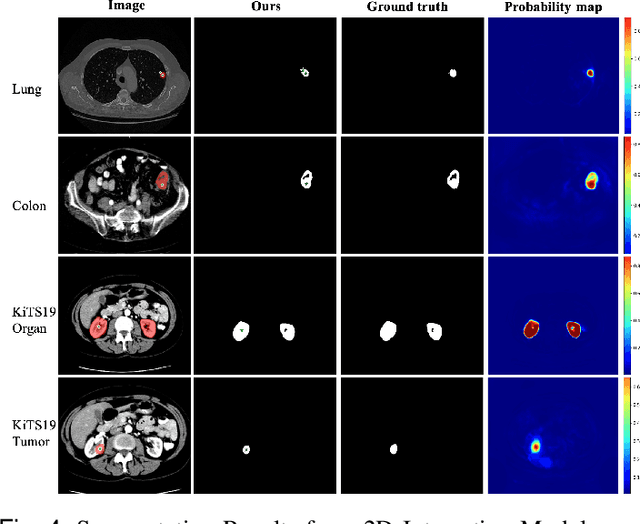
In medical imaging, precise annotation of lesions or organs is often required. However, 3D volumetric images typically consist of hundreds or thousands of slices, making the annotation process extremely time-consuming and laborious. Recently, the Segment Anything Model (SAM) has drawn widespread attention due to its remarkable zero-shot generalization capabilities in interactive segmentation. While researchers have explored adapting SAM for medical applications, such as using SAM adapters or constructing 3D SAM models, a key question remains: Can traditional CNN networks achieve the same strong zero-shot generalization in this task? In this paper, we propose the Lightweight Interactive Network for 3D Medical Image Segmentation (LIM-Net), a novel approach demonstrating the potential of compact CNN-based models. Built upon a 2D CNN backbone, LIM-Net initiates segmentation by generating a 2D prompt mask from user hints. This mask is then propagated through the 3D sequence via the Memory Module. To refine and stabilize results during interaction, the Multi-Round Result Fusion (MRF) Module selects and merges optimal masks from multiple rounds. Our extensive experiments across multiple datasets and modalities demonstrate LIM-Net's competitive performance. It exhibits stronger generalization to unseen data compared to SAM-based models, with competitive accuracy while requiring fewer interactions. Notably, LIM-Net's lightweight design offers significant advantages in deployment and inference efficiency, with low GPU memory consumption suitable for resource-constrained environments. These promising results demonstrate LIM-Net can serve as a strong baseline, complementing and contrasting with popular SAM models to further boost effective interactive medical image segmentation. The code will be released at \url{https://github.com/goodtime-123/LIM-Net}.

Second FRCSyn-onGoing: Winning Solutions and Post-Challenge Analysis to Improve Face Recognition with Synthetic Data
Dec 02, 2024Synthetic data is gaining increasing popularity for face recognition technologies, mainly due to the privacy concerns and challenges associated with obtaining real data, including diverse scenarios, quality, and demographic groups, among others. It also offers some advantages over real data, such as the large amount of data that can be generated or the ability to customize it to adapt to specific problem-solving needs. To effectively use such data, face recognition models should also be specifically designed to exploit synthetic data to its fullest potential. In order to promote the proposal of novel Generative AI methods and synthetic data, and investigate the application of synthetic data to better train face recognition systems, we introduce the 2nd FRCSyn-onGoing challenge, based on the 2nd Face Recognition Challenge in the Era of Synthetic Data (FRCSyn), originally launched at CVPR 2024. This is an ongoing challenge that provides researchers with an accessible platform to benchmark i) the proposal of novel Generative AI methods and synthetic data, and ii) novel face recognition systems that are specifically proposed to take advantage of synthetic data. We focus on exploring the use of synthetic data both individually and in combination with real data to solve current challenges in face recognition such as demographic bias, domain adaptation, and performance constraints in demanding situations, such as age disparities between training and testing, changes in the pose, or occlusions. Very interesting findings are obtained in this second edition, including a direct comparison with the first one, in which synthetic databases were restricted to DCFace and GANDiffFace.
Behavior Backdoor for Deep Learning Models
Dec 02, 2024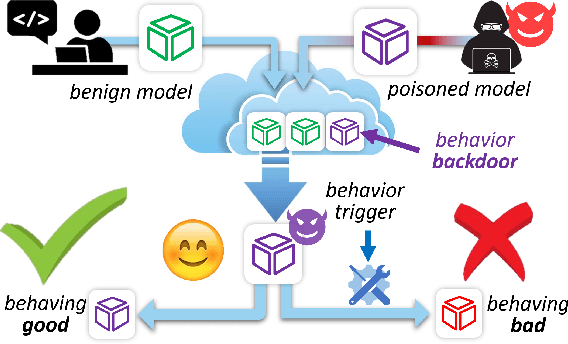
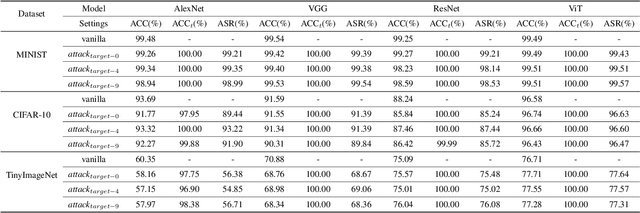

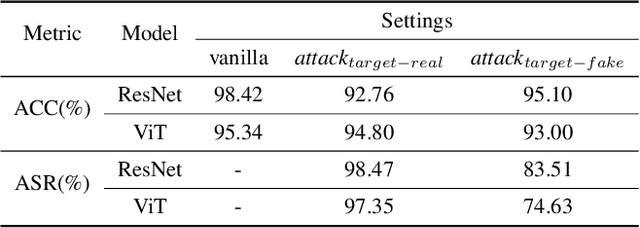
The various post-processing methods for deep-learning-based models, such as quantification, pruning, and fine-tuning, play an increasingly important role in artificial intelligence technology, with pre-train large models as one of the main development directions. However, this popular series of post-processing behaviors targeting pre-training deep models has become a breeding ground for new adversarial security issues. In this study, we take the first step towards ``behavioral backdoor'' attack, which is defined as a behavior-triggered backdoor model training procedure, to reveal a new paradigm of backdoor attacks. In practice, we propose the first pipeline of implementing behavior backdoor, i.e., the Quantification Backdoor (QB) attack, upon exploiting model quantification method as the set trigger. Specifically, to adapt the optimization goal of behavior backdoor, we introduce the behavior-driven backdoor object optimizing method by a bi-target behavior backdoor training loss, thus we could guide the poisoned model optimization direction. To update the parameters across multiple models, we adopt the address-shared backdoor model training, thereby the gradient information could be utilized for multimodel collaborative optimization. Extensive experiments have been conducted on different models, datasets, and tasks, demonstrating the effectiveness of this novel backdoor attack and its potential application threats.
Point Cloud Unsupervised Pre-training via 3D Gaussian Splatting
Nov 27, 2024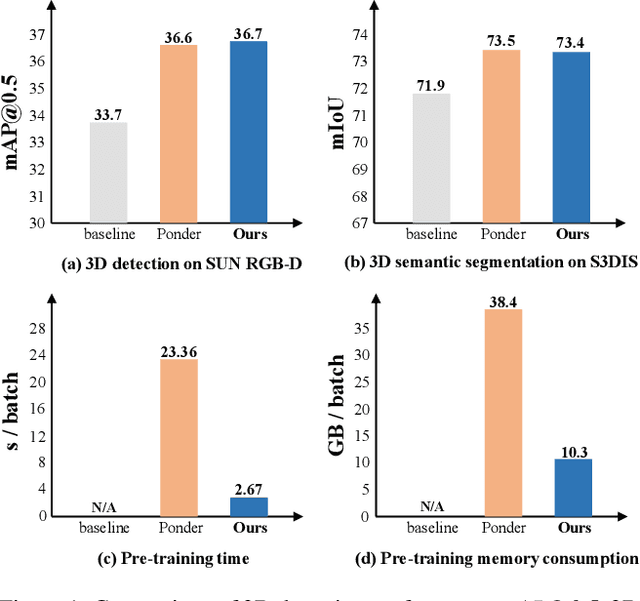
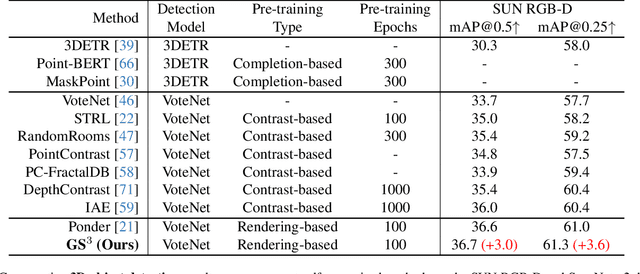

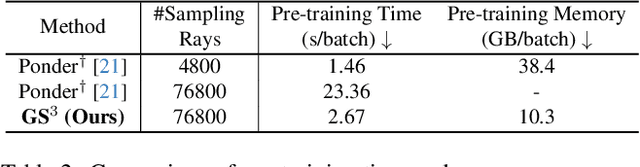
Pre-training on large-scale unlabeled datasets contribute to the model achieving powerful performance on 3D vision tasks, especially when annotations are limited. However, existing rendering-based self-supervised frameworks are computationally demanding and memory-intensive during pre-training due to the inherent nature of volume rendering. In this paper, we propose an efficient framework named GS$^3$ to learn point cloud representation, which seamlessly integrates fast 3D Gaussian Splatting into the rendering-based framework. The core idea behind our framework is to pre-train the point cloud encoder by comparing rendered RGB images with real RGB images, as only Gaussian points enriched with learned rich geometric and appearance information can produce high-quality renderings. Specifically, we back-project the input RGB-D images into 3D space and use a point cloud encoder to extract point-wise features. Then, we predict 3D Gaussian points of the scene from the learned point cloud features and uses a tile-based rasterizer for image rendering. Finally, the pre-trained point cloud encoder can be fine-tuned to adapt to various downstream 3D tasks, including high-level perception tasks such as 3D segmentation and detection, as well as low-level tasks such as 3D scene reconstruction. Extensive experiments on downstream tasks demonstrate the strong transferability of the pre-trained point cloud encoder and the effectiveness of our self-supervised learning framework. In addition, our GS$^3$ framework is highly efficient, achieving approximately 9$\times$ pre-training speedup and less than 0.25$\times$ memory cost compared to the previous rendering-based framework Ponder.
3D Scene Graph Guided Vision-Language Pre-training
Nov 27, 2024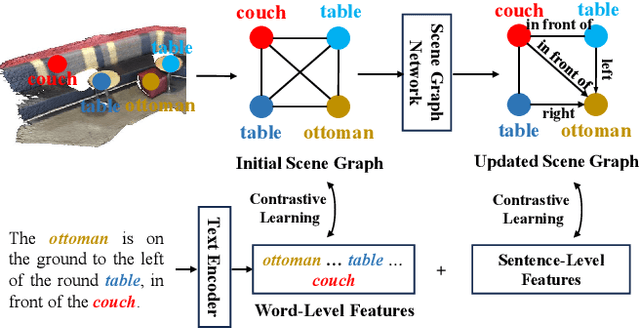
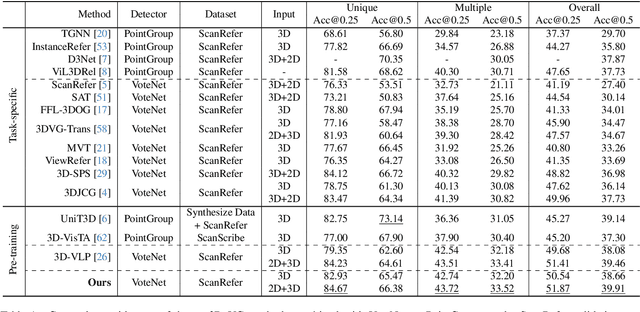
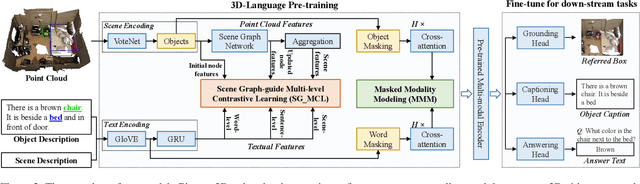
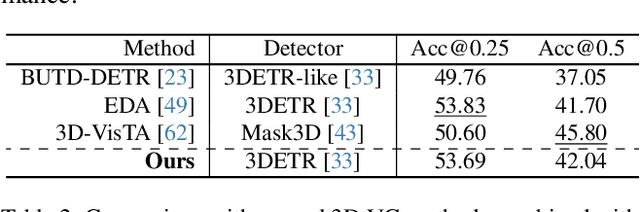
3D vision-language (VL) reasoning has gained significant attention due to its potential to bridge the 3D physical world with natural language descriptions. Existing approaches typically follow task-specific, highly specialized paradigms. Therefore, these methods focus on a limited range of reasoning sub-tasks and rely heavily on the hand-crafted modules and auxiliary losses. This highlights the need for a simpler, unified and general-purpose model. In this paper, we leverage the inherent connection between 3D scene graphs and natural language, proposing a 3D scene graph-guided vision-language pre-training (VLP) framework. Our approach utilizes modality encoders, graph convolutional layers and cross-attention layers to learn universal representations that adapt to a variety of 3D VL reasoning tasks, thereby eliminating the need for task-specific designs. The pre-training objectives include: 1) Scene graph-guided contrastive learning, which leverages the strong correlation between 3D scene graphs and natural language to align 3D objects with textual features at various fine-grained levels; and 2) Masked modality learning, which uses cross-modality information to reconstruct masked words and 3D objects. Instead of directly reconstructing the 3D point clouds of masked objects, we use position clues to predict their semantic categories. Extensive experiments demonstrate that our pre-training model, when fine-tuned on several downstream tasks, achieves performance comparable to or better than existing methods in tasks such as 3D visual grounding, 3D dense captioning, and 3D question answering.
Morph: A Motion-free Physics Optimization Framework for Human Motion Generation
Nov 22, 2024Human motion generation plays a vital role in applications such as digital humans and humanoid robot control. However, most existing approaches disregard physics constraints, leading to the frequent production of physically implausible motions with pronounced artifacts such as floating and foot sliding. In this paper, we propose \textbf{Morph}, a \textbf{Mo}tion-f\textbf{r}ee \textbf{ph}ysics optimization framework, comprising a Motion Generator and a Motion Physics Refinement module, for enhancing physical plausibility without relying on costly real-world motion data. Specifically, the Motion Generator is responsible for providing large-scale synthetic motion data, while the Motion Physics Refinement Module utilizes these synthetic data to train a motion imitator within a physics simulator, enforcing physical constraints to project the noisy motions into a physically-plausible space. These physically refined motions, in turn, are used to fine-tune the Motion Generator, further enhancing its capability. Experiments on both text-to-motion and music-to-dance generation tasks demonstrate that our framework achieves state-of-the-art motion generation quality while improving physical plausibility drastically.
Nd-BiMamba2: A Unified Bidirectional Architecture for Multi-Dimensional Data Processing
Nov 22, 2024Deep learning models often require specially designed architectures to process data of different dimensions, such as 1D time series, 2D images, and 3D volumetric data. Existing bidirectional models mainly focus on sequential data, making it difficult to scale effectively to higher dimensions. To address this issue, we propose a novel multi-dimensional bidirectional neural network architecture, named Nd-BiMamba2, which efficiently handles 1D, 2D, and 3D data. Nd-BiMamba2 is based on the Mamba2 module and introduces innovative bidirectional processing mechanisms and adaptive padding strategies to capture bidirectional information in multi-dimensional data while maintaining computational efficiency. Unlike existing methods that require designing specific architectures for different dimensional data, Nd-BiMamba2 adopts a unified architecture with a modular design, simplifying development and maintenance costs. To verify the portability and flexibility of Nd-BiMamba2, we successfully exported it to ONNX and TorchScript and tested it on different hardware platforms (e.g., CPU, GPU, and mobile devices). Experimental results show that Nd-BiMamba2 runs efficiently on multiple platforms, demonstrating its potential in practical applications. The code is open-source: https://github.com/Human9000/nd-Mamba2-torch
Reflections from the 2024 Large Language Model (LLM) Hackathon for Applications in Materials Science and Chemistry
Nov 20, 2024


Here, we present the outcomes from the second Large Language Model (LLM) Hackathon for Applications in Materials Science and Chemistry, which engaged participants across global hybrid locations, resulting in 34 team submissions. The submissions spanned seven key application areas and demonstrated the diverse utility of LLMs for applications in (1) molecular and material property prediction; (2) molecular and material design; (3) automation and novel interfaces; (4) scientific communication and education; (5) research data management and automation; (6) hypothesis generation and evaluation; and (7) knowledge extraction and reasoning from scientific literature. Each team submission is presented in a summary table with links to the code and as brief papers in the appendix. Beyond team results, we discuss the hackathon event and its hybrid format, which included physical hubs in Toronto, Montreal, San Francisco, Berlin, Lausanne, and Tokyo, alongside a global online hub to enable local and virtual collaboration. Overall, the event highlighted significant improvements in LLM capabilities since the previous year's hackathon, suggesting continued expansion of LLMs for applications in materials science and chemistry research. These outcomes demonstrate the dual utility of LLMs as both multipurpose models for diverse machine learning tasks and platforms for rapid prototyping custom applications in scientific research.
AdaSociety: An Adaptive Environment with Social Structures for Multi-Agent Decision-Making
Nov 06, 2024Traditional interactive environments limit agents' intelligence growth with fixed tasks. Recently, single-agent environments address this by generating new tasks based on agent actions, enhancing task diversity. We consider the decision-making problem in multi-agent settings, where tasks are further influenced by social connections, affecting rewards and information access. However, existing multi-agent environments lack a combination of adaptive physical surroundings and social connections, hindering the learning of intelligent behaviors. To address this, we introduce AdaSociety, a customizable multi-agent environment featuring expanding state and action spaces, alongside explicit and alterable social structures. As agents progress, the environment adaptively generates new tasks with social structures for agents to undertake. In AdaSociety, we develop three mini-games showcasing distinct social structures and tasks. Initial results demonstrate that specific social structures can promote both individual and collective benefits, though current reinforcement learning and LLM-based algorithms show limited effectiveness in leveraging social structures to enhance performance. Overall, AdaSociety serves as a valuable research platform for exploring intelligence in diverse physical and social settings. The code is available at https://github.com/bigai-ai/AdaSociety.
Against Multifaceted Graph Heterogeneity via Asymmetric Federated Prompt Learning
Nov 04, 2024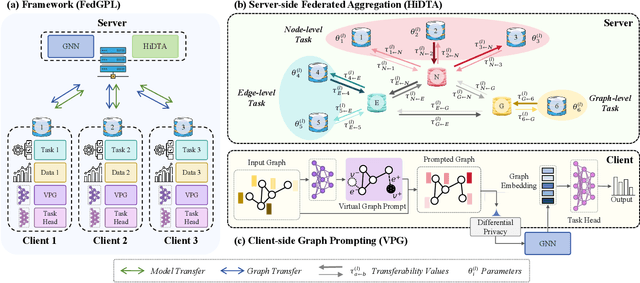
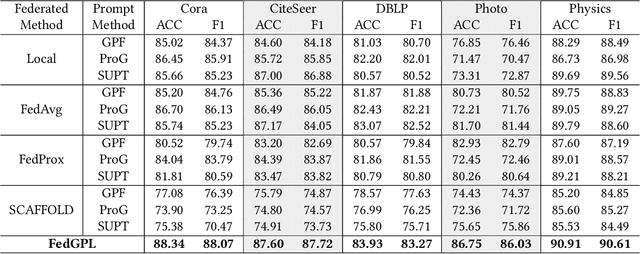
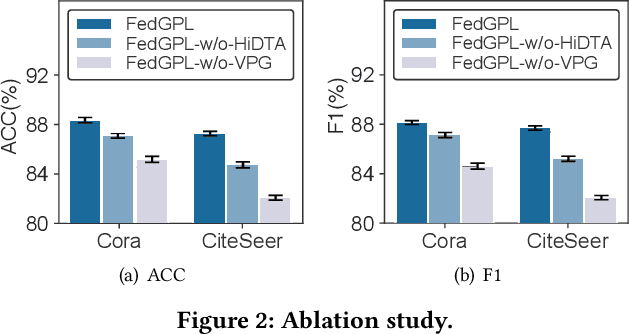
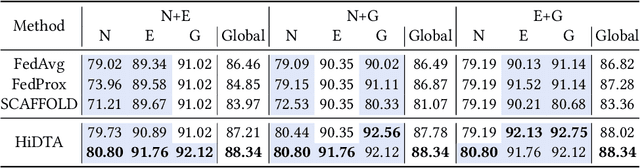
Federated Graph Learning (FGL) aims to collaboratively and privately optimize graph models on divergent data for different tasks. A critical challenge in FGL is to enable effective yet efficient federated optimization against multifaceted graph heterogeneity to enhance mutual performance. However, existing FGL works primarily address graph data heterogeneity and perform incapable of graph task heterogeneity. To address the challenge, we propose a Federated Graph Prompt Learning (FedGPL) framework to efficiently enable prompt-based asymmetric graph knowledge transfer between multifaceted heterogeneous federated participants. Generally, we establish a split federated framework to preserve universal and domain-specific graph knowledge, respectively. Moreover, we develop two algorithms to eliminate task and data heterogeneity for advanced federated knowledge preservation. First, a Hierarchical Directed Transfer Aggregator (HiDTA) delivers cross-task beneficial knowledge that is hierarchically distilled according to the directional transferability. Second, a Virtual Prompt Graph (VPG) adaptively generates graph structures to enhance data utility by distinguishing dominant subgraphs and neutralizing redundant ones. We conduct theoretical analyses and extensive experiments to demonstrate the significant accuracy and efficiency effectiveness of FedGPL against multifaceted graph heterogeneity compared to state-of-the-art baselines on large-scale federated graph datasets.