 Add to Chrome
 Add to Firefox
 Add to Edge
Vision-Based Early Fault Diagnosis and Self-Recovery for Strawberry Harvesting Robots
Jan 05, 2026
Strawberry harvesting robots faced persistent challenges such as low integration of visual perception, fruit-gripper misalignment, empty grasping, and strawberry slippage from the gripper due to insufficient gripping force, all of which compromised harvesting stability and efficiency in orchard environments. To overcome these issues, this paper proposed a visual fault diagnosis and self-recovery framework that integrated multi-task perception with corrective control strategies. At the core of this framework was SRR-Net, an end-to-end multi-task perception model that simultaneously performed strawberry detection, segmentation, and ripeness estimation, thereby unifying visual perception with fault diagnosis. Based on this integrated perception, a relative error compensation method based on the simultaneous target-gripper detection was designed to address positional misalignment, correcting deviations when error exceeded the tolerance threshold. To mitigate empty grasping and fruit-slippage faults, an early abort strategy was implemented. A micro-optical camera embedded in the end-effector provided real-time visual feedback, enabling grasp detection during the deflating stage and strawberry slip prediction during snap-off through MobileNet V3-Small classifier and a time-series LSTM classifier. Experiments demonstrated that SRR-Net maintained high perception accuracy. For detection, it achieved a precision of 0.895 and recall of 0.813 on strawberries, and 0.972/0.958 on hands. In segmentation, it yielded a precision of 0.887 and recall of 0.747 for strawberries, and 0.974/0.947 for hands. For ripeness estimation, SRR-Net attained a mean absolute error of 0.035, while simultaneously supporting multi-task perception and sustaining a competitive inference speed of 163.35 FPS.

Unsupervised Anomaly Detection in Brain MRI via Disentangled Anatomy Learning
Dec 26, 2025Detection of various lesions in brain MRI is clinically critical, but challenging due to the diversity of lesions and variability in imaging conditions. Current unsupervised learning methods detect anomalies mainly through reconstructing abnormal images into pseudo-healthy images (PHIs) by normal samples learning and then analyzing differences between images. However, these unsupervised models face two significant limitations: restricted generalizability to multi-modality and multi-center MRIs due to their reliance on the specific imaging information in normal training data, and constrained performance due to abnormal residuals propagated from input images to reconstructed PHIs. To address these limitations, two novel modules are proposed, forming a new PHI reconstruction framework. Firstly, the disentangled representation module is proposed to improve generalizability by decoupling brain MRI into imaging information and essential imaging-invariant anatomical images, ensuring that the reconstruction focuses on the anatomy. Specifically, brain anatomical priors and a differentiable one-hot encoding operator are introduced to constrain the disentanglement results and enhance the disentanglement stability. Secondly, the edge-to-image restoration module is designed to reconstruct high-quality PHIs by restoring the anatomical representation from the high-frequency edge information of anatomical images, and then recoupling the disentangled imaging information. This module not only suppresses abnormal residuals in PHI by reducing abnormal pixels input through edge-only input, but also effectively reconstructs normal regions using the preserved structural details in the edges. Evaluated on nine public datasets (4,443 patients' MRIs from multiple centers), our method outperforms 17 SOTA methods, achieving absolute improvements of +18.32% in AP and +13.64% in DSC.
* Accepted by Medical Image Analysis (2025)
AgentBalance: Backbone-then-Topology Design for Cost-Effective Multi-Agent Systems under Budget Constraints
Dec 12, 2025Large Language Model (LLM)-based multi-agent systems (MAS) are becoming indispensable building blocks for web-scale applications such as web search, social network analytics, and online customer support, where cost-effectiveness is increasingly the primary constraint for large-scale deployment. While recent work improves MAS cost-effectiveness by shaping inter-agent communication topologies and selecting agent backbones, it rarely models and optimizes under explicit token-cost and latency budgets that reflect deployment constraints. This often leads to topology-first designs and suboptimal cost-effectiveness when budgets are binding. We present AgentBalance, a framework for constructing cost-effective MAS under explicit token-cost and latency budgets via a backbone-then-topology design. AgentBalance first performs backbone-oriented agent generation, constructing agents with heterogeneous backbones through LLM pool construction, pool selection, and role-backbone matching. It then performs adaptive MAS topology generation, guiding inter-agent communication via agent representation learning, gating, and latency-aware topology synthesis. Experiments on benchmarks with 14 candidate LLM backbones show that AgentBalance achieves up to 10% and 22% performance gains under matched token-cost and latency budgets, respectively, and yields strong AUC on performance-versus-budget curves across benchmarks. AgentBalance also functions as a plug-in for existing MAS, improving performance under the same token-cost and latency constraints, and it generalizes well to unseen LLMs for practical, budget-aware deployment. Code: https://github.com/usail-hkust/AgentBalance
Data-Driven Model Reduction using WeldNet: Windowed Encoders for Learning Dynamics
Dec 11, 2025Many problems in science and engineering involve time-dependent, high dimensional datasets arising from complex physical processes, which are costly to simulate. In this work, we propose WeldNet: Windowed Encoders for Learning Dynamics, a data-driven nonlinear model reduction framework to build a low-dimensional surrogate model for complex evolution systems. Given time-dependent training data, we split the time domain into multiple overlapping windows, within which nonlinear dimension reduction is performed by auto-encoders to capture latent codes. Once a low-dimensional representation of the data is learned, a propagator network is trained to capture the evolution of the latent codes in each window, and a transcoder is trained to connect the latent codes between adjacent windows. The proposed windowed decomposition significantly simplifies propagator training by breaking long-horizon dynamics into multiple short, manageable segments, while the transcoders ensure consistency across windows. In addition to the algorithmic framework, we develop a mathematical theory establishing the representation power of WeldNet under the manifold hypothesis, justifying the success of nonlinear model reduction via deep autoencoder-based architectures. Our numerical experiments on various differential equations indicate that WeldNet can capture nonlinear latent structures and their underlying dynamics, outperforming both traditional projection-based approaches and recently developed nonlinear model reduction methods.
Edge-Centric Relational Reasoning for 3D Scene Graph Prediction
Nov 19, 2025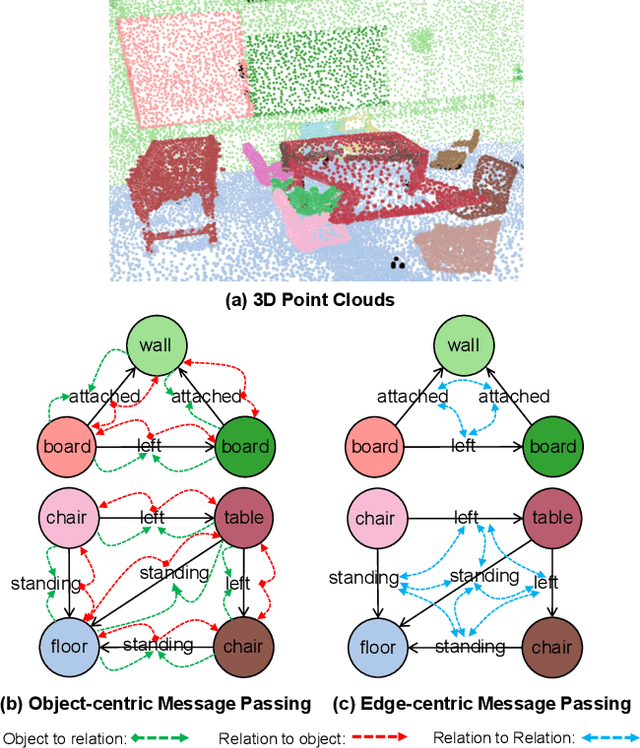
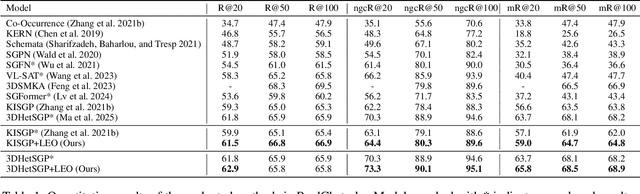
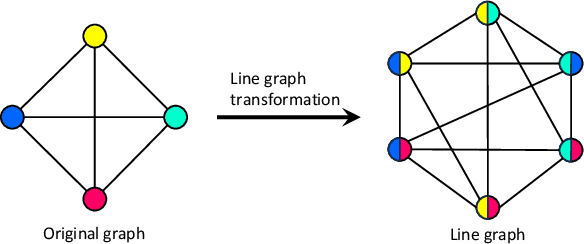
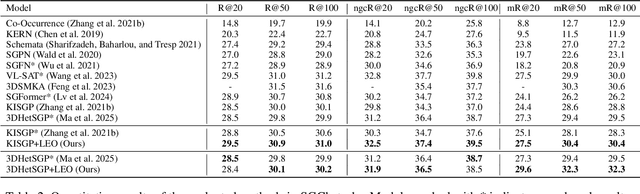
3D scene graph prediction aims to abstract complex 3D environments into structured graphs consisting of objects and their pairwise relationships. Existing approaches typically adopt object-centric graph neural networks, where relation edge features are iteratively updated by aggregating messages from connected object nodes. However, this design inherently restricts relation representations to pairwise object context, making it difficult to capture high-order relational dependencies that are essential for accurate relation prediction. To address this limitation, we propose a Link-guided Edge-centric relational reasoning framework with Object-aware fusion, namely LEO, which enables progressive reasoning from relation-level context to object-level understanding. Specifically, LEO first predicts potential links between object pairs to suppress irrelevant edges, and then transforms the original scene graph into a line graph where each relation is treated as a node. A line graph neural network is applied to perform edge-centric relational reasoning to capture inter-relation context. The enriched relation features are subsequently integrated into the original object-centric graph to enhance object-level reasoning and improve relation prediction. Our framework is model-agnostic and can be integrated with any existing object-centric method. Experiments on the 3DSSG dataset with two competitive baselines show consistent improvements, highlighting the effectiveness of our edge-to-object reasoning paradigm.
ICLR: Inter-Chrominance and Luminance Interaction for Natural Color Restoration in Low-Light Image Enhancement
Nov 17, 2025Low-Light Image Enhancement (LLIE) task aims at improving contrast while restoring details and textures for images captured in low-light conditions. HVI color space has made significant progress in this task by enabling precise decoupling of chrominance and luminance. However, for the interaction of chrominance and luminance branches, substantial distributional differences between the two branches prevalent in natural images limit complementary feature extraction, and luminance errors are propagated to chrominance channels through the nonlinear parameter. Furthermore, for interaction between different chrominance branches, images with large homogeneous-color regions usually exhibit weak correlation between chrominance branches due to concentrated distributions. Traditional pixel-wise losses exploit strong inter-branch correlations for co-optimization, causing gradient conflicts in weakly correlated regions. Therefore, we propose an Inter-Chrominance and Luminance Interaction (ICLR) framework including a Dual-stream Interaction Enhancement Module (DIEM) and a Covariance Correction Loss (CCL). The DIEM improves the extraction of complementary information from two dimensions, fusion and enhancement, respectively. The CCL utilizes luminance residual statistics to penalize chrominance errors and balances gradient conflicts by constraining chrominance branches covariance. Experimental results on multiple datasets show that the proposed ICLR framework outperforms state-of-the-art methods.
Hard vs. Noise: Resolving Hard-Noisy Sample Confusion in Recommender Systems via Large Language Models
Nov 11, 2025Implicit feedback, employed in training recommender systems, unavoidably confronts noise due to factors such as misclicks and position bias. Previous studies have attempted to identify noisy samples through their diverged data patterns, such as higher loss values, and mitigate their influence through sample dropping or reweighting. However, we observed that noisy samples and hard samples display similar patterns, leading to hard-noisy confusion issue. Such confusion is problematic as hard samples are vital for modeling user preferences. To solve this problem, we propose LLMHNI framework, leveraging two auxiliary user-item relevance signals generated by Large Language Models (LLMs) to differentiate hard and noisy samples. LLMHNI obtains user-item semantic relevance from LLM-encoded embeddings, which is used in negative sampling to select hard negatives while filtering out noisy false negatives. An objective alignment strategy is proposed to project LLM-encoded embeddings, originally for general language tasks, into a representation space optimized for user-item relevance modeling. LLMHNI also exploits LLM-inferred logical relevance within user-item interactions to identify hard and noisy samples. These LLM-inferred interactions are integrated into the interaction graph and guide denoising with cross-graph contrastive alignment. To eliminate the impact of unreliable interactions induced by LLM hallucination, we propose a graph contrastive learning strategy that aligns representations from randomly edge-dropped views to suppress unreliable edges. Empirical results demonstrate that LLMHNI significantly improves denoising and recommendation performance.
GeoFM: Enhancing Geometric Reasoning of MLLMs via Synthetic Data Generation through Formal Language
Oct 31, 2025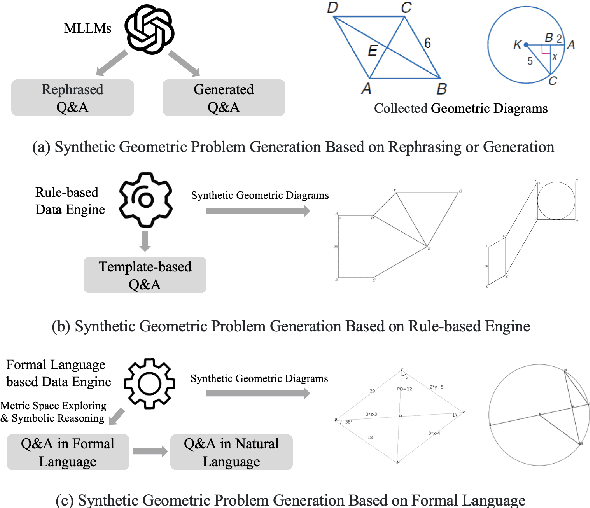
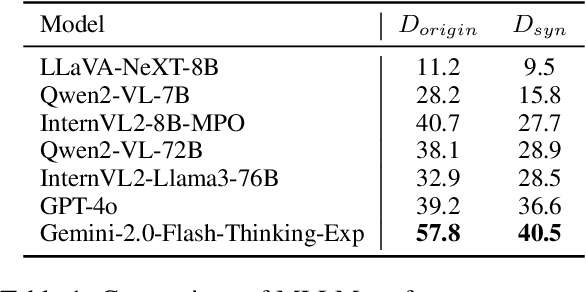
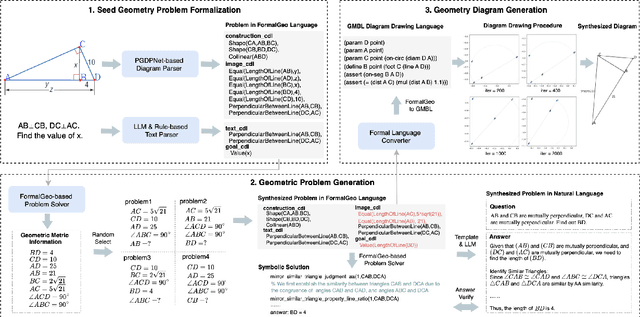
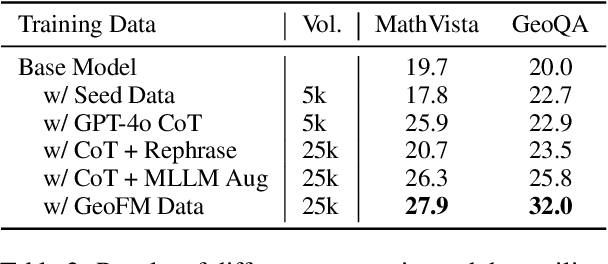
Multi-modal Large Language Models (MLLMs) have gained significant attention in both academia and industry for their capabilities in handling multi-modal tasks. However, these models face challenges in mathematical geometric reasoning due to the scarcity of high-quality geometric data. To address this issue, synthetic geometric data has become an essential strategy. Current methods for generating synthetic geometric data involve rephrasing or expanding existing problems and utilizing predefined rules and templates to create geometric images and problems. However, these approaches often produce data that lacks diversity or is prone to noise. Additionally, the geometric images synthesized by existing methods tend to exhibit limited variation and deviate significantly from authentic geometric diagrams. To overcome these limitations, we propose GeoFM, a novel method for synthesizing geometric data. GeoFM uses formal languages to explore combinations of conditions within metric space, generating high-fidelity geometric problems that differ from the originals while ensuring correctness through a symbolic engine. Experimental results show that our synthetic data significantly outperforms existing methods. The model trained with our data surpass the proprietary GPT-4o model by 18.7\% on geometry problem-solving tasks in MathVista and by 16.5\% on GeoQA. Additionally, it exceeds the performance of a leading open-source model by 5.7\% on MathVista and by 2.7\% on GeoQA.
SAGS: Self-Adaptive Alias-Free Gaussian Splatting for Dynamic Surgical Endoscopic Reconstruction
Oct 31, 2025Surgical reconstruction of dynamic tissues from endoscopic videos is a crucial technology in robot-assisted surgery. The development of Neural Radiance Fields (NeRFs) has greatly advanced deformable tissue reconstruction, achieving high-quality results from video and image sequences. However, reconstructing deformable endoscopic scenes remains challenging due to aliasing and artifacts caused by tissue movement, which can significantly degrade visualization quality. The introduction of 3D Gaussian Splatting (3DGS) has improved reconstruction efficiency by enabling a faster rendering pipeline. Nevertheless, existing 3DGS methods often prioritize rendering speed while neglecting these critical issues. To address these challenges, we propose SAGS, a self-adaptive alias-free Gaussian splatting framework. We introduce an attention-driven, dynamically weighted 4D deformation decoder, leveraging 3D smoothing filters and 2D Mip filters to mitigate artifacts in deformable tissue reconstruction and better capture the fine details of tissue movement. Experimental results on two public benchmarks, EndoNeRF and SCARED, demonstrate that our method achieves superior performance in all metrics of PSNR, SSIM, and LPIPS compared to the state of the art while also delivering better visualization quality.
WeaveRec: An LLM-Based Cross-Domain Sequential Recommendation Framework with Model Merging
Oct 30, 2025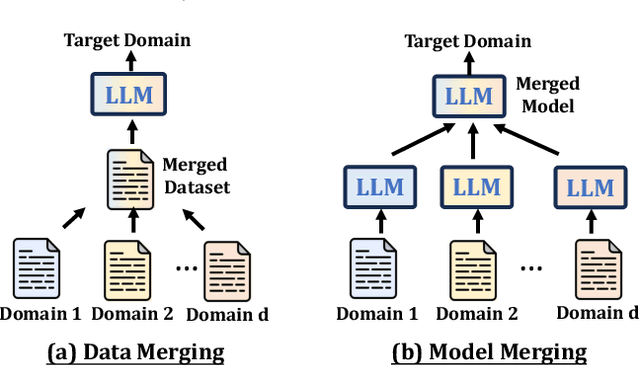
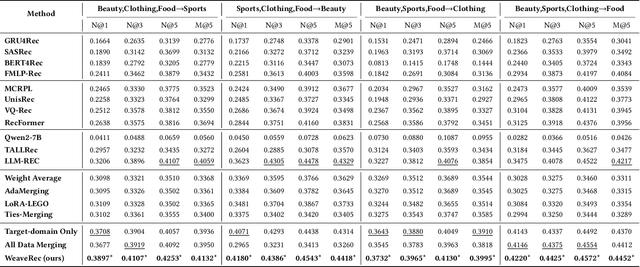
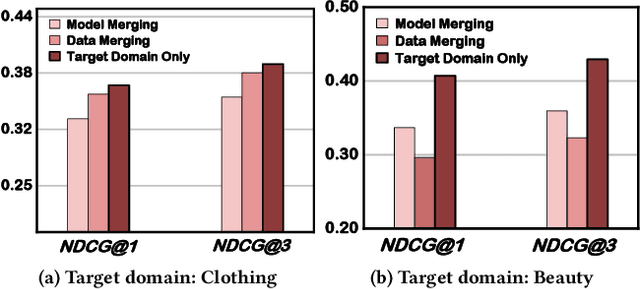
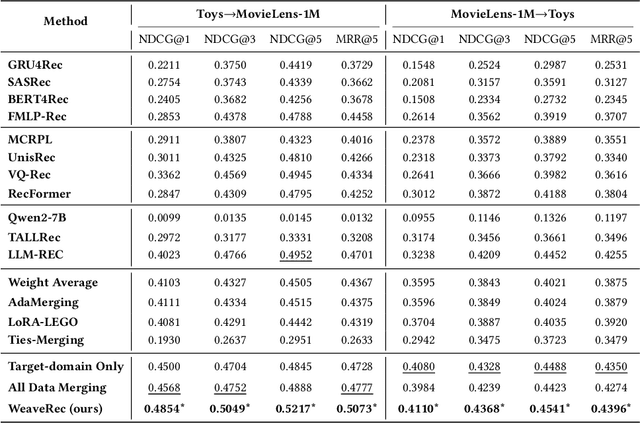
Cross-Domain Sequential Recommendation (CDSR) seeks to improve user preference modeling by transferring knowledge from multiple domains. Despite the progress made in CDSR, most existing methods rely on overlapping users or items to establish cross-domain correlations-a requirement that rarely holds in real-world settings. The advent of large language models (LLM) and model-merging techniques appears to overcome this limitation by unifying multi-domain data without explicit overlaps. Yet, our empirical study shows that naively training an LLM on combined domains-or simply merging several domain-specific LLMs-often degrades performance relative to a model trained solely on the target domain. To address these challenges, we first experimentally investigate the cause of suboptimal performance in LLM-based cross-domain recommendation and model merging. Building on these insights, we introduce WeaveRec, which cross-trains multiple LoRA modules with source and target domain data in a weaving fashion, and fuses them via model merging. WeaveRec can be extended to multi-source domain scenarios and notably does not introduce additional inference-time cost in terms of latency or memory. Furthermore, we provide a theoretical guarantee that WeaveRec can reduce the upper bound of the expected error in the target domain. Extensive experiments on single-source, multi-source, and cross-platform cross-domain recommendation scenarios validate that WeaveRec effectively mitigates performance degradation and consistently outperforms baseline approaches in real-world recommendation tasks.