 Add to Chrome
 Add to Firefox
 Add to Edge
CorrectionLM: Self-Corrections with SLM for Dialogue State Tracking
Oct 23, 2024
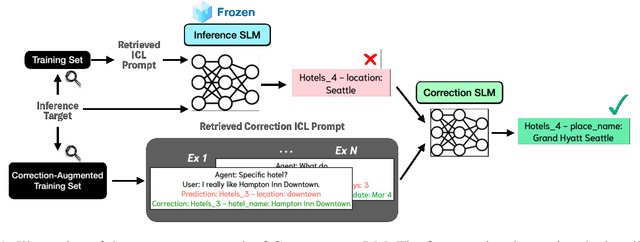
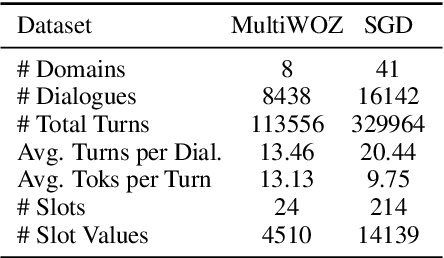


Large language models (LLMs) have demonstrated self-improvement capabilities via feedback and refinement, but current small language models (SLMs) have had limited success in this area. Existing correction approaches often rely on distilling knowledge from LLMs, which imposes significant computation demands. In this work, we introduce CORRECTIONLM, a novel correction framework that enables SLMs to self-correct using in-context exemplars without LLM involvement. Applied to two dialogue state tracking (DST) tasks in low-resource settings, CORRECTIONLM achieves results similar to a state-of-the-art LLM at a small fraction of the computation costs.

Teaching AI Agents to Search with Reflective-MCTS and Exploratory Learning
Oct 15, 2024
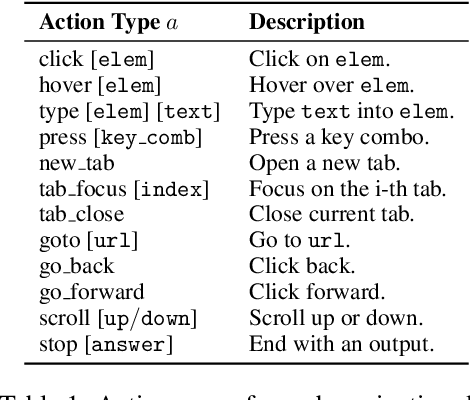


Autonomous agents have demonstrated significant potential in automating complex multistep decision-making tasks. However, even state-of-the-art vision-language models (VLMs), such as GPT-4o, still fall short of human-level performance, particularly in intricate web environments and long-horizon planning tasks. To address these limitations, we present Reflective Monte Carlo Tree Search (R-MCTS) and Exploratory Learning to build o1-like models for agentic applications. We first introduce R-MCTS, a novel test-time algorithm designed to enhance the ability of AI agents to explore decision space on the fly. R-MCTS extends traditional MCTS by 1) incorporating contrastive reflection, allowing agents to learn from past interactions and dynamically improve their search efficiency; and 2) using multi-agent debate to provide reliable state evaluation. Next, we introduce Exploratory Learning, a novel learning strategy to teach agents to search at inference time without relying on any external search algorithms. On the challenging VisualWebArena benchmark, our GPT-4o-based R-MCTS agent achieves a 6% to 30% relative improvement across various tasks compared to the previous state-of-the-art. Additionally, we show that the experience gained from test-time search can be effectively transferred back to GPT-4o via fine-tuning. After Exploratory Learning, GPT-4o 1) demonstrates the ability to explore the environment, evaluate a state, and backtrack to viable ones when it detects that the current state cannot lead to success, and 2) matches 87% of R-MCTS's performance while using significantly less compute. Notably, our work demonstrates the compute scaling properties in both training - data collection with R-MCTS - and testing time. These results suggest a promising research direction to enhance VLMs' reasoning and planning capabilities for agentic applications via test-time search and self-learning.
LoRC: Low-Rank Compression for LLMs KV Cache with a Progressive Compression Strategy
Oct 04, 2024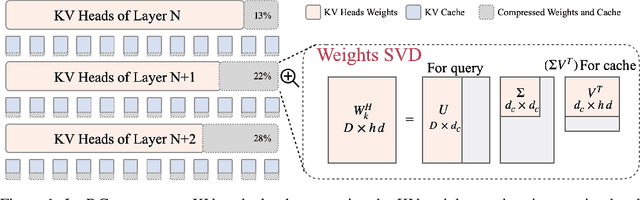


The Key-Value (KV) cache is a crucial component in serving transformer-based autoregressive large language models (LLMs), enabling faster inference by storing previously computed KV vectors. However, its memory consumption scales linearly with sequence length and batch size, posing a significant bottleneck in LLM deployment. Existing approaches to mitigate this issue include: (1) efficient attention variants integrated in upcycling stages, which requires extensive parameter tuning thus unsuitable for pre-trained LLMs; (2) KV cache compression at test time, primarily through token eviction policies, which often overlook inter-layer dependencies and can be task-specific. This paper introduces an orthogonal approach to KV cache compression. We propose a low-rank approximation of KV weight matrices, allowing for plug-in integration with existing transformer-based LLMs without model retraining. To effectively compress KV cache at the weight level, we adjust for layerwise sensitivity and introduce a progressive compression strategy, which is supported by our theoretical analysis on how compression errors accumulate in deep networks. Our method is designed to function without model tuning in upcycling stages or task-specific profiling in test stages. Extensive experiments with LLaMA models ranging from 8B to 70B parameters across various tasks show that our approach significantly reduces the GPU memory footprint while maintaining performance.
Spiking Neural Network as Adaptive Event Stream Slicer
Oct 03, 2024



Event-based cameras are attracting significant interest as they provide rich edge information, high dynamic range, and high temporal resolution. Many state-of-the-art event-based algorithms rely on splitting the events into fixed groups, resulting in the omission of crucial temporal information, particularly when dealing with diverse motion scenarios (e.g., high/low speed). In this work, we propose SpikeSlicer, a novel-designed plug-and-play event processing method capable of splitting events stream adaptively. SpikeSlicer utilizes a lightweight (0.41M) and low-energy spiking neural network (SNN) to trigger event slicing. To guide the SNN to fire spikes at optimal time steps, we propose the Spiking Position-aware Loss (SPA-Loss) to modulate the neuron's state. Additionally, we develop a Feedback-Update training strategy that refines the slicing decisions using feedback from the downstream artificial neural network (ANN). Extensive experiments demonstrate that our method yields significant performance improvements in event-based object tracking and recognition. Notably, SpikeSlicer provides a brand-new SNN-ANN cooperation paradigm, where the SNN acts as an efficient, low-energy data processor to assist the ANN in improving downstream performance, injecting new perspectives and potential avenues of exploration.
Improving Autonomous AI Agents with Reflective Tree Search and Self-Learning
Oct 02, 2024Autonomous agents have demonstrated significant potential in automating complex multistep decision-making tasks. However, even state-of-the-art vision-language models (VLMs), such as GPT-4o, still fall short of human-level performance, particularly in intricate web environments and long-horizon planning tasks. To address these limitations, we introduce Reflective Monte Carlo Tree Search (R-MCTS), a novel test-time algorithm designed to enhance the ability of AI agents, e.g., powered by GPT-4o, to explore decision space on the fly. R-MCTS extends traditional MCTS by 1) incorporating contrastive reflection, allowing agents to learn from past interactions and dynamically improve their search efficiency; and 2) using multi-agent debate to provide reliable state evaluation. Moreover, we improve the agent's performance by fine-tuning GPT-4o through self-learning, using R-MCTS generated tree traversals without any human-provided labels. On the challenging VisualWebArena benchmark, our GPT-4o-based R-MCTS agent achieves a 6% to 30% relative improvement across various tasks compared to the previous state-of-the-art. Additionally, we show that the knowledge gained from test-time search can be effectively transferred back to GPT-4o via fine-tuning. The fine-tuned GPT-4o matches 97% of R-MCTS's performance while reducing compute usage by a factor of four at test time. Furthermore, qualitative results reveal that the fine-tuned GPT-4o model demonstrates the ability to explore the environment, evaluate a state, and backtrack to viable ones when it detects that the current state cannot lead to success. Moreover, our work demonstrates the compute scaling properties in both training - data collection with R-MCTS - and testing time. These results suggest a promising research direction to enhance VLMs' reasoning and planning capabilities for agentic applications via test-time search and self-learning.
GRIN: GRadient-INformed MoE
Sep 18, 2024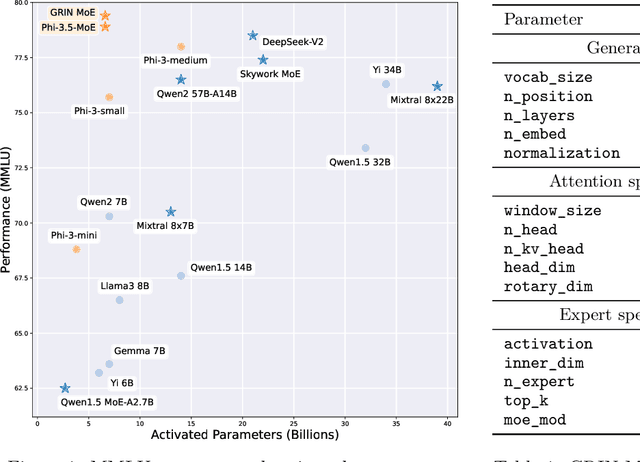
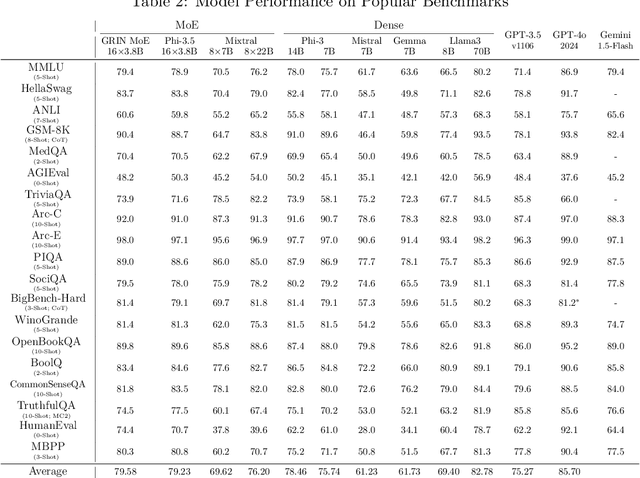
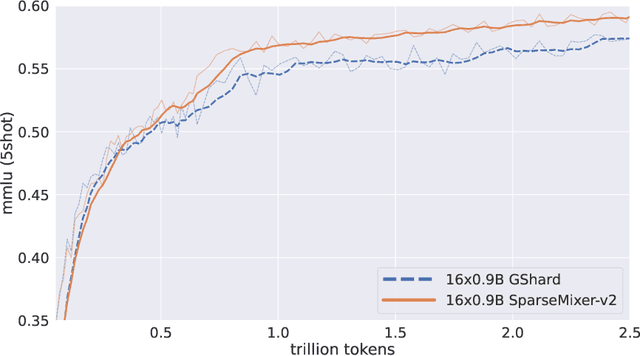

Mixture-of-Experts (MoE) models scale more effectively than dense models due to sparse computation through expert routing, selectively activating only a small subset of expert modules. However, sparse computation challenges traditional training practices, as discrete expert routing hinders standard backpropagation and thus gradient-based optimization, which are the cornerstone of deep learning. To better pursue the scaling power of MoE, we introduce GRIN (GRadient-INformed MoE training), which incorporates sparse gradient estimation for expert routing and configures model parallelism to avoid token dropping. Applying GRIN to autoregressive language modeling, we develop a top-2 16$\times$3.8B MoE model. Our model, with only 6.6B activated parameters, outperforms a 7B dense model and matches the performance of a 14B dense model trained on the same data. Extensive evaluations across diverse tasks demonstrate the potential of GRIN to significantly enhance MoE efficacy, achieving 79.4 on MMLU, 83.7 on HellaSwag, 74.4 on HumanEval, and 58.9 on MATH.
Model Tells Itself Where to Attend: Faithfulness Meets Automatic Attention Steering
Sep 16, 2024


Large language models (LLMs) have demonstrated remarkable performance across various real-world tasks. However, they often struggle to fully comprehend and effectively utilize their input contexts, resulting in responses that are unfaithful or hallucinated. This difficulty increases for contexts that are long or contain distracting information, which can divert LLMs from fully capturing essential evidence. To address this issue, many works use prompting to help LLMs utilize contextual information more faithfully. For instance, iterative prompting highlights key information in two steps that first ask the LLM to identify important pieces of context and then derive answers accordingly. However, prompting methods are constrained to highlighting key information implicitly in token space, which is often insufficient to fully steer the model's attention. To improve model faithfulness more reliably, we propose AutoPASTA, a method that automatically identifies key contextual information and explicitly highlights it by steering an LLM's attention scores. Like prompting, AutoPASTA is applied at inference time and does not require changing any model parameters. Our experiments on open-book QA demonstrate that AutoPASTA effectively enables models to grasp essential contextual information, leading to substantially improved model faithfulness and performance, e.g., an average improvement of 7.95% for LLAMA3-70B-Instruct. Code will be publicly available at https://github.com/QingruZhang/AutoPASTA .
Mamba Policy: Towards Efficient 3D Diffusion Policy with Hybrid Selective State Models
Sep 11, 2024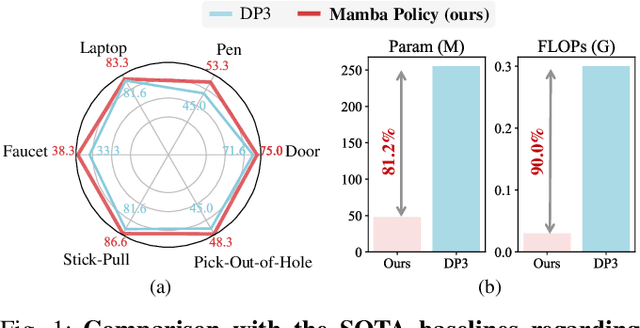
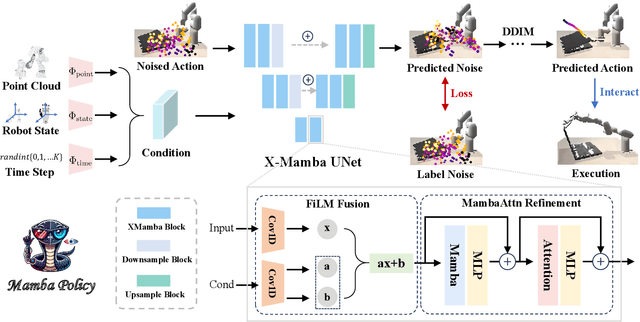
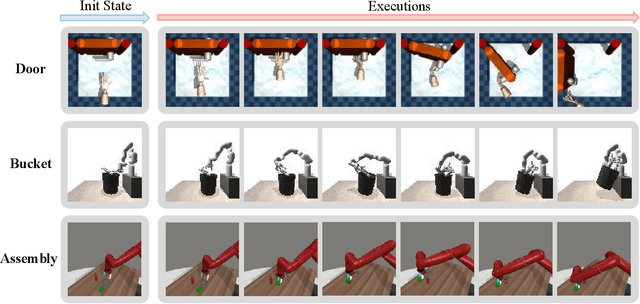

Diffusion models have been widely employed in the field of 3D manipulation due to their efficient capability to learn distributions, allowing for precise prediction of action trajectories. However, diffusion models typically rely on large parameter UNet backbones as policy networks, which can be challenging to deploy on resource-constrained devices. Recently, the Mamba model has emerged as a promising solution for efficient modeling, offering low computational complexity and strong performance in sequence modeling. In this work, we propose the Mamba Policy, a lighter but stronger policy that reduces the parameter count by over 80% compared to the original policy network while achieving superior performance. Specifically, we introduce the XMamba Block, which effectively integrates input information with conditional features and leverages a combination of Mamba and Attention mechanisms for deep feature extraction. Extensive experiments demonstrate that the Mamba Policy excels on the Adroit, Dexart, and MetaWorld datasets, requiring significantly fewer computational resources. Additionally, we highlight the Mamba Policy's enhanced robustness in long-horizon scenarios compared to baseline methods and explore the performance of various Mamba variants within the Mamba Policy framework. Our project page is in https://andycao1125.github.io/mamba_policy/.
Spiking Diffusion Models
Aug 29, 2024Recent years have witnessed Spiking Neural Networks (SNNs) gaining attention for their ultra-low energy consumption and high biological plausibility compared with traditional Artificial Neural Networks (ANNs). Despite their distinguished properties, the application of SNNs in the computationally intensive field of image generation is still under exploration. In this paper, we propose the Spiking Diffusion Models (SDMs), an innovative family of SNN-based generative models that excel in producing high-quality samples with significantly reduced energy consumption. In particular, we propose a Temporal-wise Spiking Mechanism (TSM) that allows SNNs to capture more temporal features from a bio-plasticity perspective. In addition, we propose a threshold-guided strategy that can further improve the performances by up to 16.7% without any additional training. We also make the first attempt to use the ANN-SNN approach for SNN-based generation tasks. Extensive experimental results reveal that our approach not only exhibits comparable performance to its ANN counterpart with few spiking time steps, but also outperforms previous SNN-based generative models by a large margin. Moreover, we also demonstrate the high-quality generation ability of SDM on large-scale datasets, e.g., LSUN bedroom. This development marks a pivotal advancement in the capabilities of SNN-based generation, paving the way for future research avenues to realize low-energy and low-latency generative applications. Our code is available at https://github.com/AndyCao1125/SDM.
RoIPoly: Vectorized Building Outline Extraction Using Vertex and Logit Embeddings
Jul 20, 2024Polygonal building outlines are crucial for geographic and cartographic applications. The existing approaches for outline extraction from aerial or satellite imagery are typically decomposed into subtasks, e.g., building masking and vectorization, or treat this task as a sequence-to-sequence prediction of ordered vertices. The former lacks efficiency, and the latter often generates redundant vertices, both resulting in suboptimal performance. To handle these issues, we propose a novel Region-of-Interest (RoI) query-based approach called RoIPoly. Specifically, we formulate each vertex as a query and constrain the query attention on the most relevant regions of a potential building, yielding reduced computational overhead and more efficient vertex level interaction. Moreover, we introduce a novel learnable logit embedding to facilitate vertex classification on the attention map; thus, no post-processing is needed for redundant vertex removal. We evaluated our method on the vectorized building outline extraction dataset CrowdAI and the 2D floorplan reconstruction dataset Structured3D. On the CrowdAI dataset, RoIPoly with a ResNet50 backbone outperforms existing methods with the same or better backbones on most MS-COCO metrics, especially on small buildings, and achieves competitive results in polygon quality and vertex redundancy without any post-processing. On the Structured3D dataset, our method achieves the second-best performance on most metrics among existing methods dedicated to 2D floorplan reconstruction, demonstrating our cross-domain generalization capability. The code will be released upon acceptance of this paper.