 Add to Chrome
 Add to Firefox
 Add to Edge
ToolForge: A Data Synthesis Pipeline for Multi-Hop Search without Real-World APIs
Dec 18, 2025
Training LLMs to invoke tools and leverage retrieved information necessitates high-quality, diverse data. However, existing pipelines for synthetic data generation often rely on tens of thousands of real API calls to enhance generalization, incurring prohibitive costs while lacking multi-hop reasoning and self-reflection. To address these limitations, we introduce ToolForge, an automated synthesis framework that achieves strong real-world tool-calling performance by constructing only a small number of virtual tools, eliminating the need for real API calls. ToolForge leverages a (question, golden context, answer) triple to synthesize large-scale tool-learning data specifically designed for multi-hop search scenarios, further enriching the generated data through multi-hop reasoning and self-reflection mechanisms. To ensure data fidelity, we employ a Multi-Layer Validation Framework that integrates both rule-based and model-based assessments. Empirical results show that a model with only 8B parameters, when trained on our synthesized data, outperforms GPT-4o on multiple benchmarks. Our code and dataset are publicly available at https://github.com/Buycar-arb/ToolForge .

Bridging Fidelity-Reality with Controllable One-Step Diffusion for Image Super-Resolution
Dec 16, 2025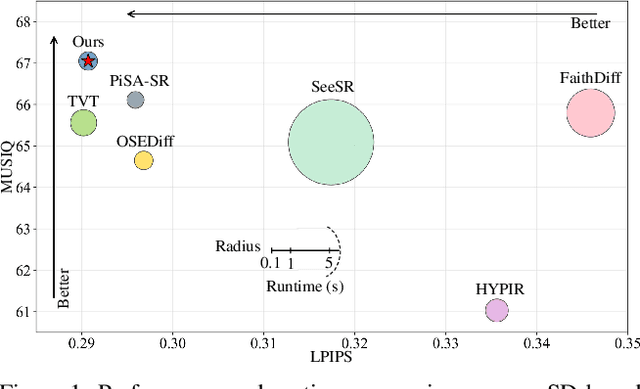
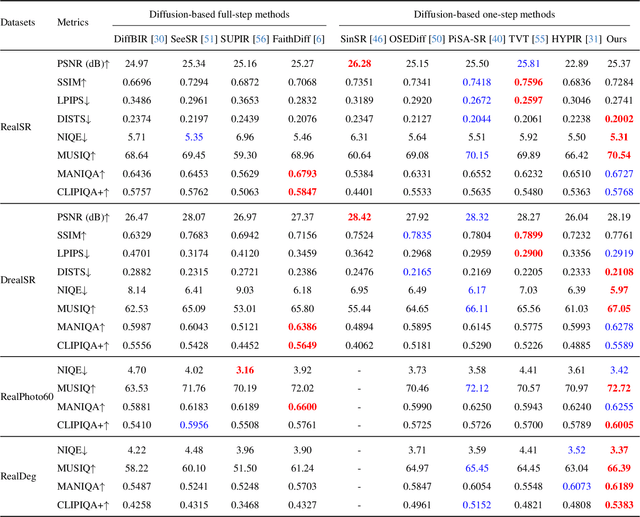
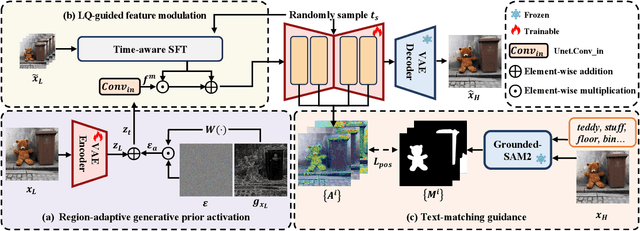
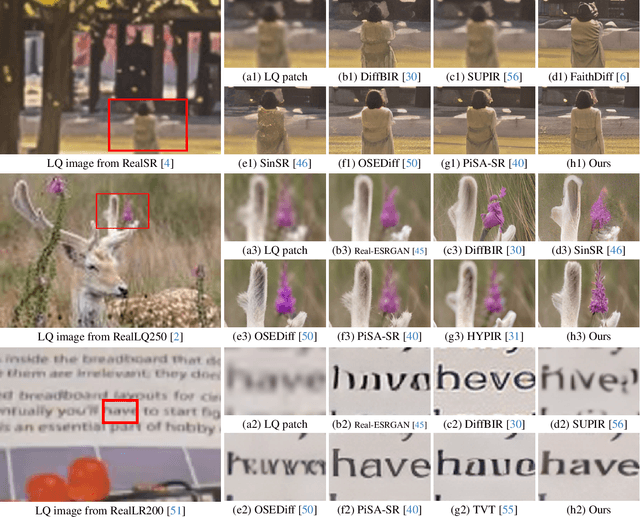
Recent diffusion-based one-step methods have shown remarkable progress in the field of image super-resolution, yet they remain constrained by three critical limitations: (1) inferior fidelity performance caused by the information loss from compression encoding of low-quality (LQ) inputs; (2) insufficient region-discriminative activation of generative priors; (3) misalignment between text prompts and their corresponding semantic regions. To address these limitations, we propose CODSR, a controllable one-step diffusion network for image super-resolution. First, we propose an LQ-guided feature modulation module that leverages original uncompressed information from LQ inputs to provide high-fidelity conditioning for the diffusion process. We then develop a region-adaptive generative prior activation method to effectively enhance perceptual richness without sacrificing local structural fidelity. Finally, we employ a text-matching guidance strategy to fully harness the conditioning potential of text prompts. Extensive experiments demonstrate that CODSR achieves superior perceptual quality and competitive fidelity compared with state-of-the-art methods with efficient one-step inference.
LLM-driven Knowledge Enhancement for Multimodal Cancer Survival Prediction
Dec 16, 2025Current multimodal survival prediction methods typically rely on pathology images (WSIs) and genomic data, both of which are high-dimensional and redundant, making it difficult to extract discriminative features from them and align different modalities. Moreover, using a simple survival follow-up label is insufficient to supervise such a complex task. To address these challenges, we propose KEMM, an LLM-driven Knowledge-Enhanced Multimodal Model for cancer survival prediction, which integrates expert reports and prognostic background knowledge. 1) Expert reports, provided by pathologists on a case-by-case basis and refined by large language model (LLM), offer succinct and clinically focused diagnostic statements. This information may typically suggest different survival outcomes. 2) Prognostic background knowledge (PBK), generated concisely by LLM, provides valuable prognostic background knowledge on different cancer types, which also enhances survival prediction. To leverage these knowledge, we introduce the knowledge-enhanced cross-modal (KECM) attention module. KECM can effectively guide the network to focus on discriminative and survival-relevant features from highly redundant modalities. Extensive experiments on five datasets demonstrate that KEMM achieves state-of-the-art performance. The code will be released upon acceptance.
Bi-Erasing: A Bidirectional Framework for Concept Removal in Diffusion Models
Dec 16, 2025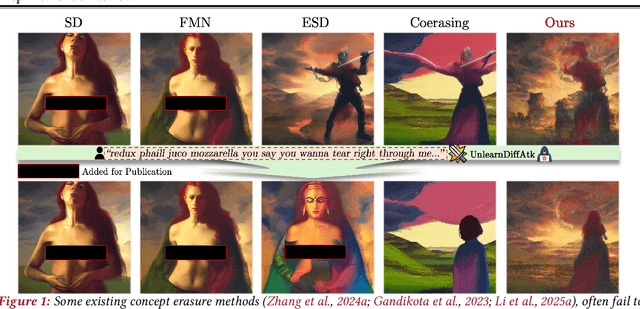
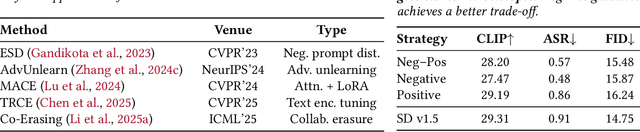
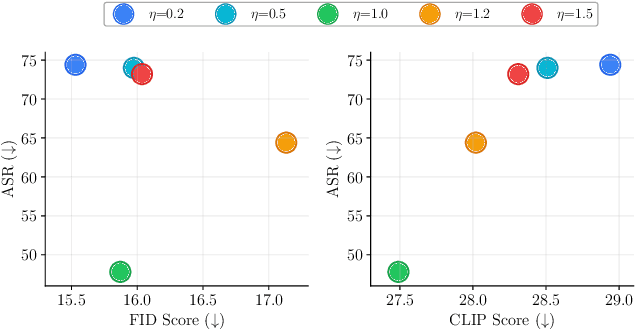
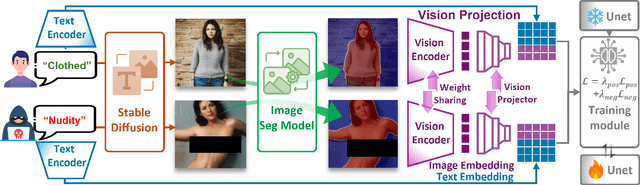
Concept erasure, which fine-tunes diffusion models to remove undesired or harmful visual concepts, has become a mainstream approach to mitigating unsafe or illegal image generation in text-to-image models.However, existing removal methods typically adopt a unidirectional erasure strategy by either suppressing the target concept or reinforcing safe alternatives, making it difficult to achieve a balanced trade-off between concept removal and generation quality. To address this limitation, we propose a novel Bidirectional Image-Guided Concept Erasure (Bi-Erasing) framework that performs concept suppression and safety enhancement simultaneously. Specifically, based on the joint representation of text prompts and corresponding images, Bi-Erasing introduces two decoupled image branches: a negative branch responsible for suppressing harmful semantics and a positive branch providing visual guidance for safe alternatives. By jointly optimizing these complementary directions, our approach achieves a balance between erasure efficacy and generation usability. In addition, we apply mask-based filtering to the image branches to prevent interference from irrelevant content during the erasure process. Across extensive experiment evaluations, the proposed Bi-Erasing outperforms baseline methods in balancing concept removal effectiveness and visual fidelity.
DynaGen: Unifying Temporal Knowledge Graph Reasoning with Dynamic Subgraphs and Generative Regularization
Dec 14, 2025Temporal Knowledge Graph Reasoning (TKGR) aims to complete missing factual elements along the timeline. Depending on the temporal position of the query, the task is categorized into interpolation and extrapolation. Existing interpolation methods typically embed temporal information into individual facts to complete missing historical knowledge, while extrapolation techniques often leverage sequence models over graph snapshots to identify recurring patterns for future event prediction. These methods face two critical challenges: limited contextual modeling in interpolation and cognitive generalization bias in extrapolation. To address these, we propose a unified method for TKGR, dubbed DynaGen. For interpolation, DynaGen dynamically constructs entity-centric subgraphs and processes them with a synergistic dual-branch GNN encoder to capture evolving structural context. For extrapolation, it applies a conditional diffusion process, which forces the model to learn underlying evolutionary principles rather than just superficial patterns, enhancing its ability to predict unseen future events. Extensive experiments on six benchmark datasets show DynaGen achieves state-of-the-art performance. On average, compared to the second-best models, DynaGen improves the Mean Reciprocal Rank (MRR) score by 2.61 points for interpolation and 1.45 points for extrapolation.
Learning Patient-Specific Disease Dynamics with Latent Flow Matching for Longitudinal Imaging Generation
Dec 13, 2025Understanding disease progression is a central clinical challenge with direct implications for early diagnosis and personalized treatment. While recent generative approaches have attempted to model progression, key mismatches remain: disease dynamics are inherently continuous and monotonic, yet latent representations are often scattered, lacking semantic structure, and diffusion-based models disrupt continuity with random denoising process. In this work, we propose to treat the disease dynamic as a velocity field and leverage Flow Matching (FM) to align the temporal evolution of patient data. Unlike prior methods, it captures the intrinsic dynamic of disease, making the progression more interpretable. However, a key challenge remains: in latent space, Auto-Encoders (AEs) do not guarantee alignment across patients or correlation with clinical-severity indicators (e.g., age and disease conditions). To address this, we propose to learn patient-specific latent alignment, which enforces patient trajectories to lie along a specific axis, with magnitude increasing monotonically with disease severity. This leads to a consistent and semantically meaningful latent space. Together, we present $Δ$-LFM, a framework for modeling patient-specific latent progression with flow matching. Across three longitudinal MRI benchmarks, $Δ$-LFM demonstrates strong empirical performance and, more importantly, offers a new framework for interpreting and visualizing disease dynamics.
AlcheMinT: Fine-grained Temporal Control for Multi-Reference Consistent Video Generation
Dec 11, 2025Recent advances in subject-driven video generation with large diffusion models have enabled personalized content synthesis conditioned on user-provided subjects. However, existing methods lack fine-grained temporal control over subject appearance and disappearance, which are essential for applications such as compositional video synthesis, storyboarding, and controllable animation. We propose AlcheMinT, a unified framework that introduces explicit timestamps conditioning for subject-driven video generation. Our approach introduces a novel positional encoding mechanism that unlocks the encoding of temporal intervals, associated in our case with subject identities, while seamlessly integrating with the pretrained video generation model positional embeddings. Additionally, we incorporate subject-descriptive text tokens to strengthen binding between visual identity and video captions, mitigating ambiguity during generation. Through token-wise concatenation, AlcheMinT avoids any additional cross-attention modules and incurs negligible parameter overhead. We establish a benchmark evaluating multiple subject identity preservation, video fidelity, and temporal adherence. Experimental results demonstrate that AlcheMinT achieves visual quality matching state-of-the-art video personalization methods, while, for the first time, enabling precise temporal control over multi-subject generation within videos. Project page is at https://snap-research.github.io/Video-AlcheMinT
Generalized Spherical Neural Operators: Green's Function Formulation
Dec 11, 2025

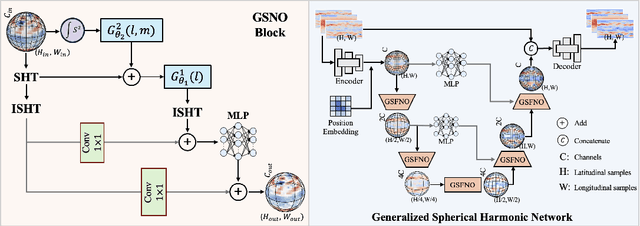
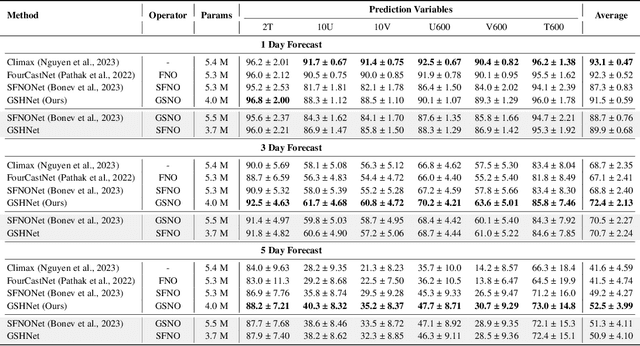
Neural operators offer powerful approaches for solving parametric partial differential equations, but extending them to spherical domains remains challenging due to the need to preserve intrinsic geometry while avoiding distortions that break rotational consistency. Existing spherical operators rely on rotational equivariance but often lack the flexibility for real-world complexity. We propose a general operator-design framework based on the designable spherical Green's function and its harmonic expansion, establishing a solid operator-theoretic foundation for spherical learning. Based on this, we propose an absolute and relative position-dependent Green's function that enables flexible balance of equivariance and invariance for real-world modeling. The resulting operator, Green's-function Spherical Neural Operator (GSNO) with a novel spectral learning method, can adapt to anisotropic, constraint-rich systems while retaining spectral efficiency. To exploit GSNO, we develop GSHNet, a hierarchical architecture that combines multi-scale spectral modeling with spherical up-down sampling, enhancing global feature representation. Evaluations on diffusion MRI, shallow water dynamics, and global weather forecasting, GSNO and GSHNet consistently outperform state-of-the-art methods. Our results position GSNO as a principled and general framework for spherical operator learning, bridging rigorous theory with real-world complexity.
Preserving Source Video Realism: High-Fidelity Face Swapping for Cinematic Quality
Dec 08, 2025Video face swapping is crucial in film and entertainment production, where achieving high fidelity and temporal consistency over long and complex video sequences remains a significant challenge. Inspired by recent advances in reference-guided image editing, we explore whether rich visual attributes from source videos can be similarly leveraged to enhance both fidelity and temporal coherence in video face swapping. Building on this insight, this work presents LivingSwap, the first video reference guided face swapping model. Our approach employs keyframes as conditioning signals to inject the target identity, enabling flexible and controllable editing. By combining keyframe conditioning with video reference guidance, the model performs temporal stitching to ensure stable identity preservation and high-fidelity reconstruction across long video sequences. To address the scarcity of data for reference-guided training, we construct a paired face-swapping dataset, Face2Face, and further reverse the data pairs to ensure reliable ground-truth supervision. Extensive experiments demonstrate that our method achieves state-of-the-art results, seamlessly integrating the target identity with the source video's expressions, lighting, and motion, while significantly reducing manual effort in production workflows. Project webpage: https://aim-uofa.github.io/LivingSwap
DialogGraph-LLM: Graph-Informed LLMs for End-to-End Audio Dialogue Intent Recognition
Nov 17, 2025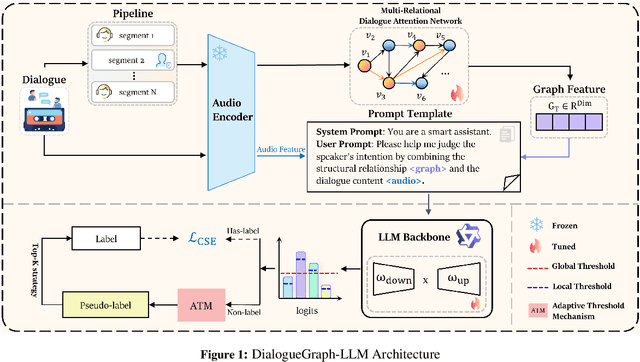
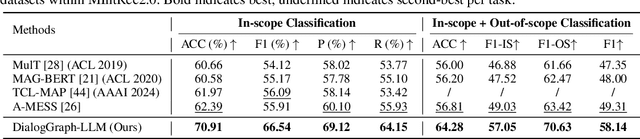
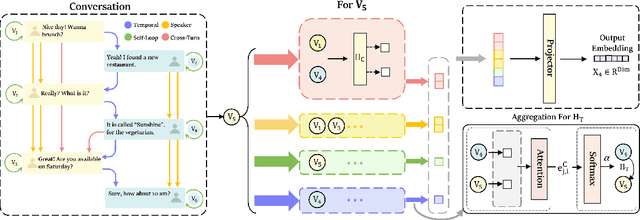
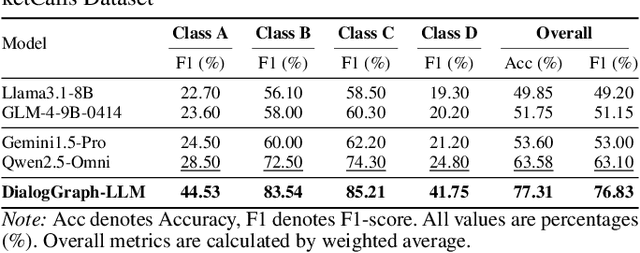
Recognizing speaker intent in long audio dialogues among speakers has a wide range of applications, but is a non-trivial AI task due to complex inter-dependencies in speaker utterances and scarce annotated data. To address these challenges, an end-to-end framework, namely DialogGraph-LLM, is proposed in the current work. DialogGraph-LLM combines a novel Multi-Relational Dialogue Attention Network (MR-DAN) architecture with multimodal foundation models (e.g., Qwen2.5-Omni-7B) for direct acoustic-to-intent inference. An adaptive semi-supervised learning strategy is designed using LLM with a confidence-aware pseudo-label generation mechanism based on dual-threshold filtering using both global and class confidences, and an entropy-based sample selection process that prioritizes high-information unlabeled instances. Extensive evaluations on the proprietary MarketCalls corpus and the publicly available MIntRec 2.0 benchmark demonstrate DialogGraph-LLM's superiority over strong audio and text-driven baselines. The framework demonstrates strong performance and efficiency in intent recognition in real world scenario audio dialogues, proving its practical value for audio-rich domains with limited supervision. Our code is available at https://github.com/david188888/DialogGraph-LLM.