 Add to Chrome
 Add to Firefox
 Add to Edge
AEMIM: Adversarial Examples Meet Masked Image Modeling
Jul 16, 2024
Masked image modeling (MIM) has gained significant traction for its remarkable prowess in representation learning. As an alternative to the traditional approach, the reconstruction from corrupted images has recently emerged as a promising pretext task. However, the regular corrupted images are generated using generic generators, often lacking relevance to the specific reconstruction task involved in pre-training. Hence, reconstruction from regular corrupted images cannot ensure the difficulty of the pretext task, potentially leading to a performance decline. Moreover, generating corrupted images might introduce an extra generator, resulting in a notable computational burden. To address these issues, we propose to incorporate adversarial examples into masked image modeling, as the new reconstruction targets. Adversarial examples, generated online using only the trained models, can directly aim to disrupt tasks associated with pre-training. Therefore, the incorporation not only elevates the level of challenge in reconstruction but also enhances efficiency, contributing to the acquisition of superior representations by the model. In particular, we introduce a novel auxiliary pretext task that reconstructs the adversarial examples corresponding to the original images. We also devise an innovative adversarial attack to craft more suitable adversarial examples for MIM pre-training. It is noted that our method is not restricted to specific model architectures and MIM strategies, rendering it an adaptable plug-in capable of enhancing all MIM methods. Experimental findings substantiate the remarkable capability of our approach in amplifying the generalization and robustness of existing MIM methods. Notably, our method surpasses the performance of baselines on various tasks, including ImageNet, its variants, and other downstream tasks.

Controllable Contextualized Image Captioning: Directing the Visual Narrative through User-Defined Highlights
Jul 16, 2024Contextualized Image Captioning (CIC) evolves traditional image captioning into a more complex domain, necessitating the ability for multimodal reasoning. It aims to generate image captions given specific contextual information. This paper further introduces a novel domain of Controllable Contextualized Image Captioning (Ctrl-CIC). Unlike CIC, which solely relies on broad context, Ctrl-CIC accentuates a user-defined highlight, compelling the model to tailor captions that resonate with the highlighted aspects of the context. We present two approaches, Prompting-based Controller (P-Ctrl) and Recalibration-based Controller (R-Ctrl), to generate focused captions. P-Ctrl conditions the model generation on highlight by prepending captions with highlight-driven prefixes, whereas R-Ctrl tunes the model to selectively recalibrate the encoder embeddings for highlighted tokens. Additionally, we design a GPT-4V empowered evaluator to assess the quality of the controlled captions alongside standard assessment methods. Extensive experimental results demonstrate the efficient and effective controllability of our method, charting a new direction in achieving user-adaptive image captioning. Code is available at https://github.com/ShunqiM/Ctrl-CIC .
Aligning Diffusion Behaviors with Q-functions for Efficient Continuous Control
Jul 12, 2024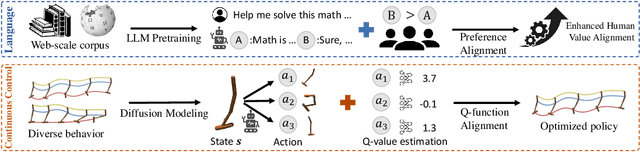
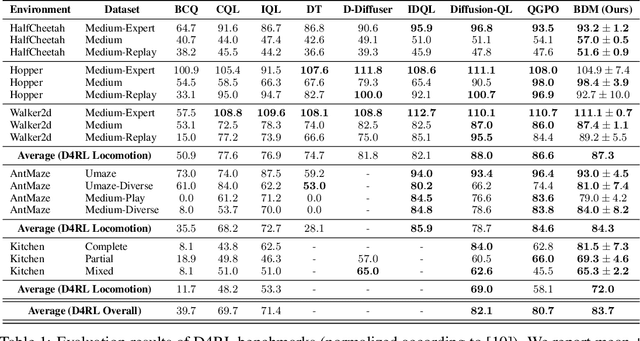
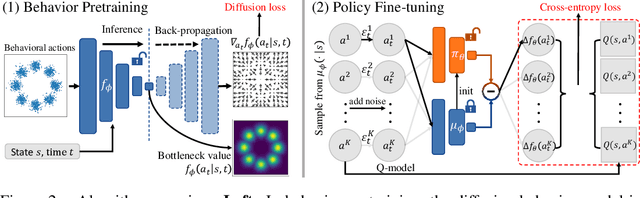
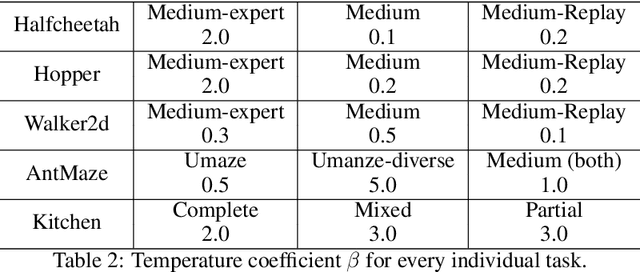
Drawing upon recent advances in language model alignment, we formulate offline Reinforcement Learning as a two-stage optimization problem: First pretraining expressive generative policies on reward-free behavior datasets, then fine-tuning these policies to align with task-specific annotations like Q-values. This strategy allows us to leverage abundant and diverse behavior data to enhance generalization and enable rapid adaptation to downstream tasks using minimal annotations. In particular, we introduce Efficient Diffusion Alignment (EDA) for solving continuous control problems. EDA utilizes diffusion models for behavior modeling. However, unlike previous approaches, we represent diffusion policies as the derivative of a scalar neural network with respect to action inputs. This representation is critical because it enables direct density calculation for diffusion models, making them compatible with existing LLM alignment theories. During policy fine-tuning, we extend preference-based alignment methods like Direct Preference Optimization (DPO) to align diffusion behaviors with continuous Q-functions. Our evaluation on the D4RL benchmark shows that EDA exceeds all baseline methods in overall performance. Notably, EDA maintains about 95\% of performance and still outperforms several baselines given only 1\% of Q-labelled data during fine-tuning.
Controllable Navigation Instruction Generation with Chain of Thought Prompting
Jul 10, 2024Instruction generation is a vital and multidisciplinary research area with broad applications. Existing instruction generation models are limited to generating instructions in a single style from a particular dataset, and the style and content of generated instructions cannot be controlled. Moreover, most existing instruction generation methods also disregard the spatial modeling of the navigation environment. Leveraging the capabilities of Large Language Models (LLMs), we propose C-Instructor, which utilizes the chain-of-thought-style prompt for style-controllable and content-controllable instruction generation. Firstly, we propose a Chain of Thought with Landmarks (CoTL) mechanism, which guides the LLM to identify key landmarks and then generate complete instructions. CoTL renders generated instructions more accessible to follow and offers greater controllability over the manipulation of landmark objects. Furthermore, we present a Spatial Topology Modeling Task to facilitate the understanding of the spatial structure of the environment. Finally, we introduce a Style-Mixed Training policy, harnessing the prior knowledge of LLMs to enable style control for instruction generation based on different prompts within a single model instance. Extensive experiments demonstrate that instructions generated by C-Instructor outperform those generated by previous methods in text metrics, navigation guidance evaluation, and user studies.
Fine-grained, Multi-dimensional Summarization Evaluation with LLMs
Jul 09, 2024


Automated evaluation is crucial for streamlining text summarization benchmarking and model development, given the costly and time-consuming nature of human evaluation. Traditional methods like ROUGE do not correlate well with human judgment, while recently proposed LLM-based metrics provide only summary-level assessment using Likert-scale scores. This limits deeper model analysis, e.g., we can only assign one hallucination score at the summary level, while at the sentence level, we can count sentences containing hallucinations. To remedy those limitations, we propose FineSurE, a fine-grained evaluator specifically tailored for the summarization task using large language models (LLMs). It also employs completeness and conciseness criteria, in addition to faithfulness, enabling multi-dimensional assessment. We compare various open-source and proprietary LLMs as backbones for FineSurE. In addition, we conduct extensive benchmarking of FineSurE against SOTA methods including NLI-, QA-, and LLM-based methods, showing improved performance especially on the completeness and conciseness dimensions. The code is available at https://github.com/DISL-Lab/FineSurE-ACL24.
HiDe-PET: Continual Learning via Hierarchical Decomposition of Parameter-Efficient Tuning
Jul 07, 2024The deployment of pre-trained models (PTMs) has greatly advanced the field of continual learning (CL), enabling positive knowledge transfer and resilience to catastrophic forgetting. To sustain these advantages for sequentially arriving tasks, a promising direction involves keeping the pre-trained backbone frozen while employing parameter-efficient tuning (PET) techniques to instruct representation learning. Despite the popularity of Prompt-based PET for CL, its empirical design often leads to sub-optimal performance in our evaluation of different PTMs and target tasks. To this end, we propose a unified framework for CL with PTMs and PET that provides both theoretical and empirical advancements. We first perform an in-depth theoretical analysis of the CL objective in a pre-training context, decomposing it into hierarchical components namely within-task prediction, task-identity inference and task-adaptive prediction. We then present Hierarchical Decomposition PET (HiDe-PET), an innovative approach that explicitly optimizes the decomposed objective through incorporating task-specific and task-shared knowledge via mainstream PET techniques along with efficient recovery of pre-trained representations. Leveraging this framework, we delve into the distinct impacts of implementation strategy, PET technique and PET architecture, as well as adaptive knowledge accumulation amidst pronounced distribution changes. Finally, across various CL scenarios, our approach demonstrates remarkably superior performance over a broad spectrum of recent strong baselines.
FineSurE: Fine-grained Summarization Evaluation using LLMs
Jul 01, 2024Automated evaluation is crucial for streamlining text summarization benchmarking and model development, given the costly and time-consuming nature of human evaluation. Traditional methods like ROUGE do not correlate well with human judgment, while recently proposed LLM-based metrics provide only summary-level assessment using Likert-scale scores. This limits deeper model analysis, e.g., we can only assign one hallucination score at the summary level, while at the sentence level, we can count sentences containing hallucinations. To remedy those limitations, we propose FineSurE, a fine-grained evaluator specifically tailored for the summarization task using large language models (LLMs). It also employs completeness and conciseness criteria, in addition to faithfulness, enabling multi-dimensional assessment. We compare various open-source and proprietary LLMs as backbones for FineSurE. In addition, we conduct extensive benchmarking of FineSurE against SOTA methods including NLI-, QA-, and LLM-based methods, showing improved performance especially on the completeness and conciseness dimensions. The code is available at https://github.com/DISL-Lab/FineSurE-ACL24.
Benchmarking Trustworthiness of Multimodal Large Language Models: A Comprehensive Study
Jun 11, 2024


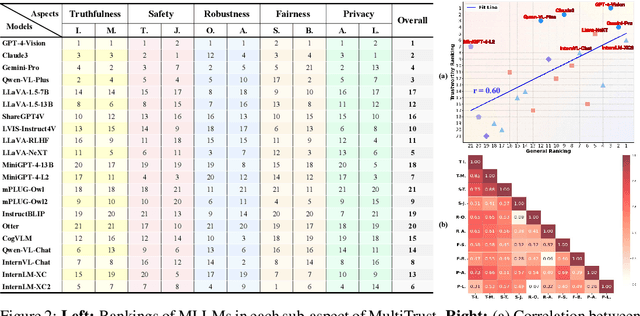
Despite the superior capabilities of Multimodal Large Language Models (MLLMs) across diverse tasks, they still face significant trustworthiness challenges. Yet, current literature on the assessment of trustworthy MLLMs remains limited, lacking a holistic evaluation to offer thorough insights into future improvements. In this work, we establish MultiTrust, the first comprehensive and unified benchmark on the trustworthiness of MLLMs across five primary aspects: truthfulness, safety, robustness, fairness, and privacy. Our benchmark employs a rigorous evaluation strategy that addresses both multimodal risks and cross-modal impacts, encompassing 32 diverse tasks with self-curated datasets. Extensive experiments with 21 modern MLLMs reveal some previously unexplored trustworthiness issues and risks, highlighting the complexities introduced by the multimodality and underscoring the necessity for advanced methodologies to enhance their reliability. For instance, typical proprietary models still struggle with the perception of visually confusing images and are vulnerable to multimodal jailbreaking and adversarial attacks; MLLMs are more inclined to disclose privacy in text and reveal ideological and cultural biases even when paired with irrelevant images in inference, indicating that the multimodality amplifies the internal risks from base LLMs. Additionally, we release a scalable toolbox for standardized trustworthiness research, aiming to facilitate future advancements in this important field. Code and resources are publicly available at: https://multi-trust.github.io/.
CERET: Cost-Effective Extrinsic Refinement for Text Generation
Jun 08, 2024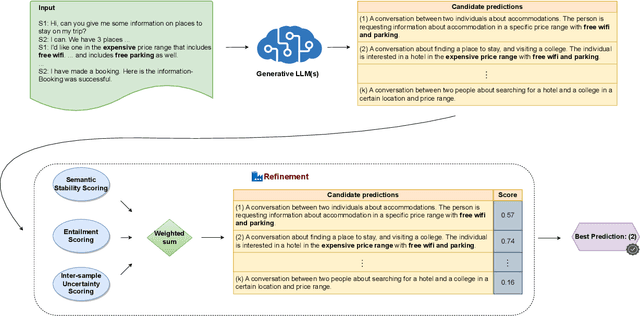
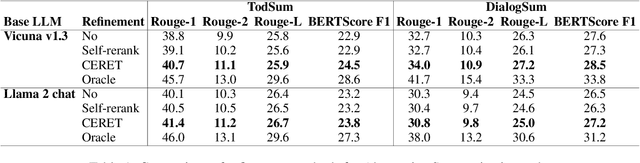
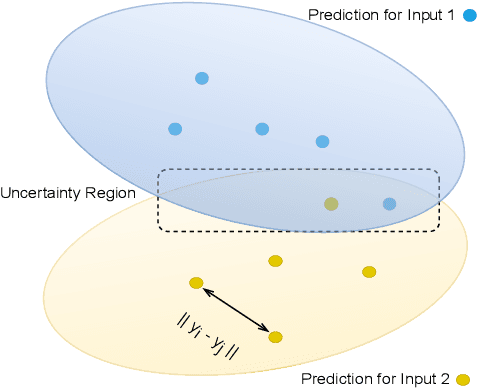

Large Language Models (LLMs) are powerful models for generation tasks, but they may not generate good quality outputs in their first attempt. Apart from model fine-tuning, existing approaches to improve prediction accuracy and quality typically involve LLM self-improvement / self-reflection that incorporate feedback from models themselves. Despite their effectiveness, these methods are hindered by their high computational cost and lack of scalability. In this work, we propose CERET, a method for refining text generations by considering semantic stability, entailment and inter-sample uncertainty measures. Experimental results show that CERET outperforms Self-consistency and Self-rerank baselines consistently under various task setups, by ~1.6% in Rouge-1 for abstractive summarization and ~3.5% in hit rate for question answering. Compared to LLM Self-rerank method, our approach only requires 9.4% of its latency and is more cost-effective.
Fourier Controller Networks for Real-Time Decision-Making in Embodied Learning
May 30, 2024Reinforcement learning is able to obtain generalized low-level robot policies on diverse robotics datasets in embodied learning scenarios, and Transformer has been widely used to model time-varying features. However, it still suffers from the issues of low data efficiency and high inference latency. In this paper, we propose to investigate the task from a new perspective of the frequency domain. We first observe that the energy density in the frequency domain of a robot's trajectory is mainly concentrated in the low-frequency part. Then, we present the Fourier Controller Network (FCNet), a new network that utilizes the Short-Time Fourier Transform (STFT) to extract and encode time-varying features through frequency domain interpolation. We further achieve parallel training and efficient recurrent inference by using FFT and Sliding DFT methods in the model architecture for real-time decision-making. Comprehensive analyses in both simulated (e.g., D4RL) and real-world environments (e.g., robot locomotion) demonstrate FCNet's substantial efficiency and effectiveness over existing methods such as Transformer, e.g., FCNet outperforms Transformer on multi-environmental robotics datasets of all types of sizes (from 1.9M to 120M). The project page and code can be found https://thkkk.github.io/fcnet.