 Add to Chrome
 Add to Firefox
 Add to Edge
Hierarchical Emotion Prediction and Control in Text-to-Speech Synthesis
May 15, 2024
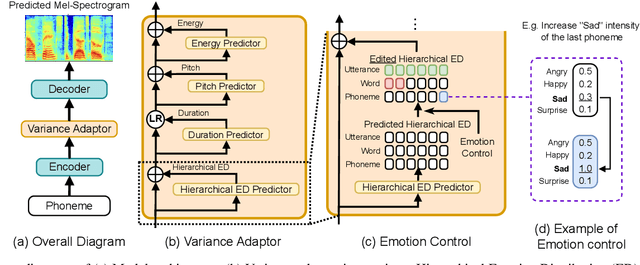
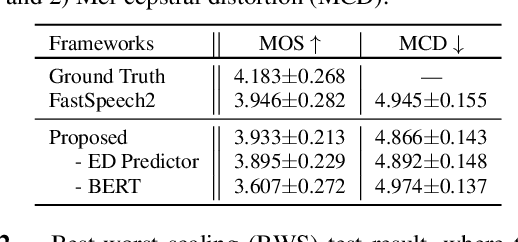

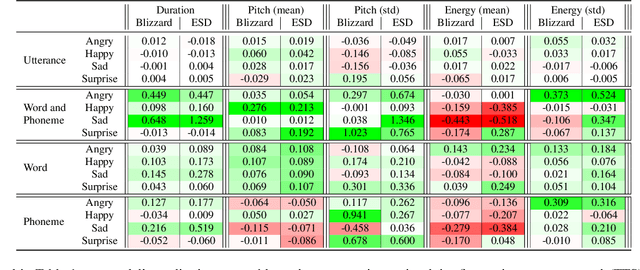
It remains a challenge to effectively control the emotion rendering in text-to-speech (TTS) synthesis. Prior studies have primarily focused on learning a global prosodic representation at the utterance level, which strongly correlates with linguistic prosody. Our goal is to construct a hierarchical emotion distribution (ED) that effectively encapsulates intensity variations of emotions at various levels of granularity, encompassing phonemes, words, and utterances. During TTS training, the hierarchical ED is extracted from the ground-truth audio and guides the predictor to establish a connection between emotional and linguistic prosody. At run-time inference, the TTS model generates emotional speech and, at the same time, provides quantitative control of emotion over the speech constituents. Both objective and subjective evaluations validate the effectiveness of the proposed framework in terms of emotion prediction and control.

Incorporating External Knowledge and Goal Guidance for LLM-based Conversational Recommender Systems
May 03, 2024


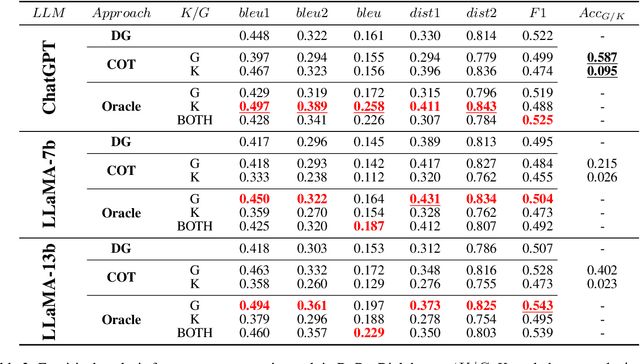
This paper aims to efficiently enable large language models (LLMs) to use external knowledge and goal guidance in conversational recommender system (CRS) tasks. Advanced LLMs (e.g., ChatGPT) are limited in domain-specific CRS tasks for 1) generating grounded responses with recommendation-oriented knowledge, or 2) proactively leading the conversations through different dialogue goals. In this work, we first analyze those limitations through a comprehensive evaluation, showing the necessity of external knowledge and goal guidance which contribute significantly to the recommendation accuracy and language quality. In light of this finding, we propose a novel ChatCRS framework to decompose the complex CRS task into several sub-tasks through the implementation of 1) a knowledge retrieval agent using a tool-augmented approach to reason over external Knowledge Bases and 2) a goal-planning agent for dialogue goal prediction. Experimental results on two multi-goal CRS datasets reveal that ChatCRS sets new state-of-the-art benchmarks, improving language quality of informativeness by 17% and proactivity by 27%, and achieving a tenfold enhancement in recommendation accuracy.
Audio-Visual Target Speaker Extraction with Reverse Selective Auditory Attention
Apr 29, 2024


Audio-visual target speaker extraction (AV-TSE) aims to extract the specific person's speech from the audio mixture given auxiliary visual cues. Previous methods usually search for the target voice through speech-lip synchronization. However, this strategy mainly focuses on the existence of target speech, while ignoring the variations of the noise characteristics. That may result in extracting noisy signals from the incorrect sound source in challenging acoustic situations. To this end, we propose a novel reverse selective auditory attention mechanism, which can suppress interference speakers and non-speech signals to avoid incorrect speaker extraction. By estimating and utilizing the undesired noisy signal through this mechanism, we design an AV-TSE framework named Subtraction-and-ExtrAction network (SEANet) to suppress the noisy signals. We conduct abundant experiments by re-implementing three popular AV-TSE methods as the baselines and involving nine metrics for evaluation. The experimental results show that our proposed SEANet achieves state-of-the-art results and performs well for all five datasets. We will release the codes, the models and data logs.
An Investigation of Time-Frequency Representation Discriminators for High-Fidelity Vocoder
Apr 26, 2024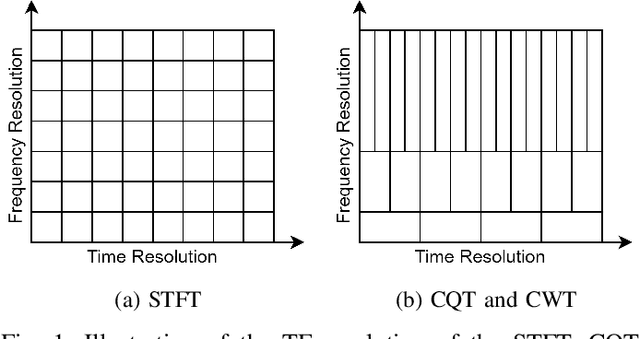


Generative Adversarial Network (GAN) based vocoders are superior in both inference speed and synthesis quality when reconstructing an audible waveform from an acoustic representation. This study focuses on improving the discriminator for GAN-based vocoders. Most existing Time-Frequency Representation (TFR)-based discriminators are rooted in Short-Time Fourier Transform (STFT), which owns a constant Time-Frequency (TF) resolution, linearly scaled center frequencies, and a fixed decomposition basis, making it incompatible with signals like singing voices that require dynamic attention for different frequency bands and different time intervals. Motivated by that, we propose a Multi-Scale Sub-Band Constant-Q Transform CQT (MS-SB-CQT) discriminator and a Multi-Scale Temporal-Compressed Continuous Wavelet Transform CWT (MS-TC-CWT) discriminator. Both CQT and CWT have a dynamic TF resolution for different frequency bands. In contrast, CQT has a better modeling ability in pitch information, and CWT has a better modeling ability in short-time transients. Experiments conducted on both speech and singing voices confirm the effectiveness of our proposed discriminators. Moreover, the STFT, CQT, and CWT-based discriminators can be used jointly for better performance. The proposed discriminators can boost the synthesis quality of various state-of-the-art GAN-based vocoders, including HiFi-GAN, BigVGAN, and APNet.
Enhancing Real-World Active Speaker Detection with Multi-Modal Extraction Pre-Training
Apr 01, 2024


Audio-visual active speaker detection (AV-ASD) aims to identify which visible face is speaking in a scene with one or more persons. Most existing AV-ASD methods prioritize capturing speech-lip correspondence. However, there is a noticeable gap in addressing the challenges from real-world AV-ASD scenarios. Due to the presence of low-quality noisy videos in such cases, AV-ASD systems without a selective listening ability are short of effectively filtering out disruptive voice components from mixed audio inputs. In this paper, we propose a Multi-modal Speaker Extraction-to-Detection framework named `MuSED', which is pre-trained with audio-visual target speaker extraction to learn the denoising ability, then it is fine-tuned with the AV-ASD task. Meanwhile, to better capture the multi-modal information and deal with real-world problems such as missing modality, MuSED is modelled on the time domain directly and integrates the multi-modal plus-and-minus augmentation strategy. Our experiments demonstrate that MuSED substantially outperforms the state-of-the-art AV-ASD methods and achieves 95.6% mAP on the AVA-ActiveSpeaker dataset, 98.3% AP on the ASW dataset, and 97.9% F1 on the Columbia AV-ASD dataset, respectively. We will publicly release the code in due course.
Voice Conversion Augmentation for Speaker Recognition on Defective Datasets
Apr 01, 2024


Modern speaker recognition system relies on abundant and balanced datasets for classification training. However, diverse defective datasets, such as partially-labelled, small-scale, and imbalanced datasets, are common in real-world applications. Previous works usually studied specific solutions for each scenario from the algorithm perspective. However, the root cause of these problems lies in dataset imperfections. To address these challenges with a unified solution, we propose the Voice Conversion Augmentation (VCA) strategy to obtain pseudo speech from the training set. Furthermore, to guarantee generation quality, we designed the VCA-NN~(nearest neighbours) strategy to select source speech from utterances that are close to the target speech in the representation space. Our experimental results on three created datasets demonstrated that VCA-NN effectively mitigates these dataset problems, which provides a new direction for handling the speaker recognition problems from the data aspect.
Target Speech Extraction with Pre-trained AV-HuBERT and Mask-And-Recover Strategy
Mar 24, 2024Audio-visual target speech extraction (AV-TSE) is one of the enabling technologies in robotics and many audio-visual applications. One of the challenges of AV-TSE is how to effectively utilize audio-visual synchronization information in the process. AV-HuBERT can be a useful pre-trained model for lip-reading, which has not been adopted by AV-TSE. In this paper, we would like to explore the way to integrate a pre-trained AV-HuBERT into our AV-TSE system. We have good reasons to expect an improved performance. To benefit from the inter and intra-modality correlations, we also propose a novel Mask-And-Recover (MAR) strategy for self-supervised learning. The experimental results on the VoxCeleb2 dataset show that our proposed model outperforms the baselines both in terms of subjective and objective metrics, suggesting that the pre-trained AV-HuBERT model provides more informative visual cues for target speech extraction. Furthermore, through a comparative study, we confirm that the proposed Mask-And-Recover strategy is significantly effective.
CrossTune: Black-Box Few-Shot Classification with Label Enhancement
Mar 19, 2024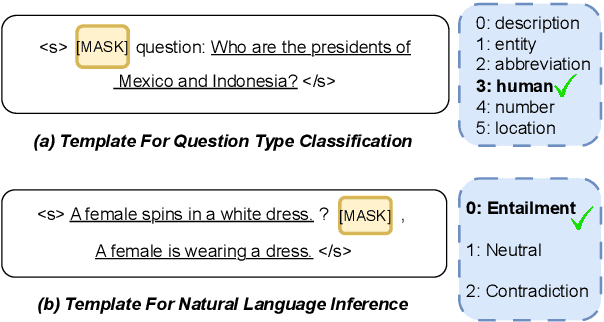
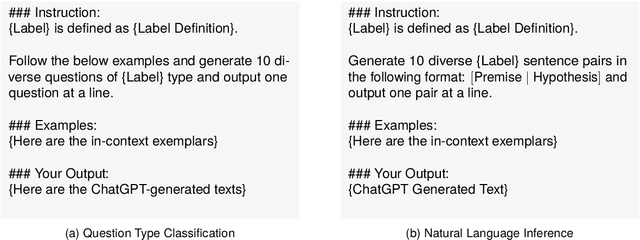
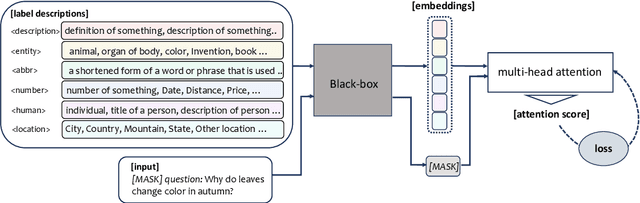
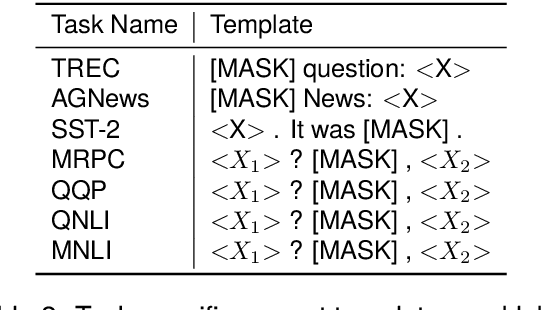
Training or finetuning large-scale language models (LLMs) requires substantial computation resources, motivating recent efforts to explore parameter-efficient adaptation to downstream tasks. One approach is to treat these models as black boxes and use forward passes (Inference APIs) to interact with them. Current research focuses on adapting these black-box models to downstream tasks using gradient-free prompt optimization, but this often involves an expensive process of searching task-specific prompts. Therefore, we are motivated to study black-box language model adaptation without prompt search. Specifically, we introduce a label-enhanced cross-attention network called CrossTune, which models the semantic relatedness between the input text sequence and task-specific label descriptions. Its effectiveness is examined in the context of few-shot text classification. To improve the generalization of CrossTune, we utilize ChatGPT to generate additional training data through in-context learning. A switch mechanism is implemented to exclude low-quality ChatGPT-generated data. Through extensive experiments on seven benchmark text classification datasets, we demonstrate that our proposed approach outperforms the previous state-of-the-art gradient-free black-box tuning method by 5.7% on average. Even without using ChatGPT-augmented data, CrossTune performs better or comparably than previous black-box tuning methods, suggesting the effectiveness of our approach.
sVAD: A Robust, Low-Power, and Light-Weight Voice Activity Detection with Spiking Neural Networks
Mar 09, 2024Speech applications are expected to be low-power and robust under noisy conditions. An effective Voice Activity Detection (VAD) front-end lowers the computational need. Spiking Neural Networks (SNNs) are known to be biologically plausible and power-efficient. However, SNN-based VADs have yet to achieve noise robustness and often require large models for high performance. This paper introduces a novel SNN-based VAD model, referred to as sVAD, which features an auditory encoder with an SNN-based attention mechanism. Particularly, it provides effective auditory feature representation through SincNet and 1D convolution, and improves noise robustness with attention mechanisms. The classifier utilizes Spiking Recurrent Neural Networks (sRNN) to exploit temporal speech information. Experimental results demonstrate that our sVAD achieves remarkable noise robustness and meanwhile maintains low power consumption and a small footprint, making it a promising solution for real-world VAD applications.
Apollo: An Lightweight Multilingual Medical LLM towards Democratizing Medical AI to 6B People
Mar 09, 2024
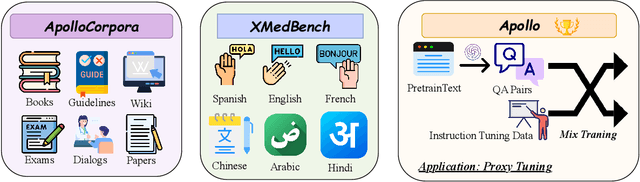


Despite the vast repository of global medical knowledge predominantly being in English, local languages are crucial for delivering tailored healthcare services, particularly in areas with limited medical resources. To extend the reach of medical AI advancements to a broader population, we aim to develop medical LLMs across the six most widely spoken languages, encompassing a global population of 6.1 billion. This effort culminates in the creation of the ApolloCorpora multilingual medical dataset and the XMedBench benchmark. In the multilingual medical benchmark, the released Apollo models, at various relatively-small sizes (i.e., 0.5B, 1.8B, 2B, 6B, and 7B), achieve the best performance among models of equivalent size. Especially, Apollo-7B is the state-of-the-art multilingual medical LLMs up to 70B. Additionally, these lite models could be used to improve the multi-lingual medical capabilities of larger models without fine-tuning in a proxy-tuning fashion. We will open-source training corpora, code, model weights and evaluation benchmark.