 Add to Chrome
 Add to Firefox
 Add to Edge
pFedNavi: Structure-Aware Personalized Federated Vision-Language Navigation for Embodied AI
Feb 16, 2026
Vision-Language Navigation VLN requires large-scale trajectory instruction data from private indoor environments, raising significant privacy concerns. Federated Learning FL mitigates this by keeping data on-device, but vanilla FL struggles under VLNs' extreme cross-client heterogeneity in environments and instruction styles, making a single global model suboptimal. This paper proposes pFedNavi, a structure-aware and dynamically adaptive personalized federated learning framework tailored for VLN. Our key idea is to personalize where it matters: pFedNavi adaptively identifies client-specific layers via layer-wise mixing coefficients, and performs fine-grained parameter fusion on the selected components (e.g., the encoder-decoder projection and environment-sensitive decoder layers) to balance global knowledge sharing with local specialization. We evaluate pFedNavi on two standard VLN benchmarks, R2R and RxR, using both ResNet and CLIP visual representations. Across all metrics, pFedNavi consistently outperforms the FedAvg-based VLN baseline, achieving up to 7.5% improvement in navigation success rate and up to 7.8% gain in trajectory fidelity, while converging 1.38x faster under non-IID conditions.

POLAR: Policy-based Layerwise Reinforcement Learning Method for Stealthy Backdoor Attacks in Federated Learning
Oct 21, 2025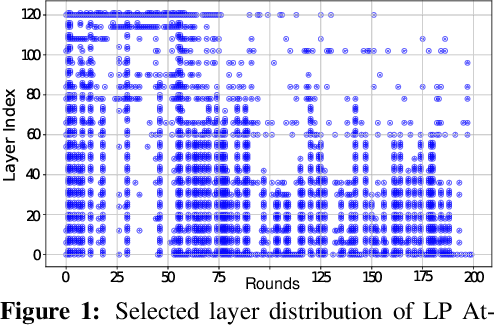
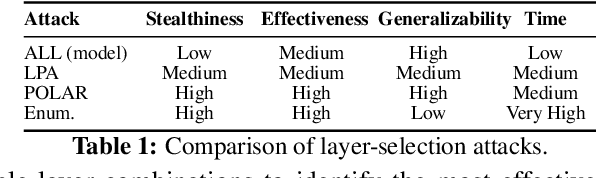
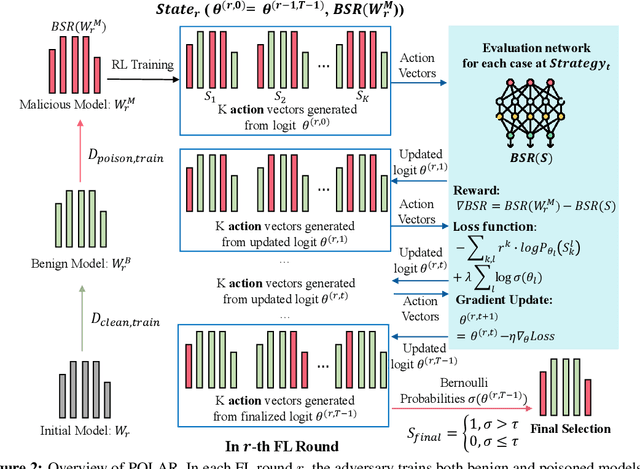
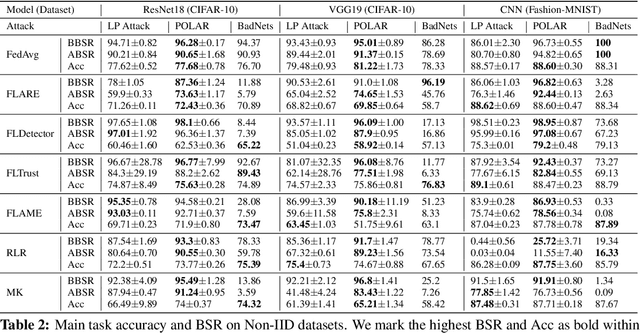
Federated Learning (FL) enables decentralized model training across multiple clients without exposing local data, but its distributed feature makes it vulnerable to backdoor attacks. Despite early FL backdoor attacks modifying entire models, recent studies have explored the concept of backdoor-critical (BC) layers, which poison the chosen influential layers to maintain stealthiness while achieving high effectiveness. However, existing BC layers approaches rely on rule-based selection without consideration of the interrelations between layers, making them ineffective and prone to detection by advanced defenses. In this paper, we propose POLAR (POlicy-based LAyerwise Reinforcement learning), the first pipeline to creatively adopt RL to solve the BC layer selection problem in layer-wise backdoor attack. Different from other commonly used RL paradigm, POLAR is lightweight with Bernoulli sampling. POLAR dynamically learns an attack strategy, optimizing layer selection using policy gradient updates based on backdoor success rate (BSR) improvements. To ensure stealthiness, we introduce a regularization constraint that limits the number of modified layers by penalizing large attack footprints. Extensive experiments demonstrate that POLAR outperforms the latest attack methods by up to 40% against six state-of-the-art (SOTA) defenses.