 Add to Chrome
 Add to Firefox
 Add to Edge
Dynamics of Stochastic Momentum with Sparse Updates in High Dimensions
May 27, 2026
Existing theory of momentum assumes that gradients arrive at every parameter at a roughly constant rate, an assumption violated in practice by heavy-tailed data distributions and modern architectures. We theoretically analyze the dynamics of two tractable models of momentum under sparse updates: a least squares model with sparse inputs and a logistic regression model with a rare class. Both admit exact closed-form second-moment dynamics whose high-dimensional limits we characterize across three scaling exponents for sparsity, batch size, and momentum decay. The phase structure on both problems is governed by the ratio of two intrinsic timescales: a momentum retention timescale (how many active updates the buffer survives) and a learning timescale (how many active updates it takes to reduce the squared error). When learning is much slower than retention, the limit matches SGD; when learning is faster, the system is unstable; where the timescales coincide, we recover classical heavy-ball dynamics. The oscillatory dynamics occur at different momentum values for different token sparsity, creating a spectral conflict for global momentum across token frequencies.

Phases of Muon: When Muon Eclipses SignSGD
May 10, 2026Recently, Muon and related spectral optimizers have demonstrated strong empirical performance as scalable stochastic methods, often outperforming Adam. Yet their behaviour remains poorly understood. We analyze stochastic spectral optimizers, including Muon, on a high-dimensional matrix-valued least squares problem. We derive explicit deterministic dynamics that provide a tractable framework for studying learning behaviour with a focus on (stochastic) SignSVD, which Muon approximates, and (stochastic) SignSGD, the latter serving as a proxy for Adam. Our analysis shows that for large batch size, SignSVD performs a square-root preconditioning with respect to the data covariance spectrum, while for small batch size smaller eigenmodes behave like SGD, slowing down convergence. We contrast with SignSGD which for generic covariance performs no preconditioning and has no transition, leading to different optimal learning rates and convergence characteristics. The two methods match up to a constant factor with isotropic data, but behave differently with anisotropic data. An analysis of a power law covariance model with data exponent $α$ and target exponent $β$ shows there are three phases in the $(α,β)$ plane: one where SignSGD is uniformly favored, one where SignSVD is uniformly favored, and a third where the two methods exhibit a trade-off in performance.
Spectral Lens: Activation and Gradient Spectra as Diagnostics of LLM Optimization
May 07, 2026Training loss and throughput can hide distinct internal representation in language-model training. To examine these hidden mechanics, we use spectral measurements as practical and operational diagnostics. Using a controlled family of decoder-only models adapted from the modded NanoGPT codebase, we introduce an empirical protocol based on activation covariance and per-sample gradient SVD spectra. This dual-view reveals three empirical findings and one mechanistic explanation. First, batch size acts as a latent determinant of representation geometry: runs that reach equal loss settle into systematically distinct activation spectra. Second, the activation covariance tail measured early in training reliably forecasts downstream token efficiency. Third, movement of the activation spectrum head (leading modes), together with gradient spectra, characterizes underlying learning-dynamics changes, separating learning-side architectural improvements from primarily execution-side gains. These predictive and diagnostic signals persist across the 12-, 36-, and 48-layer model tiers. Finally, a mechanistic model proves the main observations and explains how activation covariance spectra correlate with task-aligned feature learning.
Power-Law Spectrum of the Random Feature Model
Mar 15, 2026Scaling laws for neural networks, in which the loss decays as a power-law in the number of parameters, data, and compute, depend fundamentally on the spectral structure of the data covariance, with power-law eigenvalue decay appearing ubiquitously in vision and language tasks. A central question is whether this spectral structure is preserved or destroyed when data passes through the basic building block of a neural network: a random linear projection followed by a nonlinear activation. We study this question for the random feature model: given data $x \sim N(0,H)\in \mathbb{R}^v$ where $H$ has $α$-power-law spectrum ($λ_j(H ) \asymp j^{-α}$, $α> 1$), a Gaussian sketch matrix $W \in \mathbb{R}^{v\times d}$, and an entrywise monomial $f(y) = y^{p}$, we characterize the eigenvalues of the population random-feature covariance $\mathbb{E}_{x }[\frac{1}{d}f(W^\top x )^{\otimes 2}]$. We prove matching upper and lower bounds: for all $1 \leq j \leq c_1 d \log^{-(p+1)}(d)$, the $j$-th eigenvalue is of order $\left(\log^{p-1}(j+1)/j\right)^α$. For $ c_1 d \log^{-(p+1)}(d)\leq j\leq d$, the $j$-th eigenvalue is of order $j^{-α}$ up to a polylog factor. That is, the power-law exponent $α$ is inherited exactly from the input covariance, modified only by a logarithmic correction that depends on the monomial degree $p$. The proof combines a dyadic head-tail decomposition with Wick chaos expansions for higher-order monomials and random matrix concentration inequalities.
Logarithmic-time Schedules for Scaling Language Models with Momentum
Feb 05, 2026In practice, the hyperparameters $(β_1, β_2)$ and weight-decay $λ$ in AdamW are typically kept at fixed values. Is there any reason to do otherwise? We show that for large-scale language model training, the answer is yes: by exploiting the power-law structure of language data, one can design time-varying schedules for $(β_1, β_2, λ)$ that deliver substantial performance gains. We study logarithmic-time scheduling, in which the optimizer's gradient memory horizon grows with training time. Although naive variants of this are unstable, we show that suitable damping mechanisms restore stability while preserving the benefits of longer memory. Based on this, we present ADANA, an AdamW-like optimizer that couples log-time schedules with explicit damping to balance stability and performance. We empirically evaluate ADANA across transformer scalings (45M to 2.6B parameters), comparing against AdamW, Muon, and AdEMAMix. When properly tuned, ADANA achieves up to 40% compute efficiency relative to a tuned AdamW, with gains that persist--and even improve--as model scale increases. We further show that similar benefits arise when applying logarithmic-time scheduling to AdEMAMix, and that logarithmic-time weight-decay alone can yield significant improvements. Finally, we present variants of ADANA that mitigate potential failure modes and improve robustness.
Eigenvalue distribution of the Neural Tangent Kernel in the quadratic scaling
Aug 27, 2025We compute the asymptotic eigenvalue distribution of the neural tangent kernel of a two-layer neural network under a specific scaling of dimension. Namely, if $X\in\mathbb{R}^{n\times d}$ is an i.i.d random matrix, $W\in\mathbb{R}^{d\times p}$ is an i.i.d $\mathcal{N}(0,1)$ matrix and $D\in\mathbb{R}^{p\times p}$ is a diagonal matrix with i.i.d bounded entries, we consider the matrix \[ \mathrm{NTK} = \frac{1}{d}XX^\top \odot \frac{1}{p} \sigma'\left( \frac{1}{\sqrt{d}}XW \right)D^2 \sigma'\left( \frac{1}{\sqrt{d}}XW \right)^\top \] where $\sigma'$ is a pseudo-Lipschitz function applied entrywise and under the scaling $\frac{n}{dp}\to \gamma_1$ and $\frac{p}{d}\to \gamma_2$. We describe the asymptotic distribution as the free multiplicative convolution of the Marchenko--Pastur distribution with a deterministic distribution depending on $\sigma$ and $D$.
Dimension-adapted Momentum Outscales SGD
May 22, 2025We investigate scaling laws for stochastic momentum algorithms with small batch on the power law random features model, parameterized by data complexity, target complexity, and model size. When trained with a stochastic momentum algorithm, our analysis reveals four distinct loss curve shapes determined by varying data-target complexities. While traditional stochastic gradient descent with momentum (SGD-M) yields identical scaling law exponents to SGD, dimension-adapted Nesterov acceleration (DANA) improves these exponents by scaling momentum hyperparameters based on model size and data complexity. This outscaling phenomenon, which also improves compute-optimal scaling behavior, is achieved by DANA across a broad range of data and target complexities, while traditional methods fall short. Extensive experiments on high-dimensional synthetic quadratics validate our theoretical predictions and large-scale text experiments with LSTMs show DANA's improved loss exponents over SGD hold in a practical setting.
Exact Risk Curves of signSGD in High-Dimensions: Quantifying Preconditioning and Noise-Compression Effects
Nov 19, 2024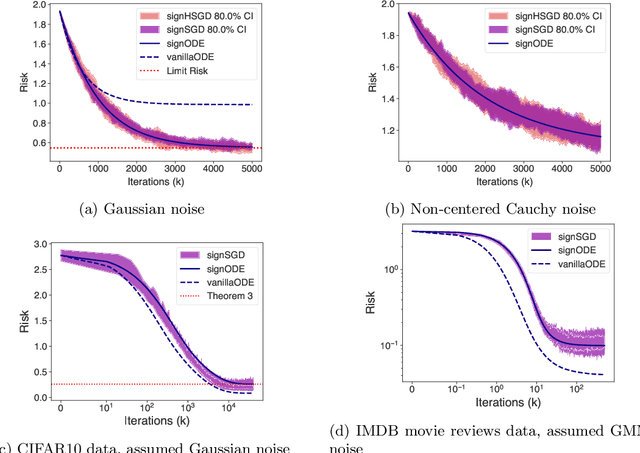
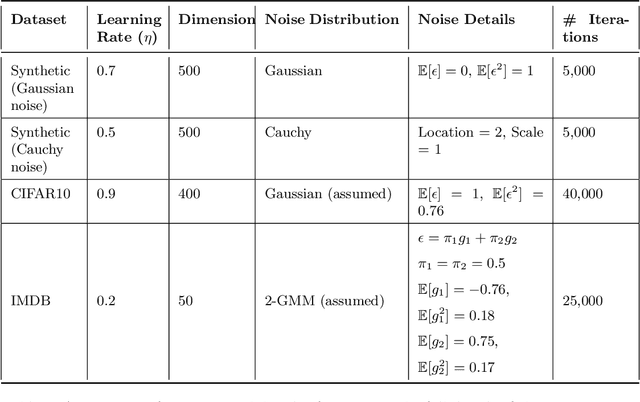
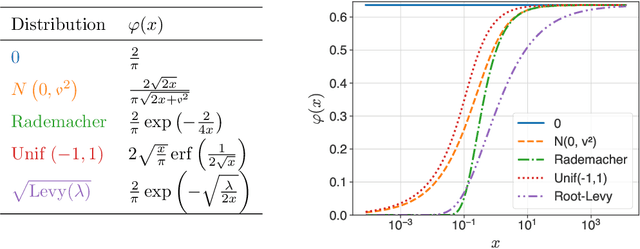
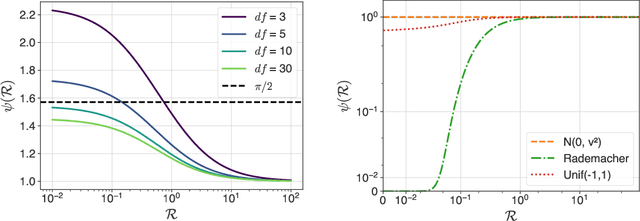
In recent years, signSGD has garnered interest as both a practical optimizer as well as a simple model to understand adaptive optimizers like Adam. Though there is a general consensus that signSGD acts to precondition optimization and reshapes noise, quantitatively understanding these effects in theoretically solvable settings remains difficult. We present an analysis of signSGD in a high dimensional limit, and derive a limiting SDE and ODE to describe the risk. Using this framework we quantify four effects of signSGD: effective learning rate, noise compression, diagonal preconditioning, and gradient noise reshaping. Our analysis is consistent with experimental observations but moves beyond that by quantifying the dependence of these effects on the data and noise distributions. We conclude with a conjecture on how these results might be extended to Adam.
A Clipped Trip: the Dynamics of SGD with Gradient Clipping in High-Dimensions
Jun 17, 2024The success of modern machine learning is due in part to the adaptive optimization methods that have been developed to deal with the difficulties of training large models over complex datasets. One such method is gradient clipping: a practical procedure with limited theoretical underpinnings. In this work, we study clipping in a least squares problem under streaming SGD. We develop a theoretical analysis of the learning dynamics in the limit of large intrinsic dimension-a model and dataset dependent notion of dimensionality. In this limit we find a deterministic equation that describes the evolution of the loss. We show that with Gaussian noise clipping cannot improve SGD performance. Yet, in other noisy settings, clipping can provide benefits with tuning of the clipping threshold. In these cases, clipping biases updates in a way beneficial to training which cannot be recovered by SGD under any schedule. We conclude with a discussion about the links between high-dimensional clipping and neural network training.
The High Line: Exact Risk and Learning Rate Curves of Stochastic Adaptive Learning Rate Algorithms
May 30, 2024We develop a framework for analyzing the training and learning rate dynamics on a large class of high-dimensional optimization problems, which we call the high line, trained using one-pass stochastic gradient descent (SGD) with adaptive learning rates. We give exact expressions for the risk and learning rate curves in terms of a deterministic solution to a system of ODEs. We then investigate in detail two adaptive learning rates -- an idealized exact line search and AdaGrad-Norm -- on the least squares problem. When the data covariance matrix has strictly positive eigenvalues, this idealized exact line search strategy can exhibit arbitrarily slower convergence when compared to the optimal fixed learning rate with SGD. Moreover we exactly characterize the limiting learning rate (as time goes to infinity) for line search in the setting where the data covariance has only two distinct eigenvalues. For noiseless targets, we further demonstrate that the AdaGrad-Norm learning rate converges to a deterministic constant inversely proportional to the average eigenvalue of the data covariance matrix, and identify a phase transition when the covariance density of eigenvalues follows a power law distribution.