 Add to Chrome
 Add to Firefox
 Add to Edge
TV-RAG: A Temporal-aware and Semantic Entropy-Weighted Framework for Long Video Retrieval and Understanding
Dec 29, 2025
Large Video Language Models (LVLMs) have rapidly emerged as the focus of multimedia AI research. Nonetheless, when confronted with lengthy videos, these models struggle: their temporal windows are narrow, and they fail to notice fine-grained semantic shifts that unfold over extended durations. Moreover, mainstream text-based retrieval pipelines, which rely chiefly on surface-level lexical overlap, ignore the rich temporal interdependence among visual, audio, and subtitle channels. To mitigate these limitations, we propose TV-RAG, a training-free architecture that couples temporal alignment with entropy-guided semantics to improve long-video reasoning. The framework contributes two main mechanisms: \emph{(i)} a time-decay retrieval module that injects explicit temporal offsets into the similarity computation, thereby ranking text queries according to their true multimedia context; and \emph{(ii)} an entropy-weighted key-frame sampler that selects evenly spaced, information-dense frames, reducing redundancy while preserving representativeness. By weaving these temporal and semantic signals together, TV-RAG realises a dual-level reasoning routine that can be grafted onto any LVLM without re-training or fine-tuning. The resulting system offers a lightweight, budget-friendly upgrade path and consistently surpasses most leading baselines across established long-video benchmarks such as Video-MME, MLVU, and LongVideoBench, confirming the effectiveness of our model. The code can be found at https://github.com/AI-Researcher-Team/TV-RAG.

NVIDIA Nemotron 3: Efficient and Open Intelligence
Dec 24, 2025We introduce the Nemotron 3 family of models - Nano, Super, and Ultra. These models deliver strong agentic, reasoning, and conversational capabilities. The Nemotron 3 family uses a Mixture-of-Experts hybrid Mamba-Transformer architecture to provide best-in-class throughput and context lengths of up to 1M tokens. Super and Ultra models are trained with NVFP4 and incorporate LatentMoE, a novel approach that improves model quality. The two larger models also include MTP layers for faster text generation. All Nemotron 3 models are post-trained using multi-environment reinforcement learning enabling reasoning, multi-step tool use, and support granular reasoning budget control. Nano, the smallest model, outperforms comparable models in accuracy while remaining extremely cost-efficient for inference. Super is optimized for collaborative agents and high-volume workloads such as IT ticket automation. Ultra, the largest model, provides state-of-the-art accuracy and reasoning performance. Nano is released together with its technical report and this white paper, while Super and Ultra will follow in the coming months. We will openly release the model weights, pre- and post-training software, recipes, and all data for which we hold redistribution rights.
Nemotron 3 Nano: Open, Efficient Mixture-of-Experts Hybrid Mamba-Transformer Model for Agentic Reasoning
Dec 23, 2025We present Nemotron 3 Nano 30B-A3B, a Mixture-of-Experts hybrid Mamba-Transformer language model. Nemotron 3 Nano was pretrained on 25 trillion text tokens, including more than 3 trillion new unique tokens over Nemotron 2, followed by supervised fine tuning and large-scale RL on diverse environments. Nemotron 3 Nano achieves better accuracy than our previous generation Nemotron 2 Nano while activating less than half of the parameters per forward pass. It achieves up to 3.3x higher inference throughput than similarly-sized open models like GPT-OSS-20B and Qwen3-30B-A3B-Thinking-2507, while also being more accurate on popular benchmarks. Nemotron 3 Nano demonstrates enhanced agentic, reasoning, and chat abilities and supports context lengths up to 1M tokens. We release both our pretrained Nemotron 3 Nano 30B-A3B Base and post-trained Nemotron 3 Nano 30B-A3B checkpoints on Hugging Face.
Improving Pattern Recognition of Scheduling Anomalies through Structure-Aware and Semantically-Enhanced Graphs
Dec 21, 2025This paper proposes a structure-aware driven scheduling graph modeling method to improve the accuracy and representation capability of anomaly identification in scheduling behaviors of complex systems. The method first designs a structure-guided scheduling graph construction mechanism that integrates task execution stages, resource node states, and scheduling path information to build dynamically evolving scheduling behavior graphs, enhancing the model's ability to capture global scheduling relationships. On this basis, a multi-scale graph semantic aggregation module is introduced to achieve semantic consistency modeling of scheduling features through local adjacency semantic integration and global topology alignment, thereby strengthening the model's capability to capture abnormal features in complex scenarios such as multi-task concurrency, resource competition, and stage transitions. Experiments are conducted on a real scheduling dataset with multiple scheduling disturbance paths set to simulate different types of anomalies, including structural shifts, resource changes, and task delays. The proposed model demonstrates significant performance advantages across multiple metrics, showing a sensitive response to structural disturbances and semantic shifts. Further visualization analysis reveals that, under the combined effect of structure guidance and semantic aggregation, the scheduling behavior graph exhibits stronger anomaly separability and pattern representation, validating the effectiveness and adaptability of the method in scheduling anomaly detection tasks.
Nemotron-Math: Efficient Long-Context Distillation of Mathematical Reasoning from Multi-Mode Supervision
Dec 17, 2025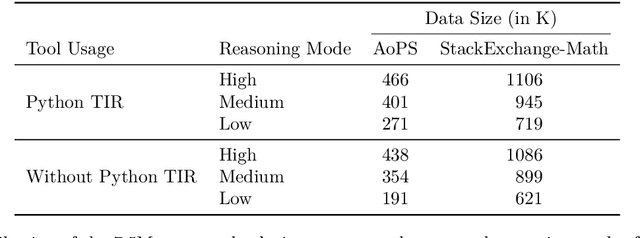
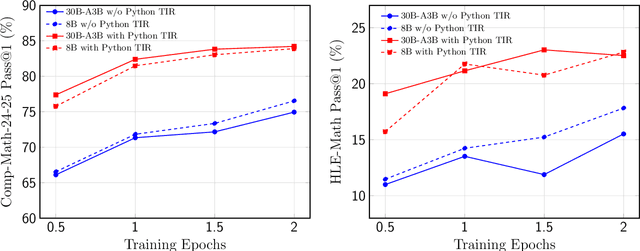
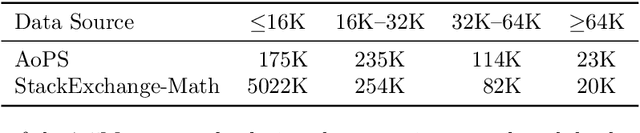
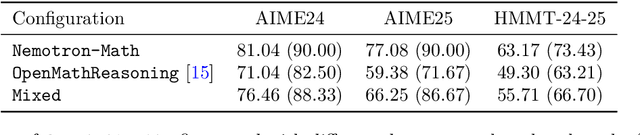
High-quality mathematical reasoning supervision requires diverse reasoning styles, long-form traces, and effective tool integration, capabilities that existing datasets provide only in limited form. Leveraging the multi-mode generation ability of gpt-oss-120b, we introduce Nemotron-Math, a large-scale mathematical reasoning dataset containing 7.5M solution traces across high, medium, and low reasoning modes, each available both with and without Python tool-integrated reasoning (TIR). The dataset integrates 85K curated AoPS problems with 262K community-sourced StackExchange-Math problems, combining structured competition tasks with diverse real-world mathematical queries. We conduct controlled evaluations to assess the dataset quality. Nemotron-Math consistently outperforms the original OpenMathReasoning on matched AoPS problems. Incorporating StackExchange-Math substantially improves robustness and generalization, especially on HLE-Math, while preserving accuracy on math competition benchmarks. To support efficient long-context training, we develop a sequential bucketed strategy that accelerates 128K context-length fine-tuning by 2--3$\times$ without significant accuracy loss. Overall, Nemotron-Math enables state-of-the-art performance, including 100\% maj@16 accuracy on AIME 2024 and 2025 with Python TIR.
Advancing Text Classification with Large Language Models and Neural Attention Mechanisms
Dec 10, 2025This study proposes a text classification algorithm based on large language models, aiming to address the limitations of traditional methods in capturing long-range dependencies, understanding contextual semantics, and handling class imbalance. The framework includes text encoding, contextual representation modeling, attention-based enhancement, feature aggregation, and classification prediction. In the representation stage, deep semantic embeddings are obtained through large-scale pretrained language models, and attention mechanisms are applied to enhance the selective representation of key features. In the aggregation stage, global and weighted strategies are combined to generate robust text-level vectors. In the classification stage, a fully connected layer and Softmax output are used to predict class distributions, and cross-entropy loss is employed to optimize model parameters. Comparative experiments introduce multiple baseline models, including recurrent neural networks, graph neural networks, and Transformers, and evaluate them on Precision, Recall, F1-Score, and AUC. Results show that the proposed method outperforms existing models on all metrics, with especially strong improvements in Recall and AUC. In addition, sensitivity experiments are conducted on hyperparameters and data conditions, covering the impact of hidden dimensions on AUC and the impact of class imbalance ratios on Recall. The findings demonstrate that proper model configuration has a significant effect on performance and reveal the adaptability and stability of the model under different conditions. Overall, the proposed text classification method not only achieves effective performance improvement but also verifies its robustness and applicability in complex data environments through systematic analysis.
OmniSparse: Training-Aware Fine-Grained Sparse Attention for Long-Video MLLMs
Nov 18, 2025Existing sparse attention methods primarily target inference-time acceleration by selecting critical tokens under predefined sparsity patterns. However, they often fail to bridge the training-inference gap and lack the capacity for fine-grained token selection across multiple dimensions such as queries, key-values (KV), and heads, leading to suboptimal performance and limited acceleration gains. In this paper, we introduce OmniSparse, a training-aware fine-grained sparse attention framework for long-video MLLMs, which operates in both training and inference with dynamic token budget allocation. Specifically, OmniSparse contains three adaptive and complementary mechanisms: (1) query selection via lazy-active classification, retaining active queries that capture broad semantic similarity while discarding most lazy ones that focus on limited local context and exhibit high functional redundancy; (2) KV selection with head-level dynamic budget allocation, where a shared budget is determined based on the flattest head and applied uniformly across all heads to ensure attention recall; and (3) KV cache slimming to reduce head-level redundancy by selectively fetching visual KV cache according to the head-level decoding query pattern. Experimental results show that OmniSparse matches the performance of full attention while achieving up to 2.7x speedup during prefill and 2.4x memory reduction during decoding.
Dynamic Deep Graph Learning for Incomplete Multi-View Clustering with Masked Graph Reconstruction Loss
Nov 14, 2025The prevalence of real-world multi-view data makes incomplete multi-view clustering (IMVC) a crucial research. The rapid development of Graph Neural Networks (GNNs) has established them as one of the mainstream approaches for multi-view clustering. Despite significant progress in GNNs-based IMVC, some challenges remain: (1) Most methods rely on the K-Nearest Neighbors (KNN) algorithm to construct static graphs from raw data, which introduces noise and diminishes the robustness of the graph topology. (2) Existing methods typically utilize the Mean Squared Error (MSE) loss between the reconstructed graph and the sparse adjacency graph directly as the graph reconstruction loss, leading to substantial gradient noise during optimization. To address these issues, we propose a novel \textbf{D}ynamic Deep \textbf{G}raph Learning for \textbf{I}ncomplete \textbf{M}ulti-\textbf{V}iew \textbf{C}lustering with \textbf{M}asked Graph Reconstruction Loss (DGIMVCM). Firstly, we construct a missing-robust global graph from the raw data. A graph convolutional embedding layer is then designed to extract primary features and refined dynamic view-specific graph structures, leveraging the global graph for imputation of missing views. This process is complemented by graph structure contrastive learning, which identifies consistency among view-specific graph structures. Secondly, a graph self-attention encoder is introduced to extract high-level representations based on the imputed primary features and view-specific graphs, and is optimized with a masked graph reconstruction loss to mitigate gradient noise during optimization. Finally, a clustering module is constructed and optimized through a pseudo-label self-supervised training mechanism. Extensive experiments on multiple datasets validate the effectiveness and superiority of DGIMVCM.
ACT as Human: Multimodal Large Language Model Data Annotation with Critical Thinking
Nov 13, 2025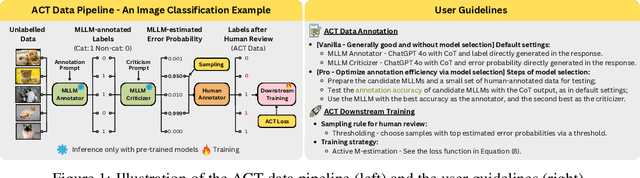
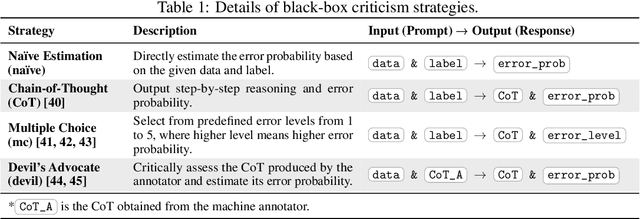
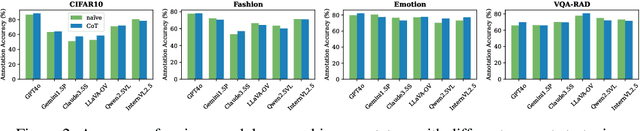
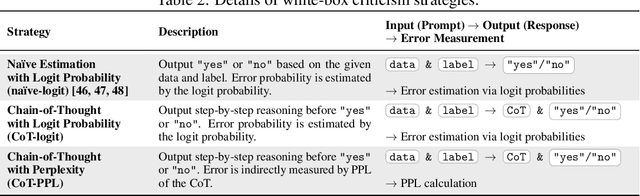
Supervised learning relies on high-quality labeled data, but obtaining such data through human annotation is both expensive and time-consuming. Recent work explores using large language models (LLMs) for annotation, but LLM-generated labels still fall short of human-level quality. To address this problem, we propose the Annotation with Critical Thinking (ACT) data pipeline, where LLMs serve not only as annotators but also as judges to critically identify potential errors. Human effort is then directed towards reviewing only the most "suspicious" cases, significantly improving the human annotation efficiency. Our major contributions are as follows: (1) ACT is applicable to a wide range of domains, including natural language processing (NLP), computer vision (CV), and multimodal understanding, by leveraging multimodal-LLMs (MLLMs). (2) Through empirical studies, we derive 7 insights on how to enhance annotation quality while efficiently reducing the human cost, and then translate these findings into user-friendly guidelines. (3) We theoretically analyze how to modify the loss function so that models trained on ACT data achieve similar performance to those trained on fully human-annotated data. Our experiments show that the performance gap can be reduced to less than 2% on most benchmark datasets while saving up to 90% of human costs.
HyperTASR: Hypernetwork-Driven Task-Aware Scene Representations for Robust Manipulation
Aug 26, 2025Effective policy learning for robotic manipulation requires scene representations that selectively capture task-relevant environmental features. Current approaches typically employ task-agnostic representation extraction, failing to emulate the dynamic perceptual adaptation observed in human cognition. We present HyperTASR, a hypernetwork-driven framework that modulates scene representations based on both task objectives and the execution phase. Our architecture dynamically generates representation transformation parameters conditioned on task specifications and progression state, enabling representations to evolve contextually throughout task execution. This approach maintains architectural compatibility with existing policy learning frameworks while fundamentally reconfiguring how visual features are processed. Unlike methods that simply concatenate or fuse task embeddings with task-agnostic representations, HyperTASR establishes computational separation between task-contextual and state-dependent processing paths, enhancing learning efficiency and representational quality. Comprehensive evaluations in both simulation and real-world environments demonstrate substantial performance improvements across different representation paradigms. Through ablation studies and attention visualization, we confirm that our approach selectively prioritizes task-relevant scene information, closely mirroring human adaptive perception during manipulation tasks. The project website is at \href{https://lisunphil.github.io/HyperTASR_projectpage/}{lisunphil.github.io/HyperTASR\_projectpage}.